By LCN Business Desk
A third of Guyana's forest carbon is sold forward under minimum prices agreed in 2022, and what the country actually collects on it has never been published.
What exactly did Guyana sell?
37.5 million credits, on a schedule running to 2030.
The Government of Guyana announced the transaction on 2 December 2022, calling it "the world's first sale of jurisdiction-scale carbon credits". The buyer named in its own fact sheet is Hess Corporation, and the volumes are split two ways: 12.5 million of the 33.47 million credits issued for the period 2016 to 2020, and 2.5 million a year from each year's issuance from 2021 to 2030.
Against an expected issuance of about 7.5 million credits a year, the government put the agreement at "about one third of all Guyana's credits (issued and anticipated) up to 2030".
What is the price?
Three minimums by vintage, and the one now running is US$25.
| Vintage | Minimum per credit |
|---|---|
| 2016-2020 | US$15 |
| 2021-2025 | US$20 |
| 2026-2030 | US$25 |
Source: Government of Guyana, Department of Environment and Climate Change, fact sheet on Guyana's engagement in ART TREES. Each credit is one tonne of carbon dioxide equivalent.
The agreement is worth a minimum of US$750 million over the decade, which the government put at approximately G$157 billion of investment with G$31.5 billion of it allocated to village-led development plans.
At 2.5 million credits a year against the US$25 minimum, the vintages now running are US$62.5 million a year, and the 15 per cent dedicated to village-led plans is US$9.375 million of that, both on this newspaper's arithmetic from the published terms.
Those prices were a considerable advance on what came before. Under the Guyana-Norway partnership the country earned over US$220 million at US$5 a tonne, so the 2022 agreement multiplied the rate three to five times over depending on the vintage.
Who holds the agreement now?
Chevron, which bought the company that signed it.
Chevron completed its acquisition of Hess Corporation on 18 July 2025. Speaking to the Georgetown Chamber of Commerce and Industry on 27 April 2026, Pradeepa Bholanath, Senior Director for Climate Change and REDD+ at the Ministry of Natural Resources, listed the buyers of Guyana's credits as "Hess, now Chevron", Apple, and 20 airlines participating in CORSIA, the international aviation emissions scheme.
Vice President Bharrat Jagdeo said at the time of the acquisition that it would not affect the carbon agreement. On 23 October 2026, Bechtel's Guyana manager told a Georgetown panel that Chevron declined to continue funding engineering and design for Guyana's Berbice deepwater port after acquiring Hess, which had funded the early work. This agreement is the other kind of inheritance, and it is one of the two Guyana commitments Chevron has continued, both of which were signed by Hess before the sale.
What do the later buyers pay?
The government says above its existing agreements, and has published no figure either side.
Bholanath told the Department of Public Information on 18 March 2026 that eighteen months of sales had reached more than nineteen airlines, and that they came "at prices that have gone beyond the levels that we have sold our carbon credits for under our existing agreements". The largest tranche received to that point was 9 million credits. No price was given for the airline sales, and none for the comparison.
What that statement compares is not stated. "Our existing agreements" is plural and unspecified, and the government has named Apple and Chevron as buyers under earlier arrangements, so the comparison may not be with this agreement alone. The 2026 to 2030 figure is a floor agreed in 2022 covering about a third of everything Guyana expects to issue, and a floor does not settle what is paid above it.
A floor can cut the other way. Saint Vincent and the Grenadines signed a 30-year cruise port concession this month obliging the operator to spend not less than US$20 million in phase one and US$60 million in phase two, with no stated ceiling. There the minimum protects the country and leaves the spending above it open. Here it guarantees what Guyana receives on a third of its credits and leaves the rest unpublished.
What the credits carry has also changed. Each one sold to the airlines carries the CORSIA label, making it eligible against aviation emissions obligations, and demand from that quarter is expected to grow as carriers work toward targets under global agreements. The 2022 agreement was signed before any of that market existed at scale.
How much has Guyana actually earned?
US$353 million since 2022, from all buyers.
Bholanath gave that total on 14 June 2026, saying "since 2022, we have earned a total of US$353 million from the sale of carbon credits". It covers the voluntary and compliance markets together and is not broken down by buyer.
Set against the agreement's own minimum of US$750 million over a decade, that running total across four years is consistent with the schedule rather than ahead of it, and it includes money from Apple and the airlines that the agreement has nothing to do with.
The arrival of the money is a separate question from the earning of it. Guyana budgeted G$49.7 billion of carbon credit inflows for 2026 and had recorded G$657.5 million by 30 June, 1.3 per cent of the estimate, which the Mid-Year Report then repeated unrevised.
Who decides where the money goes?
A split agreed in a national consultation, and village plans written by villages.
Fifteen per cent of revenues is dedicated to village-led plans for Indigenous villages and communities, set out in Village Sustainability Plans produced under free, prior and informed consent. The remaining 85 per cent funds multi-community and national programmes under the Low Carbon Development Strategy (LCDS) 2030.
The allocation was not decided administratively. The draft strategy went through consultations from October 2021 to July 2022 across all ten administrative regions, engaging over 200 Indigenous villages and forest-based communities, with feedback published in a 315-page report. At the National Toshaos' Council conference in July 2022, with 176 leaders in attendance, a resolution endorsing LCDS 2030 passed with no objection. The strategy was tabled in the National Assembly on 21 July 2022 and passed on 8 August 2022.
Amerindian titled lands and extensions are 12.7 per cent of Guyana's forested area, and the 15 per cent share was deliberately set above that. It was also widened during the consultation to cover titled and untitled communities alike, and communities in savannahs and wetlands as well as forest.
What does this mean for a Guyanese business?
The money is contracted, the timing is not, and the buyer is now an oil company.
Three things follow for anyone planning against this revenue. The price on about a third of the credits is fixed until 2030 and will not rise with the market, so growth in carbon income has to come from the credits that are not committed. The payment schedule and the budget line have not matched in 2026, which matters for anyone contracting against programmes funded from it. And the largest single counterparty is now the same company that holds 30 per cent of the Stabroek block, so the country's forest revenue and a large part of its oil revenue rest on one corporate relationship.
That last point is a concentration rather than a criticism. It is also checkable: the operator of that block reported paying Guyanese government bodies US$2,581,822 thousand for 2024, while Chevron's own filing under the same rule carries twenty countries and does not include Guyana.
What is settled, and what is not?
The terms, the split and the endorsement are settled. The airline price is not.
The volumes, the three minimum prices, the US$750 million floor, the 85 and 15 per cent split and the consultation record all come from the Government of Guyana's own published fact sheet. The buyer list, the earnings total and the statement about airline pricing are each attributed to the same named senior official on three dated occasions.
Not established: what the airlines actually paid, which no published figure gives; how much of that total came from this agreement rather than from Apple or the airlines; whether Chevron has taken delivery of the 2026 vintage, which no public document records; and whether the agreement's minimums have been exceeded in practice, since a minimum is a floor and the fact sheet gives no actual settled price.
Guyana priced a third of its forest carbon for a decade in 2022, before the aviation market arrived. The country that did it first also locked in first. What the buyer carries on its own books is set out separately: Chevron's 2025 annual report puts Guyana net properties at US$50,960 million and Hess earnings at US$193 million for the 166 days after the acquisition closed.
The entities
- ART-TREES is the jurisdictional forest carbon standard under which Guyana's credits are issued, assessed by the government as the best standard available for its purposes.
- CORSIA is the Carbon Offsetting and Reduction Scheme for International Aviation, whose participating airlines buy the labelled credits.
- Hess Corporation signed the agreement on 2 December 2022 and was acquired by Chevron on 18 July 2025.
- Pradeepa Bholanath is Senior Director for Climate Change and REDD+ at Guyana's Ministry of Natural Resources.
- Bharrat Jagdeo is the Vice President of Guyana.
- Low Carbon Development Strategy (LCDS) 2030 is the national strategy under which the revenue is allocated, passed by the National Assembly on 8 August 2022.
- National Toshaos' Council is the body representing all Indigenous villages in Guyana under the Amerindian Act 2006.
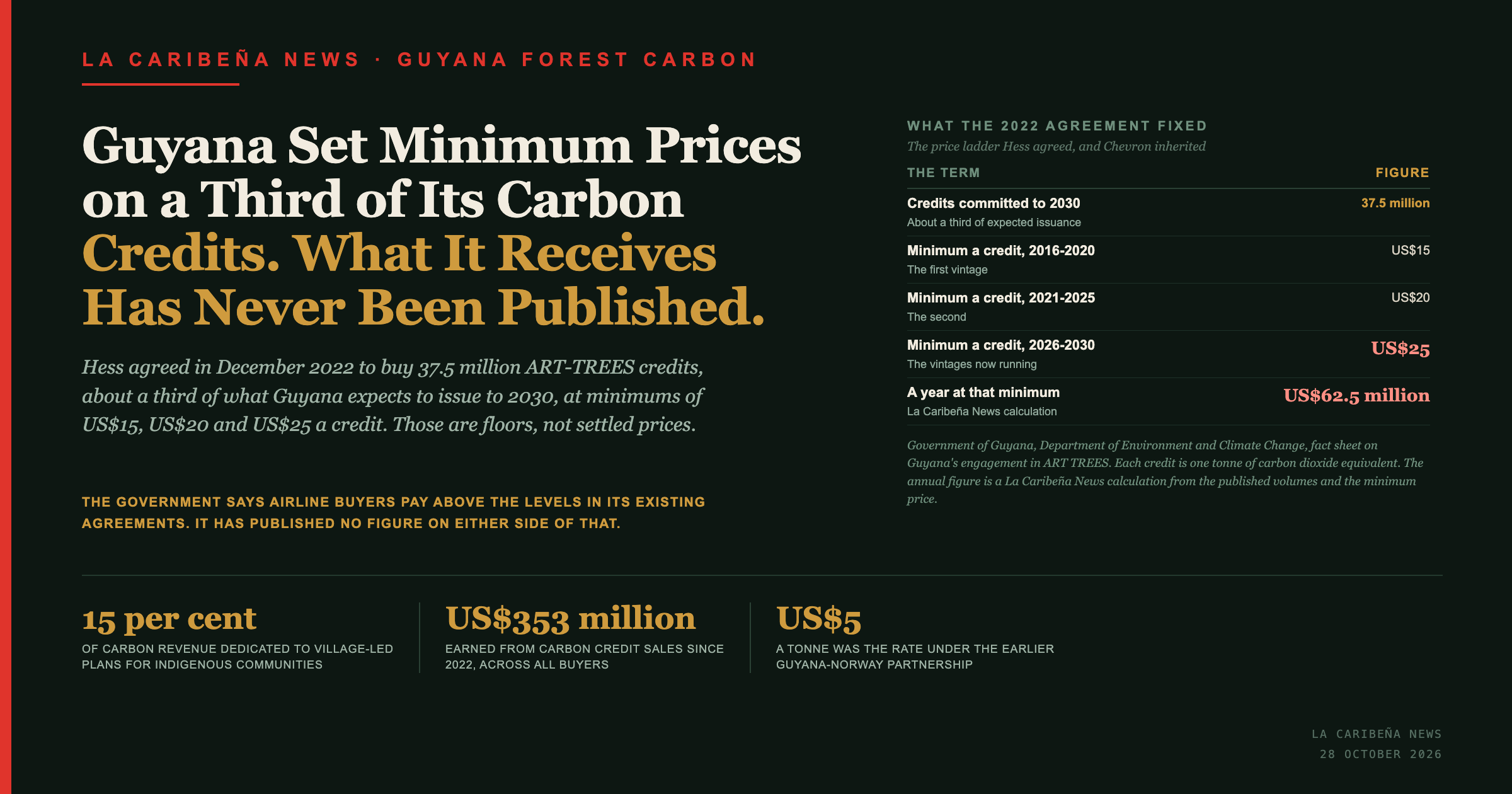
What the title card shows
Every data point on the article's title card, in text.
- 37.5 million. Credits committed under the 2022 agreement. Source: Government of Guyana ART TREES fact sheet.
- US$15, US$20, US$25. The minimum price a credit by vintage, for 2016-2020, 2021-2025 and 2026-2030. Source: as above.
- About a third. The share of all Guyana's credits to 2030 that the agreement covers. Source: as above.
- US$62.5 million. The value of a year's credits at the 2026-2030 minimum, on this newspaper's arithmetic.
- 15 per cent. The share of revenue dedicated to village-led plans for Indigenous villages and communities. Source: as above.
- US$353 million. Total earned from carbon credit sales since 2022. Source: Pradeepa Bholanath, 14 June 2026.
Frequently Asked Questions
How many carbon credits did Guyana sell to Hess?
37.5 million ART-TREES credits: 12.5 million of the 33.47 million issued for 2016 to 2020, and 2.5 million a year from each year's issuance from 2021 to 2030. The government describes that as about one third of all the credits it has issued and anticipates issuing up to 2030.
What price does the agreement set?
Minimums of US$15 a credit for 2016-2020 vintages, US$20 for 2021-2025 and US$25 for 2026-2030, each credit being one tonne of carbon dioxide equivalent. The agreement is worth a minimum of US$750 million over the decade.
Does Chevron now hold the agreement?
Yes. Chevron completed its acquisition of Hess Corporation on 18 July 2025, and Pradeepa Bholanath named the buyers on 27 April 2026 as "Hess, now Chevron", Apple and 20 airlines participating in CORSIA. Vice President Bharrat Jagdeo said the acquisition would not affect the agreement.
Do the airlines pay more than Chevron?
Bholanath said on 18 March 2026 that eighteen months of sales to more than nineteen airlines came "at prices that have gone beyond the levels that we have sold our carbon credits for under our existing agreements". No figure has been published for the airline price or for the difference.
How much of the money goes to Indigenous villages?
Fifteen per cent of revenues is dedicated to village-led plans for Indigenous villages and communities, through Village Sustainability Plans produced under free, prior and informed consent. On the 2026-2030 vintages that is about US$9.375 million a year, on this newspaper's arithmetic. The other 85 per cent funds multi-community and national programmes.
How much has Guyana earned from carbon credits so far?
US$353 million since 2022 across the voluntary and compliance markets, according to Pradeepa Bholanath on 14 June 2026. The figure is not broken down by buyer, so it covers sales to Apple and to airlines as well as the 2022 agreement.