By LCN Business Desk
The study now running on Guyana's deepwater port is not designing it. It is establishing whether anyone can finance it.
What did Chevron stop paying for?
The engineering and design stage, and a commitment that came with Hess.
Harry Pastuszek, Bechtel's Guyana manager, told a panel at the World Trade Centre Guyana that Hess had funded the pre-front-end engineering and design his firm completed two years ago, on the understanding it would keep paying as the project advanced. Demerara Waves reported his account on 23 October.
"Then they (Hess) funded the pre-front-end engineering and design we did on the port with a notional agreement that they would continue to fund in partnership with the government as we pushed forward," Pastuszek said. "Chevron acquired HESS and Chevron sort of sat down and said, 'you're doing what? Why would we? No, not going to do (it). So, no shade thrown at Chevron'."
Hess spent US$4 million on those initial studies, Demerara Waves reported.
The buyer that walked away from a US$4 million commitment carries US$50.96 billion of Guyana on its books and booked US$193 million from the Hess business in its first five months of ownership.
What is the money behind the next stage?
No money yet. A letter of interest.
| The next stage | |
|---|---|
| What it is | Phase three engineering design study |
| Cost | About US$50 million |
| Who holds the paper | The Export-Import Bank of the United States |
| What the paper is | A letter of interest, handed to the government |
| When it would apply | "Hopefully very quickly after the feasibility study is done" |
Source: Bruce Ellsworth, Senior Commercial Officer at the US Embassy, to the same panel, via Demerara Waves.
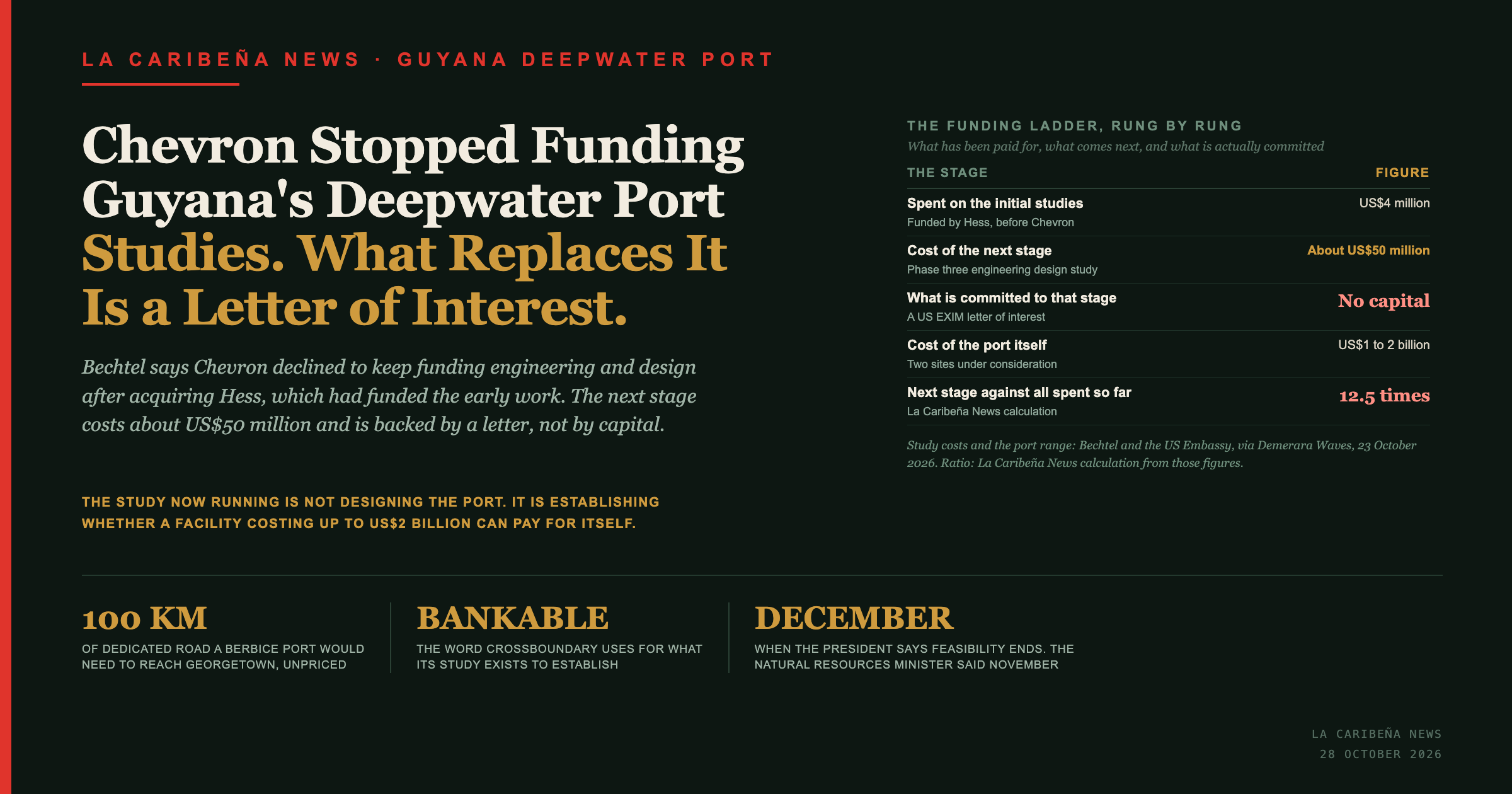
A letter of interest records that a lender will look at a transaction. It commits no capital and carries no terms. The distinction matters here because the stage it covers costs twelve and a half times everything spent on the project so far, on La Caribeña News' arithmetic from the two figures above.
President Dr Mohamed Irfaan Ali met EXIM's chairman John Jovanovic in New York on 21 September, and the following day the bank signed the U.S.-Argentina Build the Future Framework making up to US$7 billion available through 2027 for railways, pipelines, ports and power networks. Argentina has a framework. Guyana has a letter.
A third form of port commitment was signed in the region the same week. Saint Vincent and the Grenadines handed its cruise port to Global Ports Holding on a 30-year concession on 26 October, under which the operator must spend not less than US$20 million in phase one and US$60 million in phase two, with no stated ceiling. The Saint Vincent minimums bind a named counterparty and were stated at the signing. The Berbice figure is a stage nobody has yet agreed to pay for.
What is the study actually trying to establish?
Whether a facility costing up to US$2 billion can pay for itself.
The feasibility work is being carried out by the CrossBoundary Group under a Guyana government contract, updating Inter-American Development Bank work from around 2016 on opening northern Brazil through an Atlantic port in Guyana.
Jamie McInerney, CrossBoundary's Deputy Head of Latin America and the Caribbean for Investment Advisory, described the exercise to the panel: "Over the course of our work, we will look to put some hard numbers on the demand and potential throughput for such a facility and then, of course, also look at what sort of revenue and cash flow that type of facility could possibly generate, all with a view to understand(ing) whether what is a very expensive piece of infrastructure is bankable."
That is a demand study, not a design brief. On the traffic it would need, McInerney said moving goods from Manaus or northern Brazil through a road being built on the Guyana-Brazil border to a deepwater port on the coast "could be a shorter, more reliable route for manufactured goods."
What does the port cost, and what is not in that figure?
Between US$1 billion and US$2 billion, and a road nobody has priced.
Two sites are under consideration, Crab Island in the mouth of the Berbice River and the old proposed CGX shorebase. Guyanese shipping executive Chandradat Chintamani told the panel that a deepwater port in Berbice would need a 100 kilometre dedicated superhighway to move cargo to Georgetown. No cost was given for it, and it sits outside the port's own range.
The government plans data centres, fertiliser plants and possibly a refinery in that part of the country, nearer ExxonMobil's Longtail project, which is to produce 1.5 billion cubic feet of gas a day and 290,000 barrels of condensate.
What dates is a contractor planning against?
Two, and they are a month apart.
| Who | When the feasibility work finishes |
|---|---|
| President Ali, 26 October | December, "completed in all its dimensions", then a meeting with potential investors |
| Natural Resources Minister Vickram Bharrat, September | About two months from then, which lands in November |
Ali's December date carries the investor meeting with it, which is the part a counterparty would plan around. Neither statement has been withdrawn.
What did the President tell the shipping industry?
That the path is intact, four days after it was reported broken.
Speaking at the opening of the Caribbean Shipping Association's 56th Annual General Meeting at the Guyana Marriott on Monday 26 October, Ali called for greater public-private investment in Caribbean ports, citing ageing infrastructure, limited cargo-handling capacity and inadequate navigational depth. Guyana Times reported his remarks.
"The issue of port capacity, cargo-handling equipment, storage facilities, navigational depth…we know about this because we face these challenges," he said. "The largest ships can't come in because we have to dredge the Demerara [River]. That is why we are now taking steps and moving forward on the development of a deepwater port, connecting that deepwater port to northern Brazil and the rest of the region."
On the financing he said: "US EXIM (United States Export-Import Bank) is also very keen on supporting the study because by December, when the feasibility is completed in all its dimensions, then we'll be having a meeting with all of the potential investors, especially the large ones, to move this forward." He also said the government had held discussions with "Qatari investment, who are all interested in coming together and being investment partners."
Asked how the studies would proceed without Chevron's support, he said the government would work with development partners to get the study done. The two Guyana commitments Chevron has continued were both signed by Hess.
Ali cited an Inter-American Development Bank study of short-sea shipping from 2018: "Most Caribbean ports are 50 years old or older, and these ports were built for a completely different commercial environment."
What is settled, and what is not?
The withdrawal, the costs and the paper are settled. The financing is not.
Chevron's decision is on the record from Bechtel's own Guyana manager, in public, and was reported the same week by Bloomberg, Baird Maritime and Maritime Executive. The US$1 billion to US$2 billion range, the two candidate sites, the CrossBoundary contract and the US$50 million next stage all come from named speakers at the same panel.
Not established: what Qatar has actually offered, since no entity is named and no sum is reported and the characterisation is the President's own; whether EXIM's letter of interest converts into terms; what the 100 kilometre road would cost; and whether the feasibility work lands in November or December. The US$4 million Hess figure is Demerara Waves' own information rather than Bechtel on the record.
The next invoice on this project is about US$50 million, and nobody has yet agreed to pay it. Chevron inherited a second Guyanese commitment with the Hess acquisition: Hess agreed in December 2022 to buy 37.5 million of Guyana's ART-TREES credits, about a third of what the country expects to issue to 2030, at minimums of US$15, US$20 and US$25 a credit by vintage.
The entities
- Bechtel is the United States engineering and procurement company that completed the pre-front-end engineering and design, and holds the Guyana government contract for the feasibility study. Its Guyana manager is Harry Pastuszek.
- CrossBoundary Group is the firm carrying out the feasibility study, whose Deputy Head of Latin America and the Caribbean for Investment Advisory is Jamie McInerney.
- Export-Import Bank of the United States (EXIM) is the federal export credit agency that has issued a letter of interest for the phase three engineering design study.
- Bruce Ellsworth is Senior Commercial Officer at the United States Embassy in Guyana.
- Hess funded the early studies before being acquired by Chevron, which declined to continue that funding.
- President Dr Mohamed Irfaan Ali is the President of Guyana.
- Vickram Bharrat is Guyana's Minister of Natural Resources.
- Chandradat Chintamani is a Guyanese shipping executive who raised the road requirement at the panel.
- Caribbean Shipping Association (CSA) held its 56th Annual General Meeting, Conference and Exhibition in Georgetown from 25 to 28 October 2026, Guyana's first time hosting.
What the title card shows
Every data point on the article's title card, in text.
- US$1 billion to US$2 billion. The cost range for the port. Source: Bechtel, via Demerara Waves.
- US$4 million. What Hess spent on the initial studies. Source: Demerara Waves' own information.
- About US$50 million. The cost of the phase three engineering design study. Source: as above.
- A letter of interest. What EXIM has issued toward that study. Source: Bruce Ellsworth, US Embassy.
- 100 kilometres. The dedicated road a Berbice port would need to reach Georgetown, unpriced. Source: Chandradat Chintamani.
- December. When President Ali says the feasibility work completes, against the Natural Resources Minister's September estimate of about two months. Source: Guyana Times, and reporting of the minister's September remarks.
Frequently Asked Questions
Why did Chevron stop funding Guyana's deepwater port studies?
Bechtel's Guyana manager Harry Pastuszek said Hess had funded the pre-front-end engineering and design under a notional agreement to keep funding, and that Chevron declined to continue after acquiring Hess. Demerara Waves reported his account on 23 October 2026, and Bloomberg, Baird Maritime and Maritime Executive carried the decision the same week.
Who is paying for the next stage?
Nobody yet. The Export-Import Bank of the United States has handed the Guyana government a letter of interest to finance the phase three engineering design study, which could cost about US$50 million. A letter of interest records that a lender will consider a transaction; it commits no capital and sets no terms.
What is the feasibility study for?
CrossBoundary Group is establishing demand, throughput, revenue and cash flow in order to determine, in its own words, "whether what is a very expensive piece of infrastructure is bankable". It updates Inter-American Development Bank work from around 2016 on opening northern Brazil through an Atlantic port in Guyana.
Where would the port be built?
Two sites are under consideration: Crab Island in the mouth of the Berbice River, and the old proposed CGX shorebase. A Berbice location would also require a 100 kilometre dedicated road to move cargo to Georgetown, which shipping executive Chandradat Chintamani raised at the same panel and for which no cost has been published.
When will the feasibility work be finished?
President Ali said on 26 October that it would be complete "in all its dimensions" by December, followed by a meeting with potential investors. Natural Resources Minister Vickram Bharrat said in September that the work would take about two months, which would place completion in November. Neither statement has been withdrawn.