--- title: "Guyana's 2026 Carbon Credit Revenue Reached 1.3 Per Cent of Budget by June. The Estimate Was Not Revised." slug: guyana-carbon-credit-inflows-657-million-against-49-7-billion-budget-2026 canonical: https://www.lacaribenanews.com/guyana-carbon-credit-inflows-657-million-against-49-7-billion-budget-2026/ date: 2026-10-26 author: LCN Business Desk tags: [Guyana, Climate, Public Finance, Analysis] meta_title: "Guyana carbon credit revenue G$657.5m against G$49.7bn 2026 budget" meta_description: "Guyana's Mid-Year Report 2026 records G$657.5 million of carbon credit inflows against a G$49.7 billion full-year estimate that was not revised, while revenue net of transfers grew 18.7 per cent." ---
By LCN Business Desk
The Senior Minister with Responsibility for Finance set out two tracks this weekend. The Ministry he runs had published the first-half figures for both of them a month earlier.
What did the Finance Minister say the two tracks are?
Growth on one side, sustainability on the other, with sustainability read to include both the fiscal and the environmental.
Dr Ashni Singh, speaking on a special edition of the Starting Point podcast and reported by Guyana Times on 25 October, put it as a deliberate pairing held over successive administrations.
"On the one hand, ensuring that we lay the foundation for strong economic growth, and secondly, ensuring that that strong economic growth is achieved in a sustainable manner with sustainability interpreted in all of its dimensions, including fiscal and debt sustainability, but also the very strong environmental dimension to sustainability, because it's impossible to speak of sustainability without taking into consideration factors such as climate."
On how the two relate, he said: "What we have been doing in Guyana demonstrates that economic growth and environmental responsibility need not be conflicting objectives but instead can be complementary objectives and are complementary objectives, if approached from the right policy posture," he said, adding that Guyana has been "at the intellectual cutting edge, at the policy cutting edge and at the implementation and execution cutting edge" of the global climate discourse.
Guyana Times, reporting the interview, set out the record behind that claim: the Low Carbon Development Strategy framework, a 2009 agreement with Norway worth US$250 million for keeping the forest standing, the strategy's revision to LCDS 2030 after 2020, the first jurisdictional certification in the world under ART-TREES in 2022, a US$750 million carbon credit sale agreement with Hess Corporation, subsequent sales including to Apple, and the first certification under the aviation industry's CORSIA mechanism, with credits sold to more than 20 airlines through the International Air Transport Association. Those figures are the outlet's own reporting around the quotations, not the Minister's words, and each rests on that single account.
The Minister made no claim about this year's receipts. His case rests on the policy relationship and on a record built over, in his words, "a long time, not yesterday, not the day before yesterday".
What does the carbon credit line show at the halfway mark?
About a seventy-fifth of the full-year estimate, with all three transfer lines moving in the same direction and the tax base moving the other way.
The report sets out the Central Government fiscal accounts in five columns, in G$ million.
| Line | 2025 actual | 2026 budget | H1 2025 | H1 2026 | 2026 revised |
|---|---|---|---|---|---|
| Carbon Credit Inflows | 14,014.0 | 49,650.6 | 7,470.9 | 657.5 | 49,650.6 |
| GRIF Inflows | 7,927.3 | 7,787.8 | 4,887.4 | 1,601 | 7,787.8 |
| NRF Withdrawal | 512,251.7 | 495,048.8 | 249,574.5 | 212,138 | 495,048.8 |
| Revenue, net of the three above | 459,333.2 | 514,085.2 | 235,398.0 | 279,467.8 | 514,085.2 |
| Total Revenue | 993,597.1 | 1,066,647.5 | 497,333.5 | 493,869.2 | 1,066,647.5 |
| Total expenditure | 1,312,354.6 | 1,519,388.8 | 537,770.8 | 599,824.0 | 1,574,278.1 |
Source: Ministry of Finance, Guyana, Mid-Year Report 2026, fiscal accounts appendix.
The first half delivered 1.3 per cent of what the year is budgeted to collect on that line, so the second half carries G$48,993.1 million, which is 74.5 times what the first half produced. The budget itself was set 254 per cent above the 2025 outturn, so the gap is against an estimate that was already a multiple of the last full year's performance. And the year-on-year fall is 91.2 per cent, which is steeper than either of the other two transfer lines.
Paragraph 3.45 records the G$212.1 billion withdrawn from the NRF to the end of June "with an additional $282.9 billion expected to be withdrawn by the end of 2026", and those two figures add to that line's full-year budget exactly. The carbon credit figure sits in the same paragraph with no equivalent statement behind it. The newspaper set out the monthly pattern of those oil fund receipts and withdrawals through September on 21 October.
Was the estimate revised down?
No. The revised column repeats the budget, in a document that revises other lines.
Total expenditure in the same table moves from G$1,519,388.8 million at budget to G$1,574,278.1 million revised, so the instrument does carry revisions where it chooses to make them. The newspaper reported one of those revisions on 7 October, when the Ministry raised what it will spend on the Guyana Sugar Corporation to G$16.4 billion, G$3 billion above budget, from this same report.
A projection is revised on climate grounds elsewhere in the document. At paragraph 3.6 the full-year growth projection for the other crops subsector is "revised to 2.1 percent accordingly", the stated reason being the El Niño heat stress expected to follow the first half's flooding.
So the document reduces a growth projection because of the weather and leaves the climate revenue line at its original figure, and it offers no reason for either the shortfall or the unchanged estimate. Paragraph 3.46 holds the overall position steady: "The target for total revenue collections for 2026 remains at $1,066.6 billion."
Where does climate appear on the fiscal side of the same report?
As the first entry in the risk register, and as a pressure on expenditure rather than a contribution to revenue.
Table 2 of the Mid-Year Report, "Summary of Explicit and Implicit Risks", lists five risks. Climate Related Risks is risk 1, placed ahead of Macroeconomic Risks and ahead of Labour Market Constraints. The detail column reads that climate unpredictability, extreme rainfall, below-normal rainfall, prolonged dry spells and drought "will lead to increased fiscal pressures". The consequences column names "damage to infrastructure, disruptions to economic activities, increased expenditure on excessive flood and drought response and recovery, reduced agricultural production and other productive sectors and delays in development projects that can defer benefits to citizens".
The spending response is recorded at paragraph 4.4: expanded investment in drainage and irrigation and in sea and river defences, and "the introduction of climate-resilient standards into the design and construction of infrastructure works". Guyana also signed a US$50,000,000 policy-based loan from the Caribbean Development Bank on 27 April 2026, for "enhancing bio-diversity governance, improving climate and water resource management and resilience".
What did the weather cost in the first half, and what is projected next?
Agriculture contracted, and the Ministry attributes that to rainfall. For the rest of the year it forecasts the opposite problem.
Agriculture, forestry and fishing is estimated to have contracted by 0.5 per cent in the first half, in an economy the report puts at 33.3 per cent growth over the same period. Paragraph 3.3 attributes the outturn to the other crops subsector, "where sustained above-normal rainfall disrupted planting cycles, damaged crops, and constrained field access across producing areas", and records that this outweighed gains in sugar, rice, livestock, forestry and fishing. Other crops fell 6.4 per cent, which paragraph 3.6 calls "the single largest contributor to the overall sector outturn". The newspaper reported the GDP side of this instrument, including the cut to the non-oil forecast, on 15 September.
Table 3 measures the rainfall against the 1981 to 2025 average, region by region.
| Region | Extreme rainfall days, Jan to Jun 2026 | Historical average | Assessment |
|---|---|---|---|
| 1 | 29 | 12 | Above historical average |
| 2 | 38 | 16 | New record-high count |
| 3 | 48 | 22 | New record-high count |
| 4 | 30 | 22 | Above historical average |
| 5 | 25 | 13 | Above historical average |
| 6 | 37 | 24 | Above historical average |
| 7 | 34 | 23 | Above historical average |
| 8 | 16 | 8 | Above historical average |
| 9 | 36 | 21 | Above historical average |
| 10 | 45 | 16 | New record-high count |
Source: Hydrometeorological Service, in the Mid-Year Report 2026, Table 3. The report notes flooding that compromised "agricultural production and other economic activities along the coast and in hinterland communities as well as implementation delays in civil works across the country". Three Region Nine villages received G$110 million of solar mini-grids on 23 October.
Ten regions of ten sit above their long-run average, and the narrowest gap, Region Four's, is still more than a third above it. The forecast for the second half runs the other way. Paragraph 4.5 projects a transition "to the main dry season together with the onset of the El Niño phase", listing 1997-1998, 2009-2010, 2016-2017 and 2023-2024 as events that brought "crop failures and food supply challenges, water shortages, increased livestock mortality, and heat stress". Paragraph 4.6 states that for the remainder of the year "all regions across the country can expect below-normal rainfall". This newspaper reported in August that the last comparable event cut Guyana's rice production by 37 per cent, and in September that the World Meteorological Organization put the odds of effects reaching February 2027 at close to 100 per cent.
Which half of the Minister's sentence do the numbers support?
The fiscal half, and strongly, on the measure that strips out the transfers.
Total current revenue fell 0.7 per cent in the first half. Stripping out the three transfer lines, paragraph 3.40 records growth of 18.7 per cent to G$279.5 billion, with tax revenue at 52.4 per cent of total collections and the growth attributed to income, value-added, excise and trade taxes, "reflecting expanded employment and sustained economic growth driven by both public and private sectors".
Those two movements are the same event seen twice. The domestic tax base expanded by almost a fifth while the transfers it is measured alongside shrank, and the shrinking transfers were large enough to turn an expanding tax take into a headline decline. On the Minister's own framing of sustainability as including "fiscal and debt sustainability", a tax base growing 18.7 per cent while the economy grows is the part of his claim the instrument evidences directly.
Nothing in the report contradicts the policy proposition either. It contains no finding that growth came at the environment's expense, and the climate chapter is a chapter about managing weather, not about a trade-off being made.
What has not been established?
Four things, each of them absent from the instrument itself.
The report gives no explanation for the carbon credit shortfall. It states the figure and does not say why collections are where they are, when inflows are expected, or against which agreement they would arrive.
It gives no revised carbon estimate, and no statement of what the second half is expected to deliver on that line, in a document that supplies exactly that statement for the NRF.
It names no buyer, agreement or vintage against the line. The sales the Minister's record rests on, including the Hess agreement and the CORSIA credits, do not appear in the instrument's figures and are sourced from elsewhere. The Hess agreement is now one of two Guyana commitments Chevron has continued, both signed by Hess, on minimums of US$15, US$20 and US$25 a credit by vintage that are floors rather than settled prices.
And it draws no connection between the two climate entries. Carbon credit revenue sits in the revenue table and climate risk sits in the risk register sixty pages later, and the report does not read one against the other.
What the halfway point establishes is narrower than either the Minister's claim or its opposite. On the government's own figures, climate has so far been a line in the risk register, a cause of the only sectoral contraction, and a US$50 million borrowing. It has been G$657.5 million of revenue. The second half is budgeted to carry the rest.
The entities
- Mid-Year Report 2026 is the Ministry of Finance's statutory half-year account of Guyana's fiscal and economic performance, published in September 2026 and covering January to June.
- Dr Ashni Singh is Guyana's Senior Minister with Responsibility for Finance.
- Carbon credit inflows is the line in Guyana's Central Government fiscal accounts recording receipts from sales of the country's certified forest carbon credits.
- Low Carbon Development Strategy (LCDS) is Guyana's national policy framework on forests, climate and low-carbon growth, revised as LCDS 2030.
- ART-TREES is the Architecture for REDD+ Transactions standard under which Guyana's forest carbon credits were certified.
- Carbon Offsetting and Reduction Scheme for International Aviation (CORSIA) is the International Civil Aviation Organisation's emissions programme under which airlines buy eligible credits.
- Natural Resource Fund (NRF) is Guyana's sovereign fund for petroleum receipts, from which withdrawals are transferred to the Consolidated Fund.
- Guyana REDD+ Investment Fund (GRIF) is the fund established to hold payments for Guyana's forest climate services.
- Caribbean Development Bank is the regional development bank that signed a US$50,000,000 policy-based loan with Guyana on 27 April 2026.
- Hydrometeorological Service is the Guyanese agency whose rainfall records the report's Table 3 reproduces.
What the title card shows
Every data point on the article's title card, in text.
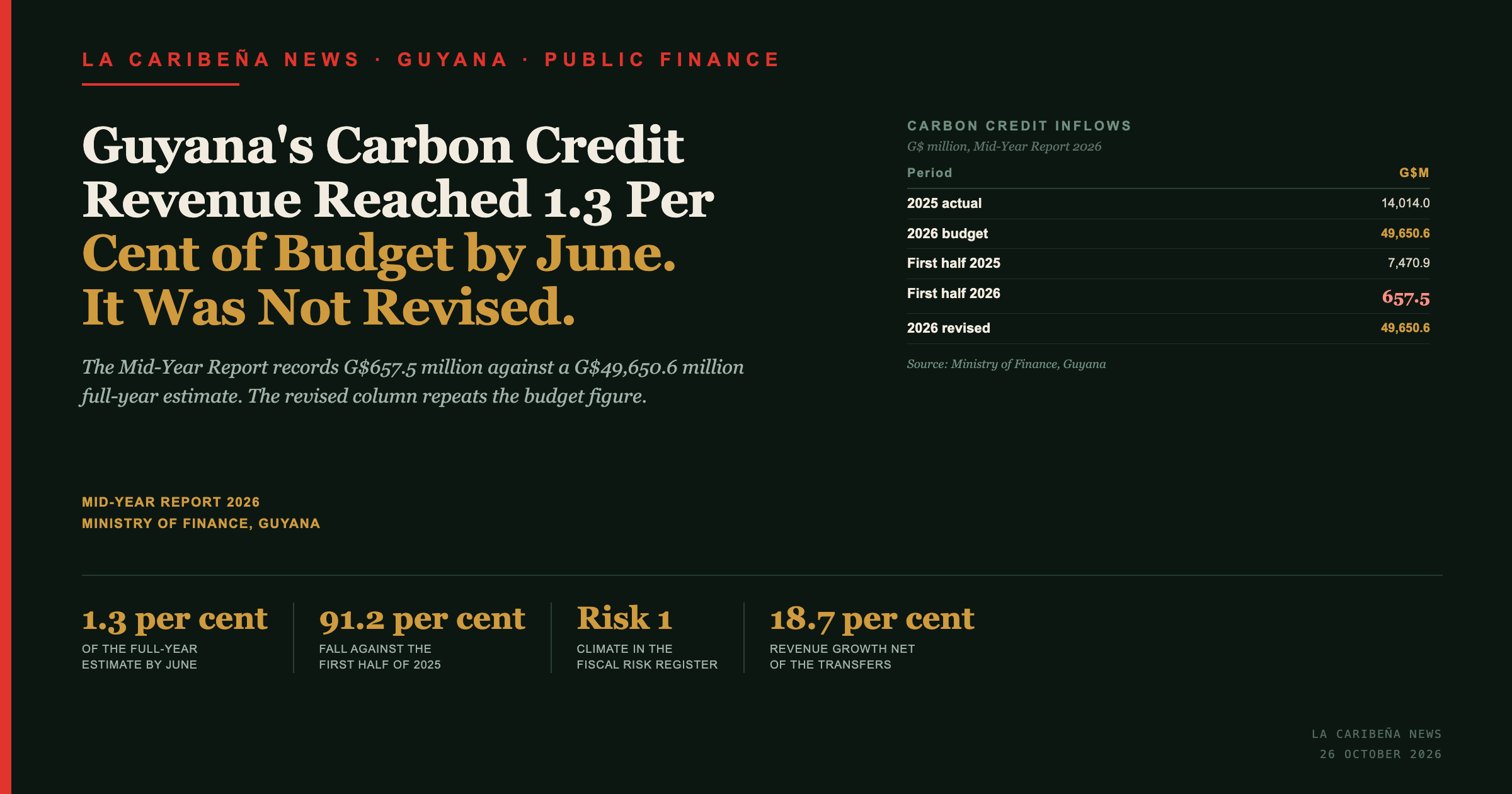
- 1.3 per cent. The share of the full-year carbon credit estimate collected in the first half. Calculated from G$657.5 million against G$49,650.6 million, both in the Mid-Year Report 2026.
- G$657.5 million. Carbon credit inflows at the end of the first half of 2026. Source: Mid-Year Report 2026, paragraph 3.45 and the fiscal accounts appendix.
- G$49,650.6 million. The 2026 budget for that line, and also its revised figure. Source: as above.
- 91.2 per cent. The year-on-year fall from G$7,470.9 million in the first half of 2025. Calculated from the same table.
- Risk 1. Climate Related Risks, first of five in Table 2 of the report.
- 18.7 per cent. Growth in current revenue net of GRIF, NRF and carbon credit inflows, to G$279.5 billion. Source: paragraph 3.40.
- 0.5 per cent. The contraction in agriculture, forestry and fishing in the first half. Source: paragraph 3.3.
- Ten of ten. Regions above their 1981 to 2025 extreme-rainfall average, three of them setting records. Source: Table 3, Hydrometeorological Service.
Frequently Asked Questions
How much carbon credit revenue did Guyana collect in the first half of 2026?
G$657.5 million, against a full-year budget of G$49,650.6 million, according to the Ministry of Finance's Mid-Year Report 2026. That is 1.3 per cent of the year's estimate, and a 91.2 per cent fall from the G$7,470.9 million recorded in the first half of 2025.
Did Guyana reduce its 2026 carbon credit forecast at mid-year?
No. The revised column for that line in the report's fiscal accounts repeats the budget figure of G$49,650.6 million. Total expenditure in the same table was revised, from G$1,519,388.8 million to G$1,574,278.1 million, so the document does carry revisions.
What did Guyana's Finance Minister say about growth and climate?
Dr Ashni Singh said on 25 October 2026 that economic growth and environmental responsibility "need not be conflicting objectives but instead can be complementary objectives", and that sustainability must be read to include fiscal and debt sustainability as well as the environmental dimension. He made no claim about this year's carbon receipts.
How does climate appear in Guyana's mid-year fiscal risk register?
As risk 1 of five. The report states that climate unpredictability, extreme rainfall, dry spells and drought "will lead to increased fiscal pressures", and names damage to infrastructure, higher flood and drought response spending, reduced agricultural production and delays to development projects as the consequences.
What did the first-half rainfall cost Guyana's economy?
Agriculture, forestry and fishing contracted 0.5 per cent, the only sectoral contraction reported, which the Ministry attributes to above-normal rainfall in the other crops subsector. That subsector fell 6.4 per cent. All ten regions exceeded their 1981 to 2025 average for extreme rainfall days, with records set in Regions 2, 3 and 10.