By LCN Wire
A business in Region Nine does not buy electricity on the same terms as a business in Georgetown, and diesel has risen 26 per cent across Latin America and the Caribbean since February against 18 per cent for gasoline. On the Guyana Energy Agency's published figure it buys diesel at up to three times the Georgetown price, in a village that may be reachable only by boat.
What was commissioned?
Three solar mini-grids in the South Rupununi, on Friday 23 October.
INews Guyana reported that Prime Minister Brigadier (Ret'd) Mark Phillips commissioned systems at Katoonarib, Potarinau and Shulinab, accompanied by the Chief Executive Officer of the Guyana Energy Agency, Dr Mahendar Sharma.
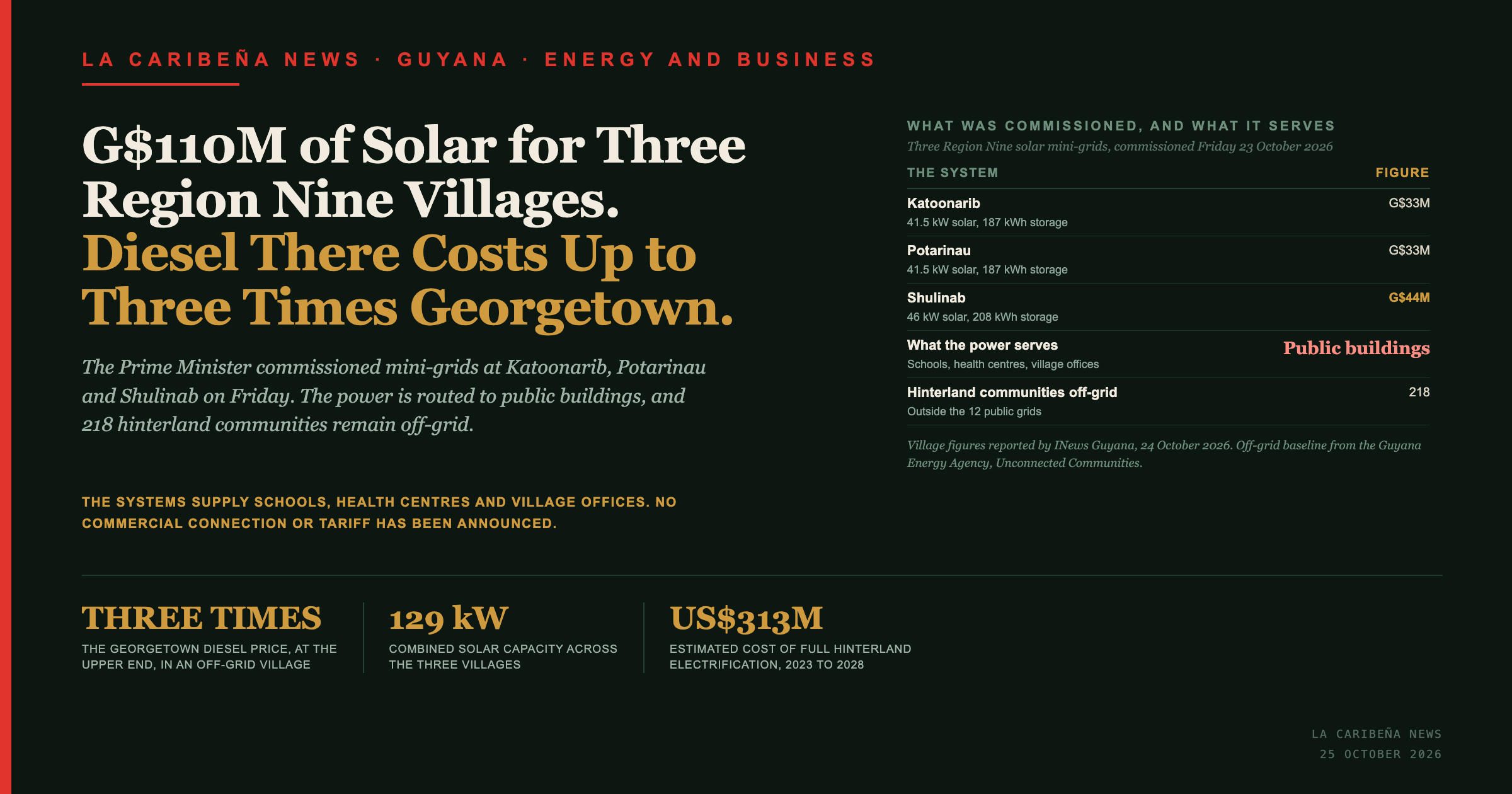
| Village | Investment | Solar capacity | Battery storage | Serves |
|---|---|---|---|---|
| Katoonarib | ~G$33 million | 41.5 kW | 187 kWh | Health and educational facilities |
| Potarinau | G$33 million | 41.5 kW | 187 kWh | Educational facilities, health centre, village offices, community facilities |
| Shulinab | G$44 million | 46 kW | 208 kWh | Educational and healthcare facilities |
Summed, the three carry 129 kW of generation and 582 kWh of storage. Potarinau's share reaches roughly 685 residents across 123 households, and the three villages are reported as covering more than 1,600 residents in total, so the spend works out at something under G$70,000 a head.
The Prime Minister said the systems could serve their communities for more than twenty years with appropriate care and periodic replacement of components, which puts the maintenance obligation on the villages rather than on a utility.
What does the power actually serve?
Public buildings. Not businesses, and not households.
Every one of the three is described the same way in the reporting: electricity to schools, health centres, village offices and community facilities. A firm trading in Katoonarib on Monday morning has no meter it can ask to be connected to.
That distinction decides what the investment changes commercially, and nothing in the reporting extends it beyond public buildings.
What does it cost to run a business out there today?
On the Guyana Energy Agency's own published figure, up to three times what it costs in Georgetown.
The GEA's Unconnected Communities page records approximately 218 hinterland communities with a total population of 98,500 people sitting outside the country's twelve public grids. Most are in remote areas, difficult to reach by road, and in many cases reachable only by boat. On the same page: "The cost of diesel in off-grid villages can be up to three times the cost in Georgetown."
A three-times fuel multiple is not a tariff difference. It is the reason a cold chain, a welding shop, a mill or a guesthouse either does not open in the South Rupununi or opens with an operating cost its coastal competitor never carries.
What that multiple is calculated against is published to the litre. The state-owned Guyana Oil Company's price list of 28 September 2026 gives retail gasoline at G$258 a litre and low-sulphur diesel at G$318 from its Providence terminal in Demerara, with Berbice and Essequibo a dollar or two above. All three of its bulk terminals are on the coast, the whole published spread is G$2 a litre, and the wholesale-to-retail margin is a uniform G$10. GuyOil says its network reaches Lethem. Its price list stops at the coast.
So the figure a hinterland business actually pays is not published by anyone. Guyana already publishes what each solar farm costs. It does not publish a delivered fuel price for Region Nine, which is the number a lender assessing a South Rupununi proposal would start from.
So what does a business get?
The services around it, and the connectivity attached to them.
The Prime Minister named the opportunity in specific terms: improved electricity access, coupled with internet connectivity, creating greater opportunities for education, professional development, agriculture, agro-processing and small businesses. At Shulinab he set the system beside a newly constructed secondary school, improved road infrastructure and an ICT hub.
The ICT hub is the part a company can use. Under a REDD+ funded programme the GEA records ICT hubs going into more than 200 hinterland villages, each powered by an average four-kilowatt system. Four kilowatts inside a forty-six kilowatt mini-grid is a tenth of the capacity, which means the constraint on a connected business in Shulinab is no longer the power behind the hub.
What changed at Shulinab specifically?
Its own generation went from a shared five kilowatts to forty-six.
The GEA records that a combined five kilowatts of solar PV was installed under the Rural Energy Project across three villages, Moraikobai, Powaikoru and Shulinab. Friday's system is roughly nine times that combined figure, for Shulinab alone, with 208 kWh of storage behind it.
Eight villages across Region Nine are in the 2025 to 2026 programme, and Katoonarib is one of 56 villages under similar initiatives tied to the Low Carbon Development Strategy 2030.
How big is this against what the country says it needs?
Small, by the government's own costing.
The GEA puts a full hinterland electrification programme at an estimated US$313 million, implementable between 2023 and 2028, with funding being worked on "including through the emerging carbon markets". Friday's roughly G$110 million reached three of the 218 unconnected communities, so what was commissioned is a sample of the method rather than the delivery of it.
The same GEA page commits the programme to "the enhancement of the productive usage of the energy to increase the longterm sustainability of the mini-grids". Productive use is the clause that would put a commercial load on these systems. Nothing published says whether it attaches to the three commissioned on Friday.
What should a firm watch next?
Three things, all of them documented rather than announced.
Whether the productive-use component attaches to the mini-grids already commissioned, or only to those still to be built. Whether a tariff or cost-recovery arrangement emerges, because a village maintaining its own asset for twenty years needs one. And whether the finance reaches that far: the Guyana Development Bank has G$20 billion to lend against a G$3 million ceiling, and of the applications it had received by 12 October, nearly 30 per cent were from agriculture, which is what the South Rupununi has to sell.
The investment question for the region is not new. A Guyanese minister asked a manufacturers' audience why nobody is investing in Lethem earlier this month. Lethem itself is not in the off-grid count, and the distinction decides the energy arithmetic for anyone choosing where in Region Nine to put a plant. The GEA lists Lethem as one of eight isolated grids, with Essequibo Coast, Linden, Bartica, Mabaruma, Mahdia, Leguan and Wakenaam, and it is the grid the Moco-Moco and Kumu hydropower projects are built to supply. The three villages commissioned on Friday sit outside all of that, among the 218. On Friday their cost of power moved for schools and health centres. Whether it moves for a business depends on a clause about productive use.
The entities
- Mark Phillips is the Prime Minister of Guyana, who commissioned the three systems on 23 October 2026.
- Katoonarib, Potarinau and Shulinab are the three Region Nine villages where the mini-grids were commissioned.
- Guyana Energy Agency (GEA) is the agency whose published baseline records 218 off-grid hinterland communities and the diesel cost multiple.
- Dr Mahendar Sharma is the Chief Executive Officer of the Guyana Energy Agency, who accompanied the Prime Minister.
- Low Carbon Development Strategy 2030 is the strategy the village solar initiatives are tied to.
- Rural Energy Project is the earlier programme under which Shulinab shared a combined five kilowatts of solar PV with two other villages.
- ICT hub is the village facility, powered by an average four-kilowatt solar system, that carries the connectivity a business can use.
- Isolated grids are the eight grids the Guyana Energy Agency lists separately from the off-grid communities, among them Lethem, and they are not part of the 218.
- Guyana Oil Company Limited (GuyOil) is the state-owned fuel company whose published price list covers three coastal terminals and no hinterland location.
What the title card shows
Every data point on the article's title card, in text.
- G$110 million. The approximate combined investment in the three commissioned systems. Source: La Caribeña News, summing the three figures reported by INews Guyana.
- 129 kW. Combined solar generating capacity across the three villages. Source: as above.
- 582 kWh. Combined battery storage across the three villages. Source: as above.
- Three times. The cost of diesel in off-grid villages against Georgetown, at the upper end. Source: Guyana Energy Agency, Unconnected Communities.
- 218. Hinterland communities off-grid, outside Guyana's twelve public grids. Source: Guyana Energy Agency.
- 98,500. People living in those communities. Source: Guyana Energy Agency.
- US$313 million. Estimated cost of a full hinterland electrification programme, 2023 to 2028. Source: Guyana Energy Agency.
- G$258 and G$318. Retail gasoline and low-sulphur diesel per litre at GuyOil's Providence terminal. Source: Guyana Oil Company Limited price list, 28 September 2026.
Frequently Asked Questions
What was commissioned in Region Nine on 23 October 2026?
Three solar mini-grids, at Katoonarib (about G$33 million, 41.5 kW, 187 kWh of storage), Potarinau (G$33 million, 41.5 kW, 187 kWh) and Shulinab (G$44 million, 46 kW, 208 kWh), commissioned by Prime Minister Mark Phillips and reported by INews Guyana.
Can a business connect to these solar mini-grids?
Not on what has been reported. All three systems are described as supplying public buildings: schools, health centres, village offices and community facilities. No commercial connection or tariff arrangement has been announced.
Why does the diesel price matter to a Region Nine business?
Because it is the energy cost a business there actually pays. The Guyana Energy Agency's published position is that diesel in off-grid villages can cost up to three times the Georgetown price, which falls on any commercial operation in the hinterland regardless of what public buildings are powered.
What does fuel cost in Region Nine?
No seller publishes it. GuyOil's price list of 28 September 2026 covers three bulk terminals, at Providence in Demerara, Heathburn in Berbice and Adventure in Essequibo, all of them coastal, with retail gasoline at G$258 a litre and low-sulphur diesel at G$318 and a spread of G$2 across the three. GuyOil says its network reaches Lethem, but publishes no hinterland price, so what a Region Nine business pays is the coastal price plus a haulage cost that is not on the public record.
Is Lethem one of the off-grid communities?
No. The Guyana Energy Agency lists Lethem as one of eight isolated grids, with Essequibo Coast, Linden, Bartica, Mabaruma, Mahdia, Leguan and Wakenaam, and names the Moco-Moco and Kumu hydropower projects as built to supply the Lethem grid. The off-grid population is separate: approximately 218 hinterland communities with a total population of 98,500 people, outside the country's twelve public grids.
What would full hinterland electrification cost?
The Guyana Energy Agency estimates US$313 million, implementable between 2023 and 2028, with funding being worked on partly through emerging carbon markets.