By LCN Business Desk
The region's benchmark fuel for freight, fishing and generation has stopped being the cheap one, and in Guyana it stopped some weeks before the region noticed.
What did the energy organisation report?
Energy prices rising at nearly twice the rate of everything else.
The Organización Latinoamericana y Caribeña de Energía, the Quito body formerly known as OLADE, published the finding on 23 October 2026.
| Latin America and the Caribbean | Rate |
|---|---|
| Annual energy inflation, August 2026 | 8.33% |
| Annual headline inflation | 4.43% |
| The previous twelve-month high | 8.03%, in June |
Headline inflation itself rose from 4.17 per cent in July, so both measures moved, and energy moved further. Energy is running at close to double the rate of general prices, which is this newspaper's reading of the two figures rather than a comparison the organisation draws.
What happened to diesel?
It caught gasoline, which the organisation says has never happened before.
In its own words: "for the first time, the average price of diesel matched that of gasoline, with both reaching US$1.41 per liter."
| Since February 2026 | Change |
|---|---|
| Diesel | +26% |
| Gasoline | +18% |
The organisation says the faster rise "fully closed the initial gap". Diesel is normally the cheaper of the two across most of the region, and it is the fuel that moves freight, runs fishing fleets, powers hospitals through outages and generates electricity wherever a grid does not reach.
When did the two prices meet?
The organisation does not say, and the outlets reading it split.
The release gives that figure for both fuels without attaching a month to it, while discussing August data throughout and noting separately that October prices "have remained at their highest levels so far this year".
| Source | Where it puts US$1.41 |
|---|---|
| MercoPress, 28 October | October. It gives August as diesel US$1.31, up 2.5 per cent, and gasoline US$1.38, up 0.6 per cent |
| Revista Electricidad | August |
| EFE, 26 October | Gives no per-litre price at all, only the rises since February |
The release's own crude series points one way. It puts West Texas Intermediate at US$83.90 a barrel in August, US$97.31 in September on preliminary data and about US$98.29 in October. A product price at the year's high sits more naturally against October crude than August crude, and MercoPress's lower August figures are consistent with that. That is an inference from the organisation's own numbers, not a correction to either outlet.
What is behind it?
A ceasefire that broke in July.
The organisation attributes the acceleration mainly to "the resumption of conflict in the Middle East in late July, following the breakdown of the fragile ceasefire between Iran and the United States". It adds that domestic prices reflected earlier increases, "amplified by market asymmetries and local pricing mechanisms", which is the phrase doing the most work in the release: the pass-through is not uniform, and where it lands depends on each country's own pricing rules.
Guyana has already seen one version of that. Guyoil raised pump prices on Saturday with the closure of the Strait of Hormuz still holding tankers out of the market, a diesel rise of 14.4 per cent and its second increase at the state company this year, moving gasoline from G$228 to G$258 a litre and diesel from G$278 to G$318 .
Where does Guyana sit against the regional average?
Past it. Diesel there is not level with gasoline, it is above it.
At the state company's September prices, diesel at G$318 against gasoline at G$258 is about 23 per cent dearer, on this newspaper's arithmetic from the two published pump prices. The regional milestone is parity. Guyana passed parity a month before the organisation reported the region reaching it.
That matters for who pays. A motorist buys gasoline. Diesel is bought by hauliers, fishing boats, mining camps, construction plant, hospitals and anyone running a generator, which in much of the country is everyone. The Guyana Energy Agency puts 218 hinterland communities and 98,500 people outside the country's twelve public grids, and says diesel there can cost up to three times the Georgetown price.
Three times a price that is itself 23 per cent above gasoline is the real number for a business in Region Nine, and no regional average reaches it.
What are governments doing about it?
Waiving duty, capping charges, and watching the pass-through fail.
The Cayman Islands Government extended a 100 per cent import duty waiver on gasoline, diesel and propane to 31 December and capped electricity fuel charges for nearly 95 per cent of households, having spent about CI$11.35 million by the end of August, while saying the waiver may not show up at the pump. That caveat and the organisation's "local pricing mechanisms" describe the same problem from two ends.
The supply question sits behind the price question. Guyana bought US$632 million of American fuels and oils last year and refines nothing, Brazil cannot supply it, Venezuela's refineries run at about a third of capacity, and a domestic refinery was costed at US$5.2 billion with a negative return.
What does the report not contain?
Any country. Any Caribbean figure. Any electricity or cooking gas price.
Across the organisation's release and the three independent accounts of it, there is no country-level figure, no Caribbean-specific figure, no electricity tariff and no liquefied petroleum gas price. A monthly report titled for Latin America and the Caribbean publishes a regional average and stops.
For a Caribbean reader that is the limit of the document. It establishes the direction and the regional magnitude. It cannot say what a litre costs in Georgetown, Kingston or Castries, and the national pump price is the only number a business actually pays.
What is settled, and what is not?
The rates, the milestone and the cause are settled. The date of the milestone is not.
The 8.33 per cent, the 4.43 per cent, the 26 and 18 per cent rises since February, the crude series and the first-time claim are all from the organisation's own release of 23 October 2026, and the inflation rates are corroborated independently by EFE and MercoPress. The Guyoil prices are from this newspaper's reporting of the state company's own increase.
Not established: which month that average belongs to, which the release does not state and which two outlets place differently; what the report's edition number is, since none of the accounts names one and the number 27 belongs to the June data at 8.03 per cent published in August; what any individual country's energy inflation was; and whether the October crude level has since fed further into pump prices, which no figure in these documents reaches.
Diesel reaching gasoline is a regional first. In Guyana the two prices crossed in September and kept going, and the gap is now the wrong way round for everyone who moves goods for a living. The oil price moved again in late October: oil rose after an attack on a tanker in the Strait of Hormuz, one of four reasons given for a fifth consecutive fall on Brazil's Ibovespa on 30 October.
The entities
- OLACDE, the Organización Latinoamericana y Caribeña de Energía, is the Quito-based intergovernmental energy body formerly known as OLADE, which publishes a monthly report on energy inflation in Latin America and the Caribbean.
- Guyoil, the Guyana Oil Company, is the state-owned fuel retailer whose September increase took diesel to G$318 a litre.
- West Texas Intermediate (WTI) is the United States crude benchmark the report uses.
- Guyana Energy Agency is the body that counts the communities outside the public grids.
- Strait of Hormuz is the shipping channel whose closure the Guyoil increase was reported against.
What the title card shows
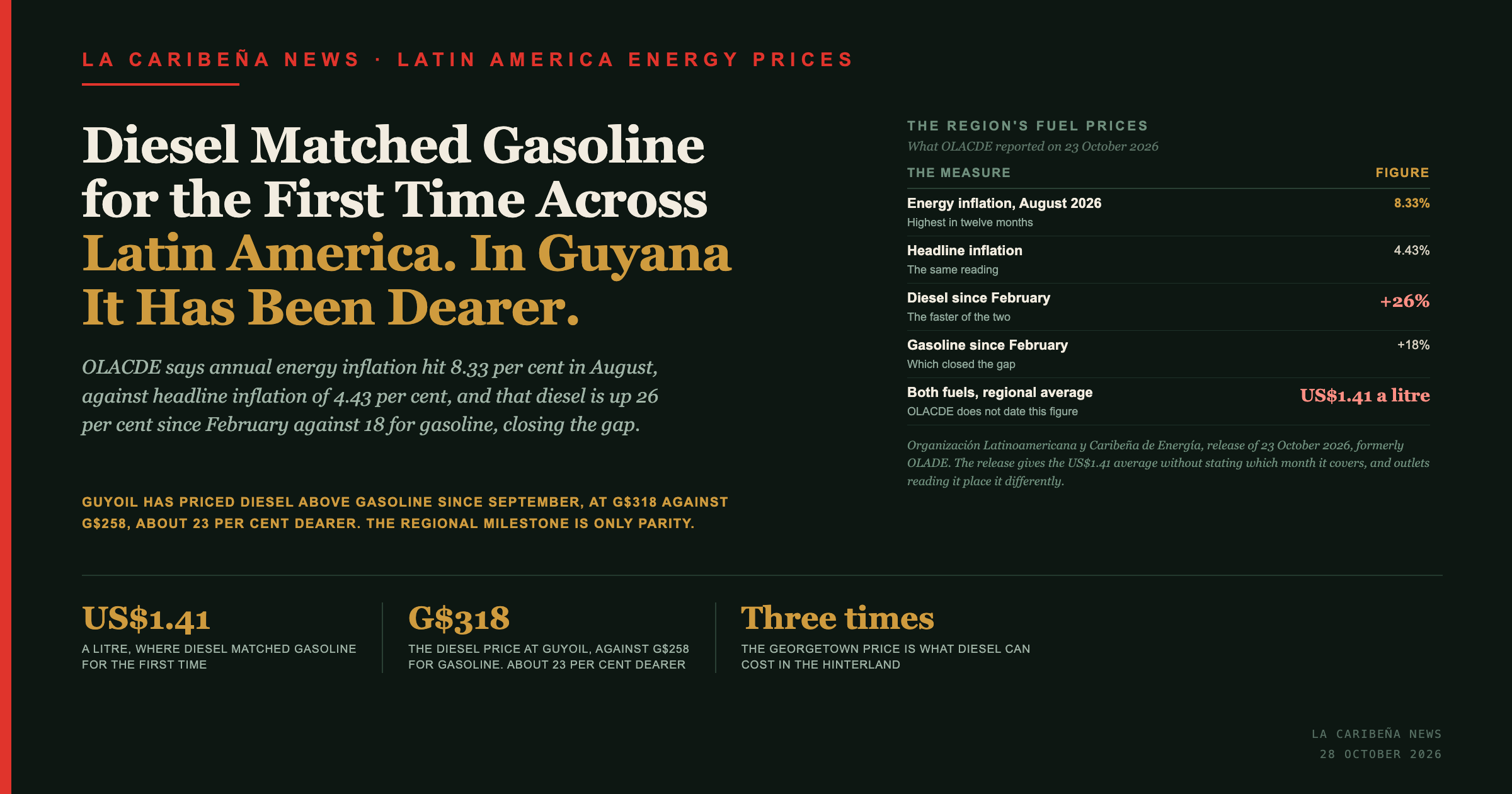
Every data point on the article's title card, in text.
- 8.33 per cent. Annual energy inflation in Latin America and the Caribbean in August 2026. Source: OLACDE, 23 October 2026.
- 4.43 per cent. Annual headline inflation for the region. Source: as above.
- US$1.41. The average price a litre at which diesel matched gasoline for the first time. Source: as above. The release does not state which month.
- +26 and +18 per cent. The rise in diesel and in gasoline since February 2026. Source: as above.
- G$318 and G$258. Guyoil's diesel and gasoline prices a litre after its late-September increase.
- About 23 per cent. How much dearer Guyoil's diesel is than its gasoline, on this newspaper's arithmetic.
Frequently Asked Questions
How fast are energy prices rising in Latin America and the Caribbean?
Annual energy inflation reached 8.33 per cent in August 2026, the highest in twelve months, against annual headline inflation of 4.43 per cent, according to OLACDE's release of 23 October 2026. The previous twelve-month high was 8.03 per cent in June, and headline inflation rose from 4.17 per cent in July.
Has diesel really become as expensive as gasoline?
OLACDE says so, in its words: "for the first time, the average price of diesel matched that of gasoline, with both reaching US$1.41 per liter." Diesel has risen 26 per cent since February 2026 against 18 per cent for gasoline, which the organisation says fully closed the gap between them.
Which month does the US$1.41 figure cover?
The release does not say. MercoPress places it in October and gives August as diesel US$1.31 and gasoline US$1.38. Revista Electricidad places it in August. EFE gives no per-litre figure. The release's own crude series, at US$83.90 a barrel in August against about US$98.29 in October, sits more naturally with the later date.
What is causing the rise?
OLACDE attributes it mainly to the resumption of conflict in the Middle East in late July, after the breakdown of the ceasefire between Iran and the United States, with domestic prices reflecting earlier increases amplified by market asymmetries and local pricing mechanisms.
What does this mean for Guyana?
Guyoil raised diesel from G$278 to G$318 a litre in late September 2026 and gasoline from G$228 to G$258, so diesel is about 23 per cent dearer than gasoline there, on this newspaper's arithmetic. The regional milestone is parity between the two fuels, and Guyana passed parity before the region reached it.
Does the report give figures for individual Caribbean countries?
No. Neither OLACDE's release nor any of the three independent accounts of it gives a country-level figure, a Caribbean-specific figure, an electricity tariff or a liquefied petroleum gas price. The report publishes a regional average.