By LCN Business Desk
The United States is the refinery the hemisphere buys from. President Donald Trump has now backed banning its diesel exports, Axios reported on 22 September, a change of position for an administration that had resisted the idea. Louisiana Governor Jeff Landry, whose state holds some of the largest refineries in the world, has called for a 90-day ban.
Bloomberg reported the following day that such a ban would leave countries including Brazil and the United Kingdom racing for the fuel, with prices already near record levels because the war involving Iran has tightened supply. Latin America would feel it first.
Is Brazil really the biggest buyer?
On the September shipments Bloomberg tracked, yes, and its planting season is why. On the last month of official figures the ranking is different. The United States Energy Information Administration's export data for June 2026 puts Mexico first at 8,654 thousand barrels of distillate fuel oil, then Brazil at 4,370, the Netherlands at 4,296, Chile at 2,489 and Peru at 2,420.
Ship tracking and customs data answer different questions. One says where cargoes are going this month, the other says where they went in a month now closed. Both put Latin America at the front of the queue.
What does Guyana buy, and from whom?
| Supplier | Value of mineral fuels, oils and distillation products bought by Guyana, 2025 |
|---|---|
| United States | US$632 million |
| Trinidad and Tobago | US$98 million |
United Nations COMTRADE figures, as carried by Trading Economics for the United States and for Trinidad and Tobago. The category covers gasoline and other refined products as well as diesel. On these figures the United States sells Guyana more than six times what Trinidad does.
Guyana produces crude and buys back the refined product, the position this newspaper set out when Red Sea shipping was last under threat, in Iran Threatens Red Sea Shipping as Guyana's Oil Windfall Strains Fuel Supply.
Where else could Guyana buy, and at what price?
The practical shortlist is short, and two of the obvious names are not on it.
| Source | State of it | What it means for Guyana |
|---|---|---|
| United States Gulf Coast | The incumbent supplier | US$632 million in 2025, and the supply now under discussion for a ban |
| Trinidad and Tobago | Pointe-a-Pierre, about 150,000 barrels a day, closed since 2018 | Trinidad is pressing Guyana and Suriname to help restart it |
| Suriname | Tout Lui Faut, 15,000 barrels a day, running | The nearest working refinery. Surplus is exported to the Caribbean |
| Colombia | Cartagena, about 210,000 barrels a day, running | On the Caribbean coast, recently into scheduled maintenance |
| Curacao | Isla, 335,000 barrels a day, shut since 2019 | Awaiting United States approval to process Venezuelan crude |
| Venezuela | 1.29 million barrels a day of capacity, running at about 35 per cent | Was Guyana's main supplier under PetroCaribe. PDVSA is under sanctions |
| Brazil | Imports more than a quarter of the diesel it burns | A rival buyer, not a seller |
| Nigeria | Dangote, 650,000 barrels a day | Its gasoil is going to West Africa and Europe |
Sources are named in the paragraphs below. Landed prices are not published for any of them, and the number that decides a cargo is the freight and the term contract rather than the posted product price, neither of which is public.
Why Brazil is a buyer and not a seller
More than a quarter of the diesel Brazil burns is imported, and Petrobras resumed importing in July despite record crude production, the Rio Times reported. A study by Brazil's Ministry of Mines and Energy and its Energy Research Company projects the country will remain a net importer of diesel and naphtha even after a 10 per cent rise in refining capacity between 2025 and 2035.
What happened to the Venezuelan supply?
It shrank. The Hartree Partners study commissioned by Guyana's Ministry of Natural Resources records that PDVSA historically supplied over 50 per cent of Guyana's petroleum product imports under the PetroCaribe agreement. By 2015 that had fallen to 2,285 barrels a day, or 17 per cent, with Trinidad's Petrotrin at 47 per cent.
Venezuela's refining system now runs at about 35 per cent of its 1.29 million barrel a day capacity, up from 20 to 25 per cent a year earlier, Inspectioneering reported in February 2026. Amuay, Cardon, El Palito and Puerto La Cruz together process around 450,000 barrels a day. PDVSA is under United States sanctions, and Venezuela claims the Essequibo, which is roughly two thirds of Guyana, in a case before the International Court of Justice.
What is running nearby?
Suriname. The Tout Lui Faut refinery processes 15,000 barrels a day of Saramacca crude into premium diesel, premium gasoline, fuel oil and bitumen, Oil and Gas Journal reported on the completion of its expansion, with most output sold locally and the surplus exported to the Caribbean. Its entire throughput is the size of the demand Hartree used for Guyana.
Colombia's Cartagena refinery runs about 210,000 barrels a day on the Caribbean coast and recently entered scheduled maintenance on three processing units, Oil and Gas Journal reported. Curacao's 335,000 barrel a day Isla refinery has been shut since 2019 and is waiting on United States approval to handle Venezuelan crude, Argus reported.
The largest new refinery in the Atlantic basin is Nigeria's Dangote, at 650,000 barrels a day. Its diesel and gasoil exports rose 23 per cent to 48,000 barrels a day in 2026 to date on Kpler figures, Hydrocarbon Processing reported, and those barrels have gone to West Africa and Europe.
What about Trinidad?
Trinidad wants Guyana's help to reopen the refinery it closed. Pointe-a-Pierre, capacity about 150,000 barrels a day, shut in 2018 after recurring losses and the cost of importing crude to run it. Trinidad and Tobago has been pressing a regional alliance with Guyana and Suriname to restart it, the Jamaica Observer reported in February 2026, with regional crude supplying the plant.
That is the nearest thing to a Caribbean answer on the table. It also carries Trinidad's own gas problems alongside it, reported in Trinidad Moved Into the Lower Band. Guyana Did Not.
Can Guyana's own crude become diesel?
Yes, and the ministry says so in its own assay. The Petroleum Management Programme's Liza crude page describes it as "Light, low sulfur crude suitable as a general purpose crude oil and suitable for production of middle distillates and mogas", and adds that "The atmospheric resid is suitable as feedstock for catalytic crackers." Middle distillates are jet fuel, kerosene and diesel. Mogas is motor gasoline.
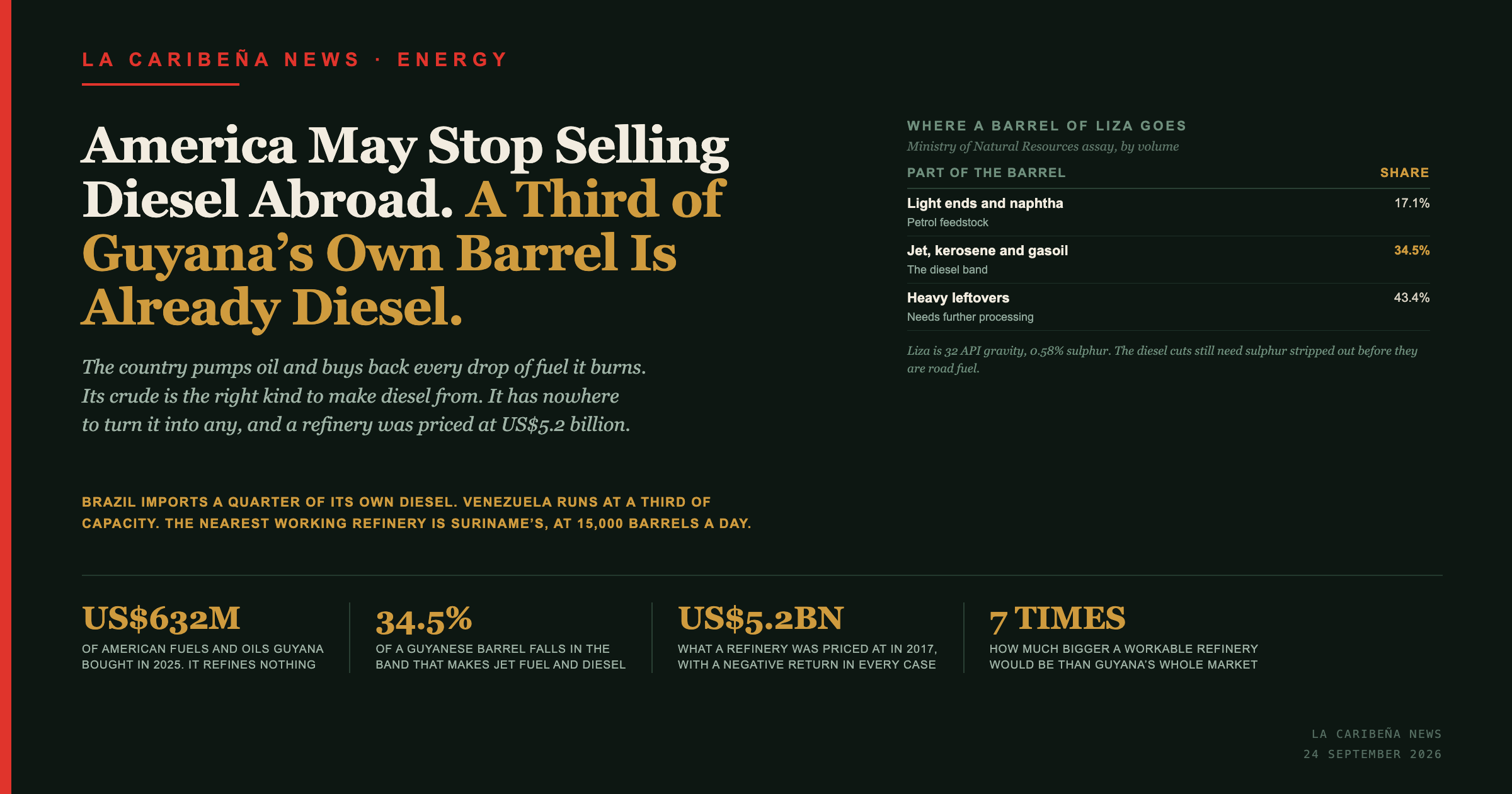
The assay puts Liza at 32.0 API gravity and 0.58 per cent sulphur by weight. Its cut data shows where the barrel goes.
| Fraction of the barrel | Share by volume |
|---|---|
| Light ends and naphtha, to 302F | 17.1 per cent |
| Jet, kerosene and gasoil, 302F to 662F | 34.5 per cent |
| of which gasoil, 482F to 662F | 18.3 per cent |
| Atmospheric residue, above 662F | 43.4 per cent |
Source: Liza Crude Assay, Ministry of Natural Resources of Guyana, Petroleum Management Programme.
So roughly a third of a Liza barrel comes off in the band that makes jet fuel and diesel, which is why European refineries want the grade. That is a feedstock statement, not a finished-fuel one.
Sulphur is the reason. It concentrates as the barrel gets heavier: 0.107 per cent by weight in the 392F to 482F cut, 0.260 per cent at 482F to 572F and 0.434 per cent at 572F to 662F. Road diesel is limited to 15 parts per million in the United States and 10 in the European Union, which is 0.0015 and 0.0010 per cent. A sweet crude is sweet by comparison with other crudes, not by comparison with the pump. Every one of those cuts needs a hydrotreater before it is road fuel.
The other grades run the same way. Payara Gold is 29 API at 0.60 per cent sulphur, and Yellowtail is Guyana's first light sweet grade, S&P Global reported. Guyanese crudes are sold precisely because refineries elsewhere want their distillate yield.
What would it take for Guyana to refine its own?
US$5.2 billion, and it loses money the day it opens. That is the finding of the Guyana Refinery Study that Hartree Partners LP presented to the Ministry of Natural Resources in May 2017 and that the ministry still publishes.
| Item | Finding |
|---|---|
| Base construction cost | US$5.2 billion |
| Net present value at 10% | Minus US$3.04 billion in the base case |
| Most optimistic scenario | Minus US$2.44 billion |
| Worst scenario | Minus US$3.69 billion |
| Internal rate of return | Negative in every scenario modelled |
| Maximum debt leverage | 13 to 18 per cent |
Source: Hartree Partners LP, Guyana Refinery Study, presentation to the Ministry of Natural Resources, May 2017.
The scale problem sits underneath the arithmetic. Hartree modelled a 100,000 barrel a day plant, because that is the marginal configuration on the United States Gulf Coast and anything smaller loses on unit costs. Guyana's entire demand for petroleum products was 15,000 barrels a day. A refinery built to be economic would be nearly seven times larger than the market it sits in, which means it is an export refinery competing with the Gulf Coast, not a domestic one.
Guyana's fuel demand has grown since 2017 and its crude production did not exist then. The study's margin assumption, a ten-year average of US$5.84 a barrel, is the number a new study would have to beat.
What happens to the price meanwhile?
CNN reported on 22 September that economists and energy analysts expect a ban to lower diesel prices for Americans in the short term and to raise them globally, eventually including in the United States. A refinery that cannot export cuts its runs.
Guatemala has already moved. Congress suspended the fuel taxes outright on 22 September, reported in Guatemala Stopped Taxing Fuel Until New Year's Eve, two weeks after capping the price. Freight adds to the landed cost: the Panama Canal cut its daily booking slots to 32, with CARICOM's exposure costed in The Panama Canal Cut Its Daily Booking Slots to 32.
Guyana burns fuel to make electricity while the gas plant is unfinished, and is negotiating for a third powership, costed in What a Third Powership Would Cost Guyana. The Prime Minister's account of when bills fall is set against the plant's schedule in Bills Will Not Halve Until the Plant Runs at Full Capacity.
No ban has been imposed. What exists is a presidential endorsement, a governor's request for 90 days, and a set of buyers who already pay near-record prices and have nowhere nearer to buy.
What the title card shows
- 90 days: the length of ban asked for by Louisiana Governor Jeff Landry, after President Trump backed the idea on 22 September 2026.
- US$632 million: what Guyana bought from the United States in mineral fuels, oils and distillation products in 2025, against US$98 million from Trinidad and Tobago. United Nations COMTRADE figures.
- 34.5 per cent: the share of a Liza barrel that comes off in the jet, kerosene and gasoil band, on the Ministry of Natural Resources own assay. The crude makes diesel; the sulphur in those cuts still needs treating.
- More than a quarter: the share of its own diesel Brazil imports, which makes Brazil a competitor for cargoes rather than a supplier. Venezuela was running about 35 per cent of its refining capacity in February 2026.
- US$5.2 billion and minus US$3.04 billion: what a Guyanese refinery would cost to build and what its net present value was calculated at, in the study Hartree Partners presented to the Ministry of Natural Resources in May 2017.
Frequently Asked Questions
Has the United States banned diesel exports?
No. President Trump said on 22 September 2026 that he backs a ban, and Louisiana's governor has asked for one lasting 90 days. Nothing has been imposed.
Where does Guyana get its fuel?
It imports all of it. On United Nations COMTRADE figures for 2025 it bought US$632 million of mineral fuels, oils and distillation products from the United States and US$98 million from Trinidad and Tobago. Venezuela supplied over half of Guyana's product imports under PetroCaribe in earlier years, falling to 17 per cent by 2015.
Can Guyana's own crude be made into diesel?
Yes. The Ministry of Natural Resources describes Liza as light, low sulphur crude suitable for the production of middle distillates, which are jet fuel, kerosene and diesel. Its assay puts 34.5 per cent of the barrel by volume in that band. The sulphur in those cuts, up to 0.434 per cent by weight, is far above the 10 to 15 parts per million allowed in road diesel, so they still need hydrotreating.
Where else could Guyana buy?
Trinidad and Tobago, if Pointe-a-Pierre restarts; Suriname, whose 15,000 barrel a day Tout Lui Faut refinery exports its surplus to the Caribbean; Colombia, whose Cartagena refinery runs about 210,000 barrels a day on the Caribbean coast; and Curacao, if its 335,000 barrel a day Isla refinery reopens. Landed prices are not published for any of them.
Could Guyana buy from Brazil or Venezuela instead?
Brazil imports more than a quarter of the diesel it consumes and its own government projects it will remain a net importer through 2035. Venezuela's refineries were running at about 35 per cent of capacity in February 2026, PDVSA is under United States sanctions, and Venezuela's claim to the Essequibo is before the International Court of Justice.
Why does Guyana not refine its own oil?
Hartree Partners costed it for the Ministry of Natural Resources in May 2017 at US$5.2 billion, with a net present value of minus US$3.04 billion in the base case and a negative internal rate of return in every scenario. An economic plant would run at 100,000 barrels a day against Guyanese demand of 15,000.
Is there a regional alternative?
Trinidad and Tobago has been pressing a regional alliance with Guyana and Suriname to restart the Pointe-a-Pierre refinery, capacity about 150,000 barrels a day, which closed in 2018.