By LCN Business Desk
A government that imports every litre of the fuel its electricity runs on has limited instruments. The Cayman Islands is using the one it controls: it has stopped collecting the duty it charges itself.
On 29 September the government extended the 2026 Fuel Relief Programme by three months, to 31 December 2026. The 100 per cent import duty waiver on gasoline, diesel and propane continues, as does a cap on the fuel charge component of residential electricity bills.
Electricity rebates and duty relief under it had reached about CI$11.35 million by the end of August.
What has actually been waived?
Specific amounts, per imperial gallon, on three fuels.
The waiver removes 75 cents from the import duty on gasoline, 85 cents from diesel sold at service stations, and 25 cents from diesel imported for electricity generation. It continues to apply to propane.
On the electricity side, the residential fuel charge is capped at CI$0.18 per kilowatt-hour. Households consuming between 101 and 3,500 kilowatt-hours a month get relief on the first 2,000, applied automatically through Caribbean Utilities Company and Island Energy with no application required. The government puts the coverage at nearly 95 per cent of households across all three islands, and Cabinet approved a further CI$3.0 million for the assistance programme.
At the September fuel cost rate the government cites, 0.2255, the cap and waiver together are worth about CI$70.44 a month to a household using 1,200 kilowatt-hours.
Will any of it reach the pump?
The government says it may not, and says so in the release itself.
"The waiver removes the Government duty component, but it does not set or freeze retail fuel prices. Prices at service stations will continue to reflect international purchase prices, shipping and supply costs, existing inventory and other market factors. Depending on movements in global fuel prices, consumers may see a reduction, little change or an increase at the pump."
That is an unusually plain thing for a government to publish about its own relief measure, and it is the structural point of the whole exercise. Eighty-five cents a gallon is a fixed amount removed from a price set by markets Cayman does not participate in. If the landed cost moves more than that, it moves more than that.
The release adds the qualifier that matters: in each case prices "should be lower than they otherwise would have been" had the duty been charged. The subsidy is real. Whether it is visible at the pump is outside the government's gift.
Oversight is assigned. The Utility Regulation and Competition Office and Customs and Border Control are to keep coordinating with the Ministry of Finance and monitoring the fuel supply chain so the benefit reaches wholesale and retail pricing.
What does the government say the exposure is?
That it is structural, and that the answer is not fuel.
The Minister for Finance and Economic Development, Rolston Anglin, put the CI$11.35 million in those terms:
"That is a significant level of support, but it reflects the scale of the exposure facing a small island economy that imports the fuel used to generate electricity and move people and goods."
The release goes further in its own voice, saying the pressures underscore "the importance of acquiring more affordable, alternative fuels and energy sources that are less susceptible to geopolitical issues."
Island Energy's director, Matthew Bishop, made the counterfactual explicit: "Without the fuel subsidy, the recent surge in global oil prices would have translated directly into significantly higher electricity costs."
Premier André Ebanks framed the limit on his own government's reach: "Although Government is unable to control global fuel prices, we can act responsibly to reduce their impact on electricity, transportation and household budgets."
Is there a plan beyond the subsidy?
Three phases, and the subsidy is the first of them.
The government describes the extension as continuing phase one of a three-phase energy relief and resilience plan. Phase two expands home energy efficiency support through the Cayman Home Energy Efficiency Retrofit programme, beginning with roof insulation and later more efficient air conditioning and fans. Phase three focuses on expanding solar generation and other renewable energy to reduce long-term exposure to oil price shocks.
A duty waiver can be enacted in a Cabinet meeting and costs the treasury directly. Roof insulation takes a season. Solar generation at a scale that changes a fuel charge takes years. Phase one buys the time in which phases two and three are supposed to happen, and it is the only one of the three whose cost appears in this year's accounts.
Why does this matter outside Cayman?
Because the structure is the region's, not one territory's.
A small island economy that imports the fuel that makes its electricity has the same three options wherever it sits: absorb the price, subsidise it, or change what it burns. Cayman is doing the second while funding the third.
The dependency runs further than the meter. Fuel generates the electricity, and in a territory without rivers the electricity makes a substantial part of the fresh water. A fuel supply question is not only a cost-of-living question.
LCN reported this month on a cargo of liquefied natural gas held off San Juan while a supplier and a bankrupt utility argued over payment, and on a US$250 million regional bond whose eligible uses begin with renewable energy and resilient infrastructure. Those are the same problem approached from three directions: a payment dispute, a capital raise, and a duty waiver.
What the title card shows
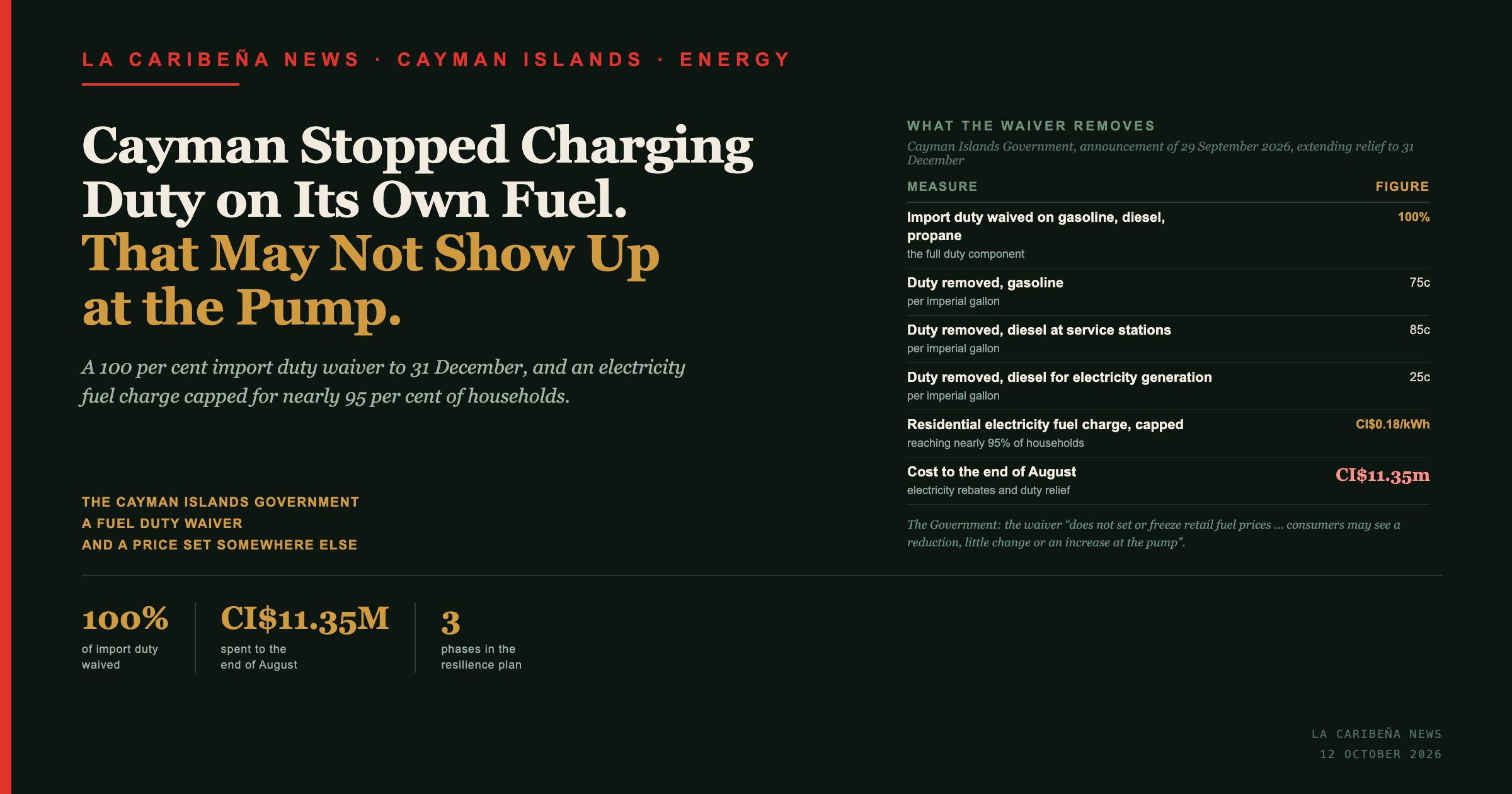
The card sets the headline against a panel drawn from the Cayman Islands Government's announcement of 29 September 2026. It gives the duty removed per imperial gallon on gasoline, 75 cents; on diesel sold at service stations, 85 cents; and on diesel imported for electricity generation, 25 cents; the cap on the residential electricity fuel charge, CI$0.18 per kilowatt-hour; the share of households the government says the cap reaches, nearly 95 per cent; and the cost of the programme in electricity rebates and duty relief by the end of August, about CI$11.35 million.
Three figures run along the foot of the card: 100%, the share of import duty waived on gasoline, diesel and propane; CI$11.35M, the cost to the end of August; and 3, the number of phases in the government's energy relief and resilience plan. The flag block reads THE CAYMAN ISLANDS GOVERNMENT, A FUEL DUTY WAIVER, AND A PRICE SET SOMEWHERE ELSE.
Frequently Asked Questions
What has the Cayman Islands Government waived?
One hundred per cent of the import duty on gasoline, diesel and propane, extended on 29 September 2026 to run to 31 December. Per imperial gallon that removes 75 cents on gasoline, 85 cents on diesel sold at service stations and 25 cents on diesel imported for electricity generation.
How much has the programme cost?
About CI$11.35 million in electricity rebates and fuel duty relief by the end of August 2026, with a further CI$3.0 million approved by Cabinet for the Electricity Assistance Programme.
Will fuel prices fall at the pump?
Not necessarily. The government states that the waiver removes the duty component but does not set or freeze retail prices, and that consumers "may see a reduction, little change or an increase at the pump" depending on global fuel prices. It says prices should be lower than they would have been had the duty been charged.
Who gets the electricity relief?
Residential customers using between 101 and 3,500 kilowatt-hours a month, on the first 2,000 kilowatt-hours, with the fuel charge capped at CI$0.18 per kilowatt-hour. It is applied automatically through Caribbean Utilities Company and Island Energy, and the government says it reaches nearly 95 per cent of households.
What comes after the subsidy?
The government describes a three-phase plan. Phase one is the current relief. Phase two expands home energy efficiency through the Cayman Home Energy Efficiency Retrofit programme. Phase three expands solar generation and other renewables to reduce long-term exposure to oil price shocks.