By LCN Business Desk
A new regional bond was put before the Caribbean Investment Forum in Barbados on 7 October. It is called the Caribbean Sustainability Bond, it seeks up to US$250 million, and it is structured to finance renewable energy, resilient infrastructure, water and wastewater systems, food security, affordable resilient housing, healthcare and climate adaptation across the Caribbean Community.
It is a serious piece of financial engineering and the first of its kind in the region. It is also, measured against the institution sponsoring it, a very large number.
Food security sits among the eligible categories, in a region where a single El Nino season can move the price of imported staples.
Who is actually issuing it?
Three parties, with distinct roles that matter.
The issuer is Caribbean Sustainability Investments Limited, a vehicle created for the purpose. The project sponsor is the CARICOM Development Fund. The lead arranger and broker is JMMB Securities, part of the Jamaican financial group. The Climate Bonds Initiative provided technical assistance, and projects are to be assessed against its resilience taxonomy.
The distinction between issuer and sponsor is the point of the structure. The Fund is not borrowing US$250 million and neither are CARICOM governments. The debt sits with the issuing vehicle, which is what allows the arrangers to describe the instrument as raising regional climate finance without adding to member states' fiscal stress.
JMMB is targeting development finance institutions and multilateral banks, naming the Caribbean Development Bank, the International Finance Corporation and the Inter-American Development Bank, alongside impact investors in Germany, elsewhere in Europe and the United Kingdom. Two multilateral institutions are reported as already engaged, and have not been named.
Karl Townsend of JMMB, whose title the Jamaica Gleaner gave as Chief Country Officer of JMMB Group Jamaica in its report of 9 October and as head of the group's capital markets unit in its editorial two days later, set out the logic: "Rather than approaching the market with multiple smaller financing requests, we can bring together eligible projects under a single regional financing framework and present investors with a compelling Caribbean investment opportunity. So, instead of fragmentation, we create scale."
How does US$250 million compare with what the Fund has done?
It is roughly one and a half times everything the CARICOM Development Fund has disbursed in its entire existence.
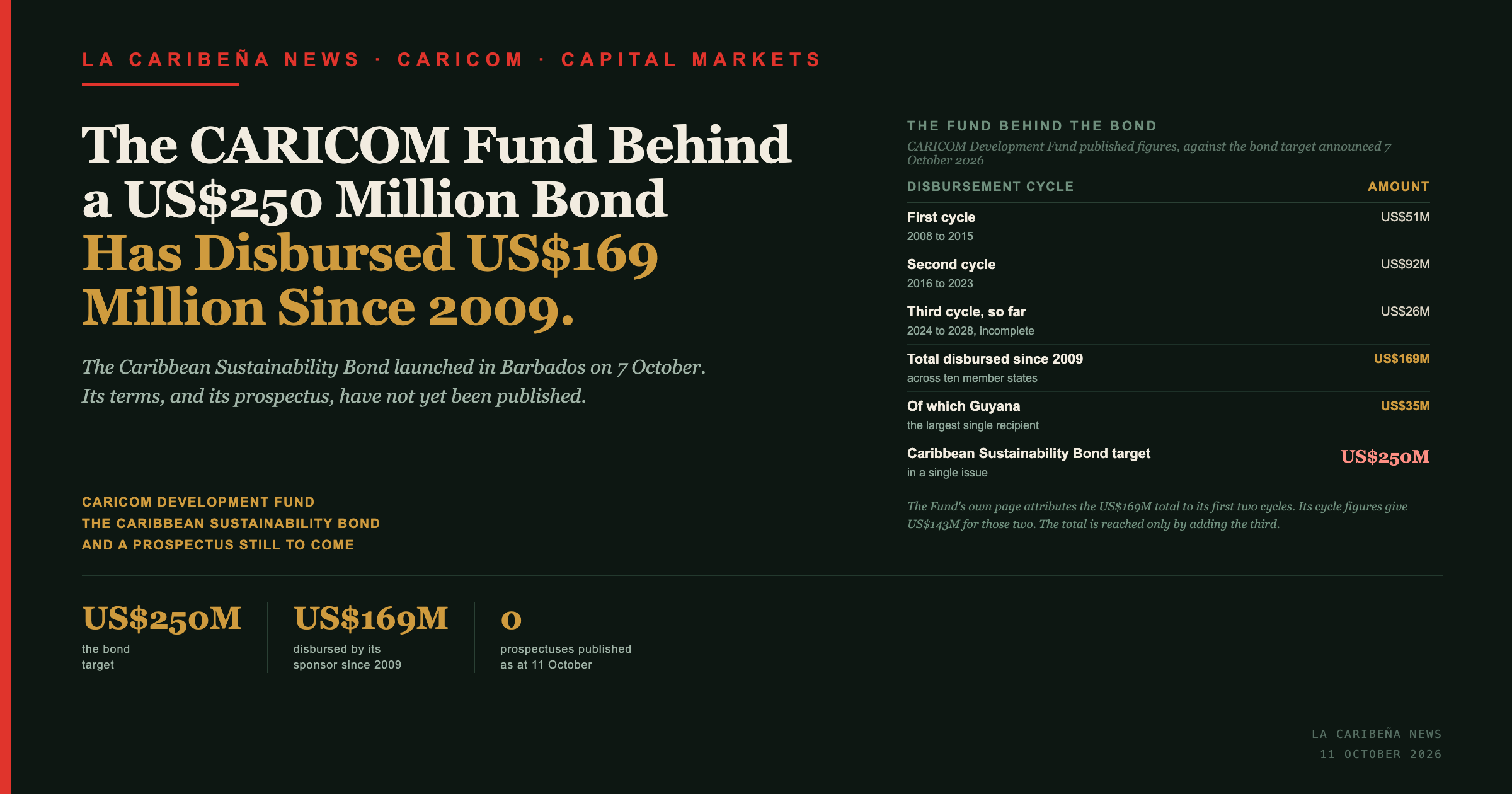
The Fund publishes its own numbers. It was established under Article 158 of the Revised Treaty of Chaguaramas, signed its agreement in July 2008 and began operating on 24 August 2009. Its disbursements run in cycles: US$51 million in the first, 2008 to 2015; US$92 million in the second, 2016 to 2023; and US$26 million so far in the third, which runs to 2028.
That is US$169 million across seventeen years and ten member states. The bond targets US$250 million in a single issue, to be raised by the end of the first quarter of 2027.
| CARICOM Development Fund | Amount |
|---|---|
| First cycle, 2008 to 2015 | US$51M |
| Second cycle, 2016 to 2023 | US$92M |
| Third cycle, 2024 to 2028, so far | US$26M |
| Total disbursed since 2009 | US$169M |
| Caribbean Sustainability Bond target | US$250M |
Source: CARICOM Development Fund; bond target as announced 7 October 2026.
One note on the Fund's own arithmetic. The same page that carries those cycle figures states that "in the first cycle (2008-2015) and second cycle (2016-2023), the CDF invested over US$169 million". Its own cycle numbers give 51 plus 92, or US$143 million, for those two cycles. The US$169 million total is reached only by adding the third. The Fund's member-state table sums to exactly US$169 million, which confirms it as a three-cycle figure.
This is not a small-print quibble. An institution asking international investors for US$250 million will have its published figures read closely, and the first thing a credit analyst does is add up the columns.
What has not been published?
The terms.
As at 11 October 2026 there is no published prospectus. There is no stated currency of issuance, no coupon, no final tenor, no credit rating, no guarantee or credit enhancement, no tranche structure, and no named provider of a second party opinion, which is the independent review that sustainability bond investors ordinarily require. The arrangers have said they are seeking "a very long tenor and a very low coupon", which is an aspiration rather than a term.
The Jamaica Gleaner, which has editorialised in favour of the instrument, put the same point plainly on 11 October: it "looks forward to the launch of the prospectus, and with it the fine print".
None of this is irregular. Launching a concept at a forum and publishing a prospectus later is ordinary practice, and the roadshow is not until the end of November. It does mean that what exists today is an announced intention with a named sponsor, a named arranger, a taxonomy and a list of eligible sectors, and that the terms on which anyone would actually buy it are still to come.
Why is the region trying this now?
Because the alternative has been priced out.
The 2020 CARICOM commission chaired by the Barbadian economist Avinash Persaud, quoted by the Gleaner, put the problem in terms no insurer disputes: "There is no tolerable level of insurance premium that would insure Dominica against losing 350 per cent of GDP every eight or so years." The commission added that "if climate change risks are known, large, and rising, then pooling with those who do not share your risk would only be helpful for you but not for them. These are increasingly uninsurable risks."
That commission proposed CARICOM growth and resilience bonds on a public-private model close to the one now being used, and estimated that upwards of US$50 billion sat in regional bank and credit union accounts that might be tapped. Against that estimate, US$250 million is modest. The region has been assembling the plumbing for this kind of pooling elsewhere too, with four Caribbean central bank governors meeting Africa's payment system in Port of Spain earlier this year.
The Fund's third cycle already carries an institutional ambition of a different order. Its published objective is "US$400 million in programme disbursements" by 2028 through three new revenue-generating financial products, against the US$26 million disbursed in that cycle so far. The bond is one of the instruments by which a fund that has moved US$169 million in seventeen years intends to move US$400 million in four.
Where does Guyana sit in this?
As the largest recipient the Fund has, and as the member whose circumstances have changed most.
Guyana has taken US$35 million of the Fund's US$169 million, more than any other member state and 20.7 per cent of everything disbursed. Dominica is next at US$23 million, then Saint Lucia at US$21 million.
Guyana's original entitlement is worth stating precisely. The Fund records that its assistance initially went only to member states classified as disadvantaged, a list that included "Guyana (due to its Heavily Indebted Poor Countries status)". That classification is historical. In 2020 the CARICOM Cohesion Policy widened the Fund's focus from disadvantaged countries to disadvantaged regions and sectors across all member states.
What has changed since is on the record. The IMF's Executive Board concluded Guyana's 2026 Article IV consultation on 8 October, three days before this bond's launch was editorialised in Kingston, recording real GDP growth of 19.3 per cent in 2025, public debt at 28.9 per cent of GDP, described by the Board as among the lowest in the Western Hemisphere, and a Natural Resource Fund holding about US$3.3 billion. LCN reported that review in full on 11 October.
A fund whose largest beneficiary now holds a sovereign wealth fund nearly twenty times the Fund's lifetime disbursements is a different institution from the one that opened in 2009. Whether Guyana remains a net recipient, becomes a contributor, or becomes an anchor investor in the very bond its regional fund is sponsoring is not addressed in anything published so far.
What the title card shows
The card sets the headline against a panel drawn from the CARICOM Development Fund's published figures and the bond's launch announcement of 7 October 2026. The rows give the Fund's first cycle, 2008 to 2015, at US$51 million; its second, 2016 to 2023, at US$92 million; its third, 2024 to 2028, at US$26 million so far; a total disbursed since 2009 of US$169 million across ten member states; Guyana's share of that total at US$35 million, the largest of any member state; and the Caribbean Sustainability Bond target at US$250 million.
Three figures run along the foot of the card: US$250M, the bond target; US$169M, everything the sponsoring fund has disbursed since 2009; and 0, the number of published prospectuses as at 11 October 2026. The flag block reads CARICOM DEVELOPMENT FUND, THE CARIBBEAN SUSTAINABILITY BOND, AND A PROSPECTUS STILL TO COME.
Frequently Asked Questions
What is the Caribbean Sustainability Bond?
A regional bond launched on 7 October 2026 at the Caribbean Investment Forum in Barbados, targeting up to US$250 million for renewable energy, resilient infrastructure, water and wastewater systems, food security, affordable resilient housing, healthcare and climate adaptation across CARICOM.
Who is issuing it and who is sponsoring it?
The issuer is Caribbean Sustainability Investments Limited. The project sponsor is the CARICOM Development Fund and the lead arranger and broker is JMMB Securities. The Climate Bonds Initiative provided technical assistance.
Are CARICOM governments taking on this debt?
No. The structure places the borrowing with the issuing vehicle rather than with member states or with the Fund, which is why its proponents describe it as raising climate finance without adding to government fiscal stress.
What are the terms of the bond?
They have not been published. As at 11 October 2026 there is no prospectus, no stated currency, coupon, final tenor, rating, guarantee or named second party opinion provider. The arrangers have said they are seeking a very long tenor and a very low coupon.
How much has the CARICOM Development Fund disbursed?
US$169 million across ten member states since it began operating on 24 August 2009, comprising US$51 million in its first cycle, US$92 million in its second and US$26 million so far in its third. Guyana is the largest recipient at US$35 million.