By LCN Business Desk
The International Monetary Fund's Executive Board concluded its annual review of Guyana on 8 October 2026. The review covers an economy that grew 19.3 per cent in 2025, pumps more than 900,000 barrels of oil a day, and holds US$3.3 billion in a sovereign fund built from four years of production.
The Board did not meet to discuss it.
Press Release No. 26/330 carries a footnote that most readers will pass over. It reads: "The Executive Board takes decisions under its lapse-of-time procedure when the Board agrees that a proposal can be considered without convening formal discussions."
What does lapse-of-time actually mean?
It means no Executive Director asked for a debate.
Under the IMF's ordinary procedure, Directors discuss a country's Article IV report and the Managing Director, as Chair, then summarises their views for transmission to the national authorities. That summary is what the published assessment normally records. Where a case is uncontroversial, the Board can instead let the proposal pass without convening.
The distinction is visible in the footnotes. The Fund's 2026 Article IV press release for Japan carries the standard formulation, that "the Managing Director, as Chair of the Board, summarizes the views of Executive Directors". So does the 2026 release for Fiji, a small island state closer to Guyana in scale. Neither mentions lapse-of-time. Guyana's does.
This is not a mark against Guyana. It is the opposite: the procedure is reserved for cases nobody wants to argue about. For the country running the fastest growth rate in the hemisphere, it is worth recording that its annual review passed without a word spoken.
How fast is Guyana growing?
Faster than the Fund expected, and faster than it will keep growing.
Real GDP rose 19.3 per cent in 2025 and is projected at 22.3 per cent for 2026. That follows average growth of nearly 40 per cent across 2023 and 2024. Crude production went from 225.4 million barrels in 2024 to 261.1 million in 2025, with 328.5 million projected this year.
The non-oil economy is the number to watch. It grew 14.0 per cent in 2025, is projected at 10.2 per cent for 2026, and the Board expects it to settle at about 7 per cent over the medium term. Growth led by construction, supported by agriculture, mining and manufacturing.
Inflation averaged 3.3 per cent in 2025 and is projected at 4.1 per cent for 2026, which the Board attributes to higher global energy and food prices. Gross official reserves stood at US$1.36 billion at end-2025 and are projected to reach US$2.45 billion. The current account surplus was US$5.7 billion, or 21.4 per cent of GDP, heading to a projected US$10.6 billion.
Public debt is 28.9 per cent of GDP, which the Board calls "one of the lowest debt-to-GDP ratios in the Western Hemisphere". The scale of the divergence from the rest of the region is set out in the World Bank's latest Latin America and Caribbean update.
Why do two different deficit figures describe the same year?
Because the Fund publishes both, and they say different things.
Measured against total GDP, Guyana's 2025 overall fiscal deficit was 5.5 per cent, narrowed by nearly two percentage points. Measured against non-oil GDP, the same deficit was 14.3 per cent. Both figures sit in the same table in the same document.
The gap is the oil. Total GDP includes it; non-oil GDP strips it out and shows what the budget would look like without it.
On that second measure the position is starker still. The non-oil primary balance was minus 36.9 per cent of non-oil GDP in 2025, and is projected to widen to minus 37.7 per cent in 2026. Central government expenditure runs at 60.7 per cent of non-oil GDP against revenue of 45.9 per cent.
The Board's recommendation follows directly: the non-oil primary balance "could serve as the main operational target, strengthening gradually over the next decade to a level consistent with a chosen long-run anchor, such as preserving the real per capita value of NRF assets."
That is a proposal to measure the budget by the half of it that does not depend on a finite resource, and to tighten that measure every year for ten years.
What did the Board say about cost-oil audits?
It put them first.
The governance paragraph opens: "Priorities include resolving outstanding cost-oil audits, improving the timeliness of public enterprise and agency accounts, further strengthening audit capacity, especially in the oil and gas sector, and ensuring consistent compliance with the procurement framework as public spending expands."
Cost-oil audits determine how much of Guyana's production goes to recovering contractor expenses before profit is shared. LCN reported in October on the US$214 million in disputed costs referred to an ICC sole expert. The Fund has now placed the resolution of those audits at the head of its governance list.
The same paragraph asks for continued work on anti-money-laundering and anti-corruption frameworks, "including by strengthening the Integrity Commission and the asset declaration regime".
What does the Board say about the exchange rate?
That it works, and that it should loosen eventually.
The Guyana dollar has averaged 208.5 to the United States dollar in both 2024 and 2025. The Board calls the arrangement appropriate, then adds that "greater flexibility could be considered over the medium term to facilitate macroeconomic adjustment and enhance resilience to shocks."
The regional contrast is sharp. Trinidad and Tobago's central bank published a five-year strategic plan this month in which foreign exchange is named once across 28 pages, with no project directed at it. Guyana's review discusses its exchange rate regime at length and recommends a direction of travel.
The Board also notes that broad money grew 28.4 per cent in 2025 and bank credit 26.1 per cent, and wants money growth brought "broadly aligned with nominal non-oil GDP growth". It flags rapid housing market growth, recommends building a real estate price index, and says cybersecurity standards "should also be enhanced as financial services become increasingly digital".
Where do the social indicators sit?
Behind the headline, and on older vintages.
The same table that records GDP per capita of US$26,104 for 2025, projected to reach US$35,445 in 2026, lists life expectancy at birth of 66 years for 2022, an under-five mortality rate of 14 per 1,000 live births for 2023, and a Human Development Index rank of 95 for 2022. Population is given as 1.025 million, marked preliminary.
Those dates matter and the Fund marks them. The social figures are two to four years behind the growth figures, which is itself the subject of the Board's closing request: it asks Guyana to update national accounts and price statistics, maintain regular labour force surveys, publish "more complete census results", and roll out a new household budget survey, calling these "critical to strengthen the evidence base for policymaking and assess the impact of policies."
What the title card shows
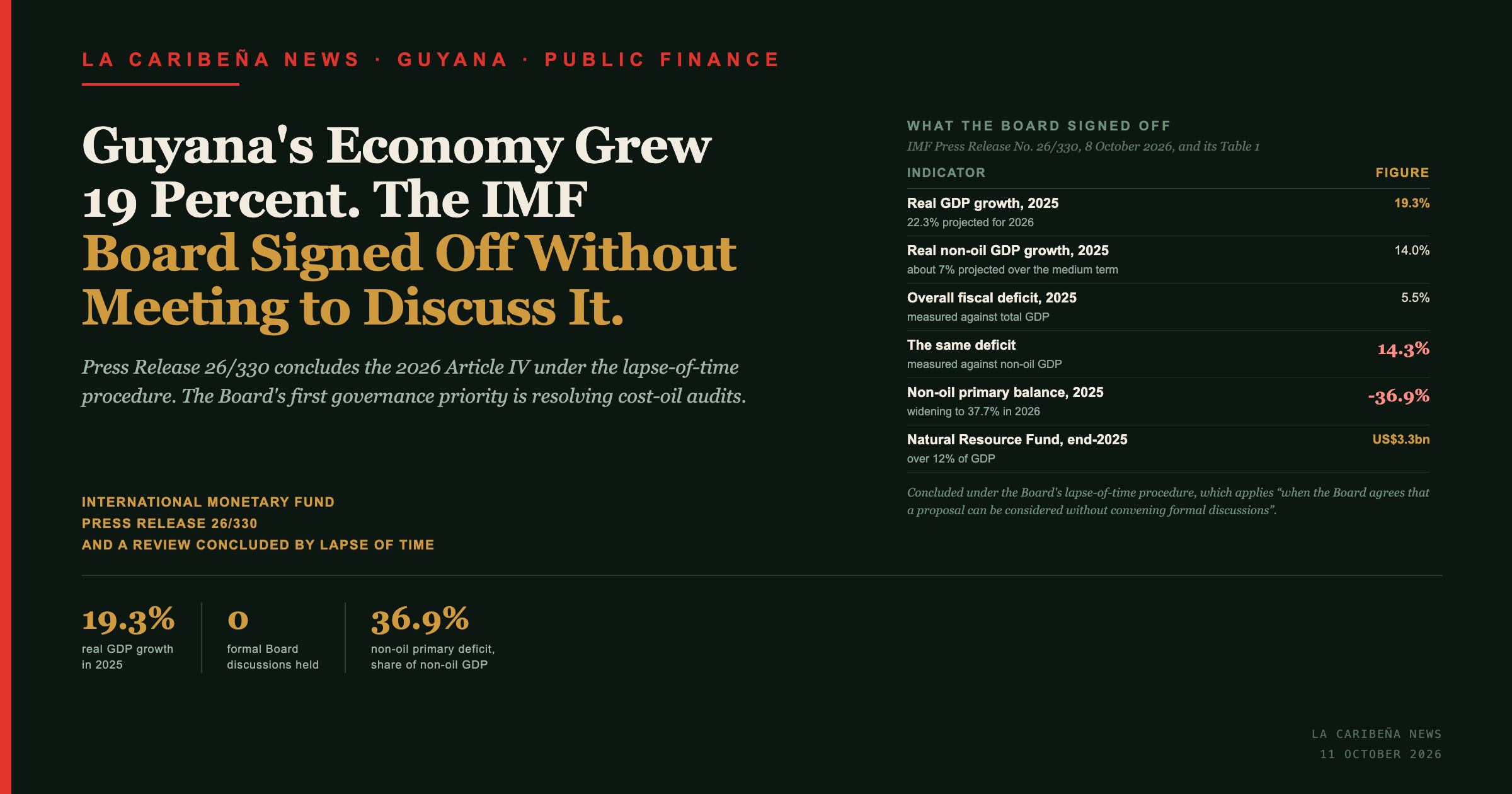
The card sets the headline against a panel drawn from IMF Press Release No. 26/330 of 8 October 2026 and its Table 1. The rows give real GDP growth of 19.3 per cent for 2025 and a 22.3 per cent projection for 2026; non-oil GDP growth of 14.0 per cent falling to a medium-term average of about 7 per cent; the overall fiscal deficit at 5.5 per cent of GDP and the same deficit at 14.3 per cent of non-oil GDP; the non-oil primary balance at minus 36.9 per cent of non-oil GDP; and the Natural Resource Fund at about US$3.3 billion, over 12 per cent of GDP, at end-2025.
Three figures run along the foot of the card: 19.3%, for real GDP growth in 2025; 0, for the number of formal Board discussions held before the consultation was concluded; and 36.9%, for the non-oil primary deficit as a share of non-oil GDP. The flag block reads INTERNATIONAL MONETARY FUND, PRESS RELEASE 26/330, AND A REVIEW CONCLUDED BY LAPSE OF TIME.
Frequently Asked Questions
Did the IMF Executive Board discuss Guyana's 2026 Article IV consultation?
No. Press Release No. 26/330 records that the consultation was concluded under the Board's lapse-of-time procedure, which its own footnote describes as applying "when the Board agrees that a proposal can be considered without convening formal discussions."
Is lapse-of-time a criticism of Guyana?
No. The procedure is used where a case is uncontroversial and no Executive Director seeks a debate, so it signals an absence of contention rather than neglect.
How fast did Guyana's economy grow in 2025?
Real GDP grew 19.3 per cent, with oil GDP up 21.1 per cent and non-oil GDP up 14.0 per cent. The IMF projects 22.3 per cent total growth for 2026 and about 7 per cent non-oil growth over the medium term.
What is Guyana's fiscal deficit?
It depends which denominator is used. The 2025 overall deficit was 5.5 per cent of total GDP, or 14.3 per cent of non-oil GDP. The non-oil primary balance was minus 36.9 per cent of non-oil GDP.
What did the IMF say about Guyana's cost-oil audits?
The Executive Board assessment lists "resolving outstanding cost-oil audits" as the first of its governance priorities, alongside improving the timeliness of public enterprise accounts, strengthening audit capacity in oil and gas, and compliance with the procurement framework.