By LCN Business Desk
The 2016 Production Sharing Agreement anticipates that a disagreement over recoverable costs will be settled quickly. It gives the parties 30 days to agree an expert and gives that expert 30 to 60 days to deliver an opinion. On its own terms the mechanism runs for about three months.
Guyana triggered it in September 2024. Twenty-five months later no expert has been appointed, and the question of who should decide has itself gone to the International Chamber of Commerce.
What was flagged, and by whom?
US$214.4 million, by IHS-Markit, in March 2021.
The British firm audited ExxonMobil's Stabroek Block costs for the period 1999 to 2017, against the US$1.6 billion in expenses the operator had submitted for cost recovery. Its report, delivered in March 2021, advised that Guyana had "reasonable grounds to dispute $214.4 million plus overhead adjustments". The 2019 audit that followed it remained unresolved this March.
That sum is 12.8 per cent of cumulative cost recovery as at the fourth quarter of 2017.
The wording matters. The audit did not find that money was taken improperly. It found that Guyana had reasonable grounds to dispute whether it should have been recovered, which is a different and narrower thing, and it is the thing the contract provides a mechanism to resolve.
The disputed figure moved once. It was reduced to about US$3 million after ExxonMobil submitted further documentation, and restored to US$214.4 million after the government rejected that documentation.
What does the contract say should happen?
Article 26, and it is specific about the clock.
The 2016 Production Sharing Agreement requires the parties to cooperate in an expert determination and to provide the access it needs. The sole expert must deliver an opinion within 30 to 60 days of appointment, and must act as an expert rather than as an arbitrator or a mediator.
Before any of that, the parties have 30 days to agree who the expert will be.
Why is it at the ICC?
Because they could not agree within those 30 days.
Vice President Bharrat Jagdeo announced in September 2024 that discussions had concluded and the dispute resolution provisions were triggered. In March 2026 the Minister of Natural Resources said the two sides had agreed on an expert. By June the nomination had drawn a question over a possible conflict of interest. By October there was still no appointment, and the matter had passed to the International Chamber of Commerce to make the choice the parties could not.
Minister of Natural Resources Vickram Bharrat put the position plainly: "Yes the ICC will make a decision on a sole expert." On timing he said: "It's already with the ICC. We have to wait on them. No fixed timeframe as yet."
A clause written to produce an answer in ninety days has spent twenty-five months choosing who should answer.
How long has this taken?
Five years and seven months since the finding.
| Date | Event |
|---|---|
| 1999 to 2017 | Period audited |
| March 2021 | IHS-Markit reports; US$214.4m flagged |
| September 2024 | Dispute procedure triggered |
| March 2026 | Parties said to have agreed an expert |
| June 2026 | Conflict of interest raised over the nomination |
| October 2026 | Before the ICC, no expert appointed, no timeframe |
The audit covers costs incurred up to 2017. Guyana's first oil came in December 2019. So the sum in dispute predates production, and it has now been unresolved for longer than the audit period's final decade took to accumulate it.
What does it mean for the money?
Cost oil is the first call on the barrel, so the question is not academic.
Under the Stabroek arrangement, recoverable costs are deducted before profit is shared, on a contract whose royalty is 2 per cent against the 6.25 per cent Suriname signed next door and which does not ring-fence project costs. A dollar wrongly recovered is a dollar that does not reach the Natural Resource Fund, and it is recovered immediately while the dispute over it runs for years. This newspaper has reported that Guyana's share of its own oil reached a record while the country paid for two vessels that had not yet produced, and that the International Monetary Fund's Article IV consultation addressed the audit backlog directly.
The capacity question sits alongside it. Last month this newspaper reported that the Audit Office of Guyana still has no oil and gas division and was asking for one again. The country has audited 1999 to 2017 and is still arguing about it, over a block where the state and the operator do not yet agree on the size of the reserves.
Nothing in the record suggests either party is obliged to move faster than it has. Article 26 binds the expert to 30 to 60 days. It does not bind the parties to agree on one, and that is where twenty-five months have gone.
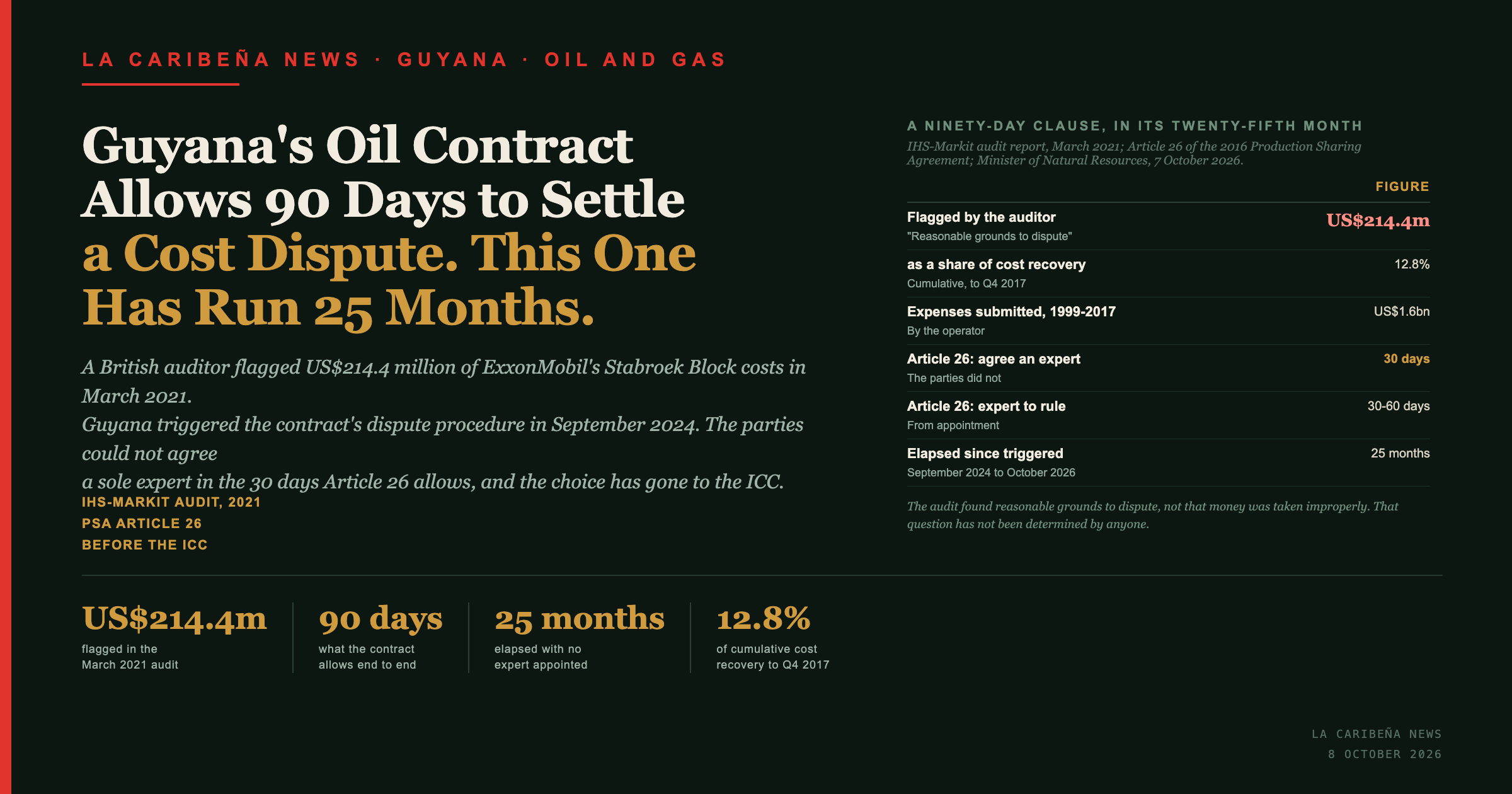
What the title card shows
Every data point on the article's title card, in text.
* US$214.4 million. The sum IHS-Markit advised Guyana had "reasonable grounds to dispute", plus overhead adjustments, in its March 2021 report. * 12.8 per cent. That sum as a share of cumulative cost recovery as at the fourth quarter of 2017. * US$1.6 billion. The expenses ExxonMobil submitted for the audited period. * 1999 to 2017. The period the audit covered. * About US$3 million. The figure the dispute was reduced to after further documentation was submitted, before the government rejected it and restored US$214.4 million. * 30 days. The time Article 26 of the 2016 Production Sharing Agreement allows the parties to agree a sole expert. * 30 to 60 days. The time the agreement allows the appointed expert to deliver an opinion. * September 2024. When the dispute resolution procedure was triggered, twenty-five months before this report.
Frequently Asked Questions
What is the US$214 million dispute about?
An audit by IHS-Markit of ExxonMobil's Stabroek Block costs for 1999 to 2017, against US$1.6 billion in submitted expenses. The March 2021 report advised that Guyana had reasonable grounds to dispute US$214.4 million plus overhead adjustments, which is 12.8 per cent of cumulative cost recovery as at the fourth quarter of 2017.
Has anyone found that money was misused?
No. The audit's finding is that Guyana has reasonable grounds to dispute whether those costs should have been recovered. That question has not yet been determined by anyone.
Why is the International Chamber of Commerce involved?
Because Article 26 of the 2016 Production Sharing Agreement gives the parties 30 days to agree a sole expert, and they did not. The ICC has been asked to appoint one.
How long should this have taken?
On the contract's own terms, about three months: 30 days to agree an expert and 30 to 60 days for that expert to deliver an opinion. The procedure was triggered in September 2024.
When will it be decided?
Not known. The Minister of Natural Resources said the matter is with the ICC and there is "no fixed timeframe as yet".