By LCN Business Desk
The Dominican Republic's World Bank portfolio is worth close to US$1.5 billion. The government reports moving US$128.9 million of it last fiscal year, and calls that an improvement on the year before.
What did the ministry report?
Net commitments of US$1,492.3 million, and a disbursement rate that more than doubled.
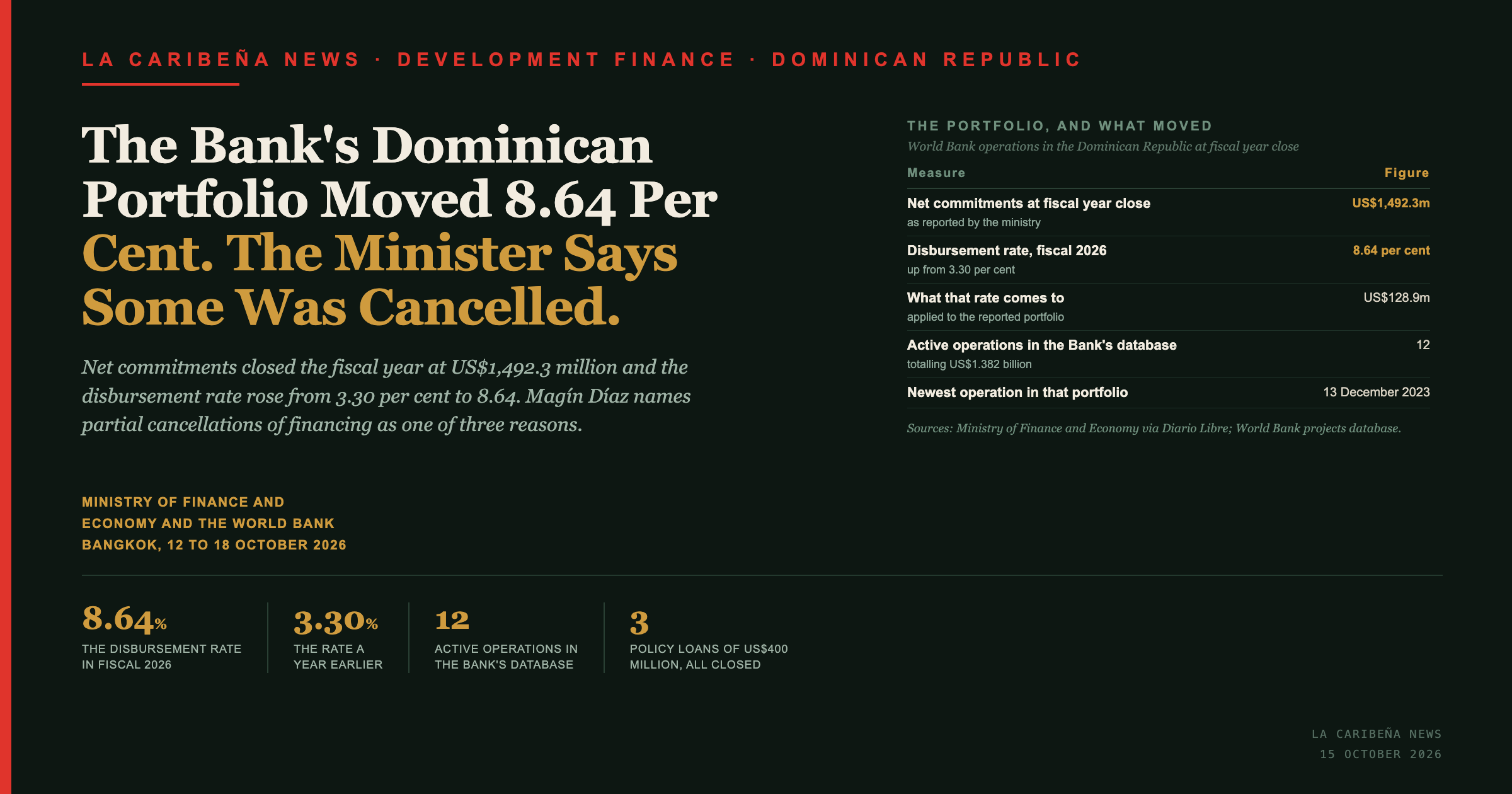
Diario Libre reported on 15 October that the World Bank portfolio in the Dominican Republic closed the fiscal year with net commitments of US$1,492.3 million, and that the disbursement rate rose from 3.30 per cent in fiscal 2025 to 8.64 per cent in 2026, an increase of 5.34 percentage points.
A disbursement rate measures money actually paid out against money committed. Applied to the portfolio the ministry reports, 8.64 per cent is US$128.9 million.
The figures come from a meeting at the Annual Meetings of the International Monetary Fund and the World Bank in Bangkok, held from 12 to 18 October and attended by finance ministers and central bank governors from the 191 member countries of both institutions. Magín Díaz, Minister of Finance and Economy, met Susana Cordeiro Guerra, the World Bank's Vice President for Latin America and the Caribbean.
What raised the rate?
Three things, according to the minister, and the third one shrinks the portfolio.
Díaz gave closer follow-up with executing units, a clean-up of the project portfolio, and partial cancellations of financing. Cordeiro Guerra noted the approval in the country of Ley 30-26 on pro-growth measures, the Plan Anticrisis.
Cancelling part of a commitment that has not been drawn reduces the amount against which disbursement is measured, and the rate rises without a dollar more leaving the Bank. Díaz did not say how much of the 5.34 points came from each of the three, and the published figures do not separate them.
What is in the portfolio?
Twelve active operations, worth less than the ministry's closing figure.
The World Bank's own project database lists twelve active projects in the Dominican Republic. Their commitments total US$1.382 billion, about US$110 million below the ministry's closing figure.
| Approved | Project | Commitment |
|---|---|---|
| 13 December 2023 | Distribution Efficiency Improvement and Utility Strengthening | US$225.0m |
| 6 December 2023 | Program to Support the Strengthening of the National Health System | US$190.0m |
| 28 November 2023 | Support for the Implementation of the Public Administration Reform | US$40.0m |
| 24 May 2023 | Integrated Social Protection Inclusion and Resilience Project | US$100.0m |
| 24 March 2023 | Water Sector Modernization Program | US$246.7m |
| 23 January 2023 | Emergency Response and Resilience Project | US$116.0m |
| 2 December 2022 | Second DRM Development Policy Loan with a Cat DDO | US$230.0m |
| 31 May 2022 | Support to the National Housing Program Project | US$100.0m |
| 4 October 2021 | Integrated Landscape Management in Watersheds | US$4.1m |
| 27 May 2021 | Water Supply and Wastewater Services Improvement Project | US$43.5m |
| 18 February 2021 | Emission Reductions Program | US$7.0m |
| 13 December 2018 | Resilient Agriculture and Integrated Water Resources Management | US$80.0m |
Source: World Bank projects database, retrieved 15 October 2026.
Water, electricity distribution, social protection and housing run through that list, and the ministry says those four areas account for close to 80 per cent of total disbursements planned for the current fiscal year.
The approval dates in that column run from December 2018 to December 2023.
Where has the large money gone?
Into three policy loans, all of which have closed.
The three biggest Dominican operations the World Bank has approved since the start of 2022 are each US$400 million, and each is a development policy loan now recorded as closed.
| Approved | Operation | Amount | Status |
|---|---|---|---|
| 7 June 2024 | Sustainable Development DPL (P500557) | US$400m | Closed |
| 26 May 2023 | Second Electricity Reform for Sustainable Growth DPL (P178570) | US$400m | Closed |
| 31 March 2022 | Electricity Reform for Sustainable Growth DPL (P175874) | US$400m | Closed |
Source: as above, filtered to operations approved since 1 January 2022.
A development policy loan pays against policy actions a government has already taken rather than against works to be built, and it closes when the money is drawn. The June 2024 loan had a closing date of 31 December 2025. An investment project pays against execution on the ground, and that is the part of the portfolio where a rate of 3.30 per cent was recorded.
Why does this matter beyond the Dominican Republic?
Because a commitment and a payment are counted differently, and governments are judged on the first.
A commitment is announced at signing. A disbursement arrives when the work is done and certified. The CARICOM Development Fund's own record on that distinction was examined in The CARICOM Fund Sponsoring a US$250 Million Bond Has Disbursed US$169 Million Since 2009.
The World Bank's latest regional update puts Caribbean growth well ahead of Latin America, as reported in The World Bank Puts Guyana at 23.7 Per Cent and the Rest of the Caribbean at 2.5, and the Bank's work in Guyana was reported in More Guyanese Are Working for Themselves.
Two of the three reasons Díaz gave add money to the numerator. One subtracts it from the denominator. The published figures do not say in what proportion.
What the title card shows
Every data point on the article's title card, in text.
- US$1,492.3 million. Net commitments in the World Bank's Dominican portfolio at fiscal year close, as reported by the Ministry of Finance and Economy.
- 8.64 per cent. The disbursement rate in fiscal 2026, up from 3.30 per cent in fiscal 2025, an increase of 5.34 percentage points.
- US$128.9 million. What 8.64 per cent of the reported portfolio comes to.
- 12 active operations. Those the World Bank's project database lists for the Dominican Republic, totalling US$1.382 billion.
- 13 December 2023. The approval date of the newest operation in that active portfolio.
- 3 policy loans of US$400 million. The largest Dominican operations approved since the start of 2022, all three recorded as closed.
Frequently Asked Questions
What is a disbursement rate?
The share of committed financing actually paid out in a period. The Dominican Republic reported 8.64 per cent in fiscal 2026, up from 3.30 per cent in fiscal 2025, an increase of 5.34 percentage points, measured against the net commitments reported at fiscal year close.
Why does cancelling financing raise a disbursement rate?
Because the rate is a ratio. Cancelling part of a commitment that has not been drawn reduces the amount against which disbursement is measured, which raises the percentage without any additional money being paid out. Minister Magín Díaz named partial cancellations as one of three reasons for the rise, alongside closer follow-up with executing units and a clean-up of the portfolio.
What is in the Dominican portfolio?
The World Bank's project database lists twelve active operations totalling US$1.382 billion, in water, electricity distribution, health, social protection, housing, public administration reform, agriculture and emission reductions. The ministry says water, electricity distribution, social protection and housing account for close to 80 per cent of disbursements planned for the current fiscal year.
What are the largest recent operations?
Three development policy loans of US$400 million each, approved in March 2022, May 2023 and June 2024. All three are recorded as closed. The newest project in the active portfolio was approved on 13 December 2023.
Where were these figures discussed?
At a meeting between the Minister of Finance and Economy and the World Bank's Vice President for Latin America and the Caribbean, held during the Annual Meetings of the International Monetary Fund and the World Bank in Bangkok from 12 to 18 October 2026.