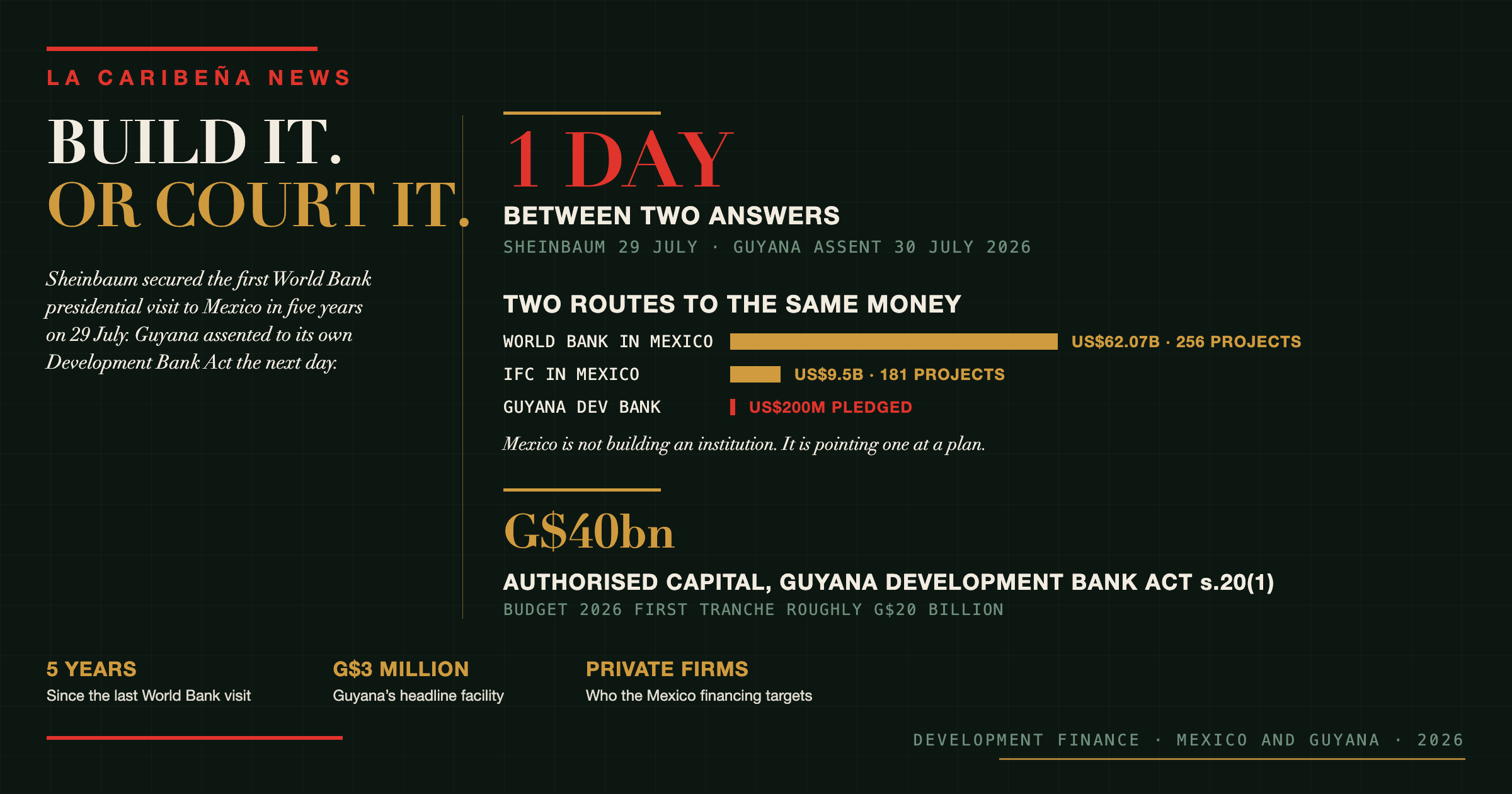
Sheinbaum secured the first World Bank presidential visit to Mexico in five years on 29 July. Guyana assented to its own Development Bank Act the next day.
BY LA CARIBEÑA NEWS
Quick summary: President Claudia Sheinbaum received World Bank Group president Ajay Banga at the National Palace on 29 July 2026, the first such visit in five years, seeking backing for Plan México. The Bank already holds about US$62 billion across 256 active projects in Mexico. Guyana's own Development Bank is pledged US$200 million.
What did Mexico actually secure?
A meeting, an expression of interest, and the beginning of a financing framework. Not yet money.
Sheinbaum received Banga and his delegation at the National Palace on Wednesday 29 July 2026, La Jornada reported. It was the first visit by a World Bank Group president to Mexico in five years. Sheinbaum said afterwards that Banga and his team had expressed interest in participating in Plan México, the government's five-year national economic strategy.
Milenio reported that the Bank's stated priorities lined up closely with the plan's: infrastructure investment, energy and water management, human capital, and long-run sustainable development. The working substance, per Infobae, is a new Framework of Alliance with Mexico and financing schemes aimed at private companies taking part in projects tied to the strategy.
What the title card shows
Every data point on the article's title card, in text.
- US$62.07 billion. World Bank IBRD commitments in Mexico across 256 active projects, as of June 2026.
- US$9.5 billion. International Finance Corporation exposure in Mexico across 181 projects, as of late July 2026.
- US$200 million. Minimum capitalisation pledged for the Guyana Development Bank. Section 20(1) of the Act sets authorised capital at G$40 billion, and the Budget 2026 first tranche is roughly G$20 billion. Source: La Caribeña News.
- 5 years. Since the last visit by a World Bank Group president to Mexico, before 29 July 2026.
- 1 day. Between the Sheinbaum meeting on 29 July and presidential assent to Guyana's Development Bank Act on 30 July. Source: La Caribeña News.
- G$3 million. The Guyana Development Bank's headline facility, at zero interest and no collateral.
Why does the scale gap matter less than it looks?
Because the interesting difference is not the size of the money. It is where the institution comes from.
Mexico is not building a development bank. It is negotiating with one that already carries roughly US$62.07 billion across 256 active IBRD projects in the country as of June 2026, with a further US$9.5 billion across 181 projects through the International Finance Corporation as of late July. The strategy is to point an existing balance sheet at a named national plan.
Guyana took the other route. The Guyana Development Bank Act 2026 received presidential assent on 30 July, the day after the Sheinbaum meeting. Section 20(1) sets authorised capital at G$40 billion, the Government has pledged a minimum capitalisation of US$200 million, and the Budget 2026 first tranche is roughly G$20 billion. The bank carries five priority sectors and a headline facility of G$3 million at zero interest with no collateral.
Both are defensible. They are simply different bets. Mexico is betting that a packaged national strategy can attract capital it does not control. Guyana is betting that an oil-funded state can build the instrument itself and keep the terms.
What does Mexico's approach require that Guyana's does not?
A strategy legible to an outside lender.
Plan México is a named, five-year, sector-mapped programme, and the Bank's interest was expressed in terms of alignment with its own priorities. That is what made the meeting possible: there was a document to align to.
Guyana's development-finance architecture is still being assembled in public. This publication has reported that the Act's commencement is left to a ministerial Order, that section 25 compels written credit policies without requiring their publication, and that the co-financing power in section 5(2)(b) carries no amount, no rate and no obligation while up to G$7 million of the borrower's stack is expected to come from commercial banks.
None of that is fatal, and it is normal for a new institution. But it is not yet the kind of packaged, quantified programme a multilateral aligns itself to. The Bank did not travel to Mexico City because Mexico is large. It travelled because there was something specific to say yes to.
Is the multilateral route open to the Caribbean?
Partly, and the private-sector element is the part worth watching.
The financing under discussion in Mexico is aimed at private companies participating in state-linked projects. That is the IFC model rather than the sovereign-lending model, and it does not require the borrower state to be large. It requires bankable projects and a credible national frame.
Guyana is attempting the same pairing domestically, stacking commercial bank money on top of a state facility. It is the same idea at a different altitude: public capital de-risking private capital. The question the Mexican meeting raises for Georgetown is whether that stacking has to stop at the commercial banks, or whether a development-finance institution could sit in the same structure.
That question is unanswered, and it is the one worth putting to the bank's board once commencement is ordered.
Frequently Asked Questions
What did Sheinbaum and the World Bank agree?
No financing was announced. Sheinbaum said the Bank expressed interest in participating in Plan México, and the parties discussed a new Framework of Alliance and financing schemes for private companies involved in projects linked to the strategy.
How much does the World Bank already have in Mexico?
Approximately US$62.07 billion across 256 active IBRD projects as of June 2026, plus about US$9.5 billion across 181 IFC projects as of late July 2026.
How large is the Guyana Development Bank by comparison?
The Act sets authorised capital at G$40 billion and the Government has pledged a minimum capitalisation of US$200 million, with a Budget 2026 first tranche of roughly G$20 billion. Its headline facility is G$3 million per borrower at zero interest with no collateral, across five priority sectors.
Why does the timing matter?
The Mexican meeting took place on 29 July 2026 and Guyana's Development Bank Act received presidential assent on 30 July, placing two different approaches to financing national strategy one day apart.
Could a Caribbean state pursue the same route?
The financing discussed in Mexico targets private companies in state-linked projects, a model that depends on bankable projects and a credible national programme rather than on the size of the borrowing state.