By LCN Business Desk
The Amur River, carrying liquefied natural gas for Puerto Rico's electricity grid, was authorised to enter San Juan Bay on Monday 12 October, with harbour pilots setting 11:30 a.m. for the manoeuvre. It had been offshore since mid-September. Scheduled entries on 4 and 5 October were cancelled.
In Puerto Rico the delay has been reported as a payment dispute, and it is one. But the supplier is a Nasdaq-listed company, and what it has told its investors sits alongside that story rather than inside it.
What is the dispute about?
Money the utility has been ordered not to pay.
New Fortress Energy supplies gas to the Puerto Rico Electric Power Authority, known locally as the AEE. On 30 September the Puerto Rico Energy Bureau issued a resolution and order directing PREPA to halt payment to the company. Puerto Rican outlets including El Nuevo Día and Metro have put the contested sums at about US$92.2 million, comprising roughly US$74.5 million for nomination excesses and US$17.6 million for substitute fuel, pending evaluation by the utility.
New Fortress has said it will not resume deliveries until the Bureau reverses its directive and the utility provides payment guarantees. LCN has not read the Bureau's order and relies on Puerto Rican reporting for its contents.
The vessel's clearance came in stages. The US Coast Guard authorised entry on 11 October; US Customs and Border Protection followed on the 12th.
What did the company tell the SEC?
That its production unit had broken down.
On 5 October, the same weekend the tanker's entries were being cancelled, New Fortress Energy furnished a current report on Form 8-K under Item 8.01. The disclosure is three sentences long:
"New Fortress Energy Inc. today announced that the Company's Fast LNG unit is offline, following a mechanical issue with the facility's gas turbine. NFE is actively working with the manufacturer of the turbine to return the FLNG unit to operation as soon as possible. The Company expects the Fast LNG unit to return to service during the fourth quarter."
That filing does not mention Puerto Rico, PREPA, San Juan or the Amur River. It names a mechanical failure and a quarter, and nothing about which market is affected.
Its forward-looking statement does list what could go wrong, and the list is specific: the company's "ability to source replacement liquified natural gas on the spot market, if necessary, or at commercially feasible prices", "potential nonpayment or nonperformance of obligations under existing contracts", and "potential challenges with commercial counterparties".
Two things are therefore on the record for the same week. A commercial and regulatory standoff over payment, reported in Puerto Rico. And a production outage at the company's own liquefaction unit, reported to the SEC. Nothing published connects them, and this article does not.
How exposed is the company to Puerto Rico?
Substantially, on its own account.
New Fortress Energy's quarterly report for the three months to 30 June 2026 names Puerto Rico 29 times and PREPA 24. Its risk factors are explicit about the concentration:
"Our current results of operations and liquidity are, and will continue to be in the near future, substantially dependent upon a limited number of customers, including CFE and PREPA, which have each entered into long-term GSAs."
CFE is Mexico's state power utility. PREPA is the other half of that pair.
The San Juan Facility, operational since the third quarter of 2020, is described in the filing as a landed micro-fuel handling facility in the Port of San Juan that "serves as our supply hub for the PREPA San Juan Power Plant and industrial end-user customers in Puerto Rico." In December 2025 the company was awarded a new seven-year gas supply agreement with the utility.
What does the filing say about getting paid?
That the customer is bankrupt and hard to enforce against.
The 10-Q states the position without softening it:
"PREPA is currently subject to bankruptcy proceedings pending in the U.S. District Court for the District of Puerto Rico. As a result, PREPA's ability to meet its payment obligations under its contracts will be largely dependent upon funding from federal sources."
And on remedies:
"Although these contracts require payment and performance of certain obligations, we remain subject to the statutory limitations on enforcement of those contractual provisions that protect these governmental entities."
The company also tells investors it supplies "customers that have sub-investment grade credit ratings."
So the commercial structure was described to the market before this autumn's events: a seven-year supply agreement, signed last December, with a bankrupt counterparty whose capacity to pay depends on federal money, and against whom the supplier's contractual remedies are limited by statute. A standoff over payment guarantees is the foreseeable shape of that arrangement under strain, and the filing says as much in the language of risk.
One absence is worth noting. The phrase "Energy Bureau" does not appear in the 10-Q at all. The regulator that would later order the utility to stop paying is not named in the company's most recent quarterly description of its Puerto Rico business.
Why does this matter beyond Puerto Rico?
Because the arrangement is not unusual in the region, and the leverage runs one way.
A Caribbean utility with weak credit contracts with a single foreign supplier for the fuel its grid runs on. When a dispute arises, the supplier can hold a cargo offshore. The utility cannot hold anything. Its regulator can order it not to pay, which protects ratepayers from a contested bill and simultaneously removes the thing the supplier wants.
Guyana is building a gas-to-power project partly to escape that structure, a project the IMF endorsed in the review LCN reported on 11 October. The CARICOM states that pooled their effort behind a US$250 million sustainability bond this month listed resilient infrastructure and energy among its eligible uses.
The Amur River is expected alongside today. The seven-year agreement runs to 2032.
What the title card shows
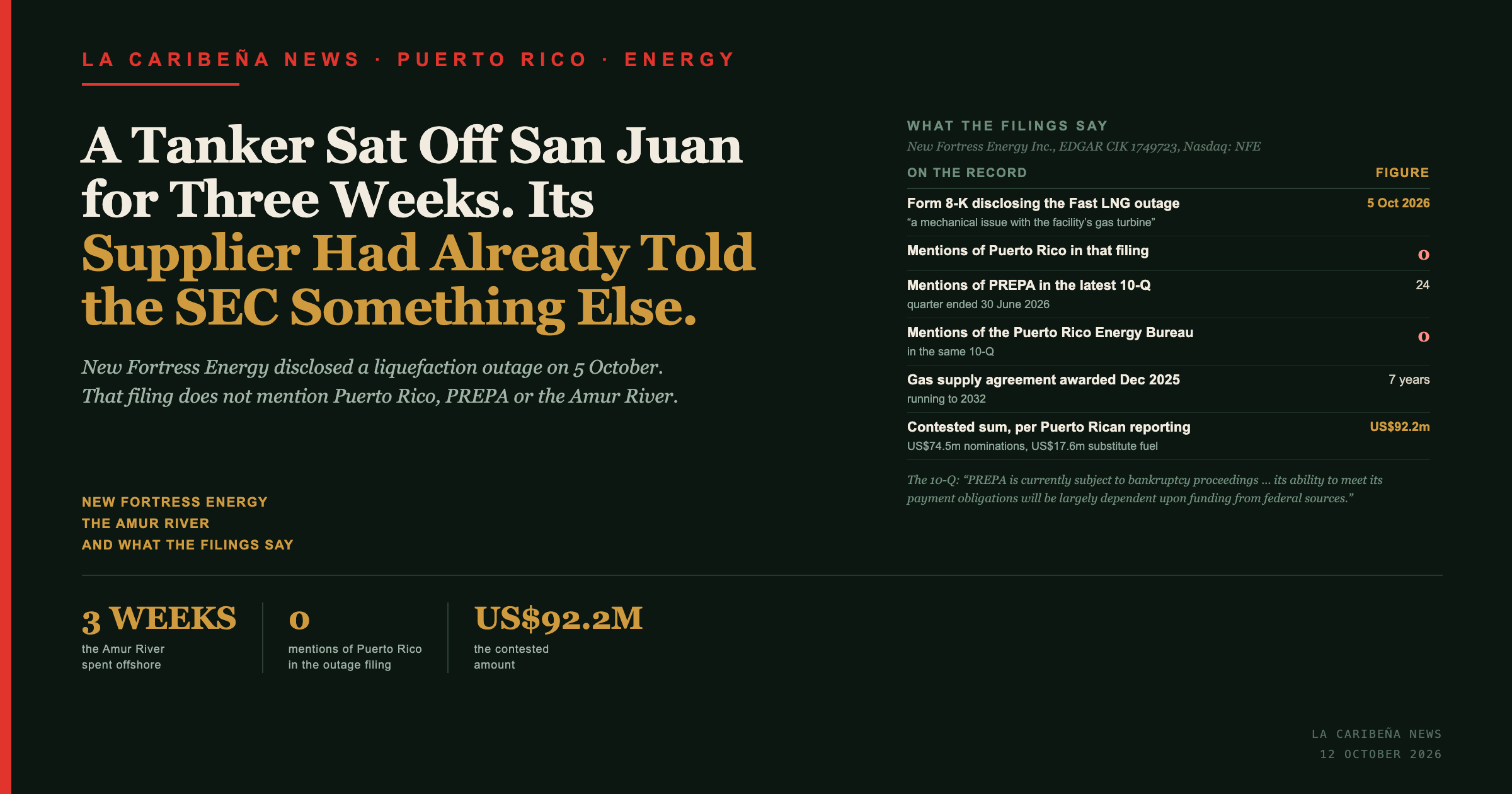
The card sets the headline against a panel drawn from New Fortress Energy's filings with the United States Securities and Exchange Commission and from Puerto Rican reporting, each row marked to its source. It gives the date of the Form 8-K disclosing the Fast LNG outage, 5 October 2026; the number of times that filing mentions Puerto Rico, which is zero; the number of times the company's most recent quarterly report mentions PREPA, which is 24; the length of the gas supply agreement awarded in December 2025, seven years; the contested sum reported in Puerto Rico, about US$92.2 million; and the number of times the quarterly report names the Puerto Rico Energy Bureau, which is zero.
Three figures run along the foot of the card: 3 WEEKS, the time the Amur River spent offshore; 0, the mentions of Puerto Rico in the outage filing; and US$92.2M, the contested amount. The flag block reads NEW FORTRESS ENERGY, THE AMUR RIVER, AND WHAT THE FILINGS SAY.
Frequently Asked Questions
Why was the Amur River held offshore from San Juan?
Entries scheduled for 4 and 5 October were cancelled amid a dispute over payment between New Fortress Energy and Puerto Rico's power utility, following a Puerto Rico Energy Bureau order of 30 September directing the utility to halt payment. The US Coast Guard cleared entry on 11 October and Customs and Border Protection on 12 October.
How much money is in dispute?
Puerto Rican outlets report about US$92.2 million, comprising roughly US$74.5 million for nomination excesses and US$17.6 million for substitute fuel. LCN has not read the Energy Bureau's order and does not independently verify those figures.
What did New Fortress Energy tell the SEC?
On 5 October it furnished a Form 8-K stating that its Fast LNG unit was offline following a mechanical issue with the facility's gas turbine, and that it expected the unit back in service during the fourth quarter. The filing does not mention Puerto Rico, PREPA, San Juan or the Amur River.
Is PREPA bankrupt?
New Fortress Energy's quarterly report states that PREPA is subject to bankruptcy proceedings pending in the US District Court for the District of Puerto Rico, and that its ability to meet payment obligations "will be largely dependent upon funding from federal sources."
How long does the supply contract run?
The company's quarterly report records that in December 2025 it was awarded a new seven-year gas supply agreement with PREPA, which would run to 2032.