By LCN Business Desk
A Caribbean government that contracts out its electricity grid finds out what leaving costs only when it tries to leave.
LUMA Energy, which operates transmission and distribution for the Puerto Rico Electric Power Authority, filed a 65-page opposition brief with the Supreme Court of Puerto Rico on 5 October. Its central number is that annulling the extension of its supplementary contract, and the termination of the transmission and distribution operating agreement that would follow, would impose approximately US$1.3 billion in quantifiable costs.
President and Chief Executive Janisse Quiñones put it in the brief, as reported by the San Juan Daily Star: "If these circumstances persist and the Extension is declared null and void, these costs would be borne by the people of Puerto Rico through higher rates."
The following day the Governor rejected it outright.
What exactly does LUMA say it would cost?
Five components, and they are published.
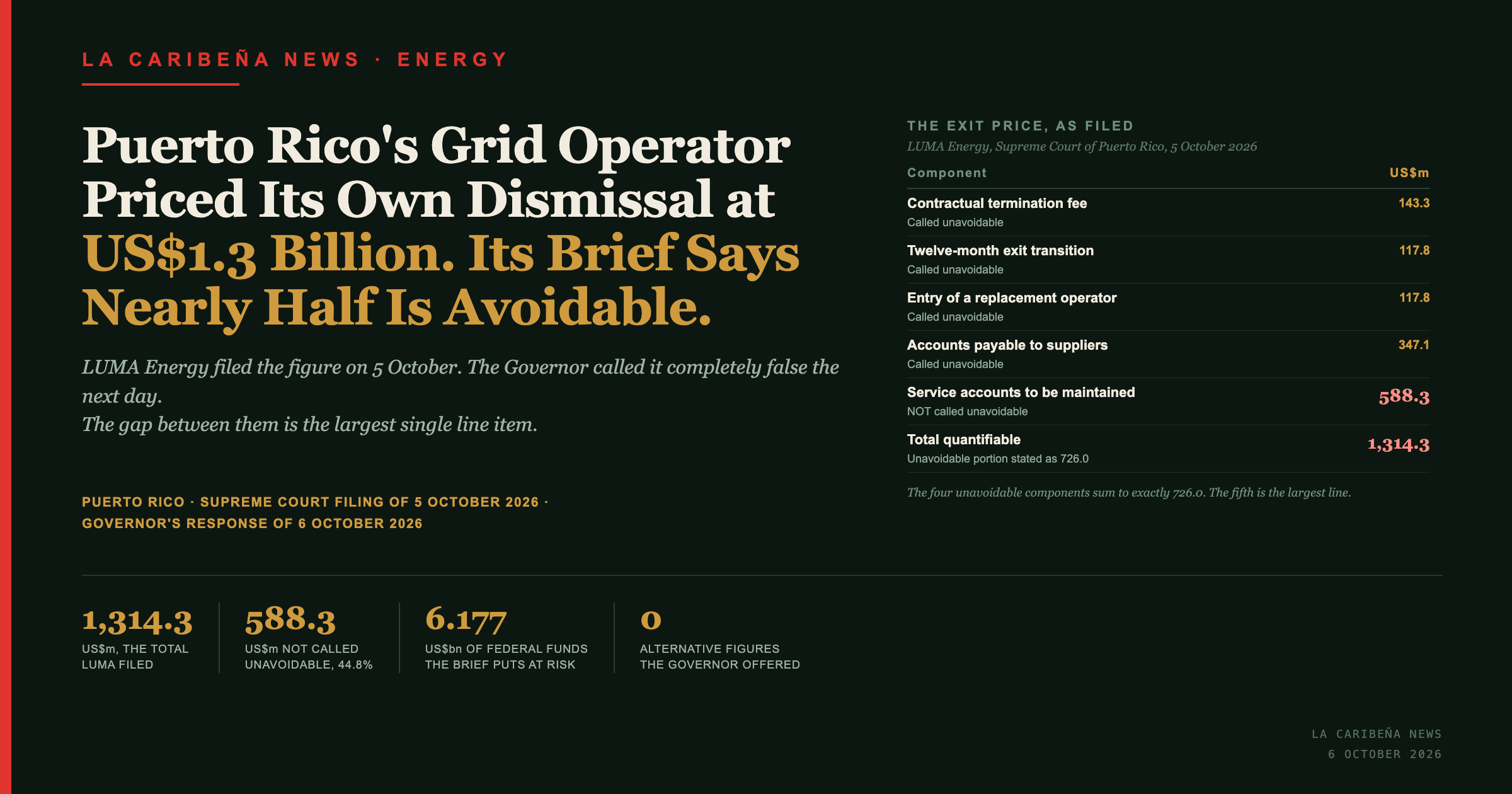
| Component | US$ million |
|---|---|
| Contractual termination fee | 143.3 |
| Twelve-month exit transition | 117.8 |
| Entry of a replacement operator | 117.8 |
| Service accounts the Authority would have to maintain | 588.3 |
| Accounts payable to suppliers | 347.1 |
| Total quantifiable | 1,314.3 |
LUMA states that at least US$726 million of that is unavoidable, being the termination fee, the exit transition, the entry transition and the supplier accounts. Those four add to exactly 726.0.
Which leaves the fifth. The service accounts the Authority would have to maintain, at US$588.3 million, are the single largest line in the total and the only one LUMA does not place in its unavoidable column. That is 44.8 per cent of the headline figure, and on the company's own arithmetic it is avoidable.
Alongside the US$1.3 billion, the brief says US$6.177 billion of obligated federal funds would be put at risk, that the Authority could face claims to repay around US$2.2 billion already invested in projects, that some 4,000 direct jobs are involved, and that 1.5 million customers are served.
What does the Governor say?
That the number is invented, and has been for two years.
Speaking to reporters on Tuesday 6 October, Jenniffer González Colón said she categorically rejected the statements LUMA made in its brief and believed them to be completely false, and that the company had been inflating and changing those numbers for two years. Her words in the original were "completamente falsas".
She offered no alternative figure.
The government's legal argument is procedural rather than arithmetical. Its position is that LUMA extended the contract by letter, without a formal amendment and without the approval of the legislature. The case consolidates challenges brought by the government and the Public-Private Partnerships Authority seeking to invalidate that extension.
LUMA's own statement on the filing, issued on 5 October and attributed to its principal legal officer Ángel Rotger Sabat rather than to its chief executive, answers that directly: "Contrario a lo que alegan las Peticionarias, la Extensión no se hizo para beneficiar a LUMA." Contrary to what the petitioners allege, the extension was not made to benefit LUMA.
Why does an exit price in San Juan matter elsewhere in the region?
Because the contracts are being signed across it, and the exit is not priced when they are.
La Caribeña News set Puerto Rico's grid beside Guyana's in September. The chairman of the Puerto Rico Energy Bureau, Edison Avilés, described a system suspended between two realities, building a future network while depending on infrastructure that is vulnerable, outdated and operationally strained. Guyana, meanwhile, rents 96 megawatts from two floating power plants at 9.5 United States cents a kilowatt hour, a price that covers the rental only, with the state buying the fuel separately at a further 8.8 to 10.5 cents.
Those are entry prices. The Puerto Rico filing is the first public exit price in the region at this scale, and the two parties to the same contract cannot agree it within a billion dollars.
What has actually been established?
Nothing yet. Both figures are positions.
The US$1.3 billion is a contractor's estimate, filed by that contractor, in its own defence, in litigation it is a party to. The Governor's rejection is a government's characterisation, offered to reporters, without a competing calculation attached. The Supreme Court of Puerto Rico has not ruled.
What can be read today is the structure of the claim rather than its truth. The components are itemised, the four LUMA calls unavoidable sum exactly to the US$726 million it states, and the one it does not is the largest.
What the title card shows
US$1,314.3 million: the total quantifiable cost LUMA Energy filed with the Supreme Court of Puerto Rico on 5 October 2026, being US$143.3 million in contractual termination fees, US$117.8 million for a twelve-month exit transition, US$117.8 million for the entry of a replacement operator, US$588.3 million in service accounts the Puerto Rico Electric Power Authority would have to maintain, and US$347.1 million in accounts payable to suppliers. US$726 million: the portion LUMA states is unavoidable, being the first, second, third and fifth of those components, which sum to exactly that figure. US$588.3 million: the remaining component, 44.8 per cent of the total and the only one not placed in the unavoidable column. US$6.177 billion: obligated federal funds the brief says would be put at risk. US$2.2 billion: already invested in projects, which the brief says the Authority could face claims to repay. 4,000: direct jobs cited. 1.5 million: customers served. 6 October 2026: the date Governor Jenniffer González Colón called the estimate completely false, without offering an alternative figure.
Frequently Asked Questions
What is the US$1.3 billion figure?
It is LUMA Energy's own estimate, filed with the Supreme Court of Puerto Rico on 5 October 2026, of the quantifiable cost of annulling the extension of its supplementary contract and terminating the transmission and distribution operating agreement.
How much of it does LUMA say cannot be avoided?
At least US$726 million, being the contractual termination fee, the twelve-month exit transition, the entry of a replacement operator and accounts payable to suppliers. Those four components sum to exactly 726.0.
What is the remaining US$588.3 million?
Service accounts the Puerto Rico Electric Power Authority would have to maintain. It is the largest single line in the total, 44.8 per cent of it, and the only component LUMA does not describe as unavoidable.
What does the Governor of Puerto Rico say?
Jenniffer González Colón said on 6 October 2026 that she categorically rejected LUMA's statements and believed them completely false, and that the company had been inflating and changing the numbers for two years. She offered no alternative figure.
Has any of this been decided?
No. The Supreme Court of Puerto Rico has not ruled. The US$1.3 billion is a party's filing in its own defence and the rejection is a government's characterisation without a competing calculation.