By LCN Business Desk
A former Minister of Finance said this month that the Government will eventually face a politically painful decision on sugar. That decision has an economic part and a political part, and only the first of them appears in the accounts.
Two public documents answer the economic part between them: the Ministry of Finance's Mid-Year Report 2026 for what sugar costs the State, and the Bank of Guyana's Annual Report 2025 for what it earns.
How much is Guyana spending on sugar this year?
G$16.4 billion, and none of the increase went to capital.
Budget 2026 allocated G$13.4 billion to GuySuCo for mechanisation, factory upgrades and value-added production. A supplementary paper laid in September added G$3 billion.
The Mid-Year Report 2026, laid by Senior Minister in the Office of the President with responsibility for Finance Dr Ashni Singh, shows where it landed. Appendix E11 puts current transfers to GuySuCo at G$8.4 billion as budgeted and G$11.4 billion as revised, while capital contributions stand at G$5 billion in both columns, unchanged.
G$8.4 billion is the figure most often quoted, and it is the subvention: the current-expenditure line on its own, excluding the G$5 billion capital contribution. The report's narrative states the whole of it in terms: Government spent "$8.9 billion of the $13.4 billion budgeted in 2026 for the operations and resuscitation of the sugar estates."
The appendix sums to the same.
Both lines sit inside the Ministry's own total expenditure and net lending. Whatever the estates return, the accounts treat the money as spending in the year it goes out.
| GuySuCo, G$ billions | 2025 actual | 2026 budget | 2026 half-year | 2026 revised |
|---|---|---|---|---|
| Current transfers | 5.90 | 8.40 | 7.81 | 11.40 |
| Capital contributions | 7.40 | 5.00 | 1.12 | 5.00 |
| Total | 13.30 | 13.40 | 8.93 | 16.40 |
Is G$16.4 billion a strain on the national budget?
On the national accounts' own measure, no.
Total expenditure and net lending for 2026 is revised to G$1.574 trillion in the same appendix. GuySuCo's G$16.4 billion is 1.04 per cent of it.
Total national expenditure in 2025 was G$1.312 trillion. The revised 2026 figure is G$262 billion higher. National spending grew, in a single year, by about sixteen times the entire sugar allocation. Sugar is not what moves Guyana's fiscal position. The overall balance after grants showed a deficit of G$105.6 billion at the end of June, six times the full-year sugar figure, driven by a public investment programme of a different order of magnitude.
Nor is the money mostly a transfer to a balance sheet. Minister of Agriculture Zulfikar Mustapha said in February that 81 per cent of the G$8.4 billion subvention would go to wages and salaries, with 8 per cent for fuel, 5 per cent for contractors, 4 per cent for materials and supplies and 2 per cent for lubricants.
The sugar subvention is, in the main, a payroll, which is a different object from a capital rescue and behaves differently when it is withdrawn.
How much does Guyana earn from sugar?
US$18.1 million in 2025, about G$3.8 billion, and less in each of the last two years.
The Bank of Guyana Annual Report 2025 gives it in Table VII, Exports of Major Commodities. Sugar export earnings were US$24.9 million in 2023, US$19.4 million in 2024 and US$18.1 million in 2025, a fall of 6.4 per cent on the year. At the official mid-rate, which held at G$208.50 across both years, US$18.1 million is G$3.77 billion.
| 2023 | 2024 | 2025 | 2026 | |
|---|---|---|---|---|
| Cost to the State, G$ billions | 13.30 | 16.40 revised | ||
| Sugar produced, tonnes | 47,103 | 59,600 | 70,401 target | |
| Sugar exported, tonnes | 35,227 | 25,848 | 34,237 | |
| Export earnings, US$ millions | 24.9 | 19.4 | 18.1 | |
| Average export price, US$ a tonne | 749.41 | 529.37 |
Blank cells are figures the two reports do not publish.
Guyana is spending more on sugar, producing more of it, and earning less from it.
In 2025, the State spent G$13.30 billion and sugar exports earned US$18.1 million, about G$3.77 billion. The State spent 3.5 times what sugar earned abroad. In 2024 it spent G$15.51 billion against export earnings of US$19.4 million, or about G$4.05 billion, a ratio of 3.8 times.
The latest figures on each side, the 2026 cost and the 2025 earnings, fall in different years and should not be read as a single-year ratio.
Table VII counts exports. Sugar sold inside Guyana is additional to it, and the industry's total revenue is therefore higher than US$18.1 million by an amount that is not published in that table.
How much higher matters, because of what the subvention is meant to cover. Mustapha put GuySuCo's total wages and salaries bill at approximately G$20 billion, larger than the whole of what the State is spending on the corporation this year. The G$8.4 billion subvention was to meet 81 per cent of it, about G$6.8 billion. "The remainder will be covered by revenue generated from the sale of sugar and molasses," he said. That leaves roughly G$13.2 billion to be found from sales, against export earnings of G$3.77 billion. The difference would have to come from domestic sugar and from molasses, neither of which appears in the Bank of Guyana's export table.
Why did earnings fall while production rose?
Because the price fell faster than the output grew.
The Bank of Guyana records sugar production rising from 47,103 tonnes in 2024 to 59,600 tonnes in 2025, a gain of 26.5 per cent, which it attributes to "better field management and incremental gains in factory efficiency" while noting that growth "remained constrained by longstanding structural challenges within the industry". Export volume rose further still, by 32.5 per cent, from 25,848 tonnes to 34,237 tonnes.
And earnings fell. The average export price dropped 29.4 per cent, to US$529.37 a tonne from US$749.41 at the end of 2024.
The estates produced more, shipped more, and were paid less for it. That is not a productivity failure, and it is not fixed by a cane unloader or a better crop. It is a price problem.
Was the European price really what kept sugar going?
The preference that carried the industry is being withdrawn in stages.
Caribbean raw sugar entered the European Union duty-free while Brazil's paid EUR 98 a tonne. That differential was the whole of the region's commercial edge, and it is being removed in tranches under the EU-Mercosur interim agreement that entered provisional application on 1 May 2026. By 24 July the European Commission had allocated 10,000 tonnes to Brazil at zero duty.
That fall came in the year the preference began to close. Guyana's sugar went elsewhere: in 2025 the United States took 37.7 per cent of it and the CARICOM region took 36.0 per cent, up from 28.7 per cent the year before, in a regional market where agriculture ministers have been asking the region to buy Caribbean produce.
An industry built on a price advantage loses its economics when the advantage goes, whatever is done inside the factory gate.
Who is calling for closure, and what is that record?
Winston Jordan, who was Finance Minister when four estates closed.
The former Minister of Finance told the programme Sources on Sunday, reported by Kaieteur News on 5 October, that the Government may eventually have to take the politically painful decision to close the sugar industry, and that billions continue to go in while it remains uncompetitive. His formulation of the structural point was direct: "In the case of sugar, it was the European price that kept sugar going. Without the European price, we should have been out of the business of sugar a long time ago."
He had put the same case a month earlier. On 6 September, speaking as the G$3 billion came before the National Assembly, he called it "a complete waste of money" and said the industry "doesn't have any coming back, no matter what". On scale he was blunter still: "The days of sugar producing 300,000 tonnes are over, gone." Production in 2025 was 59,600 tonnes. The revised target for this year is 70,401.
He put spending since 2020 at nearly G$50 billion. The Ministry's own appendix does not contradict the scale of it: G$15.5 billion was spent in 2024 alone, G$13.3 billion in 2025, and G$16.4 billion is now revised for 2026. He also noted that an industry his government found "completely bankrupt" received a G$12 billion emergency injection between May and December 2015, which was his own administration's first eight months in office.
The closures followed. Wales closed at the end of 2016, and East Demerara at Enmore, Rose Hall and Skeldon at the end of 2017, under the administration in which he served as Finance Minister. Reporting at the time and since has put the job losses at about 7,000, with just over 3,000 in Region Six and roughly 1,830 at Skeldon alone. Those counts come from secondary and in several cases partisan sources; the closures themselves are a matter of record. The administration that took office in 2020 has been reopening and funding estates since.
The sugar item was among the larger in that supplementary, which totalled G$54.8 billion. Sugar was about five and a half per cent of it.
Both of the published performance claims come from interested parties. A Parliamentary Opposition figure put GuySuCo's production cost at 154 per cent above its selling price in February. The Minister of Agriculture said in the same month that the corporation was on track for a 2030 turnaround to profitability. Neither is a neutral measure. Neither the Mid-Year Report nor the Bank of Guyana publishes a unit cost of production.
Guyana is not alone in the position. Suriname pays its national airline up to US$2.2 million a month while its last approved accounts date from years earlier. Trinidad and Tobago's Caribbean Airlines told its annual general meeting in September that it had cleared three more years of an inherited nine-year audit backlog, leaving six still outstanding. Its 2016 accounts, released earlier this year, showed an accumulated deficit of TT$2.17 billion.
A state carrying a loss-making enterprise is a regional pattern. What separates the cases is the reporting, and Guyana's sugar figures are published twice a year.
What is actually being installed in the estates?
Milling and extraction equipment, in the second half of this year.
The report commits to a cane unloader at Albion Estate to give a consistent flow of billet canes from trucks for milling, with construction of a new feeder table to commence. A reverse rotation knife is to be installed at Rose Hall to increase juice extraction, and two turbo filters are to be acquired for Albion and Blairmont to improve the purity of the sugar produced. Field operations saw 696 hectares converted in the review period.
The first crop yielded 19,031 tonnes, with output hampered by heavy rainfall affecting harvesting and factory operations, the same weather exposure that cut Guyana's rice crop by 37 per cent in the last comparable El Nino, and "compounded by labour shortages, and poor cane quality". The first crop is the smaller of the two. The full-year target has been revised to 70,401 tonnes, with the sugar growing subsector already up 19.3 per cent on the first half of last year, against an economy whose overall real growth is now projected at 20.8 per cent while the forecast for everything except oil was cut to 10.2 per cent.
Every one of those interventions raises yield or purity. None of them raises the price. In 2025 more sugar earned less money.
What the title card shows
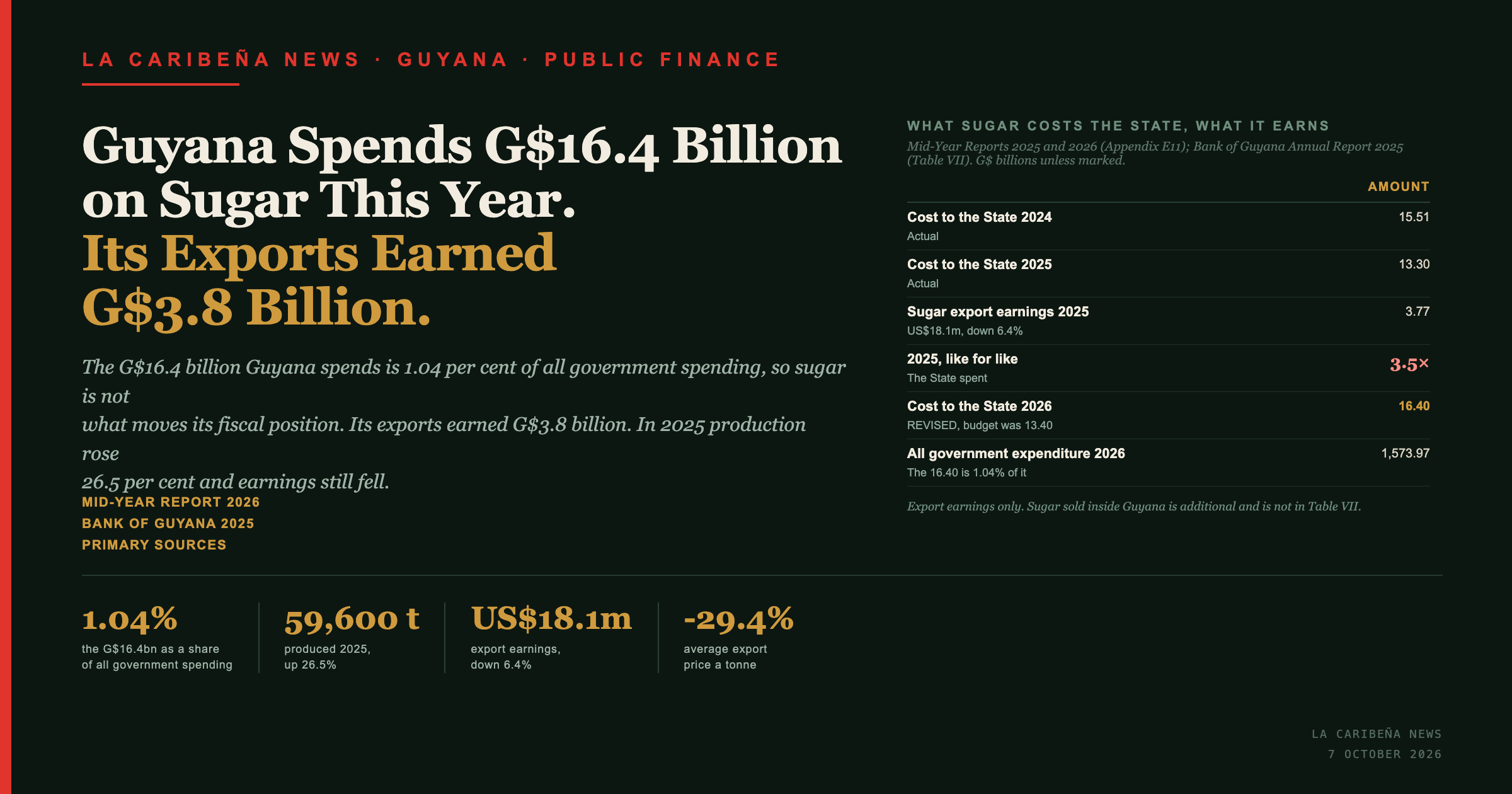
Every data point on the article's title card, in text.
Cost figures from the Ministry of Finance, Guyana, Mid-Year Report 2026, Appendix E11, Central Government Summary of Expenditures, lines 4.1.2, 4.1.3.1 and 1.0. Export, price and production figures from the Bank of Guyana Annual Report 2025, Table VII, Exports of Major Commodities, and the Sugar section. Conversions at the official mid-rate of G$208.50, which held across both years.
* G$16.40 billion. What the State spends on GuySuCo in 2026, revised, being G$11.40 billion in current transfers plus G$5.00 billion in capital. The budgeted total was G$13.40 billion. * G$13.30 billion. What the State spent on GuySuCo in 2025, actual. The 2024 figure was G$15.51 billion. * G$4.05 billion. Sugar export earnings in 2024, being US$19.4 million. * G$3.77 billion. Sugar export earnings in 2025, being US$18.1 million. * 3.5 times. What the State spent in 2025 divided by 2025 sugar export earnings. The equivalent 2024 ratio is 3.8 times. Calculated from the figures above. * 1.04 per cent. The G$16.40 billion as a share of revised total expenditure and net lending of G$1,573.97 billion. * US$18.1 million. Sugar export earnings in 2025, down 6.4 per cent on 2024. * 59,600 tonnes. Sugar produced in 2025, up 26.5 per cent from 47,103 tonnes in 2024. * Minus 29.4 per cent. The fall in the average export price, to US$529.37 a tonne from US$749.41 at end-December 2024.
Correction
This report originally gave G$13.30 billion as the 2024 outturn and G$1.312 trillion as 2024 national expenditure, and put the spending-to-exports ratio at 3.3 times, following the column headed "2024 ACTUAL" in Appendix E11 of the Mid-Year Report 2026. That column carries 2025 figures. The Mid-Year Report 2025 gives GuySuCo's 2024 current transfer as G$10,289,812,000 against the 2026 report's G$5,904,000,000, and across 29 comparable lines of the appendix the column matches the 2025 revised estimates and the 2024 actuals on none. The 2026 Budget Speech states that "in 2025, $13.3 billion was spent in the sector". The figures above are now given as 2025, with the 2024 outturn of G$15.51 billion shown alongside. Corrected 7 October 2026. The six-year series is set out in a separate report.
Frequently Asked Questions
How much does Guyana spend on GuySuCo in 2026?
G$16.4 billion on the Ministry of Finance's revised estimate, made up of G$11.4 billion in current transfers and G$5 billion in capital contributions. The originally budgeted total was G$13.4 billion. G$8.93 billion of it had been spent by the end of June.
How much does Guyana earn from sugar?
Sugar export earnings were US$18.1 million in 2025, about G$3.77 billion, down 6.4 per cent on 2024's US$19.4 million and down from US$24.9 million in 2023. Those are export earnings only; sugar sold inside Guyana is additional and is not in that table.
Why do some reports say G$8.4 billion?
Because G$8.4 billion is the budgeted current-expenditure line on its own. It excludes the G$5 billion capital contribution, and it predates the revision to G$11.4 billion. Anyone citing G$8.4 billion as the 2026 subsidy is quoting one component of it.
Is the sugar subsidy a significant burden on Guyana's economy?
Not on the scale of the national accounts. At G$16.4 billion against revised total national expenditure of G$1.574 trillion it is 1.04 per cent, and national spending grew by about sixteen times that amount in a single year. The pressure the figures do show is inside the industry, where in 2025 the State spent 3.5 times what sugar earned in export markets.
Is GuySuCo producing more sugar?
Yes. Production rose 26.5 per cent in 2025, from 47,103 tonnes to 59,600 tonnes, and export volume rose 32.5 per cent. Export earnings still fell, because the average export price dropped 29.4 per cent in the same period.