By LCN Business Desk
Two neighbours in the Caribbean Community have stopped each other's farm produce at the border inside a week.
Guyana went first. Minister of Agriculture Zulfikar Mustapha said on 30 September that Guyana had stopped importing bananas from Suriname because Guyanese farmers grow enough to meet domestic demand. The policy is stated plainly: when local farmers produce enough of a given fruit, imports of it must be restricted to protect home production. He added that informal complaints about Surinamese bananas had reached him, though officially no such imports were taking place.
Five days later, 282 big bags of parboiled rice from Guyana, just over 385,000 kilograms, were seized in Paramaribo.
Who actually seized the rice?
Customs did, and the minister who announced a seizure was refused permission for his own.
Suriname's Customs service took the consignment on Monday at 18:37, under the order of the Inspector of Import Rights and Excises, Starnieuws reported. The rice had arrived aboard the MV Falk, consigned to the rice mill of Bhagwatpersad Ramadhin in Nickerie, Suriname's own rice-growing district.
Minister of Economic Affairs, Entrepreneurship and Technological Innovation Andrew Baasaron had announced a seizure by his own inspectors. It did not happen that way. Inspectors of Economic Affairs did not receive permission from the Public Prosecutor to seize, so the economic control route closed and the customs route opened instead.
Baasaron has said of the earlier release of part of the cargo, "De Douane heeft vrijgegeven. En dat is fout gegaan." Customs released it, and that went wrong. He is seeking action against the officers involved.
What does the State say was missing?
Not a certificate from Guyana. An approval from Suriname.
The shipment carried a phytosanitary certificate issued in Guyana. Suriname requires more than that: an importer must apply in advance to the National Plant Protection Organisation, which sits inside the Ministry of Agriculture, Livestock and Fisheries. The authorities say that prior application was not made. Ramadhin disputes the State's case and has put it before a judge.
Separately, rice sits on Suriname's negative list, which means it cannot be imported without a licence from Economic Affairs. That is an economic control on volume rather than a check on plant health, and it is decided by a different ministry.
So the exporting state's health certificate is not in dispute. Whether the importing state's two approvals were obtained is the question before the court.
What has the court decided?
Nothing yet.
Ramadhin has sued the State and the agriculture ministry in summary proceedings, asking that the consignment be inspected, that permission follow if no phytosanitary risk is found, and that the State be barred from returning the rice to Guyana or destroying it. The State's position is that he holds no import licence and that rice is on the negative list.
The judge has not ruled.
How does this sit with the Treaty?
The Treaty provides for goods to move, and it also provides exceptions.
Under the Revised Treaty of Chaguaramas, Community treatment means access for goods of Community origin to the markets of member states without import duties or quantitative restrictions, and member states shall not introduce new restrictions on Community-origin imports save as the Treaty otherwise provides. Quantitative restrictions are dealt with at Article 91.
Guyanese rice and Surinamese bananas are both Community-origin produce. A negative list requiring an import licence is a restriction on one. A halt to imports declared in order to protect domestic growers is a restriction on the other, and Guyana's agriculture minister described it in exactly those terms.
Neither measure has been tested. The only case before a judge was brought by an importer against his own government, not by either state against the other, and not by the Community.
What had CARICOM asked for that week?
That its members trade more food with one another.
On 30 September this newspaper reported that CARICOM's agriculture ministers had asked the region to buy Caribbean produce as Caribbean Week of Agriculture closed. Guyana's banana decision was reported the same day.
Guyana's rice crop is the region's largest, and this newspaper reported in September on the risk a strong El Niño poses to the harvests that feed the Caribbean market, alongside the regional food prices against which every one of these decisions is taken.
What the title card shows
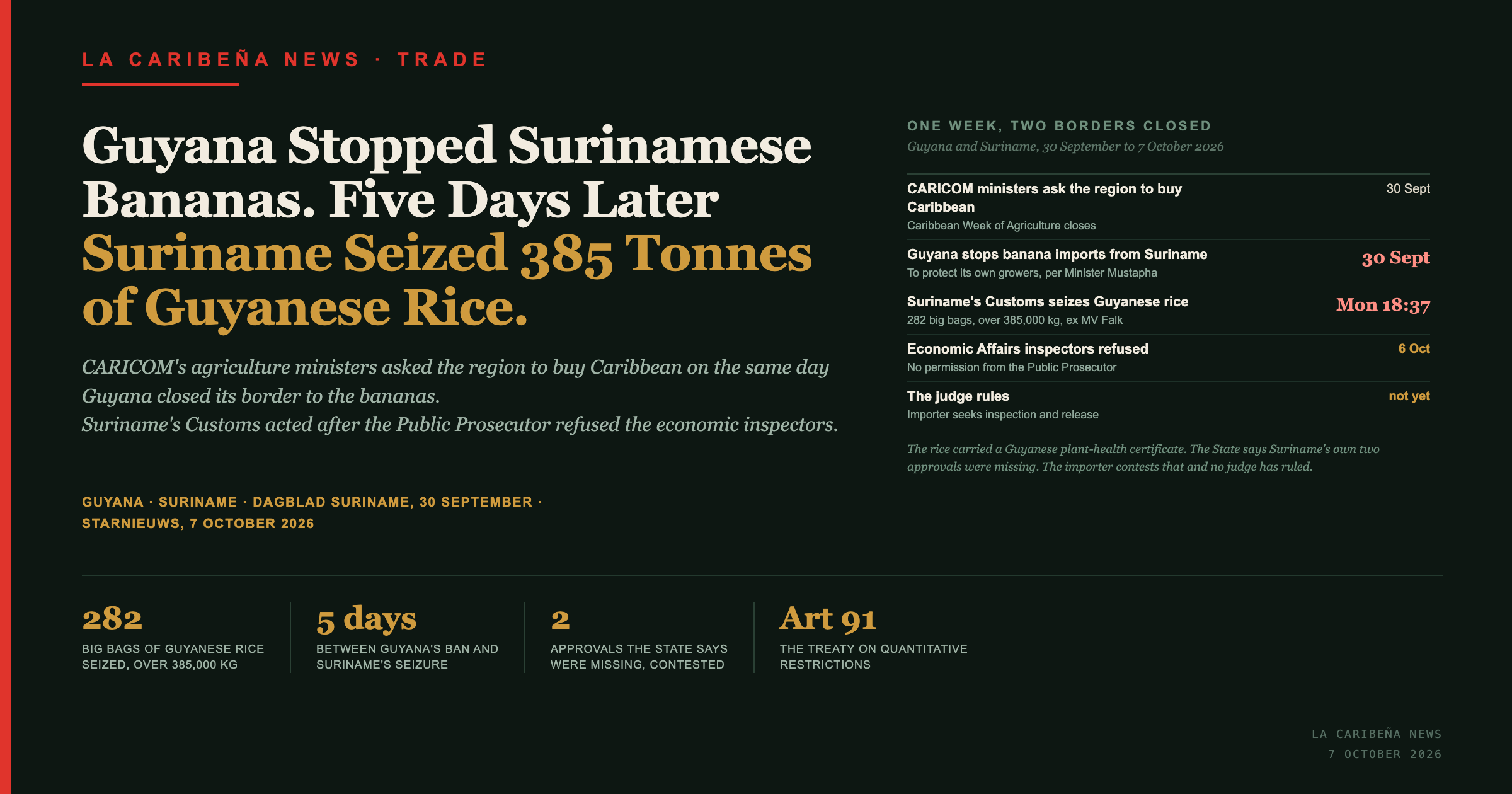
30 September 2026: the date Guyana's Minister of Agriculture Zulfikar Mustapha said banana imports from Suriname had been stopped, reported by Dagblad Suriname, and the date La Caribeña News reported CARICOM's agriculture ministers asking the region to buy Caribbean produce. 282 big bags: the parboiled rice from Guyana seized in Suriname, just over 385,000 kilograms. 18:37 on Monday: the time Suriname's Customs executed the seizure, under the order of the Inspector of Import Rights and Excises. MV Falk: the vessel that carried the rice. Nickerie: the district of the consignee's rice mill, and Suriname's own rice-growing region. Two: the Surinamese approvals the State says the shipment lacked, being prior application to the National Plant Protection Organisation and an import licence from Economic Affairs, rice being on the negative list, both contested by the importer before a judge who has not ruled. One: the certificate it did carry, issued in Guyana, covering plant health. Article 91: the provision of the Revised Treaty of Chaguaramas dealing with quantitative restrictions.
Frequently Asked Questions
What did Guyana stop, and why?
Banana imports from Suriname, reported on 30 September 2026. Minister of Agriculture Zulfikar Mustapha said Guyanese farmers produce enough to meet domestic demand, and that Guyana's policy is to restrict imports of a fruit when local production is sufficient, in order to protect it.
What did Suriname seize?
282 big bags of parboiled rice from Guyana, just over 385,000 kilograms, carried by the MV Falk and consigned to a rice mill in Nickerie. Customs executed the seizure on Monday at 18:37 under the order of the Inspector of Import Rights and Excises.
Did the rice have health clearance?
It carried a phytosanitary certificate issued in Guyana. Suriname additionally requires a prior application to its National Plant Protection Organisation and an import licence from Economic Affairs, because rice is on the negative list. The State says neither was obtained. The importer contests that, and no judge has ruled.
Why did the Economic Affairs inspectors not seize it?
They did not receive permission from the Public Prosecutor. The minister had announced a seizure by his inspectors; Customs acted instead, on its own legal basis.
Has a court decided anything?
No. The importer has asked a judge to order inspection and release and to bar the State from returning or destroying the consignment. The State says he holds no import licence and that rice is on the negative list. No ruling has been given.