By LCN Business Desk
Michael Munroe, Director of Guyana's Local Content Secretariat, told the Guyana Supplier Forum at the Marriott in Georgetown on Wednesday that the Secretariat intends to ask the oil companies what work might be set aside for small and women-owned businesses.
The Act he administers reserves forty services for Guyanese firms. It does not mention either category.
What exactly did the Secretariat say?
He described a discussion the Secretariat has not yet had.
"That too is a conversation that we're going to have with these [major oil] companies to see what opportunities can be specifically carved out for small businesses and women-owned businesses," Munroe said in his keynote on 4 November.
What does the Act reserve, and for whom?
The First Schedule sets a minimum local content level against each of forty services, and a company qualifies by the citizenship of the people who own and run it.
The First Schedule of the Local Content Act 2021 is headed "SPECIFIC SECTORS FOR GUYANESE COMPANIES AND GUYANESE NATIONALS" and sets a minimum local content level against each of forty numbered sectors.
| Reserved in full | At the bottom of the schedule |
|---|---|
| Immigration support services, 100% | Engineering and machining, 5% |
| Work permits, visas and in-water activity permits, 100% | Metrology services, 10% |
| Customs brokerage, 100% | Dredging services, 10% |
| Ground transportation of personnel, 100% | ICT network installation and support, 20% |
| Local insurance services, 100% | Aviation support services, 20% |
First Schedule, Local Content Act 2021, No. 18, gazetted 31 December 2021.
The qualifying test is in section 2. A Guyanese company is one incorporated under the Companies Act that is beneficially owned by Guyanese nationals holding at least 51 per cent of voting rights, with Guyanese nationals in at least 75 per cent of executive and senior management positions and at least 90 per cent of non-managerial positions.
Citizenship and control decide it. How large the company is does not enter the definition, and neither does who owns it beyond their nationality.
Where do small and women-owned firms appear in the Act?
The statute uses the words sex or gender once in 1,212 lines, and that clause tells contractors not to differentiate.
The single place the statute uses the words sex or gender is an obligation on contractors inside the employment sub-plan provisions, requiring them to ensure "equal treatment and opportunity be afforded to all Guyanese nationals, including equal remuneration, irrespective of race, political opinions, colour, creed, age, disability, marital status, sex, gender, language, birth, social class, pregnancy, religion, conscience, belief or culture or geographical location in Guyana".
That is a duty owed to employees, and it is a duty not to draw distinctions. A reserved share for women-owned suppliers would draw one, between firms rather than between staff. The two provisions act on different objects, so the clause does not stand in the way of such a reservation. It is simply not one.
::: The schedule reserves by citizenship. Nothing in the Act reserves by the size of a company or by who owns it. :::
How does the Secretariat count these firms at all?
It classifies them on criteria of its own, through the registration portal, because the Act supplies none.
The Secretariat's digital Local Content Registration Portal, introduced in February 2026, collects a registrant's operating region and sector. Staff then use employee numbers and revenue to decide whether a firm is small, and cross-check the gender of its ownership.
So the category is measured administratively while the statute is silent on it. About 500 Guyanese businesses applied for the Local Content Certificate in the first half of 2026, according to the 2026 Mid-Year Report published in September.
Where the Act does bind the Secretariat on information is section 11(5), which requires it to publish an approved extract of each Local Content Plan. The Georgetown Chamber of Commerce and Industry asked the government in September to tell Guyanese firms more about coming work, and to watch foreign and regional contractors more closely.
What does a firm get for registering?
Registration is what makes a firm count towards an operator's targets, and section 6(8) is blunt about the alternative.
Section 6(8) is short and absolute: "A Guyanese national or Guyanese company who is not registered on the Local Content Register shall not be measured for the purpose of compliance with the minimum local content levels as set out in the First Schedule."
An unregistered firm may still win work. It does not move any operator's number, which is the thing the operator is obliged to deliver, so there is no compliance reason to prefer it.
When were the schedule's targets due?
Every percentage in the schedule was set for the end of 2022, and no later date appears anywhere in it.
The target column in the First Schedule is headed "End of 2022", and no later date appears anywhere in it. The percentages that reserve ground transportation at 100 per cent and engineering and machining at 5 per cent were set for a deadline that fell four years ago.
The Act gives the Minister one express power of amendment, at section 26: to amend the monetary penalties specified in the Act, by Order subject to affirmative resolution of the National Assembly. There is no matching express power over the First Schedule, and section 25's general power to make regulations for carrying out the purposes of the Act does not say whether it reaches a schedule.
Is the list being changed?
Twenty more sectors have been proposed and are with the Government.
Munroe told the forum that stakeholder consultations have identified 20 additional service areas for the First Schedule, and that these are under Government review. That would take the schedule from forty sectors to sixty.
What the published record does not show is whether the addition would also introduce a category the Act has never carried. Reserving a share for small or women-owned firms is a different instrument from reserving one for Guyanese firms, because it would require the Act to define those terms, and at present it defines neither.
Guyanese law does that elsewhere. The Procurement (Amendment) Act inserted a section providing that "procuring entities shall only procure from small businesses approved under the Small Business Act" such goods, works and services as the Minister specifies by regulation. The drafting exists, it names a defining statute, and it sits in the law governing what the state buys rather than the one governing what the oil industry buys.
What is not established here?
Whether the 20 proposed sectors require an amendment to the Act or can be made another way. Nothing published says which.
How many registered firms are small or women-owned. The Secretariat classifies them internally and no breakdown appears in the material reviewed for this article.
Whether the end-2022 targets were met. No measurement against them has been published since.
Whether any operator reports its spend with women-owned suppliers separately.
The entities
- Local Content Act 2021 is the Guyanese statute, No. 18 of 2021, gazetted on 31 December 2021, whose First Schedule reserves 40 services. - Local Content Secretariat is the body administering the Act and the registration portal, directed by Michael Munroe. - Michael Munroe is the Director of the Local Content Secretariat, who gave the keynote at the forum on 4 November 2026. - Guyana Supplier Forum 2026 is the event at the Marriott in Georgetown where the remarks were made. - Local Content Register is the list under section 6(8) on which a firm must appear to be measured towards an operator's targets. - First Schedule is the part of the Act carrying the 40 sectors and their minimum local content levels.
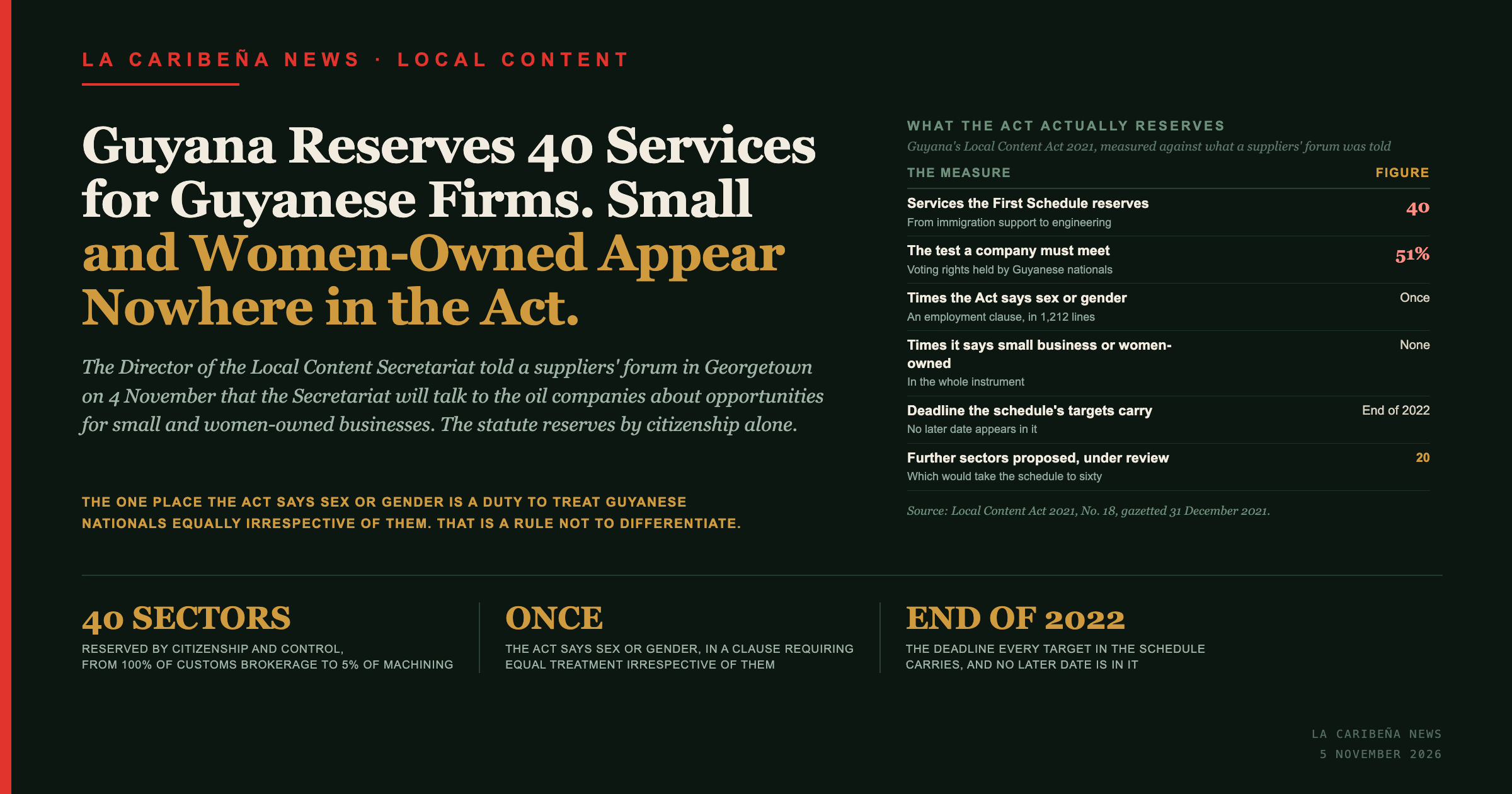
What the title card says
- Headline: Guyana reserves 40 services for Guyanese firms, and the words small and women-owned appear nowhere in the Act. - Sectors reserved by the First Schedule: 40. - Deadline the schedule's targets carry: end of 2022, with no later date in it. - Times the Act uses the words sex or gender: once, in an employment non-discrimination clause. - Times it uses small business, women-owned or an equivalent: none. - The qualifying test for a Guyanese company: 51 per cent of voting rights, 75 per cent of senior management, 90 per cent of other positions, all held by Guyanese nationals. - Lowest reserved share in the schedule: engineering and machining, 5 per cent. - Sectors reserved in full: immigration support, work permits and visas, customs brokerage, ground transportation of personnel, local insurance. - Additional sectors proposed and under Government review: 20. - The Minister's only express power of amendment: the monetary penalties, section 26. - Source: Local Content Act 2021 as gazetted, and the Guyana Supplier Forum 2026 as reported on 5 November 2026.
Frequently Asked Questions
Does Guyana's Local Content Act reserve work for small businesses?
No. The First Schedule reserves 40 services for Guyanese companies and Guyanese nationals, and the qualifying test in section 2 is one of citizenship and control. Company size does not appear in the definition.
Does it reserve work for women-owned businesses?
No. The only place the Act uses the words sex or gender is a clause requiring contractors to treat Guyanese nationals equally in employment irrespective of them. That is a duty owed to employees, not a reservation for suppliers.
What qualifies a company as Guyanese under the Act?
Incorporation under the Companies Act, beneficial ownership by Guyanese nationals holding at least 51 per cent of voting rights, and Guyanese nationals in at least 75 per cent of executive and senior management positions and at least 90 per cent of non-managerial positions. A partnership between Guyanese nationals and such a company also qualifies.
What happens if a Guyanese firm does not register?
Section 6(8) provides that a firm not on the Local Content Register is not measured for compliance with the First Schedule. It can still trade, but it does not count towards the targets an operator must meet.
Are the reserved sectors being expanded?
Twenty additional service areas have come out of stakeholder consultations and are under Government review, which would take the schedule from 40 to 60. Whether that requires an amendment to the Act is not stated in the published record.