By LCN Business Desk
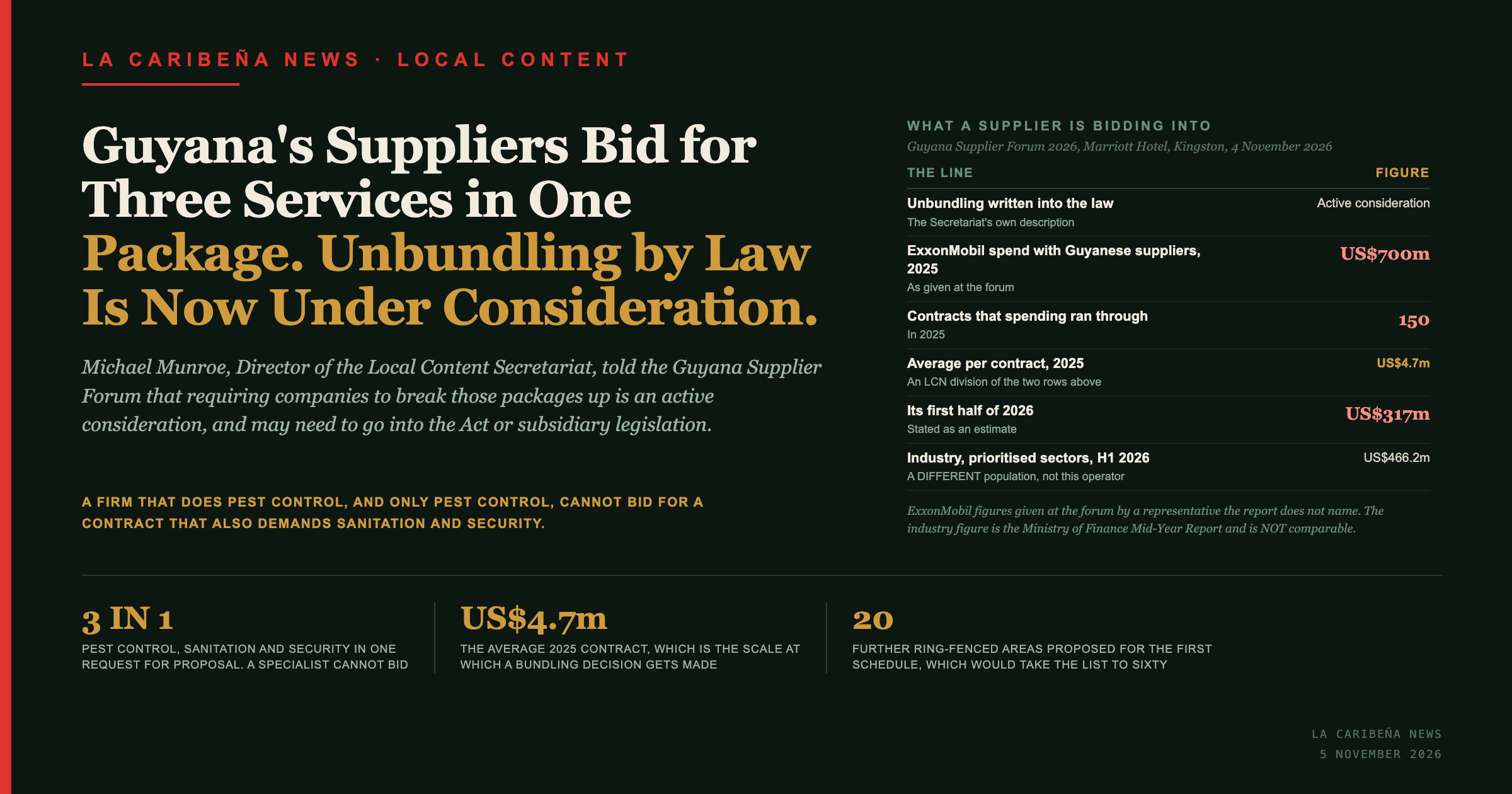
A Guyanese firm that does pest control, and only pest control, cannot bid for a contract that also demands sanitation and security, and that is how several oil and gas tenders are currently written. Michael Munroe, Director of the Local Content Secretariat, told the Guyana Supplier Forum 2026 at the Marriott in Kingston on 4 November that requiring companies to break those packages up is "an active consideration", and that "we may need to elevate it to the level of the actual law itself or perhaps subsidiary legislation".
The Secretariat has had supplier feedback on how Requests For Proposal are packaged. Packaging done poorly, in the account of the forum, can create an artificial barrier to local content, which is a different failure from a Guyanese firm losing a tender it was able to enter.
What is being proposed?
That the obligation to split a package move from encouragement into an instrument.
Munroe urged companies to package opportunities so that "Guyanese companies can participate" and spoke of "further unpackaging of bundles". The question he answered was whether that becomes a requirement rather than a request, and the two routes he named are the Act itself and subsidiary legislation.
No date attaches to either. Active consideration is the whole of the commitment, and it is the second thing the Secretariat said at that forum about reaching firms the current regime does not. This newspaper reported the first, that the Act reserves 40 services by citizenship and names neither small nor women-owned businesses anywhere in its 1,212 lines.
Why does a bundle shut a local firm out?
Because the test is whether a bidder can supply everything in the package, not whether it can supply well.
A single Request For Proposal that asks for pest control, sanitation and security is three businesses in Guyana and one in a multinational's vendor list. A firm that holds one of the three has nothing to bid with, however competitive it is at the thing it does. The bundle is not a judgement on any supplier; it is a procurement convenience that happens to exclude them. Packaging decisions are visible on the state's side too: Guyana's own register of awarded tenders prices 410 contracts in US dollars, worth US$1.96 billion.
::: A package of three services is one bid for an international contractor and no bid at all for a specialist. :::
How much money is in the question?
One operator put three numbers on the record there.
| ExxonMobil Guyana, spend with Guyanese suppliers | |
|---|---|
| Since operations began | US$3.9 billion |
| 2025 | close to US$700 million, through 150 contracts |
| First half of 2026 | about US$317 million, an estimate |
Figures given at the Guyana Supplier Forum by an ExxonMobil Guyana Limited representative, who the report does not name. No contract count is given for 2026.
Last year's spending averages about US$4.7 million for each of those 150 contracts, which is the scale at which bundling decisions are made. A contract of that size can carry three services comfortably, and a Guyanese specialist firm is rarely built to carry all three.
The half-year figure also sits against an industry that is producing far more. Guyana's oil and gas sector expanded 41.3 per cent in the first half of 2026 on production of 163.3 million barrels, against 115.7 million in the same months of 2025. Supplier spending of about US$317 million over those months would annualise below last year's total, though the operator states it as an estimate and gives no contract count to set beside the 150.
Is the cumulative figure moving?
By about US$300 million in three months, on the operator's own two statements.
ExxonMobil Guyana's president put the cumulative total at more than US$3.6 billion in August 2026. The figure given at the November forum is US$3.9 billion. Both describe spending with Guyanese suppliers since operations commenced in 2019. Supplier spending is a separate flow from what the operator pays the state, which is disclosed under a United States rule: ExxonMobil's Form SD for 2024 records US$2,581,822 thousand paid to six Guyanese government bodies.
What is the industry doing, as distinct from one operator?
Spending more, on the Ministry of Finance's own count.
Oil and gas companies spent approximately US$466.2 million on goods and services in prioritised sectors in the first half of 2026, against US$352 million in the same period of 2025, according to the Mid-Year Report. The Mid-Year figure covers the industry in the ring-fenced areas rather than any single operator, so the ExxonMobil numbers cannot be set against it or subtracted from it.
What else is the Secretariat changing?
It is widening the list of reserved sectors.
The First Schedule is under government review with 20 further ring-fenced areas proposed, which would take it to sixty. Adding sectors widens what must be bought locally. Requiring unbundling would change how any of it is bought, and the second does not follow from the first.
What is not established here?
Whether any amendment will be brought, in what form, or when. Nothing beyond active consideration was stated.
Which operators bundle, how often, and in which categories. The forum account gives one example and no frequency.
How much of the spending reported reaches Guyanese ownership rather than Guyanese registration, which is the question the Secretariat's own supplier feedback is circling.
The basis of the 2026 half-year figure, which the source gives as an estimate, and whether it is measured on the same footing as the 2025 total.
The entities
- Michael Munroe is the Director of Guyana's Local Content Secretariat, which sits under the Ministry of Natural Resources. - Local Content Secretariat is the body that administers the Local Content Act and has taken supplier feedback on how tenders are packaged. - Guyana Supplier Forum 2026 is the event held at the Marriott Hotel in Kingston, Georgetown on 4 November 2026, themed "From capability to growth: building Guyanese businesses for long-term success". - ExxonMobil Guyana Limited is the operator whose representative gave the spending figures at that forum. - Local Content Act is the 2021 statute whose First Schedule reserves services for Guyanese companies and which is under review.
What the title card says
- Headline: tenders bundle pest control, sanitation and security into one package, and putting unbundling into law is an active consideration. - Date of the Guyana Supplier Forum: 4 November 2026. - ExxonMobil spending with Guyanese suppliers since operations began: US$3.9 billion. - Its 2025 spending: close to US$700 million. - Contracts that spending ran through in 2025: 150. - Its first-half 2026 spending, estimated: about US$317 million. - Industry spending in prioritised sectors, first half 2026: US$466.2 million. - The same industry figure a year earlier: US$352 million. - Further ring-fenced areas proposed for the First Schedule: 20.
Frequently Asked Questions
What is contract bundling in Guyana's oil sector?
Combining several services into a single Request For Proposal. The example given at the Guyana Supplier Forum was pest control, sanitation and security in one package, which a firm offering only one of the three cannot bid for.
Will unbundling become law?
The Director of the Local Content Secretariat, Michael Munroe, described it as "an active consideration" and said it may need to be elevated to the Act itself or to subsidiary legislation. No date or draft was given.
How much does ExxonMobil spend with Guyanese suppliers?
US$3.9 billion since operations began, close to US$700 million in 2025 through 150 contracts, and about US$317 million in the first half of 2026 on an estimated basis, according to figures given at the forum.
Is that the same as the industry figure?
No. The Ministry of Finance Mid-Year Report puts oil and gas spending in prioritised sectors at approximately US$466.2 million for the first half of 2026 against US$352 million a year earlier. That covers the industry in ring-fenced areas and is a different population from one operator's total.
Is the Local Content Act changing in other ways?
The First Schedule is under review with 20 further ring-fenced areas proposed, which would take the reserved list to sixty.
Who administers local content in Guyana?
The Local Content Secretariat, under the Ministry of Natural Resources.