By LCN Business Desk
A work permit is the thing being removed.
What does the Order actually do?
It adds three categories to the list of skilled nationals Guyana admits without a work permit.
Order No. 175 of 2026 amends section 8(1) of the principal Act, Cap. 18:08, by inserting three paragraphs immediately after paragraph (j). It was made at Georgetown and carries no commencement provision.
| New paragraph | Category |
|---|---|
| (jA) | Private security officers |
| (jB) | Agricultural workers |
| (jC) | Aviation personnel, with fourteen professions named |
Source: Order No. 175 of 2026, Official Gazette (Extraordinary) of Guyana, 7 September 2026, Legal Supplement B.
The Order was made by Hugh Hilton Todd, Minister of Foreign Affairs and International Cooperation, on 18 August 2026, under the power conferred by section 8(1) of the Act.
Which aviation professions are named?
Fourteen, numbered (i) to (xiv), from professional pilots to flight attendants.
| Profession | |
|---|---|
| (i) | Aircraft maintenance engineers |
| (ii) | Professional pilots |
| (iii) | Air traffic controllers |
| (iv) | Flight operations officers |
| (v) | Aerodrome inspector |
| (vi) | Accident investigator |
| (vii) | Air navigation service inspector |
| (viii) | Inspector |
| (ix) | Aviation security inspector |
| (x) | Hazardous material inspector, or dangerous goods inspector |
| (xi) | Flight operations inspector |
| (xii) | Certified aviation security inspector |
| (xiii) | Maintenance and communications navigation surveillance personnel |
| (xiv) | Flight attendant |
Source: as above.
The 14 entries run from (i) to (xiv). Paragraph (viii) reads only "inspector", unqualified, between two named inspector roles. It is set out here as it appears in the instrument.
Did Guyana decide this on its own?
No. CARICOM Heads of Government approved it seven months earlier.
At their summit in St Kitts and Nevis from 24 to 27 February 2026, Heads approved recommendations for "(i) the inclusion of additional professions in the approved category of aviation personnel and (ii) the definitions and qualification criteria for professions in this category".
From the close of that summit to the making of the Order is 172 days. To gazetting, 192.
So the instrument is Guyana giving domestic effect to a Community decision. Which member states have made the equivalent order is not established on the record this newspaper can see.
Why does the Community's own list still read differently?
Because the Secretariat's published definitions predate the February decision.
The CARICOM Secretariat's Categories of Skilled Nationals, as at December 2025, lists thirteen agreed categories and defines aviation personnel as "aircraft maintenance engineers, professional pilots, air traffic controllers, flight operations officers". It then records that "the outstanding work for this category involves confirming the definitions and qualification criteria as well as expansion of professions to be covered".
No later version has been published. On the public record we can find, the fourteen professions are written down in Guyana's Order and in no CARICOM document we can retrieve.
How does a worker actually use the right?
The worker applies for a skills certificate; the Order alone confers nothing.
The Secretariat's position is that eligible nationals "have to apply for a Certificate of Recognition of CARICOM Skills Qualification (Skills Certificate)", and that this "can be done in any of the CSME participation Member States". The underlying right sits in Article 46 of the Revised Treaty of Chaguaramas.
For the two non-aviation categories the Secretariat sets out what qualifies a person. An agricultural worker needs a relevant qualification in the field, including but not limited to a Caribbean Vocational Qualification or its equivalent, or a letter of recommendation from a national agricultural body. A private security officer needs a letter from a previous employer covering at least one year of employment, or a relevant qualification such as a CVQ or professional licence, together with a letter from the body that maintains the register of private security officers or of Estate, Island and District Constables.
What does this mean for the rest of the Caribbean?
That between four member states, the list this Order extends no longer governs who may work.
Barbados, Belize, Dominica and St Vincent and the Grenadines began full free movement among themselves on 1 October 2025, and reported to the February summit that it had successfully begun. That regime has been running 381 days.
At the 51st Heads of Government meeting in Saint Lucia in July, the Secretary-General pointed to the start of full free movement among four member states, and Heads welcomed notification from Grenada and Saint Lucia that they are actively taking steps to join it. Guyana appears in neither group in that communique.
CARICOM's unfinished free movement work was examined in CARICOM at 53: The Caribbean Community's Wins and Unfinished Work, and the direction Guyanese skills have been travelling in The Exit Corridor.
The aviation category lands in a month when Guyana gazetted four new civil aviation rulebooks. Requirements Nos. 8 to 11 of 2026, covering meteorological service for air navigation, aeronautical information services, communication navigation and surveillance, and certified aerodromes, were published in Extraordinary Gazettes dated 12 October 2026.
So two tracks ran in the same quarter. The rulebooks set the standard an operator must meet, and the Order widens the pool of people who may be hired to meet it. The training track is separate: G$100 million is budgeted for a partner to train pilots and no partner has been named, reported in Guyana Wants a Partner to Train Its Pilots. The hub plan for Terminal 2 at Cheddi Jagan International has no airline attached, reported in Guyana Is Ready to Sign a Hub Deal for Terminal 2. Two of the professions the Order names, aerodrome inspector and accident investigator, are the roles that examine incidents of the kind reported in An Airline Warned Twice About Animals on the Runway.
The entities
- The Caribbean Community (Free Entry of Skilled Nationals) Act, Cap. 18:08 is the Guyanese statute that lists who may enter and work without a permit.
- Order No. 175 of 2026 is the subsidiary legislation that added the three categories.
- Hugh Hilton Todd is Guyana's Minister of Foreign Affairs and International Cooperation, who made the Order.
- The CARICOM Secretariat publishes the agreed categories of skilled nationals and their definitions.
- Article 46 of the Revised Treaty of Chaguaramas is the provision under which free movement of skills operates.
- Certificate of Recognition of CARICOM Skills Qualification is the document a worker applies for.
- Official Gazette (Extraordinary) of Guyana is the publication in which the Order appeared, printed every Saturday and on extraordinary days by Guyana National Printers Limited.
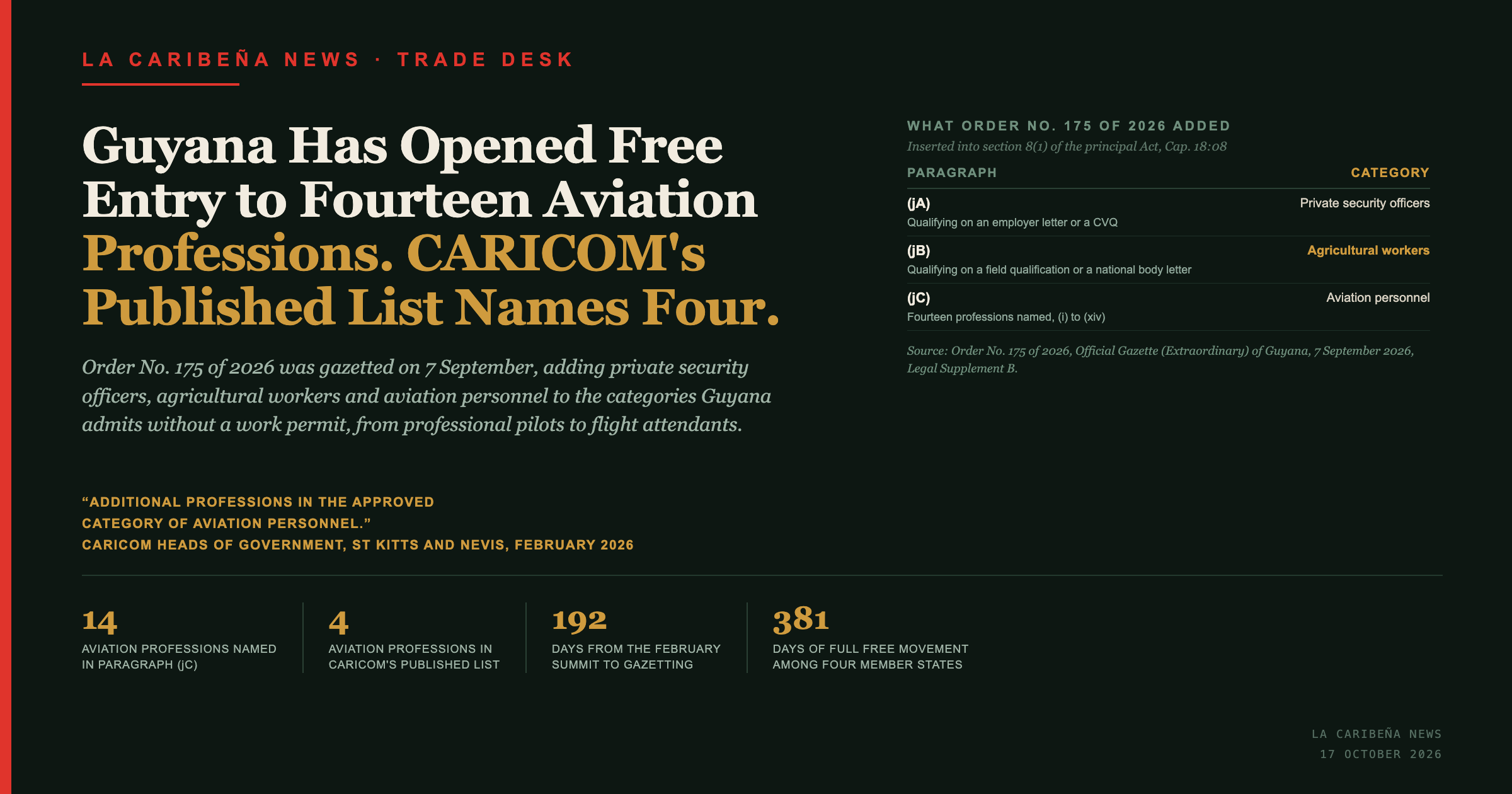
What the title card shows
Every data point on the article's title card, in text.
- 14. Aviation professions named in paragraph (jC) of the Order. Source: Order No. 175 of 2026.
- 4. Aviation professions in the CARICOM Secretariat's published definition. Source: Categories of Skilled Nationals as at December 2025.
- 3. New paragraphs inserted into section 8(1). Source: Order No. 175 of 2026.
- 192. Days from the close of the February summit to gazetting on 7 September 2026. Source: communique via Stabroek News; Official Gazette.
- 381. Days that full free movement among four member states had been running on 17 October 2026. Source: reported to the February summit.
- Quotation: "The outstanding work for this category involves confirming the definitions and qualification criteria as well as expansion of professions to be covered." CARICOM Secretariat, December 2025.
Frequently Asked Questions
What did Order No. 175 of 2026 change?
It inserted three paragraphs into section 8(1) of the Caribbean Community (Free Entry of Skilled Nationals) Act, Cap. 18:08, adding private security officers, agricultural workers, and aviation personnel with fourteen named professions.
When was it made and gazetted?
Made on 18 August 2026 by the Minister of Foreign Affairs and International Cooperation, and published in the Official Gazette (Extraordinary) of Guyana on Monday 7 September 2026. The Order carries no commencement provision.
Which aviation professions does it cover?
Aircraft maintenance engineers, professional pilots, air traffic controllers, flight operations officers, aerodrome inspector, accident investigator, air navigation service inspector, inspector, aviation security inspector, hazardous material or dangerous goods inspector, flight operations inspector, certified aviation security inspector, maintenance and communications navigation surveillance personnel, and flight attendant.
Is this a Guyanese initiative or a CARICOM one?
A Community decision implemented domestically. CARICOM Heads of Government approved the inclusion of additional aviation professions, and their definitions and qualification criteria, at their summit in St Kitts and Nevis from 24 to 27 February 2026.
Does a worker need anything besides the Order?
Yes. The CARICOM Secretariat states that eligible nationals must apply for a Certificate of Recognition of CARICOM Skills Qualification, which can be done in any participating member state.
How many categories of skilled national are there now?
The CARICOM Secretariat lists thirteen agreed categories as at December 2025: graduates, media persons, artistes, musicians, sportspersons, nurses, teachers, artisans with a CVQ, holders of associate degrees, domestic workers, agricultural workers, private security officers and aviation personnel.
Which states have gone further than categories?
Barbados, Belize, Dominica and St Vincent and the Grenadines began full free movement among themselves on 1 October 2025. Grenada and Saint Lucia notified the July 2026 Heads meeting that they are taking steps to join.