By LCN Business Desk
A standing committee is now a duty, not advice.
What did the Authority gazette?
Three amendments and one new rulebook, all signed by the Director-General.
The power used is section 142 of the Civil Aviation Act 2018, which sits with the Authority rather than with a Minister. All four appeared in Extraordinary Gazettes dated Monday 12 October 2026.
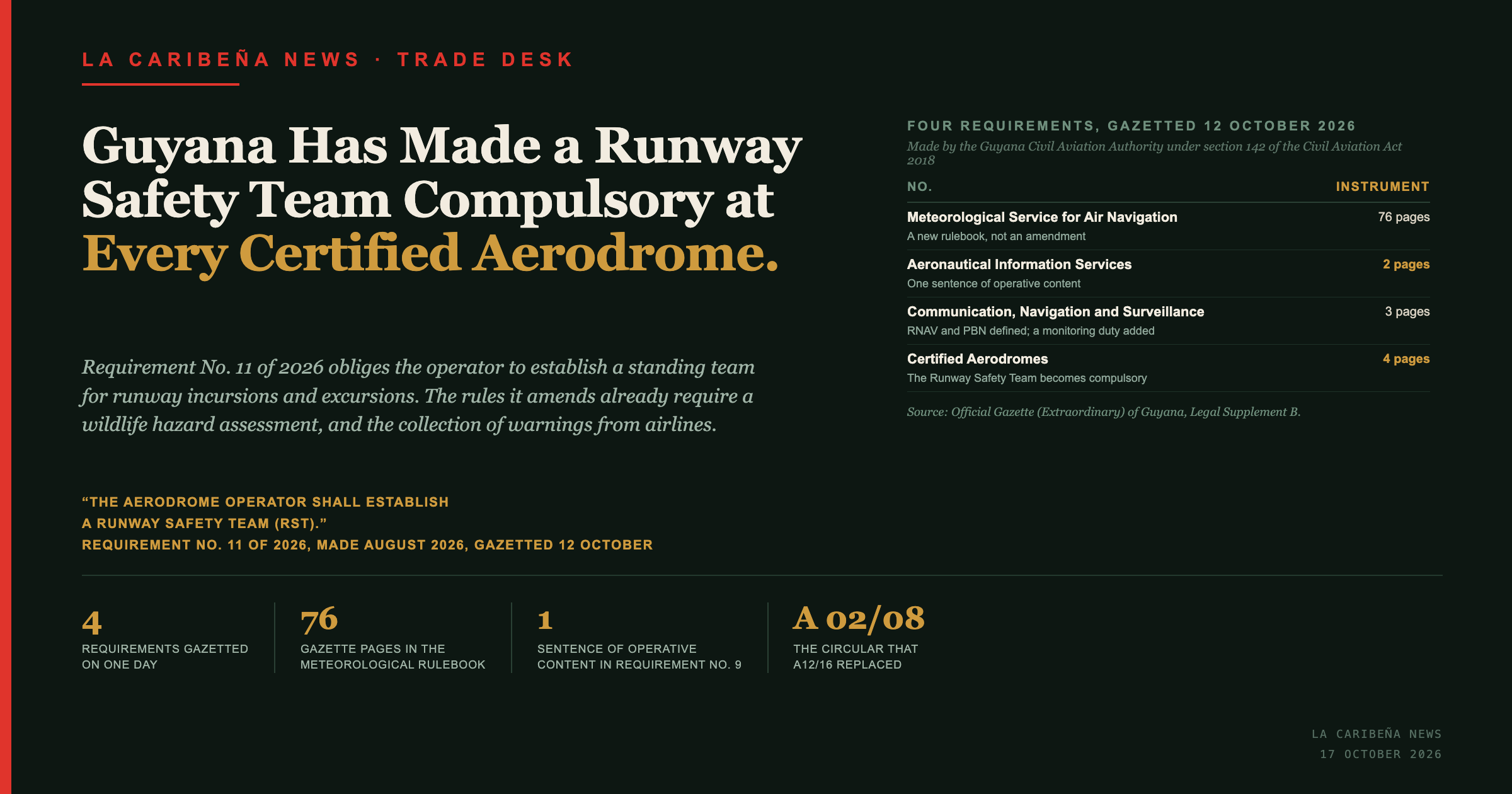
| No. | Instrument | Length |
|---|---|---|
| 8 | Civil Aviation Requirements for Meteorological Service for Air Navigation 2026 | 76 gazette pages |
| 9 | Civil Aviation (Amendment) Requirements for Aeronautical Information Services 2026 | 2 pages |
| 10 | Civil Aviation (Amendment) Requirements for Communication, Navigation and Surveillance 2026 | 3 pages |
| 11 | Civil Aviation (Amendment) (No. 2) Requirements for Certified Aerodromes 2026 | 4 pages |
Source: Official Gazette (Extraordinary) of Guyana, Legal Supplement B.
Requirement No. 8 is a new rulebook rather than an amendment, prescribed in respect of the Civil Aviation (Air Navigation Services) Regulations 2024. Requirement No. 9 runs to two pages, of which the operative content is a single sentence: "Selective distribution lists should be used when practicable."
The day of the month on each signature is illegible in the gazette scan. The months are legible, and Requirement No. 11 is dated August.
What does the aerodrome Requirement actually impose?
A standing team, named in the instrument, with runway incursions and excursions as its subject.
Requirement No. 11 substitutes paragraph 2.7 of Attachment C, which governs aerodrome safety management systems. The new text reads:
The aerodrome operator shall establish a Runway Safety Team (RST), comprising representatives of organizations involved in runway operations, to serve as a collaborative platform for identifying runway safety hazards, reviewing runway safety performance, promoting the exchange of safety information, and developing and monitoring mitigation measures to address runway incursions, runway excursions, and other runway safety-related occurrence.
Three further changes sit beside it. The safety management duty moves from "establish" to "establish, implement and maintain". The operator must keep a Management of Change process covering changes to infrastructure, equipment, systems, procedures, organisational structure, personnel and operating conditions. And safety assessments now extend to "contracted activities and external service providers whose activities may affect aerodrome safety".
Who is responsible when the hazard is an animal?
The aerodrome operator, under Section 9.4 of the instrument Requirement No. 11 amends.
Requirement No. 11 amends the Civil Aviation Requirements for Certified Aerodromes and Ground Aids 2024, a 530-page instrument gazetted on 16 May 2024. Section 9.4 of it is headed Wildlife Strike Hazard Reduction, and opens with a note that the presence of wildlife, "birds and other animals", on or near an aerodrome "poses a serious threat to aircraft operational safety".
| Provision | What the operator must do |
|---|---|
| 9.4.1(a) | Establish an aerodrome procedure for recording and reporting wildlife strikes |
| 9.4.1(b) | Collect information from aircraft operators, aerodrome personnel and other sources on wildlife constituting a potential hazard |
| 9.4.1(c) | Keep an ongoing evaluation of the hazard by competent personnel |
| 9.4.1(d) | Participate in the national wildlife committee |
| 9.4.2 | Collect wildlife strike reports and forward them to ICAO for the Bird Strike Information System |
| 9.4.3 | Take action to decrease the risk of collisions between wildlife and aircraft |
| 9.4.4 | Eliminate or prevent garbage dumps or any other source that may attract wildlife, or reduce the risk to as low as reasonably practicable |
Source: Section 9.4 of the 2024 Requirements, as gazetted.
Paragraph 9.4.1(b) puts the duty on the operator to gather what airlines report about wildlife on and around the aerodrome, not only to observe it directly.
Section 9.4.5 binds parties outside the aerodrome: "Developers and local authorities shall give due consideration to aviation safety concerns related to land developments in the vicinity of the aerodrome that may attract wildlife."
Whether the national wildlife committee named at 9.4.1(d) exists and meets is not established on the public record.
Where does Mabaruma sit in the sequence?
Between the signing of the Requirement and its publication.
| Date | Event |
|---|---|
| 23 June 2016 | AIC A12/16 issued, replacing AIC A 02/08 |
| 16 June 2026 | Trans Guyana Airways writes to the Director General about animals and people on interior airstrips |
| July 2026 | Requirements 9 and 10 made |
| August 2026 | Requirement 11 made, creating the Runway Safety Team duty |
| 9 September 2026 | The airline writes again, naming Mabaruma as the worst affected |
| 17 September 2026 | One of its aircraft is forced off the runway at Mabaruma by an animal |
| 12 October 2026 | All four Requirements gazetted |
Sources: GCAA AIC A12/16; the four Requirements as gazetted; airline correspondence released by Trans Guyana Airways.
The Requirement was signed before the occurrence and published about eight weeks after it. It is not a response to Mabaruma. The airline's two letters, of 16 June and 9 September, are the kind of report that Section 9.4.1(b) obliges the operator of a certified aerodrome to collect. The two warning letters and the aircraft leaving the runway were reported in An Airline Warned Twice About Animals on the Runway.
Who is bound, and can an operator find out?
Only holders of an aerodrome certificate are bound, and that list is not public.
Requirement No. 11 applies to "the Operator of a Certified Aerodrome". The document that would list which of Guyana's aerodromes hold that status is the Aeronautical Information Publication, and the Authority does not publish it online. Its own page carries a contact address instead: "For information on the Guyana AIP, please contact the Aeronautical Information Management Services."
So whether the hinterland strips are certified aerodromes is not established on the public record. Trans Guyana Airways described them in its own statement as owned and operated by the government, under significant expansion, and not under required supervision. On the public record this newspaper can reach, the question of whether the new duty reaches Mabaruma cannot be answered either way.
What does this mean for the rest of the Caribbean?
That the duty over animals sits in the wildlife section, not in the runway incursion rules.
An operator reading these instruments has two separate duties to place. Runway incursions and excursions now belong to a standing Runway Safety Team under Requirement No. 11. Wildlife belongs to Section 9.4, which has required a hazard assessment, the collection of airline reports and participation in a national committee since May 2024.
The Authority's guidance on runway incursions is older than either. Its Aeronautical Information Circular A12/16 of 23 June 2016 addresses them as guidance to pilots, airside drivers, operators and controllers, and records that it replaces AIC A 02/08. What changed on 12 October is the form of words: the new instrument says the operator shall establish the team. How that is enforced is not set out in it, and it binds only the holder of an aerodrome certificate.
Guyana's wider aviation build-out is moving on other tracks at the same time. Free CARICOM entry was opened to fourteen aviation professions, including aerodrome inspector and accident investigator, in Guyana Has Opened Free CARICOM Entry to Fourteen Aviation Professions. The pilot training partner is budgeted at G$100 million and unnamed, in Guyana Wants a Partner to Train Its Pilots. The Terminal 2 hub plan has no airline attached, in Guyana Is Ready to Sign a Hub Deal for Terminal 2.
The entities
- Guyana Civil Aviation Authority is the regulator that made all four Requirements.
- Section 142 of the Civil Aviation Act 2018 is the power under which they were made.
- Requirement No. 11 of 2026 is the instrument that creates the Runway Safety Team duty.
- Aeronautical Information Circular A12/16 is the 2016 circular that defines a runway incursion.
- Trans Guyana Airways is the airline that wrote twice and whose aircraft left the runway at Mabaruma.
- Attachment C is the part of the certified aerodrome Requirements that governs safety management systems.
- Aeronautical Information Publication is the document that would identify Guyana's certified aerodromes.
What the title card shows
Every data point on the article's title card, in text.
- 4. Requirements gazetted in Extraordinary Gazettes dated 12 October 2026. Source: Official Gazette.
- 76. Gazette pages in Requirement No. 8, the meteorological rulebook. Source: as above.
- 1. Sentence of operative content in Requirement No. 9. Source: as above.
- A 02/08. The circular that AIC A12/16 records replacing. Source: GCAA AIC A12/16.
- 17 September 2026. The date an aircraft was forced off the runway at Mabaruma, after Requirement No. 11 was signed in August. Source: the instrument and the airline's statement.
- Quotation: "The aerodrome operator shall establish a Runway Safety Team (RST)." Requirement No. 11 of 2026.
Frequently Asked Questions
What is a Runway Safety Team?
Under Requirement No. 11 of 2026 it is a standing forum of representatives from the organisations involved in runway operations, established by the aerodrome operator to identify runway safety hazards, review runway safety performance, exchange safety information, and develop and monitor measures addressing runway incursions, runway excursions and other runway safety occurrences.
Who has to establish one?
The operator of a certified aerodrome in Guyana.
Which rule covers an animal on a runway?
Section 9.4 of the Civil Aviation Requirements for Certified Aerodromes and Ground Aids 2024, headed Wildlife Strike Hazard Reduction, gazetted 16 May 2024. It requires the operator to assess the hazard, to collect information from aircraft operators about wildlife on or around the aerodrome, to participate in the national wildlife committee, to forward wildlife strike reports to ICAO, and to remove sources that attract wildlife.
Was this a response to the Mabaruma occurrence?
No. Requirement No. 11 was made in August 2026 and the aircraft was forced off the runway at Mabaruma on 17 September 2026. The instrument was gazetted about eight weeks after the occurrence.
What else changed for aerodrome operators?
The safety management duty became "establish, implement and maintain", a Management of Change process is required for changes to infrastructure, equipment, systems, procedures, structure, personnel and operating conditions, and safety assessments must extend to contracted activities and external service providers.
What do the other three Requirements do?
No. 8 prescribes a new 76-page rulebook for meteorological service for air navigation. No. 9 adds one sentence to the aeronautical information rules on selective distribution lists. No. 10 adds definitions of area navigation, performance-based navigation and RNAV specification, and requires the communication, navigation and surveillance provider to set formal monitoring criteria showing that services continue to perform after any change to a functional system.
Which Guyanese aerodromes are certified?
Not established on the public record. The Aeronautical Information Publication would identify them and the Authority does not publish it online, directing enquiries to its Aeronautical Information Management Services instead.