By LCN Business Desk
Guyana told a room holding the civil aviation authorities of about sixty countries that it is ready to sign.
President Dr Mohamed Irfaan Ali made the announcement on Tuesday at the opening of the 3rd Global Regional Safety Oversight Organizations and Regional Accident and Investigation Organization Forum for Aviation Safety at the Arthur Chung Conference Centre, a two-day summit hosted with the International Civil Aviation Organization (ICAO) and the European Union Aviation Safety Agency (EASA).
"We are ready to finalise those negotiations. So I make that very clear. We have to ensure that we have a major player utilising Terminal 2 as the hub, as their hub, our hub," the President said, in remarks published by the Department of Public Information. The Ministry of Public Utilities and Aviation is mandated to negotiate with carriers interested in connecting West Africa and South America to the Caribbean through Guyana.
No airline was named. No consideration on either side was described, and no date was given.
What has Guyana already built?
More than the announcement suggested, and in exactly the direction the President described.
At the 17th ICAO Air Services Negotiation Event in Punta Cana last November, the Guyana Civil Aviation Authority signed air services agreements with six countries: Panama, St Maarten, Uganda, Ecuador, Liberia and Kenya. Three are African and two sit in the Americas. Guyana now holds bilateral and multilateral air services arrangements with more than sixty countries, Caribbean National Weekly reported, citing the delegation led by Director General Lt. Col. (Ret'd) Egbert Field.
"We are building a transformative aviation sector and having ASAs with other states is critical to accomplishing the vision of connecting Guyana with the rest of the world and building the Cheddi Jagan International Airport into an international air transport hub," Minister of Public Utilities and Aviation Deodat Indar said at the time.
The region has been moving on the same file. Haiti signed the Caribbean Community's multilateral air services agreement this month, eight years after it was opened for signature there, in Haiti Has Signed the Caribbean's Open-Skies Agreement.
The traffic has moved with it. Passenger movements through the airport rose from 182,736 in 2020 to 973,016 in 2025. Airlines and aviation companies operating in Guyana went from four in 2020 to sixteen, Indar told the same forum on Tuesday. Indar has since said the Government is seeking an international partner to build and operate an Aviation Centre of Excellence, with no partner named and G$100 million in the budget to start it. Caribbean Airlines, meanwhile, opened three international connections in fifteen weeks without a hub arrangement of any kind.
Terminal 2 is a 150,000 square foot arrivals facility. President Ali turned the sod on 25 August 2025, with G$7 billion set aside in that year's national budget, Kaieteur News reported. It is due on stream in 2028. The airport is owned by the Government of Guyana and operated by the Cheddi Jagan International Airport Corporation, and its runway was extended to 10,800 feet in the last expansion, long enough for a Boeing 747-400, according to the project record.
What may an airport actually give an airline?
Less than most people assume, and for a shorter time.
The United States publishes the clearest rulebook, because its airports take federal money and must account for it. The Federal Aviation Administration's final policy on air carrier incentive programmes, effective 7 December 2023 and superseding the 2010 guidebook, draws one line and holds it.
"Air carrier operations are not a capital or operating cost of an airport; therefore, use of airport revenue for a carrier's operations is a prohibited use of airport revenue."
An airport may waive or discount landing fees and other airport charges. It may fund marketing, so long as the marketing promotes the airport rather than the destination. It may not pay an airline to fly.
The clock is short. A new carrier flying nonstop to a destination not currently served nonstop from that airport may receive incentives for up to two years. On a route that already has service, the limit is one year, after which, in the policy's words, "the new entrant would be considered an incumbent air carrier, and similarly situated to other carriers at the airport." Incentives for adding frequencies on existing service are capped at one year and cannot be the only incentive on offer.
And it cannot be a private arrangement. "Generally, new entrant incentives must be available to all new entrant carriers on the same basis," the policy states. "The ACIP may not select one new entrant and deny the program to another new entrant." There is one exception, and it turns on disclosure: an airport with a limited budget may restrict incentives to the first carrier to start service, but only if it has told all carriers in advance that this is the rule.
Who pays for the things an airport cannot pay for?
The city, the chamber of commerce and the hotels.
This is the split that makes hub deals work in the United States, and it is the one most often missed. Airport-sponsored incentives are fee relief and airport marketing. Community-sponsored incentives, funded by local governments, chambers of commerce, tourism organisations and local businesses, can include the things airlines actually want: minimum revenue guarantees, travel banks and destination marketing.
A minimum revenue guarantee promises the airline a set level of ticket revenue on a new route and pays cash for any shortfall. The Airport Cooperative Research Program's standard definitions, published through the Transportation Research Board, put it plainly: "Generally, airline managers favor revenue guarantee incentives."
The same document is candid about what the cheaper instruments are worth. Fee waivers "must be for a limited period, typically no longer than 12 months," and in any case "airport fees are a relatively small part of an airline's total operating cost." Marketing support is "by far, the most used airline incentive" and reaches only half the market, because 40 to 60 per cent of passengers on a route originate outside the community paying for the advertising. Letters from local businesses promising to fly are treated with open scepticism: "airline managers are distrustful of community promises and/or pledges of support."
What does a single route cost?
About a million US dollars, paid by the city, against performance.
| Airport | What was committed | For what |
|---|---|---|
| Corpus Christi, Texas | US$1,182,326 across three coordinated funding agreements | Frontier Airlines nonstop to Denver |
| Rochester, Minnesota | A US$1.5 million minimum revenue guarantee fund | Attracting low-cost direct service to leisure destinations |
| Killeen, Texas | US$1 million in year one, then a US$750,000 guarantee | New airline service at Killeen Regional |
Figures as announced by the City of Corpus Christi, Rochester International Airport and the Killeen council.
Note the shape rather than the size. These are not cheques. They are shortfall cover: the money moves only if the route underperforms, which means the community is buying risk, not seats.
The Caribbean pays on the same pattern. A Dominican second city bought three winter routes for the 2026-2027 season, in A Dominican Second City Just Bought Three Winter Routes. At the other end of the scale sits the cost of owning the airline instead of incentivising one: Suriname pays its state carrier between US$1 million and US$2.2 million a month, in Suriname Pays Its Airline Up to US$2.2 Million a Month. The region's other state carrier, Caribbean Airlines, which serves Georgetown, has been working through a backlog of unaudited years, in Caribbean Airlines Has Audited Three More Years.
Which terms cost more than the money?
The ones that are not denominated in money at all.
A carrier that commits to hub somewhere will ask for the facility, and for a say in what happens to it. The FAA and Office of the Secretary of Transportation task force on airline competition named the two instruments in October 1999, and named them as barriers to entry.
"General Accounting Office and other observers have pointed to airports' long-term, exclusive-use gate-lease agreements with tenant airlines and to majority-in-interest (MII) clauses, which give signatory airlines special rights to approve airport capital improvement plans."
A majority-in-interest clause gives the airlines carrying most of the landed weight a right of review over the airport owner's own capital programme. An exclusive-use gate lease means only that airline controls the gate, whatever else the airport would like to do with it. Airport managers told the task force that long-term exclusive-use gate leases are the practice that "makes it difficult for new entrant air carriers to begin serving an airport."
These are not short arrangements. "The average length of a hybrid use and lease agreement at large hub airports is approximately 20 years," the report found.
Three questions follow for any Terminal 2 agreement, and each has a published answer elsewhere. Are the gates exclusive use, preferential use or common use. Does the agreement carry a majority-in-interest clause, and if so over which projects. And how long does it run, against a terminal due on stream in 2028.
How did Panama actually do it?
Not by signing a foreign airline. By registering its own.
Tocumen International Airport is the closest working model to what Guyana has described: a single national gateway in a small economy, consolidating traffic between continents. Copa Airlines, the flag carrier of Panama, has called it the "Hub of the Americas" since the 1990s.
Copa's own filing with the United States Securities and Exchange Commission explains what a hub is for, better than any outside description.
"Copa's base of operations at the geographically central location of Tocumen International Airport in Panama City, Panama provides convenient connections to our principal markets in North, Central and South America and the Caribbean, enabling us to consolidate traffic to serve several destinations that do not generate enough demand to justify point-to-point service."
The same annual report on Form 20-F, filed on 26 February 2026 for the year ended 31 December 2025, explains the part that is easy to miss. Under Law No. 21 of 29 January 2003, the Panamanian Aviation Act, Panamanian nationals must exercise effective control over the airline and maintain substantial ownership. And the consequence reaches beyond the operating licence:
"Under certain of the bilateral agreements between Panama and other countries pursuant to which we have the right to fly to those other countries and over their territories, we must also continue to have substantial Panamanian ownership and effective control by Panamanian nationals to retain these rights."
Failure to comply, Copa tells its investors, "could result in the loss of our Panamanian operating license and/or our right to fly to certain important countries."
The structure that satisfies it is instructive for a country with capital and no large carrier. A 25 November 2005 executive decree treats the test as met where a Panamanian citizen or company holds 51 per cent or more of the voting power. Corporación de Inversiones Aéreas, S.A., a Panamanian entity controlled by Panamanian investors, holds all of Copa Holdings' Class B shares: approximately 26.6 per cent of the economic interest and 100 per cent of the voting power. Foreign money owns most of the airline. Panamanians control it.
That arrangement is why Copa needs no special permission from anyone to connect a Lagos passenger to São Paulo through its own capital. As a Panamanian carrier, it flies each leg on Panama's own bilateral rights. A foreign airline doing the same through a third country is exercising a fifth freedom, the right to carry traffic between two foreign countries, which the Congressional Research Service notes is granted selectively and negotiated country by country.
Guyana has signed agreements with sixty countries and added Uganda, Liberia, Kenya, Panama and Ecuador to the list last November. Which freedoms those agreements confer is the operative term in any hub deal, and it is not on the public record.
What happens if the airline leaves?
The airport keeps the building and the debt, and everyone else pays more to use it.
This is the part of the benchmark that American cities learned in public.
| Airport | At its peak | After the hub closed |
|---|---|---|
| Pittsburgh | Midfield terminal opened 1 October 1992 with airside capacity for 100 gates; about 80 per cent of passengers were connecting | US Airways closed the hub in 2004 after a cost dispute. Cost per enplanement went from US$6 to US$13.80 |
| Cincinnati | By 2005 Delta's second largest hub and the fourth largest of any airline worldwide, more than 600 flights a day to 150 destinations | Down to 180 daily departures and six million passengers |
| Memphis | 240 Delta flights a day in June 2009 | 83 daily flights in total, all airlines, in July 2014 |
| Cleveland | A Continental hub inherited by United in the 2010 merger | Dehubbed in 2014 |
Pittsburgh figures reported by ABC News and by the airport's own executive director in an interview with Cranky Flier; Cincinnati and Memphis figures reported by AirlineGeeks.
The cost per enplanement number is the one to carry. It is what every remaining airline pays the airport for each departing passenger, and it more than doubled in Pittsburgh because the fixed cost of a terminal built for one carrier did not leave when the carrier did. A hub agreement that fixes a term, a facility and a rate without addressing what happens on exit leaves that arithmetic to whoever is in office when it happens.
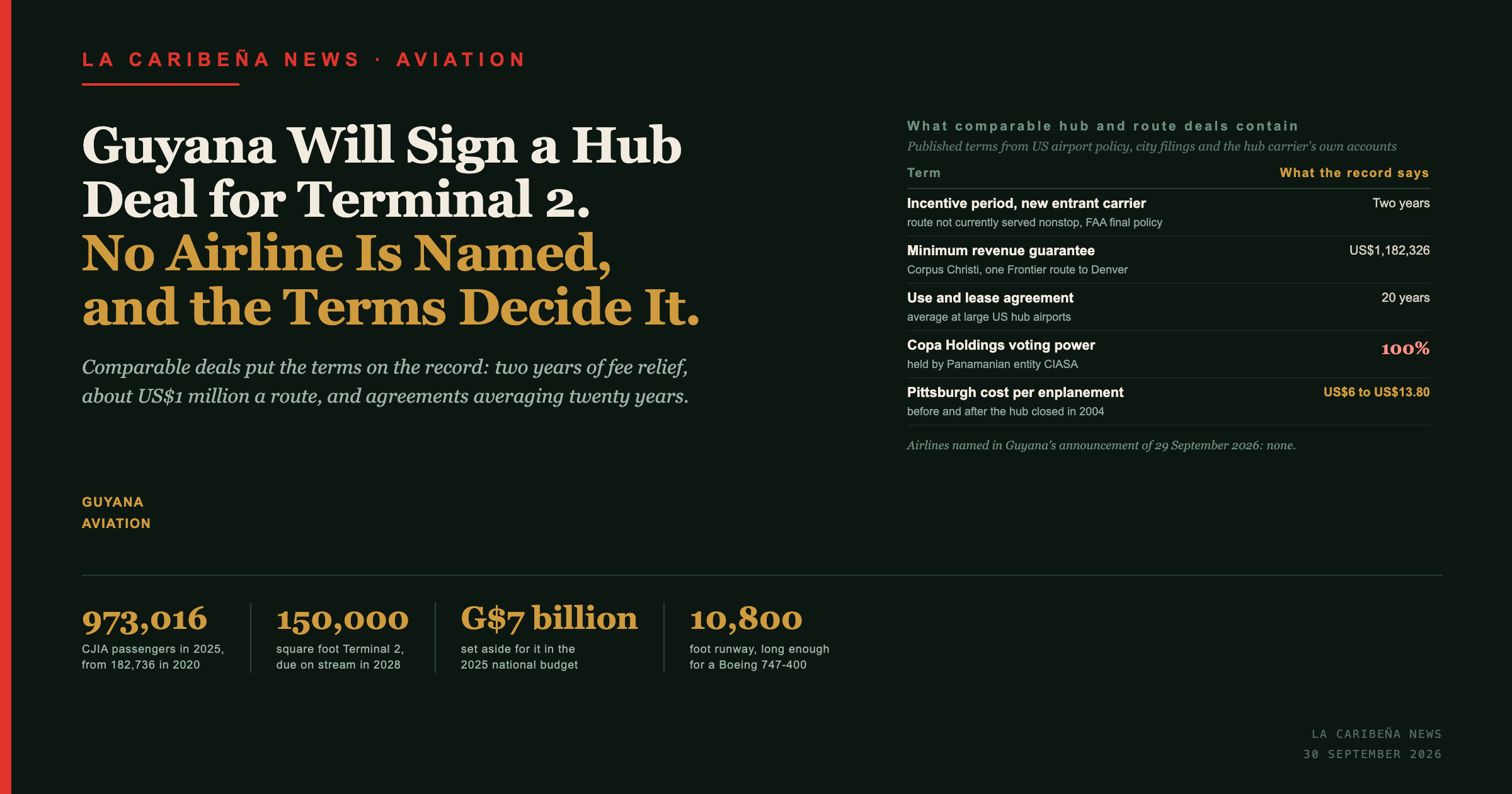
What the title card shows
Every data point on the article's title card, in text.
The panel, "What comparable hub and route deals contain":
- Two years. The incentive period a US airport may offer a new entrant carrier on a route not currently served nonstop. Source: FAA final policy on air carrier incentive programmes, effective 7 December 2023.
- US$1,182,326. The minimum revenue guarantee agreements Corpus Christi approved for one Frontier route to Denver. Source: City of Corpus Christi.
- 20 years. The average length of a use and lease agreement at large US hub airports. Source: FAA and Office of the Secretary of Transportation task force on airline competition, October 1999.
- 100%. Copa Holdings' voting power held by the Panamanian entity CIASA, against approximately 26.6 per cent of the economic interest. Source: Copa Holdings Form 20-F for the year ended 31 December 2025.
- US$6 to US$13.80. Pittsburgh's cost per enplanement before and after the hub closed in 2004. Source: Pittsburgh International Airport's executive director, interviewed by Cranky Flier.
- None. Airlines named in Guyana's announcement of 29 September 2026. Source: Department of Public Information, Guyana.
The footer strip:
- 973,016. CJIA passengers in 2025, from 182,736 in 2020.
- 150,000. Square foot Terminal 2, due on stream in 2028. Source: Kaieteur News and the Department of Public Information.
- G$7 billion. Set aside for it in the 2025 national budget. Source: Kaieteur News.
- 10,800. Foot runway, long enough for a Boeing 747-400. Source: the CJIA expansion project record.
What should be read on the day the airline is named?
Six terms, in this order.
The nationality of the carrier, because it decides whether the traffic rights already exist or have to be negotiated with every country at both ends. The freedoms conferred by the relevant air services agreements. The length of the agreement, against a terminal that comes on stream in 2028. Whether the gates are exclusive, preferential or common use. Whether a majority-in-interest clause gives the airline a say over the Government's future airport spending. And what happens on exit, including who carries the cost per enplanement afterwards.
Guyana has spent a year building the legal framework and has the traffic growth to argue with. The announcement was that the country is ready to sign. What it signs is a separate question, and it is the one the record elsewhere can already answer.
Frequently Asked Questions
What did President Ali actually announce about CJIA Terminal 2?
That the Government is ready to finalise negotiations with international airlines interested in using Terminal 2 at Cheddi Jagan International Airport as their global hub, and that the Ministry of Public Utilities and Aviation is mandated to negotiate with carriers connecting West Africa and South America to the Caribbean through Guyana. He named no airline, no terms and no timeline.
How long can an airport offer an airline incentives?
Under the FAA's final policy, effective 7 December 2023, a new entrant carrier flying nonstop to a destination not currently served nonstop from that airport can receive incentives for up to two years. On a route with existing service the limit is one year, and incentives for adding frequencies are capped at one year.
Can an airport pay an airline to fly a route?
Not from airport revenue. The FAA policy states that air carrier operations are not a capital or operating cost of an airport, so using airport revenue for a carrier's operations is prohibited. Minimum revenue guarantees are funded instead by local governments, chambers of commerce, tourism bodies and businesses, which in the United States routinely commit around US$1 million for a single new route.
Why does the hub airline's nationality matter?
Because traffic rights follow it. Copa Airlines can connect passengers between two foreign countries through Panama on Panama's own bilateral rights, and its filings state that its right to fly to certain countries depends on remaining substantially owned and effectively controlled by Panamanian nationals. A foreign carrier hubbing in a third country is exercising fifth freedom rights, which are negotiated selectively, country by country.
What is a majority-in-interest clause?
A provision in an airline use and lease agreement giving the airlines that account for most of an airport's landed weight a right to review and approve the airport owner's capital improvement plans. The FAA and Office of the Secretary of Transportation task force on airline competition identified these clauses, alongside long-term exclusive-use gate leases, as barriers to entry for new carriers.