By LCN Business Desk
Prime Minister Alix Didier Fils-Aimé and the Secretary-General of the Caribbean Community, Carla Barnett, have signed the Multilateral Air Services Agreement, HaitiLibre reported on Tuesday. The government said the signing opens new prospects for air connectivity and regional mobility, that ending Haiti's isolation is a strategic priority, and that the agreement supports aviation safety through closer alignment with international standards.
The agreement, known as MASA, was opened for signature at the 29th Inter-Sessional Meeting of CARICOM Heads of Government, held in Port-au-Prince on 26 and 27 February 2018 and chaired by Haiti's then President Jovenel Moïse, according to CARICOM. Guyana, St Vincent and the Grenadines and Belize signed it there. Haiti has signed it eight years later.
What does the agreement actually allow?
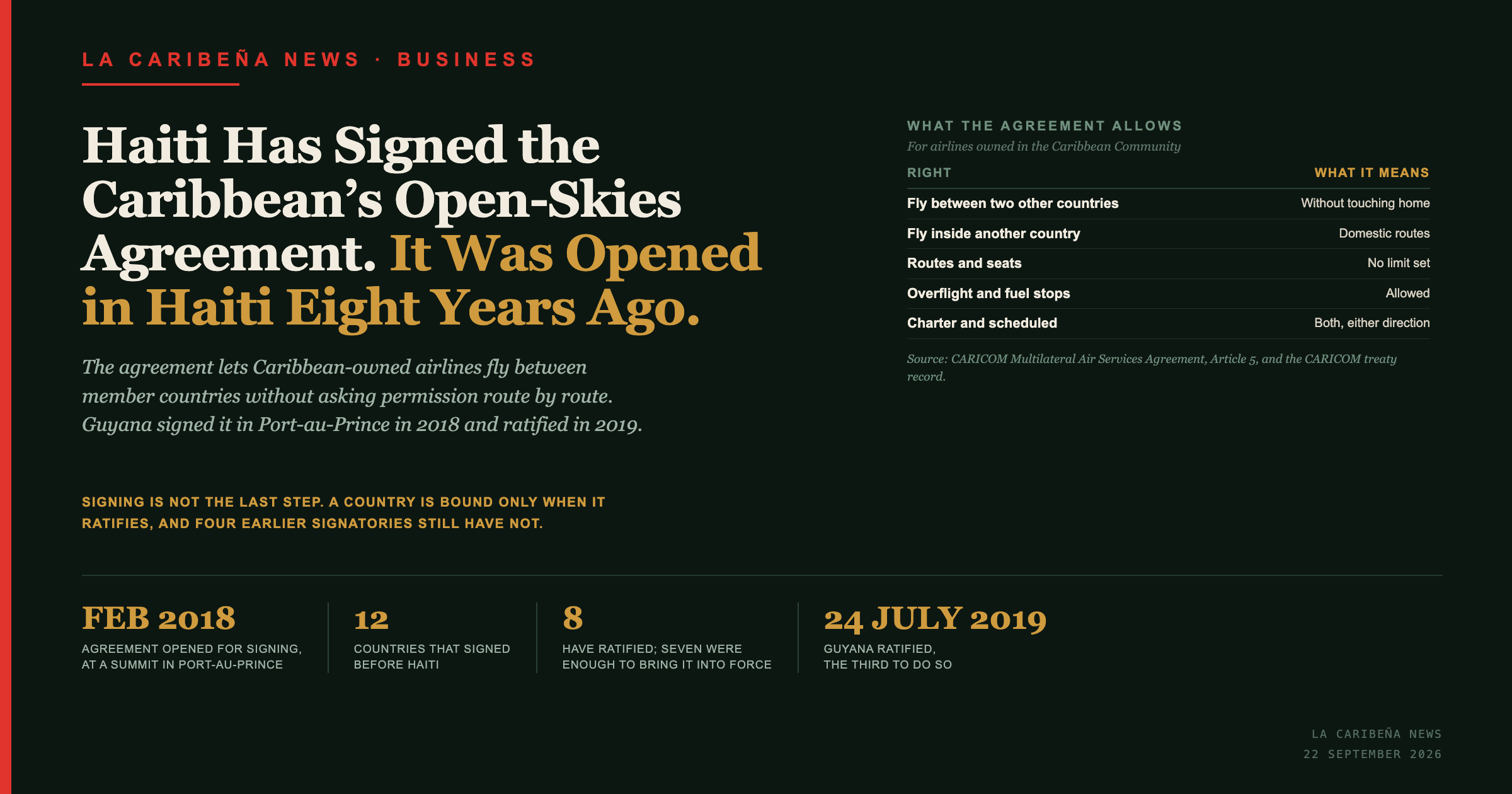
It creates a single market for air transport inside CARICOM. Under Article 5 of the agreement, each member state grants carriers designated by the others a set of rights that go further than most air services treaties:
| Right granted | What it means in practice |
|---|---|
| Overflight | Fly across another member state without landing |
| Technical stops | Land for refuelling or maintenance, without picking up passengers |
| Seventh freedom | Fly between two other member states without the flight touching the airline's home country |
| Cabotage | Fly domestic routes inside another member state |
| Operating freedom | Scheduled, charter and non-scheduled services, in either direction, with flight numbers combined in one aircraft |
Source: Multilateral Air Services Agreement, Article 5. The rights are for carriers that qualify as Community nationals, which the agreement defines to include a company registered in a member state with its head office there and substantial activities in the Community.
It replaces an agreement the member states concluded on 17 November 1998, before the Revised Treaty of Chaguaramas took effect, and which the text says needed revision to deliver the liberalised air transport regime the Revised Treaty envisaged. The agreement expands the scope for airlines owned by CARICOM nationals to provide services throughout the Community, with no restriction on routes, capacity or traffic rights, CARICOM said when the first states signed.
Was the agreement already in force?
Yes. Article 32 says it enters into force when the seventh instrument of ratification is deposited. Eight member states have ratified, the last of them in September 2020, according to CARICOM's treaty record.
| Member state | Signed | Ratified |
|---|---|---|
| Guyana | 27 February 2018 | 24 July 2019 |
| Belize | 27 February 2018 | 29 July 2019 |
| St Vincent and the Grenadines | 27 February 2018 | 17 July 2020 |
| Suriname | 6 July 2018 | Not recorded |
| Antigua and Barbuda | 4 December 2018 | Not recorded |
| Barbados | 4 December 2018 | 4 December 2018 |
| St Kitts and Nevis | 4 December 2018 | 25 September 2020 |
| Saint Lucia | 4 December 2018 | 27 March 2020 |
| Grenada | 26 February 2019 | Not recorded |
| Dominica | 27 February 2019 | 17 August 2020 |
| Jamaica | 27 February 2019 | Not recorded |
| Trinidad and Tobago | 27 February 2019 | 3 July 2019 |
Source: CARICOM treaty record, as published. Haiti's signature is not yet listed there.
What does Haiti's signature change?
By itself, nothing at the airport. Article 31 says the agreement is subject to ratification by signatories under their own constitutional procedures, with the instruments deposited with the Secretary-General. Four of the twelve earlier signatories have no ratification recorded. Article 30 allows eight or more states that were party to the 1998 agreement to declare that they will apply it provisionally.
What it changes is the legal room for Haiti's own carrier. Sunrise Airways, founded in 2010 and based in Port-au-Prince, is Haiti's only airline. Its own site lists Antigua, Santo Domingo, Miami, Cap-Haïtien and Port-au-Prince among the places it flies. It launched nonstop flights between Antigua and Barbados in August, as La Caribeña News reported in Sunrise Airways Launches Nonstop Antigua-Barbados Flights. Under MASA those routes stop depending on bilateral permissions negotiated country by country.
Where does Guyana sit?
Guyana was among the first three to sign, in Port-au-Prince in 2018, and ratified on 24 July 2019, the third state to do so. That makes Guyana one of the seven ratifications that brought the agreement into force. Guyana's air links to the rest of the Community run mostly through carriers registered elsewhere, and its main outside connection runs through Panama, as reported in Aeroméxico Will Fly to Jamaica and The Bahamas.
How does this sit with the rest of Haiti's position in CARICOM?
Haiti trades inside the Community but its people face the tightest limits on moving within it, as La Caribeña News reported in CARICOM Trade With Haiti: The Market Courted, The People Shut Out. Free movement remains the Community's unfinished business, reported in CARICOM at 53. Haitian households are also the fastest-growing recipients of remittances in the Caribbean, reported in Remittances Nearly Doubled in a Decade, money that moves with the people the flights carry.
Regional aviation economics remain hard. Suriname pays its state airline up to US$2.2 million a month, as reported in Suriname Pays Its Airline Up to US$2.2 Million a Month. A signature grants rights. It does not fill an aircraft.
What the title card shows
- February 2018: the month MASA opened for signature, at a CARICOM summit in Port-au-Prince. Source: CARICOM.
- 12 signatories before Haiti: member states that had signed. Source: CARICOM treaty record.
- 8 ratifications: enough to bring it into force, which needs seven under Article 32. Source: CARICOM treaty record and the agreement text.
- Seventh freedom and cabotage: the two strongest rights the agreement grants, letting a Community carrier fly between two other member states, and inside one of them. Source: Article 5.
- Guyana ratified on 24 July 2019, the third member state to do so. Source: CARICOM treaty record.
Frequently Asked Questions
What is the CARICOM Multilateral Air Services Agreement?
A treaty creating a single market for air transport within CARICOM. It lets airlines that qualify as Community nationals fly between member states with no restriction on routes, capacity or traffic rights, including seventh freedom and cabotage rights.
Has Haiti joined the agreement?
Haiti has signed it. Under Article 31 signatories must still ratify under their own constitutional procedures and deposit the instrument with the CARICOM Secretary-General.
Is the agreement in force?
Yes. It enters into force on the deposit of the seventh ratification, and eight member states have ratified, the most recent in September 2020.
Does the agreement create new flights?
No. It removes the need to negotiate route rights country by country. Airlines still decide whether a route is commercially viable.
Has Guyana ratified it?
Yes. Guyana signed on 27 February 2018 and ratified on 24 July 2019, according to CARICOM's treaty record.