By LCN Business Desk
A Trans Guyana Airways aircraft was forced off the runway at Mabaruma on the morning of 17 September when an animal came onto the strip as it was landing, causing considerable damage to the aircraft and endangering passenger safety, the airline said in a press release the following day.
The airline had written to the Director General of the Guyana Civil Aviation Authority twice before that. It released both letters publicly with its statement: one sent on 16 June and one on 9 September. Animal and human entry onto hinterland airports "owned and operated by the government and currently under significant expansion and development" is a continuing threat to all commercial and private aircraft using aerodromes "which are not under required supervision", the airline said.
What happened, and when?
| Date | Event |
|---|---|
| 16 June 2026 | Trans Guyana Airways writes to the GCAA Director General about animals, people and other hazards at several interior airstrips |
| 9 September 2026 | The airline writes again, about increased wildlife activity and repeated bird strikes, naming Mabaruma as the location most seriously affected |
| 17 September 2026 | An animal enters the runway at Mabaruma as a TGA aircraft lands. The aircraft runs off the runway and is damaged |
| 18 September 2026 | TGA issues a statement and releases both letters |
| 22 September 2026 | The Aviation Operators' Association of Guyana warns publicly that the problem could end in a serious aviation tragedy |
Sources: the Trans Guyana Airways release; Kiskadee Watch for the dates of the letters and the regulator's response; Kaieteur News and Guyana Times for the operators' statement.
What did the operators ask for?
Inspections, perimeter security and wildlife control. Local airlines called on the GCAA and other stakeholders to put those measures in place at hinterland airstrips, in a statement issued on Monday by the Aviation Operators' Association of Guyana, Guyana Times reported. "The recent aircraft occurrence at Mabaruma has again brought public attention to the issue of runway incursions," the association said.
The association warned that the growing threat of animals, people and other obstructions entering active runways, particularly at hinterland aerodromes, could result in a serious aviation tragedy if urgent measures are not taken, Kaieteur News reported. It said the entry of animals and people into aerodrome operating areas has been a longstanding concern for operators, and that the Mabaruma circumstances remain under investigation by the regulator.
What has the regulator said?
That it received the warnings. GCAA Director General, retired Lieutenant Colonel Egbert Field, confirmed that the authority had the airline's complaints, and said he had begun discussions with the Commissioner of Police and received a police report setting out enforcement action against people entering restricted airport areas, Kiskadee Watch reported.
More than nine people have been placed before the courts since January for illegally entering airport compounds, and were fined between $30,000 and $300,000, Field said. "Between January and now, they have placed before the court over nine persons," he said.
Why do hinterland airstrips matter this much?
Because for much of Guyana they are the road. Interior communities and the businesses that supply them depend on aircraft where river and road links are slow or seasonal, a dependence La Caribeña News set out in A 1959 Ferry Is Still Alongside at Bartica. The government counts its road programme in hours saved, reported in 40 Bridges, 500 Kilometres, and One Argument.
The airstrips are being expanded at the same time. What happens after the building is the question an international engineering body put to Guyana in July, reported in IRF Chairman Tells Guyana: Investigate the Failure, Then Maintain What You Build.
Aviation safety records in the region are thin where accounts and oversight are thin, as reported in Suriname Pays Its Airline Up to US$2.2 Million a Month. In this case the record is not thin: two letters, dated, released in full by the airline that wrote them.
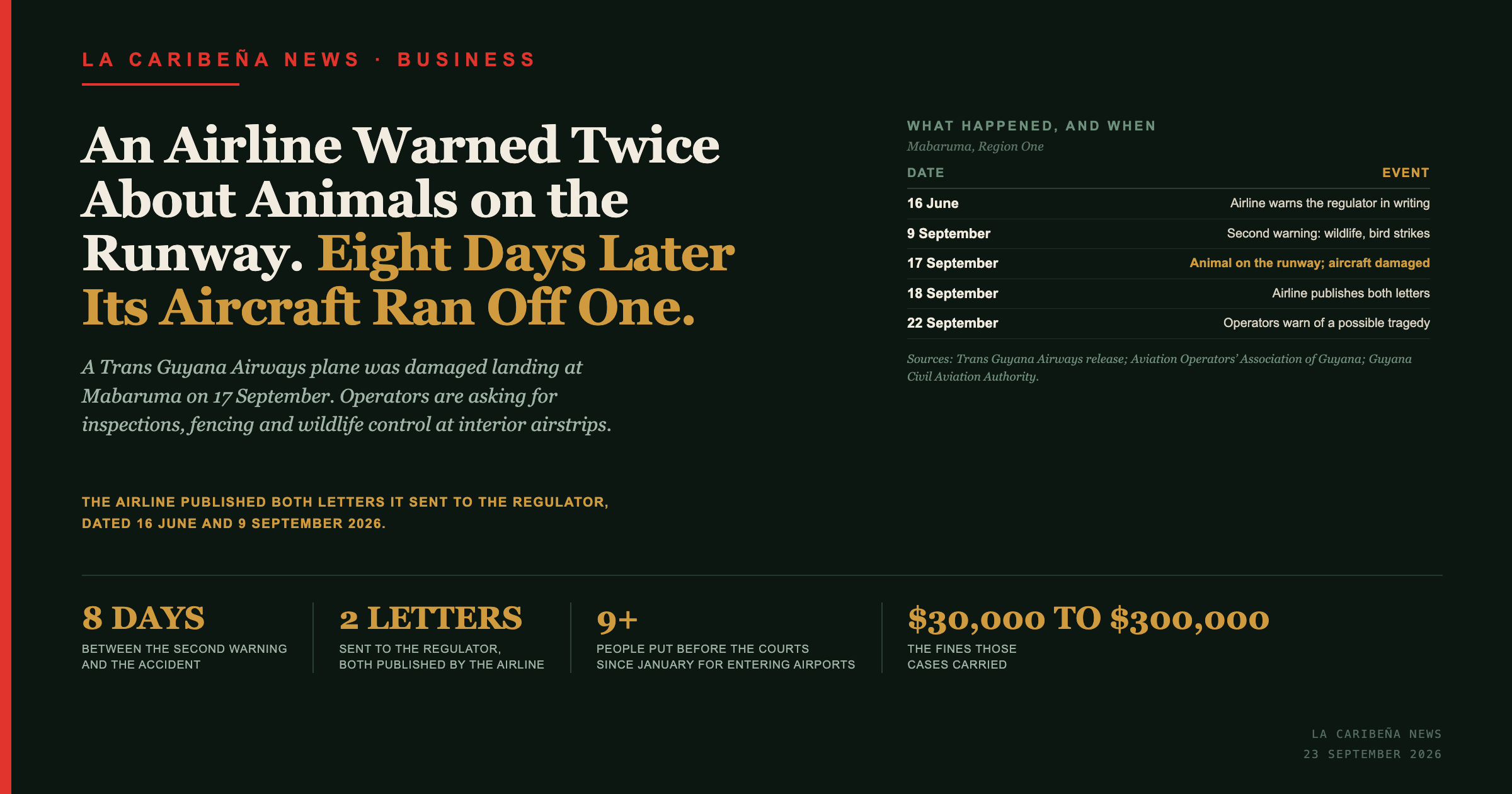
What the title card shows
- 17 September 2026: an animal entered the runway at Mabaruma as a Trans Guyana Airways aircraft landed. The aircraft ran off the runway and was damaged. Source: Trans Guyana Airways.
- 16 June and 9 September: the dates of the airline's two written warnings to the Civil Aviation Authority, both released publicly. Source: Trans Guyana Airways, Kiskadee Watch.
- Eight days: between the second warning and the accident. Source: Kiskadee Watch.
- More than nine people have been put before the courts since January for illegally entering airport compounds, fined between $30,000 and $300,000. Source: GCAA Director General Egbert Field, via Kiskadee Watch.
- Three measures asked for: inspections, perimeter security and wildlife control. Source: Aviation Operators' Association of Guyana.
Frequently Asked Questions
What happened at Mabaruma airstrip?
A Trans Guyana Airways aircraft was forced off the runway on the morning of 17 September 2026 when an animal entered the landing area. The airline said the aircraft was considerably damaged and passenger safety was endangered. The Civil Aviation Authority is investigating.
Had the airline warned anyone beforehand?
Yes. It wrote to the GCAA Director General on 16 June about animals, people and other hazards at several interior airstrips, and again on 9 September about increased wildlife activity and repeated bird strikes, naming Mabaruma as worst affected. It released both letters publicly.
What are Guyana's aviation operators asking for?
Better inspections, perimeter security and wildlife control at hinterland airstrips, in a statement issued on 22 September by the Aviation Operators' Association of Guyana, which warned that the problem could end in a serious aviation tragedy.
Is anyone being prosecuted for entering airstrips?
More than nine people have been placed before the courts since January for illegally entering airport compounds and fined between $30,000 and $300,000, according to GCAA Director General Egbert Field.