By LCN Business Desk
Justice Abel named two pressures on the independence of Caribbean judges, and both are live in Guyana. Speaking at the Commonwealth Magistrates and Judges Association annual conference, he said the United States decision to bar Guyanese High Court judge Justice Gino Persaud from transiting Florida has serious implications for judicial independence, Demerara Waves reported.
His formulation of how the pressure works was precise. "The modern assault may leave no fingerprints," he said. "It may never tell the judge what to decide. It may merely teach the judge what decisions are costly," Kaieteur News reported.
Attorney General Anil Nandlall said the government had nothing to do with the United States review of the judge's visa, Demerara Waves reported on 23 September.
What is the second pressure?
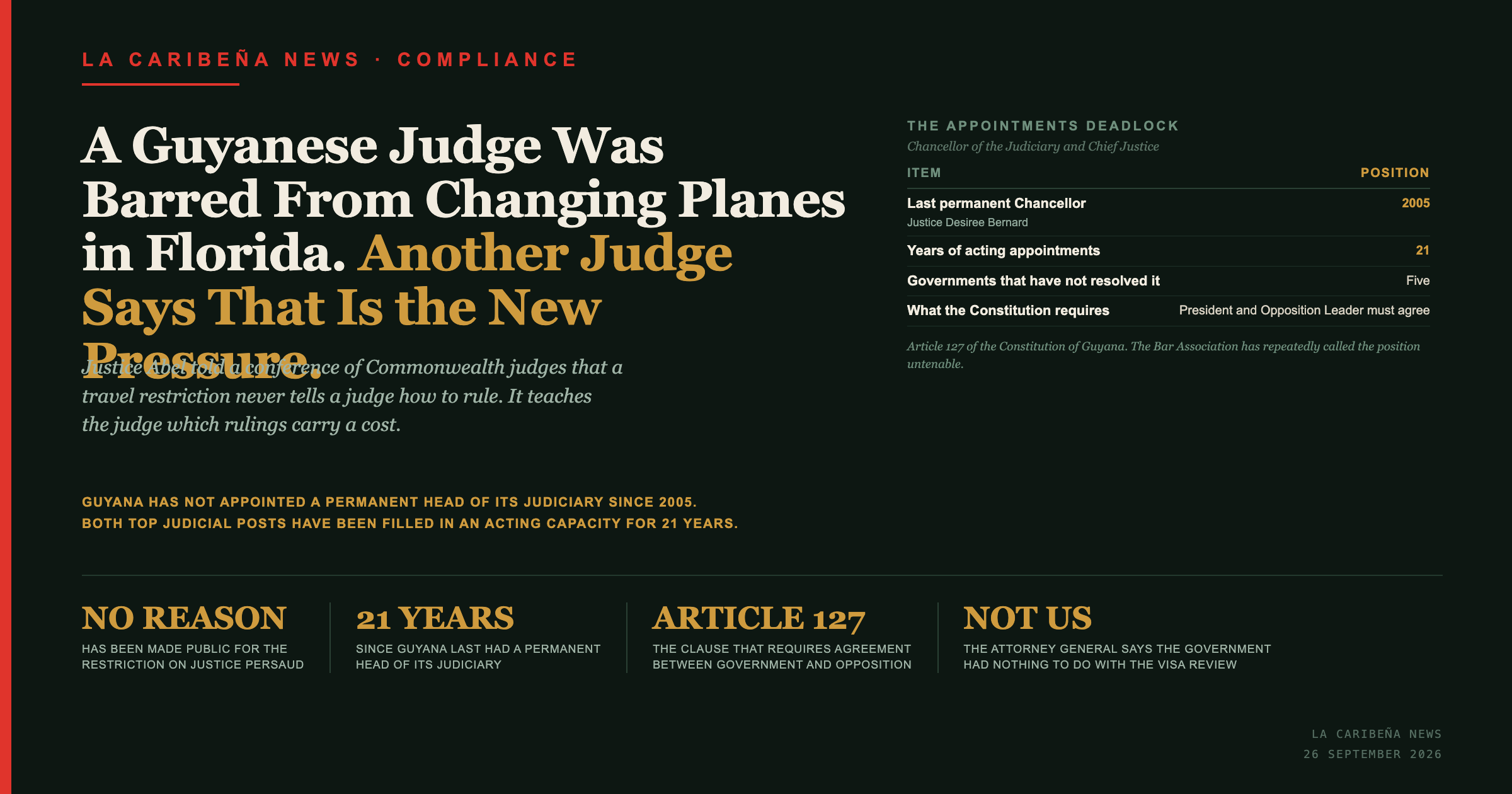
Appointments that never become permanent. Justice Abel criticised Guyana's failure to fill its two most senior judicial posts substantively, and called the reliance on long-term acting roles "permanent temporariness".
Article 127 of Guyana's Constitution requires the President to obtain the agreement of the Leader of the Opposition before appointing the Chancellor of the Judiciary and the Chief Justice. Agreement has not been reached since 2005, when Justice Desiree Bernard was the last substantive Chancellor. The Guyana Bar Association has called the position untenable and has repeatedly asked for confirmations, Stabroek News reported in January 2025.
| Position | |
|---|---|
| Last substantive Chancellor | Justice Desiree Bernard, to 2005 |
| Years since | Twenty-one |
| Presidential administrations spanned | Five |
| Constitutional requirement | Article 127: the President appoints after obtaining the agreement of the Leader of the Opposition |
| Effect | Both senior judicial offices held in an acting capacity |
Source: Article 127 of the Constitution of Guyana, and reporting of the Guyana Bar Association's repeated calls for confirmation.
Why does this sit on a business page?
Because a court is the last resort in every commercial relationship a country has. Contract enforcement, security over assets, the winding up of a company, the review of a regulator's decision and the arbitration of a concession all end in the same building. An investor's counsel prices the independence of that building, whether or not anybody says so out loud.
Guyana's own commercial disputes have been reaching courts and tribunals steadily. Argentina's Falklands injunction showed what a national court can and cannot reach, in An Argentine Judge Halted the Falklands Oilfield, and Guyana has promised five mining companies that if the law changes the state pays, in Guyana Has Promised Five Mining Companies That If the Law Changes, the State Pays. A stability clause is worth what the forum enforcing it is worth.
What does a visa have to do with a judgment?
Nothing directly, which is the point Justice Abel was making. A transit restriction imposes no instruction. It attaches a cost to a person, and the person happens to hold judicial office. His argument is that the cost is what does the work, without anyone having to say what the cost is for.
No reason for the restriction on Justice Persaud has been made public by the United States, and none appears in the reporting. The Attorney General's statement addresses the Guyanese government's role and does not speak to Washington's reasons.
Where does this sit regionally?
The Commonwealth Magistrates and Judges Association conference is the forum where Caribbean judiciaries compare notes on exactly this. The region's compliance institutions have been meeting on a similar cycle, reported in Lima Hosts the Hemisphere's Compliance Congress in September.
Visa measures have been used in this region before, against people who are not judges. Washington went after the visas of a Patagonian power co-operative's directors over a supplier choice, in A Patagonian Power Co-op Chose Huawei, and restricted Antigua and Dominica in December before a deportee agreement was signed the next day, in Washington Restricted Antigua and Dominica on 16 December.
Article 127 has not changed since 2005 and can be changed only by those it binds. The visa decision belongs to a government that has given no reason for it.
What the title card shows
- Justice Gino Persaud: the Guyanese High Court judge barred by the United States from transiting Florida.
- "It may merely teach the judge what decisions are costly": Justice Abel, describing how a modern pressure on judicial independence works without instructing anyone.
- Twenty-one years: since Guyana last had a substantive Chancellor of the Judiciary, Justice Desiree Bernard, who served to 2005.
- Article 127: requires the President to obtain the agreement of the Leader of the Opposition before appointing the Chancellor and the Chief Justice. Agreement has not been reached across five administrations.
- The government's position: Attorney General Anil Nandlall said it had nothing to do with the United States review of the judge's visa.
Frequently Asked Questions
What did Justice Abel say?
That the United States decision barring Justice Gino Persaud from transiting Florida has serious implications for judicial independence, and that Guyana's long-term reliance on acting appointments to its two most senior judicial offices is a second pressure. He described the latter as "permanent temporariness".
Who appoints Guyana's Chancellor and Chief Justice?
The President, after obtaining the agreement of the Leader of the Opposition, under Article 127 of the Constitution. That agreement has not been reached since 2005, so both offices have been held in an acting capacity.
Has the government responded?
Attorney General Anil Nandlall said on 23 September that the government had nothing to do with the United States review of the judge's visa.
Why does judicial independence matter commercially?
Because contract enforcement, security over assets, insolvency, regulatory review and concession disputes all end in court. The value of a legal protection depends on the forum that enforces it.