By LCN Business Desk
A payment system has two dates. The one its builder gives, and the one it opens on. CAPSS has the first. The second does not exist, and the meeting that will set it has not been held.
What did the governors decide in Belize?
Two things about payments, and they are separate pieces of work. The Central Bank of Belize hosted the 67th Bi-Annual Meeting of the CARICOM Central Bank Governors on 19 and 20 November, chaired by Governor Kareem Michael. Ten governors are named on it.
A conference ran alongside it. There, the Governor of the Central Bank of Trinidad and Tobago called the effect of high energy prices a macroeconomic policy paradox, and urged diversification first.
On payments, the governors "endorsed the development of a strategic roadmap to accelerate interoperable payments across the region, to be led by the Bank of Jamaica with support from the Eastern Caribbean Central Bank". Separately they took a status update on CAPSS, the CARICOM Payment and Settlement System. They agreed that "potential pilot banks in the participating countries will soon be approached to take part".
Soon is not a date. Approached is not signed. The statement gives neither. Four Caribbean governors met a team from the same African system in Port of Spain in September.
Who is actually in the pilot?
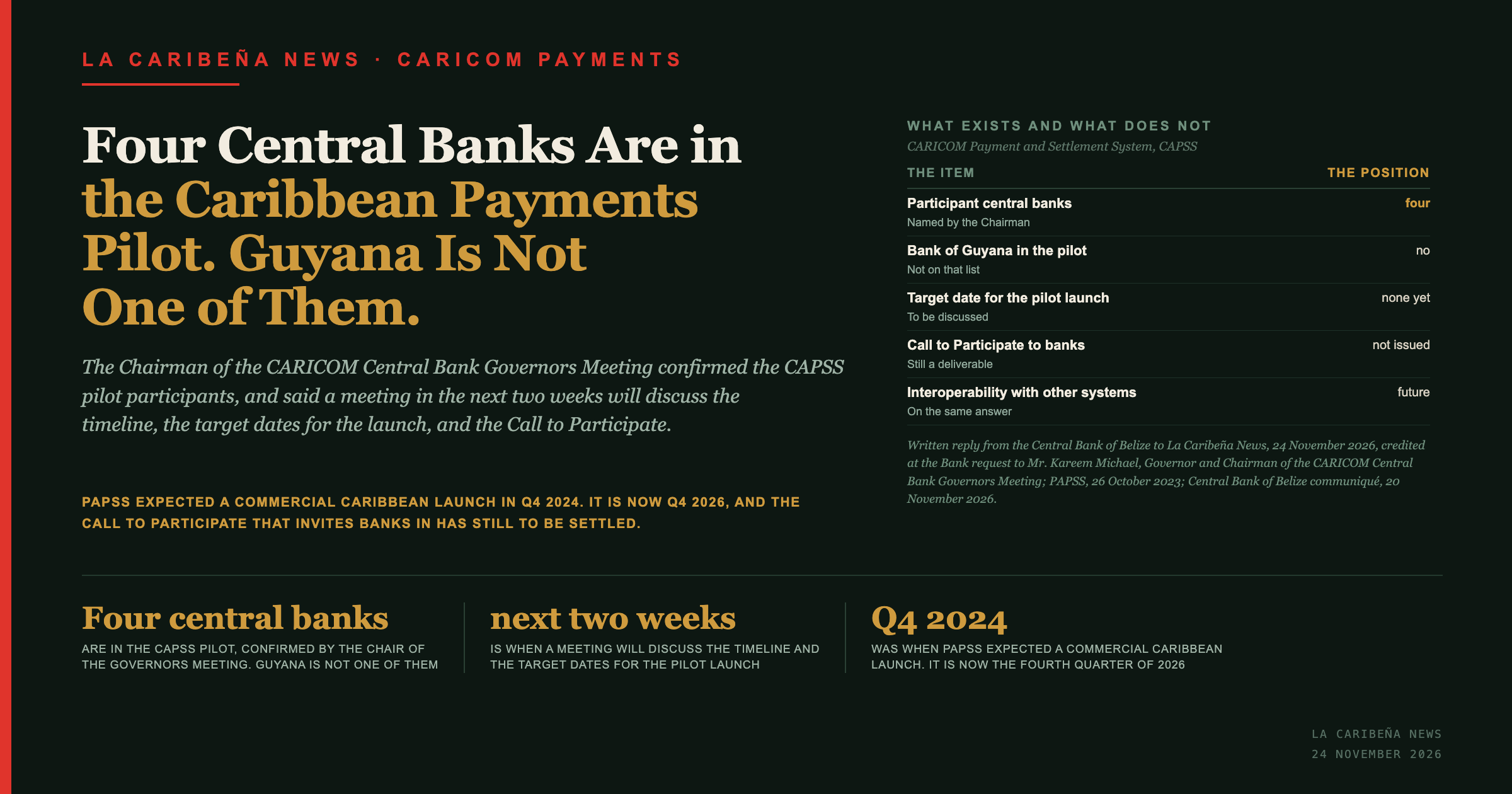
The same four this newspaper reported in September. Kareem Michael is Governor of the Central Bank of Belize and chairs the CARICOM central bank governors' meeting. He set the list out in writing on 24 November:
"Eastern Caribbean Central Bank (ECCB), Central Bank of The Bahamas, Central Bank of Barbados, and Central Bank of Trinidad and Tobago."
Those are the four governors who met a team from the Pan-African Payment and Settlement System in Port of Spain on 18 September. What the answer adds is authority and one deletion: it comes from the chair of the governors' meeting rather than from a national central bank's account of a meeting, and it leaves Suriname out.
One of the four is a currency union rather than a country. The ECCB issues for eight members: Anguilla, Antigua and Barbuda, Dominica, Grenada, Montserrat, St Kitts and Nevis, St Lucia, and St Vincent and the Grenadines. The territories behind the four banks number eleven, which is where the eleven of the earlier announcements comes from. Four banks is the stated figure; eleven follows from the ECCB's membership, and no announcement on the public record puts it that way.
Belize is not on it either, though its Governor chairs the meeting. Nor is Jamaica, which is leading the separate roadmap.
When will it launch?
There is no launch date, and the meeting that will set one has not been held.
The communique said pilot banks "will soon be approached". On the date of that approach, and on the launch target, Governor Michael said:
"A meeting will be convened in the next two weeks to discuss timeline and other key deliverables, which include the target dates for the launch of the Pilot and a Call to Participate to banks and other payment service providers."
The timeline is to be discussed. The target dates for the pilot launch are among the deliverables of that discussion. And the Call to Participate, the step by which banks are actually invited in, is itself one of the things the meeting has to settle.
So "soon be approached" describes an invitation that has not been drafted, on a timetable that has not been agreed, four years after the African system it is modelled on went live in Accra.
How does the Jamaica roadmap fit?
Separately. And joining the two up is not part of the pilot.
The governors endorsed a Bank of Jamaica roadmap for interoperable payments in the same communique that reported the CAPSS update, which left open whether the two are one programme. On that, Governor Michael said:
"This is a consideration for BoJ but will not affect the pursuit of a regional payments system during pilot phase. Interoperability of CAPSS with other payment systems is a future consideration."
A business paying across the region does not care which programme owns the rail. It cares whether the rail connects to the one its bank already uses. On that answer, the connection is not something the pilot is being built to do. It comes later.
Who actually has to join?
Banks and the firms that move money for them, and none has been invited.
The Call to Participate goes to "banks and other payment service providers", on Governor Michael's answer. That phrase is not loose. On the African system's own description, the bodies that connect to it are its Participants: commercial banks, payment service providers and other financial intermediaries. Central banks build the rail. Participants are what a business actually touches.
Recruiting them took the African original years. PAPSS had brought over 25 commercial banks onto its system by March 2024, two years after it launched in Accra. At the same Lagos discussion, fintech firms were pressing for a route in rather than waiting to be asked, among them Oluwatimi Adesoji, head of backend engineering at the payments firm Kora.
That is the gap a Caribbean business should watch. A central bank joining is a decision by one institution. A rail a shopkeeper can use needs the bank that holds the account, and in the Caribbean no bank has yet been asked.
One of the four has said what it expects the system to do. The Eastern Caribbean Central Bank told its Monetary Council that CAPSS "will facilitate instant cross-border payments in local currencies, reducing transaction costs and reliance on correspondent banking". It carries CAPSS as one of two flagship payment initiatives under a programme it calls The Big Push. The other is a Fast Payment System for real-time payments inside the currency union, which is domestic and does not wait on eleven territories.
When was this supposed to launch?
Two years ago. The system's own operator said so in writing. PAPSS announced on 26 October 2023 that the Caribbean's central banks had adopted it. Its release ends on a date:
"An official commercial launch of the system in the Caribbean region is expected to occur in Q4 2024."
It is now the fourth quarter of 2026. The same release says the pilot exists "to identify any problems with the system before it is fully implemented".
| Date | What was said | Who said it |
|---|---|---|
| 13 January 2022 | PAPSS launches in Accra | PAPSS |
| 26 October 2023 | "All eleven Central Banks have unanimously adopted PAPSS". Commercial Caribbean launch expected Q4 2024 | PAPSS |
| February 2025 | Proof of concept at the Central Bank of The Bahamas. A live payment settles in each country's own currency, no dollars between them | Global Finance |
| 25 June 2025 | A "resounding success", and "full implementation should not be a prolonged process" | Afreximbank's Caribbean office |
| 13 October 2026 | CAPSS "has entered its pilot phase"; November is "the next point at which the timetable could firm up" | Global Finance |
| 20 November 2026 | Pilot banks "will soon be approached" | CARICOM governors |
| 24 November 2026 | A meeting "in the next two weeks" will discuss the timeline, the target dates for the pilot launch and the Call to Participate | Chairman of the governors' meeting |
The language gets softer as the dates get later. Nothing in the Belize statement says the timetable slipped. Nothing says it held.
What has actually been tested?
More than has been described. One transfer has been set out in detail, and the testing did not stop there.
In February 2025, at the Central Bank of The Bahamas, a live transfer settled in each country's own currency. No dollars passed between them. The payments software firm Montran Corp built the link between the two national systems. That is the only test anyone has described in that much detail.
It was not the last. Governors widened the test at their 65th meeting in November 2025. They took a status update at the 67th in November 2026. Global Finance reported in October that CAPSS had entered its pilot phase. On the public record this newspaper can find, no result from any of that has been published.
So the testing has carried on for twenty-one months and the findings have not. What a reader can check is one proof of concept from early last year.
Published accounts had differed on one name. Suriname was listed among the participants in one account of the February test and described as sending an observer in another. Governor Michael's list leaves Suriname out.
In Abuja that June, Okechukwu Ihejirika of Afreximbank's Caribbean office called the test a "resounding success". He said the governors had agreed to widen it to floating currencies as well as those fixed to the dollar. He added that "with the success of the pilot, full implementation should not be a prolonged process".
What does the wait cost a Caribbean business?
It leaves them on a shrinking rail. About 40 per cent of correspondent banks left the Caribbean over the previous fifteen years, on 2024 research by the Economist Intelligence Unit. Those are the banks abroad that carry a regional payment when it travels as dollars.
An IMF working paper of May 2026, Mind the Gaps: Caribbean Trade Patterns and the Connectivity Constraint, found that cross-border banking ties lift CARICOM trade at less than half the global rate. Intra-CARICOM goods exports are about 8 per cent of the bloc's goods exports, on IMF figures. The Africa side is smaller still: interregional trade with Africa stands at US$729 million, after the International Trade Centre and Afreximbank cut their projection for Africa-Caribbean trade by a fifth.
Ihejirika gave the example of a buyer without dollars. "If for instance, I am in Barbados and I want to buy goods from Trinidad and I don't have the U.S. dollars to make that payment, then it becomes simply wishful thinking. We think that stifles trade."
Does CAPSS actually take the dollar out?
Not entirely. The announcements leave this part out. Timothy Antoine, Governor of the Eastern Caribbean Central Bank, told Global Finance that "while background settlements will still involve U.S. dollars among central banks, day-to-day transactions will use local currencies".
So the dollar does not leave. It moves to the back, where central banks carry it instead of firms. That matters most where dollars are rationed: the Dominican central bank handled 93 per cent of spot dollar trades in 2019 and about 10 per cent now, while Trinidad and Guyana still decide who gets them. For a business paying a supplier that is a real saving. It strips out two swaps and a bank abroad. It also means a central bank joining the system takes on the dollar leg itself. The African original now connects banks and payment providers across 16 countries. In Guyana, the commercial banks told President Irfaan Ali that unmet requests for foreign currency stand at just over US$200 million.
Where does Guyana stand?
Outside the pilot, and now confirmed by the chair.
Governor Michael's list does not include it. This newspaper reported in September that Guyana signed with India's NPCI International in November 2024 and is not in the regional system's pilot group. The chairman's answer puts that on his own authority. Guyana is building a national platform on a different model.
Guyana appears once in the Belize statement, in its last line: Dr. Gobind Ganga, its Governor, chairs the 68th meeting in May 2027. The country outside the pilot takes the chair at the next meeting of the governors running it.
Dr. Ganga and his team did not respond to questions put on 24 November. They were asked three things. Whether Guyana is one of the pilot jurisdictions, and what would have to change for it to join. Where the Bank's own payments work stands, and whether its platform will connect to CAPSS. And what joining would require of Guyana's foreign reserves.
Staying on the old rail has a cost. When the Guyana Development Bank opened in October with a first tranche of US$100 million, an importer buying from Ghana found the payment still had to leave in United States dollars. A furniture exporter asked why a small business cannot open a United States dollar account, and Dr. Ganga asked her why she wanted one. On 4 November he said routinely opening foreign-currency accounts is too risky.
Households are on the same plumbing. Guyana's commercial banks took in US$81.5 million of arriving remittances in the first quarter of 2026 against US$62.8 million through the agencies, the first quarter in which the banks carried more. The bank channel is also the dearest way to send money, on the de-risking record.
What the title card shows
- The CAPSS pilot participants are the Eastern Caribbean Central Bank, the Central Bank of The Bahamas, the Central Bank of Barbados and the Central Bank of Trinidad and Tobago. Source: Kareem Michael, Governor of the Central Bank of Belize and chairman of the CARICOM central bank governors' meeting, in writing, 24 November 2026. - The Bank of Guyana is not among the named pilot participants. Source: Kareem Michael, Governor of the Central Bank of Belize and chairman of the CARICOM central bank governors' meeting, in writing, 24 November 2026. - A meeting will be convened in the next two weeks to discuss timeline and other key deliverables, which include the target dates for the launch of the pilot and a Call to Participate to banks and other payment service providers. Source: Kareem Michael, Governor of the Central Bank of Belize and chairman of the CARICOM central bank governors' meeting, in writing, 24 November 2026. - Interoperability of CAPSS with other payment systems is a future consideration, and the Bank of Jamaica roadmap will not affect the pursuit of a regional payments system during the pilot phase. Source: Kareem Michael, Governor of the Central Bank of Belize and chairman of the CARICOM central bank governors' meeting, in writing, 24 November 2026. - The Bank of Guyana did not respond to questions put to its Governor and his team on 24 November 2026. Source: La Caribena News correspondence. - PAPSS said on 26 October 2023 that a commercial launch of the system in the Caribbean region was expected in Q4 2024. Source: PAPSS press release, 26 October 2023. - CARICOM's central bank governors said on 20 November 2026 that potential pilot banks will soon be approached. Source: Central Bank of Belize, 20 November 2026. - About 40 per cent of correspondent banks withdrew from the Caribbean over the previous fifteen years. Source: Economist Intelligence Unit research, 2024, reported by Global Finance. - Intra-CARICOM goods exports are about 8 per cent of the bloc's total goods exports. Source: IMF, reported by Global Finance. - The 68th meeting falls in May 2027, chaired by Dr. Gobind Ganga of the Bank of Guyana. Source: Central Bank of Belize, 20 November 2026.
The entities
- PAPSS: the Pan-African Payment and Settlement System, launched in Accra in January 2022 and developed by the African Export-Import Bank. - CAPSS: the CARICOM Payment and Settlement System, the Caribbean system built on the PAPSS model and now in a pilot phase. - Afreximbank: the African Export-Import Bank, which developed PAPSS and whose Caribbean office supports the Caribbean work. - Kareem Michael: Governor of the Central Bank of Belize and chairman of the CARICOM central bank governors' meeting, who gave the pilot participant list and the position on the timeline. - Central Bank of Belize: host of the 67th meeting, whose Governor Kareem Michael chaired it. - Eastern Caribbean Central Bank (ECCB): the currency union's central bank, supporting the Bank of Jamaica on the interoperable payments roadmap. - Bank of Guyana: whose Governor, Dr. Gobind Ganga, chairs the 68th meeting in May 2027.
Frequently asked questions
When was CAPSS supposed to launch commercially?
PAPSS said in its release of 26 October 2023 that an official commercial launch of the system in the Caribbean region was expected to occur in Q4 2024. That quarter passed two years ago. The governors said on 20 November 2026 that pilot banks will soon be approached, without giving a date.
Which countries are in the pilot?
Four central banks: the Eastern Caribbean Central Bank, the Central Bank of The Bahamas, the Central Bank of Barbados and the Central Bank of Trinidad and Tobago, on the answer given by the chairman of the governors' meeting on 24 November 2026. The Eastern Caribbean Central Bank issues for eight members, so eleven territories sit behind the four banks. Suriname is not among them, which settles earlier accounts that had differed on the point.
When will CAPSS launch?
No target date has been set. The chairman of the governors' meeting said on 24 November 2026 that a meeting would be convened in the next two weeks to discuss the timeline and other key deliverables, among them the target dates for the launch of the pilot and the Call to Participate that invites banks and other payment service providers in.
Is Guyana in it?
No. The chairman's list does not include the Bank of Guyana. Guyana signed with India's NPCI International in November 2024 and is building a national payments platform on that model. Its Governor chairs the next governors' meeting in May 2027.
Does the system remove the United States dollar from Caribbean payments?
Not completely. The Governor of the Eastern Caribbean Central Bank has said background settlements between central banks will still involve dollars, while day-to-day transactions use local currencies. The saving falls to the business making the payment rather than to the central bank carrying it.
Why does any of this matter to a trading company?
Because about 40 per cent of correspondent banks have left the Caribbean over fifteen years, and those banks are what carry a regional payment when it travels as dollars. An IMF paper of May 2026 found cross-border banking relationships lift CARICOM trade at less than half the global rate.