By LCN Business Desk
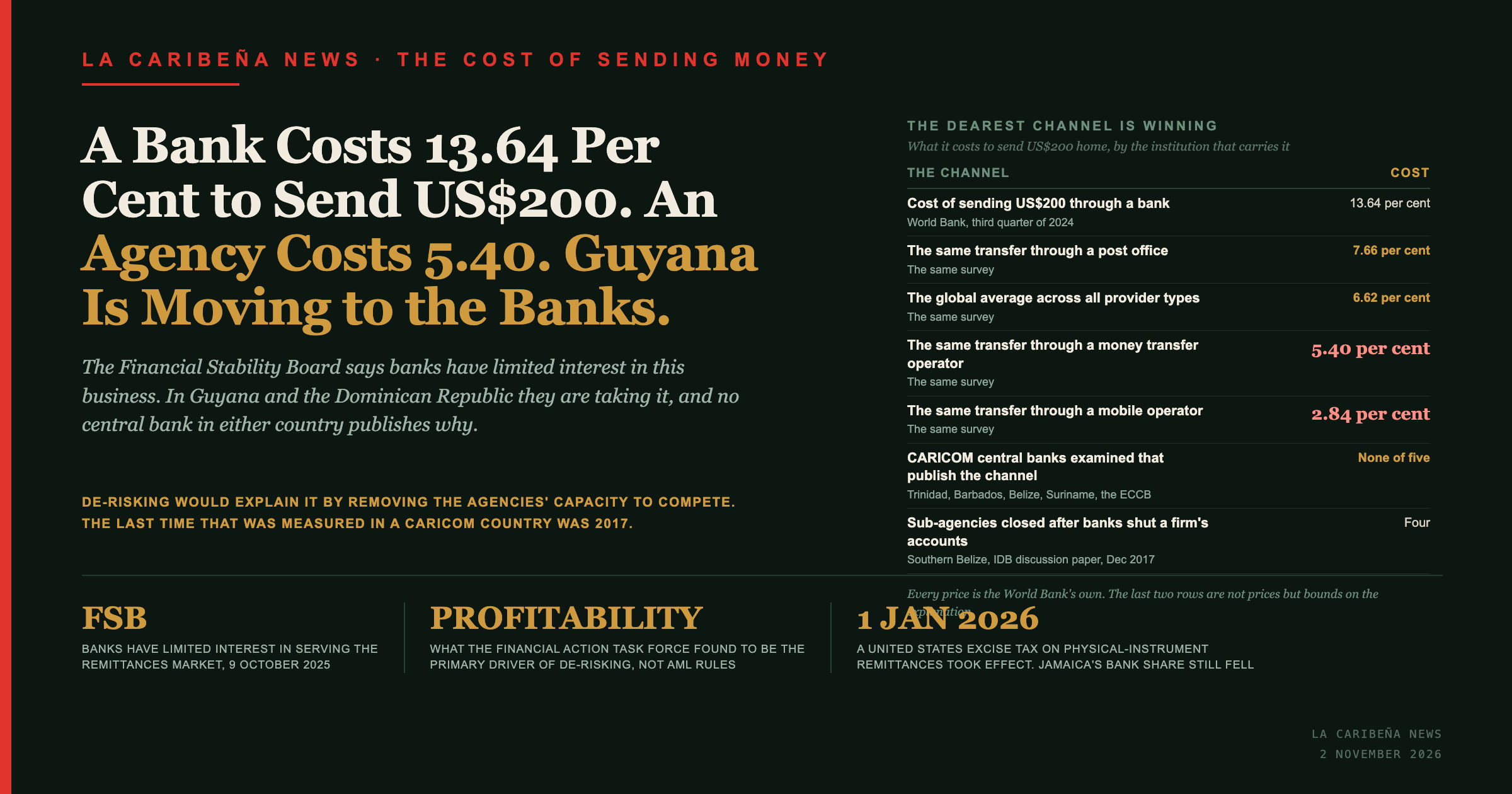
The World Bank prices the cost of sending money home by the type of institution that carries it. On a US$200 transfer in the third quarter of 2024 it put banks at 13.64 per cent, post offices at 7.66, money transfer operators at 5.40 and mobile operators at 2.84, against a global average of 6.62. Its own commentary is that banks *"have been firmly above the Global Average, whereas MTOs and mobile operators have remained below."*
The Financial Stability Board (FSB) put the supply side plainly on 9 October 2025: *"There is weak competition as banks have limited interest in serving the remittances market, but non-bank PSPs lack direct access to payment systems."*
So the dearest channel, run by institutions a standard-setter describes as uninterested in the business, is the one gaining share in two Caribbean countries. Guyana's remittances moved into the banks and Jamaica's moved the other way, and on those economics Jamaica is the ordinary case.
Why would remittance business move to the most expensive channel?
No central bank in the countries concerned publishes an explanation, and no global trend is available to supply one.
No international institution publishes a measured series of money transfer operator share against bank share. The World Bank's survey counts services and prices them; it does not measure volumes by channel. Its own definition of a digital remittance includes bank account to bank account transfers, so the familiar cash-to-digital story cannot be pointed in either direction here.
Outside the region the clearest comparator runs the same way as Jamaica. The Reserve Bank of Fiji reported mobile money at 46.1 per cent of inward remittances in its March 2026 quarter, with *"transfers via foreign exchange dealers and banks declined"* over the same period. Fiji also publishes this as a routine quarterly statistic, which is worth knowing because it shows the measurement is ordinary somewhere.
Is de-risking the mechanism?
It is a candidate with a documented precedent in CARICOM, and nobody has measured whether it still operates.
The mechanism would not work through what households choose. It would work by removing the agencies' capacity to compete. An Inter-American Development Bank discussion paper on Belize, published in December 2017, records it happening: *"At least two banks have now de-risked or closed the accounts of local money remittance agents, with at least one major remittance firm closing four subagencies in Southern Belize."* The paper's own warning is that enhanced due diligence on remittance firms *"could adversely affect the volume of remittance receipts through conventional channels, as well as enable funds to be funneled into the informal economy."*
Guyana's agency credits fell in each of the four completed years. A measured channel falling is also not proof of where the money went: that and money moving to another measured channel are not the same event.
Three things bound the candidate.
The Belize evidence is nine years old. The United States Treasury's own de-risking strategy of April 2023 states that *"There is no current data to determine whether the MTO sector continues to experience a significant loss of access to banking services."*
The cause is not the one usually assumed. The Financial Action Task Force's stocktake of October 2021 found that *"profitability concerns are the primary driver"* of de-risking, that *"AML/CFT rules are not the main cause of de-risking, but can be a related factor"*, and that on the effects *"the data are unclear on the extent and impact of these phenomena."*
And the pressure does not run only one way. Correspondent banking withdrawal, which the International Monetary Fund named Guyana among affected countries for in 2016, strips banks rather than agencies of dollar clearing. This newspaper has reported the European Union court ruling that appearing on a US sanctions list does not, by itself, justify a bank refusing to open an account.
Did a United States tax change the instrument?
One took effect on 1 January 2026 and it falls on physical instruments only, which is the period the newest readings cover.
The Bank of Jamaica's 2025 annual report describes a 1 per cent United States excise tax on remittances, effective at the start of this year, applying to cash, a money order, a cashier's cheque or any other physical instrument, and says only that *"The Bank will assess the impact of the tax on remittance flows to Jamaica."*
The timing invites the inference and the figures do not support it. Guyana's first quarter of 2026 and the Dominican Republic's first nine months are both the highest bank readings in their series, and both fall after that date. Jamaica's bank channel also began growing in level in the same year. But Jamaica's bank share kept falling through those months, which a tax penalising cash-based instruments would not produce. No central bank has connected the tax to channel composition.
Which Caribbean central banks publish the channel at all?
None of five. The regional practice is to supervise the channel without measuring it publicly.
| Central bank | Publishes remittances | Publishes the channel |
|---|---|---|
| Trinidad and Tobago | as `Secondary Income, net` | No |
| Barbados | `Of which: Workers' remittances` | No |
| Belize | a headline inflows indicator | No |
| Suriname | balance of payments secondary income | Not established |
| Eastern Caribbean Central Bank | the full BPM6 hierarchy, eight territories | No |
*Each bank's own published statistics. Suriname is recorded as unestablished rather than as a negative.*
What Barbados and the Eastern Caribbean do publish is `Personal transfers` and, beneath it, `Of which: Workers' remittances`. Both are splits by who sent the money, not by what carried it, and reporting either as a channel figure would be wrong. Three of the five publish a register of the remittance firms they license and no volumes at all.
Two of those rows carry a finding of their own. Barbados' published remittance series ends in 2017, so the country has no figures at all for the period under discussion. And the Eastern Caribbean's workers' remittance credits fall across 2023 to 2025, from EC$727.52 million to EC$704.91 million, which says nothing about channel and is the only directional movement the region's shared central bank makes available.
What is missing from Haiti's figures?
The channel is in the title of the series, and what it excludes is not stated.
The Banque de la République d'Haïti publishes a remittance series titled *"transferts reçus de l'étranger en USD par pays via les maisons de transfert"*. Its rows are countries, not institutions. But *maisons de transfert* is the name of one of the two transfer categories the bank supervises, the other being bank transfer divisions, and it licenses both separately: six money transfer houses on one register and three bank transfer divisions on another, with no volumes on either page.
Whether the national figure excludes those divisions or uses the phrase loosely is not stated anywhere in its published material. On the figures it does publish, transfers received through money transfer houses reached US$4,435.4 million in the fiscal year to September 2025.
What should a reader do with a regional remittance figure?
Read it as money arriving, and not as a statement about the institution that handled it.
Three Caribbean countries publish the channel and they do not agree on its direction. The countries that would settle a regional claim publish nothing. So a lender sizing household income, a ministry citing regional growth or a firm pricing a remittance product has figures for the volume and none for the route.
That is also the reason an international estimate of a Caribbean remittance market describes only the volume. Guyana was among the nine countries the development bank estimated rather than measured in the first quarter of 2026, and Caribbean inflows rose 10.8 per cent in 2025, led by Haiti, then slowed to 5.9 per cent in early 2026 on figures that carry no channel at all.
The entities
- World Bank is the development institution whose Remittance Prices Worldwide survey prices the cost of sending money by provider type.
- Financial Stability Board (FSB) is the international body that monitors the global financial system and reports on cross-border payments.
- Financial Action Task Force is the international standard-setter on money laundering and terrorist financing, whose 2021 stocktake examined de-risking.
- Inter-American Development Bank is the regional development bank whose December 2017 discussion paper examined de-risking in Belize.
- International Monetary Fund is the institution that named Guyana among the countries affected by correspondent banking withdrawal in 2016.
- Reserve Bank of Fiji is Fiji's central bank, which publishes remittance channel composition quarterly.
- Bank of Jamaica is Jamaica's central bank, whose annual report describes the United States excise tax on remittances.
- Eastern Caribbean Central Bank is the shared central bank of eight Eastern Caribbean territories.
- Banque de la République d'Haïti is Haiti's central bank, which supervises both money transfer houses and bank transfer divisions.
- De-risking is the practice of a financial institution ending or restricting a business relationship to avoid rather than manage risk.
- Money transfer operators are the non-bank firms licensed to move money across borders, recorded by some central banks as a separate channel.
What the title card says
- Headline: a bank costs 13.64 per cent to send US$200, an agency costs 5.40, and Guyana is moving to the banks.
- Cost of sending US$200 through a bank, third quarter of 2024: 13.64 per cent. Source: the World Bank.
- The same transfer through a money transfer operator: 5.40 per cent. Same source.
- The same transfer through a mobile operator: 2.84 per cent. Same source.
- The global average across all provider types: 6.62 per cent. Same source.
- CARICOM central banks among the five examined that publish the channel: none of five.
- Sub-agencies closed in Southern Belize after banks closed a remittance firm's accounts: four. Source: an Inter-American Development Bank discussion paper of December 2017.
- What the Financial Action Task Force found to be the primary driver of de-risking: profitability concerns.
- The Financial Stability Board, 9 October 2025: banks have limited interest in serving the remittances market.
- The year a Caribbean remittance firm's loss of banking access was last documented: 2017.
- The date a United States excise tax on physical-instrument remittances took effect: 1 January 2026.
Frequently Asked Questions
What does it cost to send money home through a bank?
The World Bank put the cost of a US$200 transfer through a bank at 13.64 per cent in the third quarter of 2024, against 5.40 per cent through a money transfer operator, 7.66 through a post office and 2.84 through a mobile operator. The global average across all provider types was 6.62 per cent, and the World Bank notes that banks have been firmly above it.
Why is it surprising that banks are gaining remittance share?
Because they are the dearest channel and the Financial Stability Board reported in October 2025 that banks have limited interest in serving the remittances market. If cost and appetite drove the outcome, the agencies would be winning, which is what Jamaica's figures show.
Does de-risking explain the shift?
It is a candidate rather than a finding. An Inter-American Development Bank paper of December 2017 records banks in Belize closing the accounts of a major remittance firm, which closed four sub-agencies. The United States Treasury stated in 2023 that there is no current data on whether the sector is still losing banking access, and the Financial Action Task Force found in 2021 that profitability rather than anti-money-laundering rules is the primary driver of such decisions.
Did the new United States tax on remittances cause it?
Nothing published supports that. The tax took effect on 1 January 2026 and applies to cash, money orders, cashier's cheques and other physical instruments. Guyana's and the Dominican Republic's highest bank readings fall after that date, but Jamaica's bank share continued to fall through the same months, which a tax on physical instruments would not produce.
How many Caribbean central banks publish which institution carried a remittance?
Three publish it: Guyana, the Dominican Republic and Jamaica. Among Trinidad and Tobago, Barbados, Belize, Suriname and the Eastern Caribbean Central Bank, none does, and three of those publish a register of the firms they license with no volumes attached. Barbados' published remittance series ends in 2017.