By LCN Business Desk
When a regional remittance figure is quoted in a budget speech or a lending note, it arrives as a single number for Latin America and the Caribbean. Behind it sit twenty-three countries, and the worker's remittances recorded for them are not all counted the same way.
The Inter-American Development Bank says so itself, in a box headed Data Sources near the top of its post of 16 June 2026. Fourteen countries had released official first-quarter data. The bank estimated the other nine.
"The 2026 data presented here are based on official remittance flow data reported by 14 countries in the first quarter and estimates for the remaining nine countries." INTER-AMERICAN DEVELOPMENT BANK, 16 JUNE 2026
Which countries were measured and which were estimated?
Fourteen reported official data, covering 89 per cent of regional flows. The rest were modelled.
| Countries | |
|---|---|
| Measured, from official first-quarter data | Bolivia, Brazil, Chile, Colombia, El Salvador, Guatemala, Haiti, Honduras, Jamaica, Mexico, Paraguay, Peru, the Dominican Republic, Suriname |
| Estimated in-house | Argentina, Guyana, Uruguay, Ecuador, Belize, Costa Rica, Nicaragua, Panama, Trinidad and Tobago |
*Source: Box 1, Data Sources, in the post cited above. The bank puts the fourteen measured countries at 89 per cent of total remittance flows to the region, and notes that data for Bolivia, Brazil, Colombia, El Salvador, Guatemala, Honduras, Mexico and the Dominican Republic run through April 2026.*
The split does not follow geography, size or income. It follows one thing only, which the bank names: whether the country had released its official first-quarter figures by the time the bank published.
That produces a result worth holding on to in the Caribbean. Suriname is in the measured fourteen. Guyana, its neighbour on the same mainland and in the same community, is in the estimated nine. So are Belize and Trinidad and Tobago.
How did the bank produce the estimates?
From the behaviour of other countries and of each country's own past.
The bank describes the method in one clause: the in-house estimates were made "based on historical data series and correlations with other countries in the region". A country that has not reported is therefore assigned a figure derived in part from countries that have.
What happens when one of the estimates can be checked?
For Guyana it can now. The bulletin puts the rise well beyond what the bank assumed.
The bank put Guyana's first-quarter growth at 9.2 per cent. Guyana's own first-quarter figures are now on the Bank of Guyana's website, in the Quarterly Report and Statistical Bulletin for March 2026, the only 2026 edition it has published. The bulletin records worker's remittance credits of US$185.4 million for January to March, against US$140.1 million in the same period of 2025.
| Guyana, first quarter | Figure |
|---|---|
| Inter-American Development Bank, estimated June 2026 | Growth of 9.2 per cent |
| Bank of Guyana, credits recorded | US$185.4 million, against US$140.1 million |
*Both figures describe money arriving, so they are comparable in direction. The bulletin's credits line is the official record of it.*
The estimate understated what arrived. It also could not describe what left, because the bank's figures for the region are receipts: transfers out of Guyana reached US$123.9 million in the first quarter against US$52.7 million a year earlier, and the net the country retained fell. Across the central bank's bulletins since 2022, departures grew faster, and the share they take has risen without interruption.
One country of nine is not a verdict on a method. It is the first of the nine whose answer can be looked up, and for that one the gap is wide in both respects.
What did the bank report for the region?
Growth of 5.7 per cent in the first quarter, slower than 2025 and below the average of the past decade.
| Subregion, US$ million | Q1 2025 | Q1 2026 | Growth |
|---|---|---|---|
| Central America | 12,422.2 | 13,553.4 | 9.1% |
| South America | 8,221.7 | 8,686.4 | 5.7% |
| Caribbean | 4,934.9 | 5,225.6 | 5.9% |
| Mexico | 14,379.5 | 14,753.3 | 2.6% |
| Latin America and the Caribbean | 39,958.2 | 42,230.7 | 5.7% |
*Inter-American Development Bank, table 1, 16 June 2026, described by the bank as authors' calculations based on data from central banks, statistical offices and IDB estimates.*
Two of those rows carry more estimated countries than the others. Central America's includes Panama, Costa Rica, Nicaragua and Belize; South America's includes Argentina, Guyana, Uruguay and Ecuador. The Caribbean row is the most heavily measured of the four: of the countries the bank names when describing that subregion, only Trinidad and Tobago was estimated.
The bank also records that the 2025 regional total reached US$173.7 billion, up 7.3 per cent, within 0.4 per cent of the forecast it made the previous November. And it reports no sign so far of an effect from the 1 per cent tax on certain remittances from the United States that took effect on 1 January 2026.
Does the bank treat Guyana as Caribbean elsewhere?
Yes. Its Caribbean Country Department runs Guyana, from an office in Georgetown.
Guyana sits on the South American mainland and is routinely grouped there, so the subregional table placing it with Brazil, Argentina and Ecuador is unremarkable in itself. It reports Guyana at 9.2 per cent in that row, alongside Brazil at 11.0 per cent and Ecuador at 7.5 per cent.
What makes the placement worth knowing is that the same bank administers Guyana as Caribbean. Its Regional Country Department Caribbean is responsible for The Bahamas, Barbados, Guyana, Jamaica, Suriname and Trinidad and Tobago, and is divided into six country offices in those same six places.
| The bank's six Caribbean department countries | Where the remittance post puts them |
|---|---|
| Jamaica, Trinidad and Tobago | Named in the Caribbean subregion |
| Guyana | Reported under South America |
| Suriname | Among the measured fourteen, subregion not named |
| The Bahamas, Barbados | Not named in the post |
*The department's membership is as the bank describes it. The remittance treatment is from the post of 16 June 2026, whose Caribbean passage names Haiti, the Dominican Republic, Jamaica and Trinidad and Tobago, where Caribbean inflows rose 10.8 per cent in 2025, led by Haiti, then slowed to 5.9 per cent in early 2026. Belize it names under Central America.*
So a reader taking the Caribbean row as a reading of the bank's own Caribbean is working from a narrower set than the one it administers under that name.
What does this mean for anyone using the regional figure?
That the number for a given country may be a measurement or may be a model, and the published note says which.
A lender sizing household income in Belize, a ministry citing regional growth, or a firm pricing a remittance product in Trinidad and Tobago is reading a figure the bank itself flags as estimated for those three markets. The bank publishes the list, so a reader can see which category a country falls into.
What follows is a question of publication timing rather than of statistics. Guyana moved out of the estimated group by publishing. The other two CARICOM members in it have not yet been tested against figures of their own.
The entities
- Inter-American Development Bank (IDB) is the regional development bank whose migration blog publishes the quarterly remittance figures described here.
- Box 1 is the data sources note in the bank's 16 June 2026 post, which names the measured and estimated countries.
- Bank of Guyana is Guyana's central bank, which publishes the Quarterly Report and Statistical Bulletin.
- Quarterly Report and Statistical Bulletin is the central bank's statistical publication carrying Guyana's balance of payments transfers.
- Caribbean Community (CARICOM) is the regional community whose members include Guyana, Belize, Trinidad and Tobago, Jamaica, Haiti and Suriname.
- Worker's remittances are personal transfers between households across borders, recorded as credits when they arrive and debits when they leave.
What the title card says
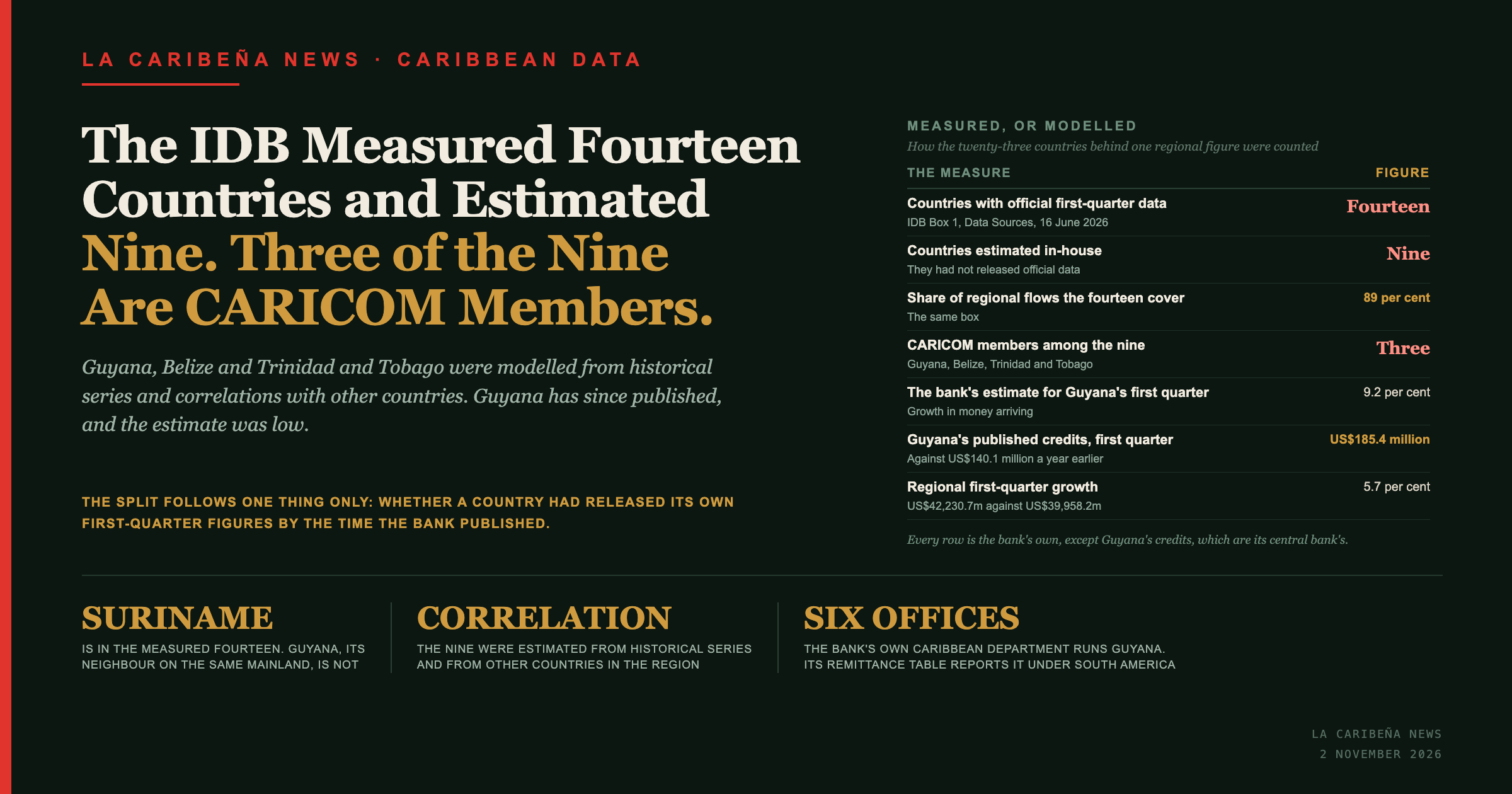
- Headline: the Inter-American Development Bank measured fourteen countries and estimated nine, and three of the nine are CARICOM members.
- Countries with official first-quarter data in the bank's 2026 figures: 14. Source: Inter-American Development Bank, Box 1, 16 June 2026.
- Countries estimated in-house because they had not released official first-quarter data: 9. Source: the same box.
- Share of total regional remittance flows covered by the fourteen measured countries: 89 per cent. Source: the same box.
- CARICOM members among the estimated nine: Guyana, Belize and Trinidad and Tobago.
- Method used for the nine: historical data series and correlations with other countries in the region. Source: the same box.
- The bank's estimate for Guyana's first quarter: growth of 9.2 per cent.
- The Bank of Guyana's published figure: worker's remittance credits of US$185.4 million for January to March 2026, against US$140.1 million a year earlier.
- Regional first-quarter growth: 5.7 per cent, from US$39,958.2 million to US$42,230.7 million. Source: the bank's table 1.
- The 2025 regional total: US$173.7 billion, up 7.3 per cent.
- The bank's Regional Country Department Caribbean covers The Bahamas, Barbados, Guyana, Jamaica, Suriname and Trinidad and Tobago, while its remittance post reports Guyana under South America.
Frequently Asked Questions
How many countries does the IDB actually measure?
Fourteen of the twenty-three in its analysis reported official first-quarter data for 2026: Bolivia, Brazil, Chile, Colombia, El Salvador, Guatemala, Haiti, Honduras, Jamaica, Mexico, Paraguay, Peru, the Dominican Republic and Suriname. The bank puts those fourteen at 89 per cent of total regional flows.
Which countries are estimated, and how?
Argentina, Guyana, Uruguay, Ecuador, Belize, Costa Rica, Nicaragua, Panama and Trinidad and Tobago. The bank says the in-house estimates are based on historical data series and correlations with other countries in the region.
Which CARICOM members are affected?
Guyana, Belize and Trinidad and Tobago are in the estimated nine. Jamaica, Haiti and Suriname are in the measured fourteen.
How close was the estimate for Guyana?
The bank estimated first-quarter growth of 9.2 per cent. The Bank of Guyana's March 2026 bulletin records worker's remittance credits of US$185.4 million against US$140.1 million a year earlier, a considerably larger rise. The bank's figures describe money arriving and do not cover money leaving, which moved further in the same quarter.
Does the IDB count Guyana as Caribbean?
It depends which part of the bank. Guyana is on the South American mainland and the remittance post's subregional table places it there, which is ordinary. The bank's Regional Country Department Caribbean, however, is responsible for The Bahamas, Barbados, Guyana, Jamaica, Suriname and Trinidad and Tobago, with a country office in each. The remittance post's Caribbean passage names Haiti, the Dominican Republic, Jamaica and Trinidad and Tobago, and names Belize under Central America.
What did the regional figures show overall?
Remittances to Latin America and the Caribbean grew 5.7 per cent in the first quarter of 2026, to US$42,230.7 million from US$39,958.2 million. Central America grew fastest at 9.1 per cent, the Caribbean 5.9 per cent, South America 5.7 per cent and Mexico 2.6 per cent. The 2025 total was US$173.7 billion, up 7.3 per cent.