By LCN Business Desk
Guyana's remittance figures are usually reported as one number, the money coming in. The Bank of Guyana records two.
Together they answer a plain question: of every dollar that arrives, how much leaves again? In 2022 it was 20.8 cents. The figure has risen in every year since.
| Worker's remittances, US$ million | 2022 | 2023 | 2024 | 2025 | 2026 Q1 |
|---|---|---|---|---|---|
| Credits, arriving | 510.9 | 499.9 | 555.0 | 632.8 | 185.4 |
| Debits, leaving | 106.1 | 107.0 | 133.7 | 188.4 | 108.3 |
| Net retained | 404.9 | 392.9 | 421.3 | 444.4 | 77.0 |
| Debits as a share of credits | 20.8% | 21.4% | 24.1% | 29.8% | 58.4% |
*Bank of Guyana, Quarterly Report and Statistical Bulletin, table 8.7(b). The 2022 column is from the December 2023 edition and the rest from the March 2026 edition, whose table begins at 2023. The share is debits divided by credits: 106.1 over 510.9 gives 20.8 per cent, and 108.3 over 185.4 gives 58.4 per cent. The final column covers three months, not twelve.*
Arrivals grew across the completed years, from US$510.9 million to US$632.8 million, even though New York City received 67,729 Guyanese immigrants in the 1980s and 31,258 in the 2010s. Departures grew faster, and the share they take has risen without interruption. The 2026 entry breaks from that trend rather than continuing it.
Which channel carries the money arriving?
It used to be the agencies. Over four years the banks took most of the growth.
The bulletin records each flow by the institution that handled it. The two large ones for money arriving move in opposite directions.
| Credits by channel, US$ million | 2022 | 2023 | 2024 | 2025 | 2026 Q1 |
|---|---|---|---|---|---|
| Money transfer agencies | 354.6 | 331.0 | 317.1 | 271.7 | 62.8 |
| Commercial banks | 39.2 | 54.9 | 114.4 | 219.7 | 81.5 |
*The same table. Agencies and banks do not sum to total credits, which also carry non-bank cambios and a residual.*
Agency inflows fell in each of the four years. Bank inflows went from under forty million dollars to over two hundred. By 2025 the gap between them had almost closed, and in the first quarter of 2026 the banks carried more than the agencies did.
Which channel carries the money leaving?
The banks, where the movement is larger and more recent.
| Debits by channel, US$ million | 2022 | 2023 | 2024 | 2025 | 2026 Q1 |
|---|---|---|---|---|---|
| Money transfer agencies | 34.3 | 44.1 | 57.0 | 88.7 | 28.5 |
| Commercial banks | 36.2 | 29.2 | 39.1 | 46.5 | 56.2 |
| Non-bank cambios | 14.4 | 12.3 | 10.8 | 15.5 | 2.0 |
| Other | 21.2 | 21.4 | 26.7 | 37.7 | 21.7 |
*The same table.*
The bank row does not climb smoothly. It stood at US$36.2 million in 2022, fell to US$29.2 million in 2023, then rose each year to US$46.5 million. The final entry is a single quarter and it is larger than any complete year above it. Through the banks the direction itself changed: worker's remittances ran a net outflow through the first nine months of 2022, and by 2025 the same channel took in US$219.7 million against US$46.5 million going out. The agency row runs the other way in that quarter: after climbing to US$88.7 million across 2025, it recorded US$28.5 million.
How does the quarter compare with earlier first quarters?
Against the four first quarters before it, both the level and the ratio are without precedent in the series.
A quarter set against a year overstates any change. Five opening quarters do not.
| First quarter only, US$ million | 2022 | 2023 | 2024 | 2025 | 2026 |
|---|---|---|---|---|---|
| Credits | 124.6 | 127.0 | 122.2 | 140.1 | 185.4 |
| Debits | 37.5 | 23.4 | 39.7 | 34.5 | 108.3 |
| Debits as a share of credits | 30.1% | 18.4% | 32.5% | 24.6% | 58.4% |
| Of which through the banks | 17.2 | 4.5 | 13.6 | 5.2 | 56.2 |
*Derived from the bulletin's January to March columns for each year. The share is debits divided by credits in each column.*
First-quarter departures had moved in a band between US$23.4 million and US$39.7 million for four years. The 2026 figure is more than two and a half times the top of that band, and the banking line within it rose from US$5.2 million to US$56.2 million.
What does a four-year view add that one quarter does not?
That the direction was set well before this year, which accelerates it rather than reversing it.
The share of arriving money that leaves again had been climbing for four years before the first quarter of 2026, from 20.8 per cent to 29.8 per cent. One quarter on its own could be an artefact. Against a four-year climb it is an acceleration of something already running.
The channel shift is the part with the longest run behind it. The banking system now handles remittance business that the agencies handled in 2022, in both directions, and the bulletin records the transition year by year. Over the same period Guyana licensed three wholesale banks and prepared to launch Fast Pay with UPI. When four Caribbean governors met Africa's payment system in Port of Spain in September to move a regional rail toward a pilot, Guyana was not at that table.
Transfers out of Guyana reached US$123.9 million in the first quarter against US$52.7 million a year earlier, across every line of the transfers account rather than worker's remittances alone, and the net the country retained fell.
What does the bulletin not show?
It defines none of its own lines and explains none of the movement.
The note for table 8.7(b) defines a transfer generically and gives no definition of the worker's remittances line, or of the MONTRANS, BANKS and NBANKS headings beneath it. The figures carry the central bank's own classification.
The March 2026 table shows a rolling window. It carries annual columns for 2016 to 2021 and quarterly columns from 2023, so 2022 has rolled out of one block without reaching the other. The December 2023 edition still carries that year in quarters, and the 2022 column is taken from it. Every 2023 figure appears identically in both editions, so nothing on this table was revised between them.
And the bank publishes no commentary on the composition of the movement. On the public record this newspaper can find, neither the Bank of Guyana nor the Ministry of Finance has explained why the banking channel behaves as it does in these figures.
Can the international figures corroborate any of this?
Only one half of it. Both regional publishers report money arriving.
The Inter-American Development Bank and the Inter-American Dialogue both publish remittance figures for Guyana, and both describe receipts. Neither reports debits, so neither can confirm or contradict the movement that the bulletin locates on the outbound side. Guyana was also among the nine countries the development bank estimated rather than measured for the first quarter of 2026.
That leaves the central bank's own table as the only published series carrying both directions.
Does anything cover the quarter after?
Yes, and it shows the first-quarter fall reversed.
The Bank of Guyana's bulletin appears for March, September and December. The gap between the first and the second is covered by a different institution: the Ministry of Finance's Mid-Year Report sets out the balance of payments for the half year, in the same edition that recorded real GDP growth of an estimated 33.3 per cent in the first half of 2026.
| Net transfers, US$ million | First half 2025 | First half 2026 |
|---|---|---|
| Official | 5.6 | 0.0 |
| Private | 473.3 | 478.7 |
| Total | 478.9 | 478.7 |
*From the summary table headed BALANCE OF PAYMENTS ANALYTICAL SUMMARY, columns 2025 HY and 2026 HY. Paragraph 3.23 of the same report describes net transfers as having fallen marginally, and private transfers as higher by US$5.4 million.*
The total barely moved. Official transfers went to nil and private transfers absorbed the difference.
If the half carried US$478.7 million and the first quarter carried US$241.0 million, the second quarter carried US$237.7 million, against US$224.8 million on the same calculation a year before. The first-quarter shortfall was made up in the three months that followed it.
The two institutions do not agree exactly on the first half of 2025. The bulletin's cumulative column gives US$479.7 million and the ministry gives US$478.9 million. For the whole of 2025 they agree precisely, at US$1,042.3 million.
What the ministry does not publish is the split. Its summary gives total transfers and divides them only into official and private, so the worker's remittances line, its channels and the credits-against-debits ratio are not available for the second quarter. Those appear in the bulletin for September.
What does this mean for a business in Guyana?
That the institution it queues at for foreign currency is also the one through which a growing share of remittance money now passes, in both directions.
A firm waiting on United States dollars deals with a commercial bank, and for two years Guyanese importers, the Georgetown Chamber of Commerce and a US government trade guide reported that businesses could not get US dollars on time. So, increasingly, does a household receiving money from abroad and a person sending money out. Four years ago most of that household business sat with the agencies. The bulletin does not show how a bank allocates between these claims, and neither the banks nor the central bank publishes it, but the competition for the same balances is now concentrated in fewer institutions than it was.
On the totals the half-year figures settle it: the first quarter was a peak, not a level. Whether the worker's remittances split and the banking channel behaved the same way is not published until the September bulletin.
The entities
- Bank of Guyana is Guyana's central bank, which publishes the Quarterly Report and Statistical Bulletin.
- Quarterly Report and Statistical Bulletin is the central bank's statistical publication, whose table 8.7(b) carries the transfers figures cited here.
- Worker's remittances are personal transfers between households across borders, recorded as credits when they arrive and debits when they leave.
- Money transfer agencies are the operators the bulletin records under the heading MONTRANS.
- Commercial banks are the institutions the bulletin records under the heading BANKS.
- Non-bank cambios are the exchange houses the bulletin records under the heading NBANKS.
- Ministry of Finance publishes Guyana's Mid-Year Report, carrying a half-year balance of payments summary.
- Mid-Year Report is that half-year publication, whose Balance of Payments Analytical Summary covers the interval between the bulletin's March and September editions.
- Inter-American Development Bank (IDB) publishes remittance estimates for Latin America and the Caribbean.
- Inter-American Dialogue publishes remittance trend projections for the region.
What the title card says
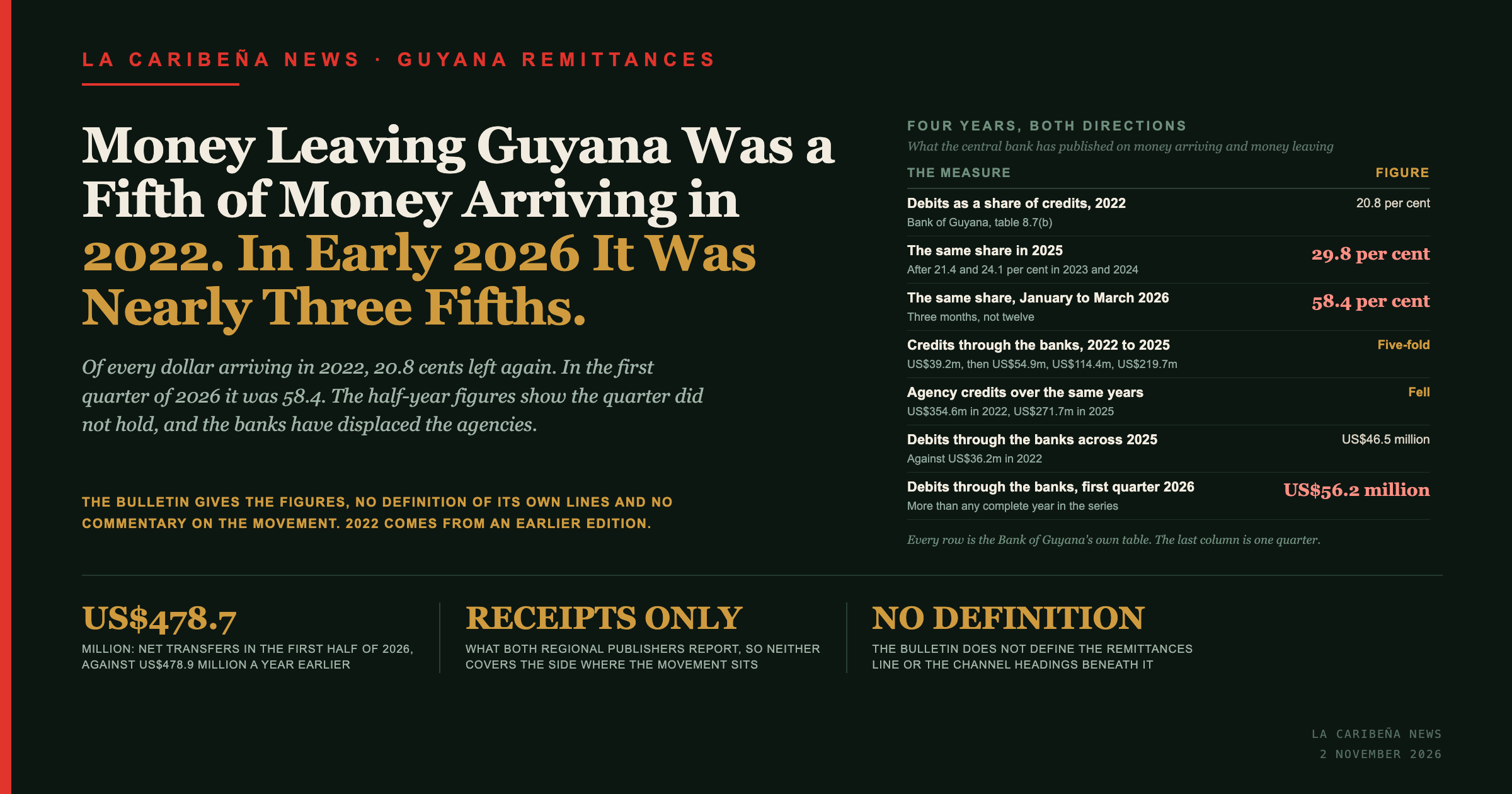
- Headline: money leaving Guyana was a fifth of money arriving in 2022, and in the first quarter of 2026 it was nearly three fifths.
- Worker's remittance debits as a share of credits: 20.8 per cent in 2022, 21.4 per cent in 2023, 24.1 per cent in 2024, 29.8 per cent in 2025 and 58.4 per cent in the first quarter of 2026. Source: Bank of Guyana, table 8.7(b), the 2022 figure from the December 2023 edition and the rest from March 2026.
- Credits: US$510.9 million in 2022, US$499.9 million in 2023, US$555.0 million in 2024, US$632.8 million in 2025, and US$185.4 million in the first quarter of 2026. Source: the same table.
- Debits: US$106.1 million, US$107.0 million, US$133.7 million, US$188.4 million, and US$108.3 million in the quarter. Source: the same table.
- Credits through the commercial banks: US$39.2 million in 2022 rising to US$219.7 million in 2025, while money transfer agencies fell from US$354.6 million to US$271.7 million.
- Debits through the commercial banks: US$36.2 million in 2022, then US$29.2 million, US$39.1 million and US$46.5 million, then US$56.2 million in a single quarter.
- First-quarter debits for the five years: US$37.5 million, US$23.4 million, US$39.7 million, US$34.5 million and US$108.3 million.
- Net transfers in the first half of 2026: US$478.7 million, against US$478.9 million a year earlier. Source: Ministry of Finance, Mid-Year Report 2026.
- The bulletin gives no definition of the worker's remittances line or of the channel headings beneath it.
Frequently Asked Questions
How much of Guyana's incoming remittance money leaves again?
Worker's remittance debits were 20.8 per cent of credits in 2022, 21.4 per cent in 2023, 24.1 per cent in 2024 and 29.8 per cent in 2025. In the first quarter of 2026 they were 58.4 per cent, on the Bank of Guyana's figures.
Is the first quarter of 2026 just a seasonal effect?
Comparing first quarters only, debits were US$37.5 million in 2022, US$23.4 million in 2023, US$39.7 million in 2024 and US$34.5 million in 2025, against US$108.3 million in 2026. The share of credits in those same quarters ran 30.1, 18.4, 32.5 and 24.6 per cent, against 58.4 per cent.
Which institutions handle Guyana's remittances?
The bulletin splits flows between money transfer agencies, commercial banks, non-bank cambios and a residual. Over 2022 to 2025 agency credits fell from US$354.6 million to US$271.7 million while bank credits rose from US$39.2 million to US$219.7 million. On the outbound side bank debits went from US$36.2 million to US$46.5 million across those years, then reached US$56.2 million in the first quarter of 2026 alone.
Do the international figures confirm this?
They cannot. The Inter-American Development Bank and the Inter-American Dialogue both publish money arriving, not money leaving, so neither covers the side of the account where the movement sits.
Did the first quarter of 2026 set a trend?
Not on the totals. The Ministry of Finance's Mid-Year Report puts net transfers at US$478.7 million for the first half of 2026 against US$478.9 million a year earlier, so the first-quarter shortfall was recovered in the second quarter. The ministry does not publish the worker's remittances split, which appears in the bulletin for September.
What is missing from the bulletin?
Any definition of the worker's remittances line or of the channel headings beneath it, and any commentary on the movement. The 2022 column is absent from the March 2026 edition, which runs annual to 2021 and quarterly from 2023, but the December 2023 edition carries it.