By LCN Business Desk
An importer in Georgetown who asks a commercial bank for United States dollars may be told to wait. The banks have put the size of that queue at just over US$200 million in foreign-currency requests unfilled, a figure President Irfaan Ali disclosed in September after meeting them, part of it carried forward from months they could not satisfy.
Those same banks file returns to the Bank of Guyana every month. The central bank has now published them for the first quarter of 2026, and they show money leaving Guyana through the transfers account at more than twice the rate of a year earlier.
| Transfers, US$ million | Jan to Mar 2025 | Jan to Mar 2026 |
|---|---|---|
| Credits, arriving | 306.8 | 364.8 |
| Debits, leaving | 52.7 | 123.9 |
| Net | 254.1 | 241.0 |
*Bank of Guyana, Quarterly Report and Statistical Bulletin, March 2026, table 8.7(b). The bulletin reports cumulative periods, so the January to March column is the first quarter in both years.*
Arrivals rose. Departures rose several times faster, and the balance between them narrowed.
How firm are those figures?
The bulletin carries them in three separate places, and they agree.
The transfers table is the first. The bulletin's balance of payments summary under the International Monetary Fund's Balance of Payments Manual, sixth edition, known as BPM6 and presented separately as table 8.8, gives secondary income credits of 364.84 and debits of 123.89 for the same quarter, and 306.76 and 52.68 for the quarter a year before, matching the transfers table to the cent.
The bank's own narrative states the result in words. The current transfers account "registered a contraction, with net current transfers declining by 5.2 percent, or US$13.3 million, to settle at US$241.0 million, a trend that occurred despite higher inflows from workers' remittances". The subtraction holds: US$364.8 million less US$123.9 million gives the US$241.0 million the narrative names.
Which line carries the increase?
The one the central bank labels worker's remittances, and the bulletin does not define it.
Within the transfers table, debits recorded under worker's remittances rose from US$34.5 million to US$108.3 million, which is most of the increase in the total. Credits under the same label rose from US$140.1 million to US$185.4 million, leaving a net of US$77.0 million against US$105.6 million.
The bulletin's note for table 8.7(b) defines a transfer as an entry corresponding to the provision of a good, service, financial asset or other non-produced asset by one institutional unit to another where there is no corresponding return of economic value. It gives no definition of the worker's remittances line within that table, and none of the sub-headings beneath it. The figures are therefore the central bank's own classification, reported as it labels them.
The narrative's one reference to the label points the other way from the debits. It describes higher inflows from workers' remittances, and makes no comment on payments out.
Which channel did the increase move through?
Most of it moved through the commercial banks. The money transfer agencies rose far less.
The bulletin splits the line by the institution that handled the payment, under headings it does not expand.
| Recorded under worker's remittances, paid out, US$ million | Jan to Mar 2025 | Jan to Mar 2026 |
|---|---|---|
| BANKS, the commercial banks | 5.2 | 56.2 |
| MONTRANS, money transfer agencies | 17.1 | 28.5 |
| NBANKS, non-bank cambios | 2.3 | 2.0 |
| Other | 9.9 | 21.7 |
| Total | 34.5 | 108.3 |
*Bank of Guyana, March 2026 bulletin. The table's source line names the Bank of Guyana, the Ministry of Finance, commercial banks, non-bank cambios and money transfer agencies, so the institutions in the first three rows report these figures themselves.*
Each row behaves differently, which is what isolates the banking one. Cambios are flat and slightly down. Agencies and the residual roughly doubled. The banking row did something else, and on its own accounts for most of the rise in the total. Across 2025 that row sat in a narrow band: US$5.2 million in the first quarter, US$27.6 million in the second, US$6.8 million in the third and US$6.9 million in the fourth, for US$46.5 million across the year. The first quarter of 2026 carried US$56.2 million.
How does this sit against what the President told the banks?
He was given one set of figures by the banks in September. The central bank has since published another set, drawn from the same returns.
The President put unmet foreign currency requests at just over US$200 million after meeting the commercial banks, and said the banks had bought US$2.279 billion of foreign currency between January and June, up 26.8 per cent on the same period of 2025, while the Bank of Guyana injected US$836 million against US$642 million. He also gave a figure for credit card settlements of US$356 million for 2026 to mid-September.
The government's nine measures of 30 September 2025, announced after it had put US$1.2 billion into the market that year, included a requirement that personal credit cards be used only for personal transactions rather than business obligations, that persons leaving Guyana with foreign currency declare its source, and penalties for inflated invoicing and related-party transfers used for capital flight. Those measures took effect at the start of the fourth quarter of 2025, and the quarter reported here is the first full one after them.
The International Monetary Fund gave its own reading of the same market on 31 July, attributing the tightness to strong foreign-exchange demand from import-heavy private investment. The Fund's reading locates the pressure on the import side. The transfers account sits elsewhere in the balance of payments and moved separately.
Why do the international figures differ from the bulletin?
Because they describe money arriving, and the bulletin also counts money leaving.
The Inter-American Development Bank put Guyana's first-quarter remittance growth at 9.2 per cent, the bank's estimate for Guyana, for which official first-quarter data were not yet published, Guyana being one of nine countries it had to estimate. The official credits figure now published is US$185.4 million against US$140.1 million, a larger rise than that. The bank’s regional picture rests on official data from fourteen countries and in-house estimates for nine, and Guyana is among the nine.
The Inter-American Dialogue published its own report in September, by Manuel Orozco. Its summary of that report gives regional family remittance growth of about 4.5 to 4.7 per cent for 2026, down from 7 per cent in 2025, and carries no country figures and no statement of method. Guyana's numbers come from Kaieteur News's account of the report: approximately US$500 million received in 2024, US$498 million in 2025 and a projected US$495 million in 2026. Those are secondary descriptions of the report's country table rather than the table itself.
| Guyana's remittances, as described | What the figure covers |
|---|---|
| Inter-American Development Bank | Money arriving, first quarter, estimated at 9.2 per cent growth |
| Inter-American Dialogue, via Kaieteur News | Money received, projected for the full year |
| Bank of Guyana | Money arriving and money leaving, measured for the first quarter |
The three are not measuring the same thing. Two describe receipts. An economy retains the difference between what arrives and what leaves, and only the March bulletin reports both.
What does the bulletin not explain?
Why the figures moved as they did, and what the labels beneath them cover.
A movement of this size in a reported line within a year can reflect a change in behaviour, a change in how an item is classified, or a change in what the reporting institutions file. Figures and sources are given; no explanation accompanies them. Read against the earlier bulletins, the banking system now handles remittance business that the agencies handled in 2022, in both directions.
Two readings inside the same table bear on it without settling it. The separate line for remittances paid to bank accounts abroad, which sits under other current transfers rather than worker's remittances, fell over the period, from US$13.1 million to US$9.4 million. A reclassification between lines would take that shape. Against it, the debit total across every line in the table rose from US$52.7 million to US$123.9 million, and the same movement appears in the separately compiled balance of payments summary, which a reclassification within a total cannot produce.
On the public record this newspaper can find, neither the Bank of Guyana nor the Ministry of Finance has published a commentary on the composition of the first-quarter transfer debits.
What does this mean for a business waiting on foreign currency?
That the queue it is standing in has a second claimant, and part of that claimant is settled through the same institutions.
A firm seeking United States dollars for an invoice is drawing on what the banks hold, and so is a transfer settled through one. The bulletin does not rank them, and the banks do not publish how they allocate between them. What the published figures establish is that during the quarter in which the unmet requests the banks reported in September were accumulating, transfer debits ran at more than twice their level a year earlier, and the share of them recorded through the commercial banks exceeded that channel's total for the whole of 2025.
The Georgetown Chamber of Commerce and Industry said in March 2023 that its members had complained of a shortage of United States dollars since 2019, and importers reported goods spoiling on the wharf in March 2025. Asgar Ally, a former Minister of Finance, is helping the President's office examine the structure of the demand.
The March bulletin is the only 2026 edition the Bank of Guyana has published. The Ministry of Finance’s Mid-Year Report covers the half year, and puts net transfers at US$478.7 million for the first half of 2026 against US$478.9 million a year earlier. On the totals, the first quarter was not sustained. The ministry does not publish the worker’s remittances split or the channels, which appear in the bulletin for September.
The entities
- Bank of Guyana is Guyana's central bank, which publishes the Quarterly Report and Statistical Bulletin.
- Quarterly Report and Statistical Bulletin is the central bank's statistical publication, whose transfers table carries the figures in this report.
- Transfers are entries recording the provision of a good, service or asset where no item of economic value returns, recorded as credits when they arrive and debits when they leave.
- Balance of Payments Manual is the International Monetary Fund's framework, whose sixth edition is known as BPM6 and under which the bulletin separately presents the same accounts.
- President Irfaan Ali met the commercial banks in September 2026 about unmet foreign currency demand.
- Asgar Ally is a former Minister of Finance helping the President's office examine the structure of the demand.
- Inter-American Development Bank (IDB) publishes remittance estimates for Latin America and the Caribbean.
- Inter-American Dialogue publishes remittance trend projections, written by Manuel Orozco.
- Manuel Orozco is the author of the Inter-American Dialogue's remittance report.
- International Monetary Fund assessed Guyana's foreign exchange market on 31 July 2026.
- Georgetown Chamber of Commerce and Industry has reported member complaints about United States dollar shortages.
What the title card says
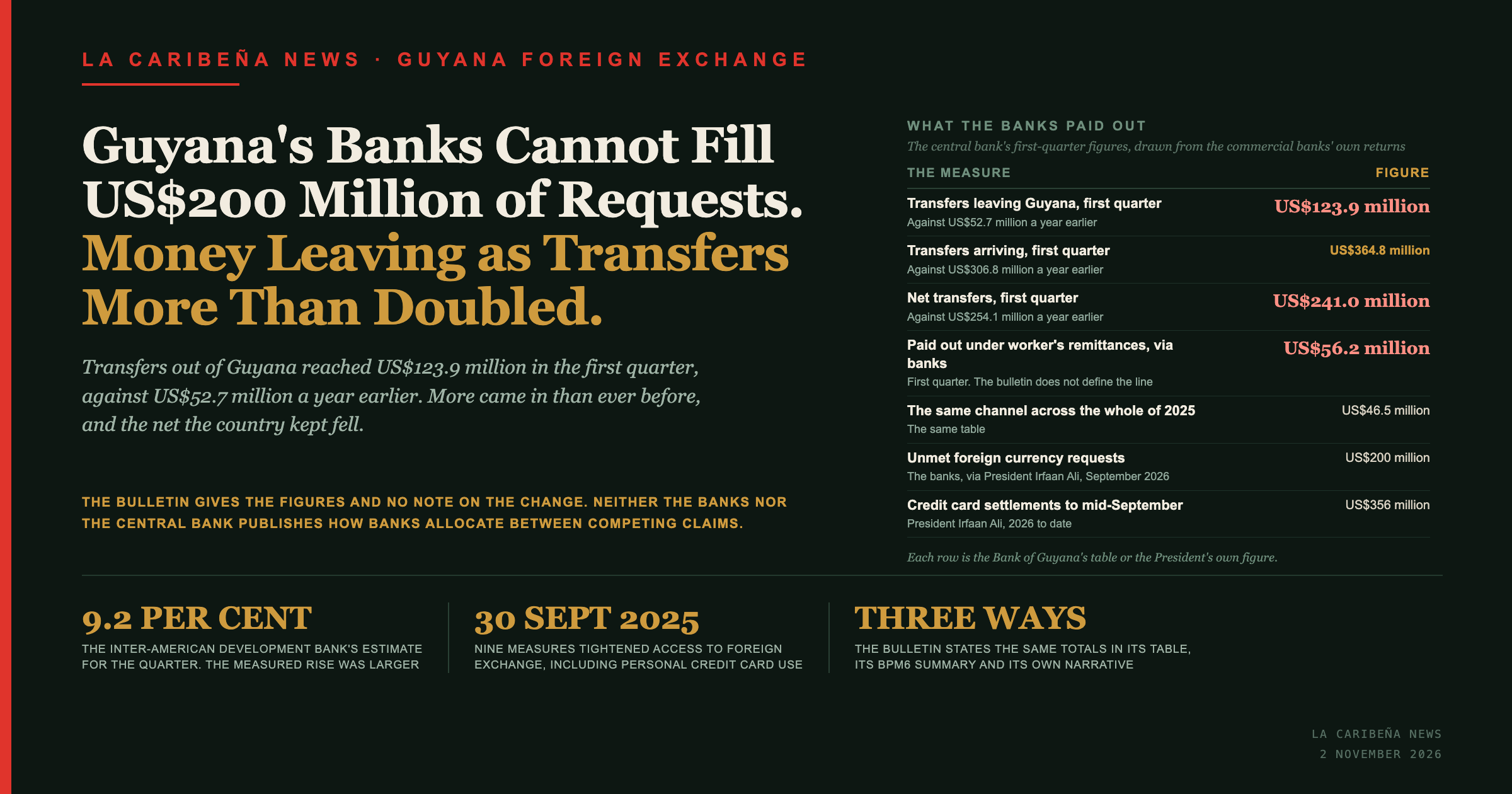
- Headline: Guyana's banks cannot fill US$200 million of requests, and money leaving the country as transfers more than doubled.
- Transfer debits, first quarter: US$123.9 million in 2026 against US$52.7 million in 2025. Source: Bank of Guyana, Quarterly Report and Statistical Bulletin, March 2026.
- Transfer credits, first quarter: US$364.8 million in 2026 against US$306.8 million in 2025. Source: the same table.
- Net transfers, first quarter: US$241.0 million in 2026 against US$254.1 million in 2025. Source: the same table, and the bulletin's own narrative, which puts the decline at 5.2 per cent or US$13.3 million.
- Debits recorded under worker's remittances through the commercial banks: US$56.2 million in the first quarter of 2026, against US$46.5 million across the whole of 2025. Source: the same table. The bulletin does not define that line or the headings beneath it.
- Unmet foreign currency requests reported by the commercial banks: just over US$200 million, stated by President Irfaan Ali in September 2026.
- Credit card settlements for 2026 to mid-September: US$356 million, stated by President Irfaan Ali.
- The Inter-American Development Bank estimated Guyana's first-quarter remittance growth at 9.2 per cent, having said official first-quarter data were not yet published.
- The March 2026 bulletin is the only 2026 edition the Bank of Guyana has published.
Frequently Asked Questions
What did the Bank of Guyana's March 2026 bulletin show?
Transfer credits of US$364.8 million in the first quarter against US$306.8 million a year earlier, debits of US$123.9 million against US$52.7 million, and a net of US$241.0 million against US$254.1 million. Money arriving rose, money leaving rose by more, and the net fell.
How certain are those figures?
The bulletin carries them three ways. The transfers table gives them, the separately compiled BPM6 summary repeats them to the cent, and the bank's own narrative states the net decline as 5.2 per cent or US$13.3 million to US$241.0 million.
Which part of the transfers account rose?
The line the central bank labels worker's remittances, where debits rose from US$34.5 million to US$108.3 million. The bulletin gives no definition of that line, or of the institution headings beneath it, so it is reported here as the central bank classifies it.
Which institutions handled it?
Mostly the commercial banks, where the figure rose from US$5.2 million to US$56.2 million, against US$46.5 million for that channel across the whole of 2025. Money transfer agencies rose from US$17.1 million to US$28.5 million and non-bank cambios were flat.
How does this relate to the shortage of United States dollars?
The commercial banks told President Irfaan Ali in September that just over US$200 million of foreign currency requests were unfilled. Part of the transfer debits in the bulletin is settled through those same banks. The published figures do not show how banks allocate between competing claims, and neither the banks nor the central bank publishes that.
Does the bulletin explain the increase?
No. The table carries the figures, names its sources and gives no note on the change. A separate line for remittances to bank accounts abroad fell over the same period, which is consistent with a reclassification, while the debit total across all lines rose and the same movement appears in the separately compiled summary, which is not.