By LCN Business Desk
The banks' report of just over US$200 million in unmet foreign-currency requests, which President Irfaan Ali disclosed last week, arrives two months after the International Monetary Fund gave its own reading of the same market, as La Caribeña News reported. Businesses had reported delays in obtaining US dollars for two years before that figure, as La Caribeña News set out in For Two Years Businesses Said They Could Not Get US Dollars. The two diagnoses point at different causes, and at different remedies.
What did the IMF say about Guyana's currency market?
"Strong foreign exchange (FX) demand, especially from private investment with heavy import content, kept the FX market tight," the Fund's Article IV mission, led by Lusine Lusinyan, said in its concluding statement after meetings in Georgetown from 20 to 31 July. In the same passage it found that rising oil production and lower oil-service imports had strengthened the external position, "assessed to be broadly in line with the level implied by fundamentals and desirable policies in 2025".
On policy, the Fund said "the current stabilized exchange rate regime remains appropriate", and that monetary policy should stay consistent with it. Over time, as foreign-exchange demand persists, it advised "activating the interest rate channel, deepening financial markets, improving macroprudential tools, and gradually scaling back broad price-mitigating measures", and said that over the medium term "consideration could be given to allowing greater exchange rate flexibility to facilitate macroeconomic adjustment and enhance resilience to shocks", according to the statement. Georgetown food prices fell 0.5 per cent in August under that regime, reported in Venezuela's Food Basket Rose 12.5 Per Cent in August.
It found no clear signs of overheating or resource-driven competitiveness pressures, but said "strong wage growth and wage-based real exchange rate indicators warrant close monitoring".
What has the government done instead?
The nine measures announced on 30 September 2025 act on documentation and on misuse: invoices and bills of lading for every import request, reconciled with the Guyana Revenue Authority and the Bank of Guyana; personal credit cards barred from business payments; penalties for over-invoicing and capital flight; declarations of the source of currency taken out of the country; and local bank accounts for the foreign earnings of local-content firms, according to the Office of the President. This week the President said the review of the backlog will look for "misdirection or financing of other operations" and at how much of the demand reflects legitimate private-sector expansion, the Guyana Chronicle reported.
| Question | IMF, 31 July 2026 | Government, September 2025 and 2026 |
|---|---|---|
| What drives demand? | Private investment with heavy import content | Rapid expansion, and possible misdirection, under review |
| Exchange rate regime | Stabilized regime appropriate; more flexibility over the medium term | Stabilized; no change announced |
| Main tools | Interest rate channel, deeper financial markets, macroprudential tools | Invoice verification, card limits, exit declarations, local accounts |
| Next step | Tighten if exchange rate pressures emerge | Meet the banks again after the UN General Assembly |
Sources: IMF, Office of the President, Guyana Chronicle.
Why does the US dollar matter to the state as well?
Because the state borrows in it. The US dollar made up 69.8 per cent of Guyana's external public debt at mid-2026, against 58.5 per cent a year earlier, according to the Ministry of Finance's mid-year report as reported by Kaieteur News, and the ministry named exchange-rate movements as one of the two main risks in the portfolio.
Where would relief come from? An LCN analysis
The IMF's reading and the government's measures are not contradictory; a market can be tight because of real investment imports and leak through misuse at the same time. But documentation measures can only remove demand that should not be there. They cannot supply the dollars that legitimate importers need, and the IMF places most of the pressure with legitimate importers.
That leaves three levers. The first is supply, which the Fund's reference to liquidity management through foreign-exchange operations describes and which the Bank of Guyana's injections, US$836 million in the first half of 2026, already use. The second is price, which the Fund places on a medium-term horizon. The third is to take some trade off the US dollar altogether: regional payments settled in local currencies through the CARICOM Payment and Settlement System, where the Bank of Guyana was not named at the September meeting, as La Caribeña News reported in Four Caribbean Governors Met Africa's Payment System and The Development Bank Opens on 5 October. The review of the structure of demand now under way with Asgar Ally is where the evidence for choosing among them will come from.
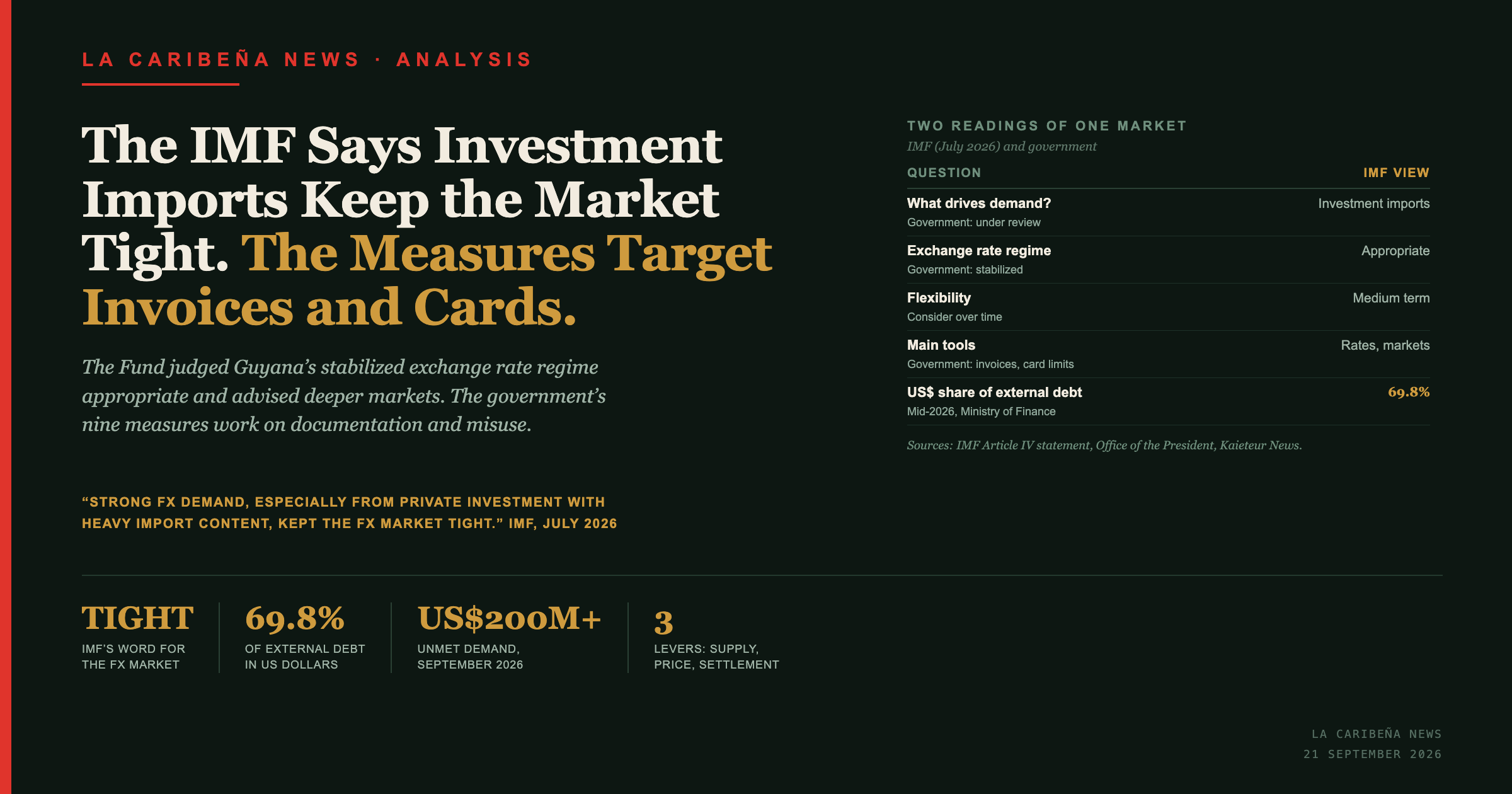
What the title card shows
- IMF diagnosis: FX demand "especially from private investment with heavy import content" kept the market tight. Source: IMF.
- Regime: stabilized arrangement "remains appropriate"; flexibility "over the medium term". Source: IMF.
- 69.8 per cent: US dollar share of external public debt, mid-2026. Source: Ministry of Finance via Kaieteur News.
- Just over US$200 million: unmet demand at the banks, September 2026. Source: Guyana Chronicle.
Frequently Asked Questions
What did the IMF say about Guyana's foreign exchange shortage?
The IMF's 2026 Article IV mission said strong foreign-exchange demand, especially from import-heavy private investment, kept the market tight, while Guyana's external position was broadly in line with fundamentals.
Does the IMF want Guyana to devalue?
No. It said the current stabilized exchange rate regime remains appropriate, and that greater flexibility could be considered over the medium term as policy frameworks mature and the economy diversifies.
What did the IMF recommend?
Activating the interest rate channel, deepening financial markets, improving macroprudential tools, gradually scaling back broad price-mitigating measures, and tightening further if exchange rate pressures emerge.
The Fund named the cause as investment. The measures address leakage. The review under way will say how much of the US$200 million queue is which.