By LCN Business Desk
A household in Georgetown collecting money from a relative abroad deals with a different kind of institution than it did four years ago. In the first quarter of 2026 Guyana's commercial banks took in US$81.5 million of arriving worker's remittances against US$62.8 million through the money transfer agencies, on the figures in the Quarterly Report and Statistical Bulletin for March 2026. It is the first quarter in the published series in which the banks carried more.
That much is Guyana's own record, and the banking system now handles remittance business that the agencies handled in 2022, in both directions. The question for anyone reading a regional figure is whether the same thing is happening next door.
For the Dominican Republic it is. For Jamaica, the largest recipient of the three, it is the reverse.
Is the Dominican Republic moving the same way as Guyana?
Yes, in every year, and its central bank publishes the split as a standing statistic.
The Banco Central de la República Dominicana maintains a table headed *Remesas familiares recibidas según participación en el pago*, one of eight standing remittance tables in its external sector statistics. It carries two rows, `Empresas Remesadoras` and `Instituciones Financieras`, and it is published as shares rather than amounts.
| Share of remittances paid | 2022 | 2023 | 2024 | 2025 | 2026 Jan to Sep |
|---|---|---|---|---|---|
| Empresas Remesadoras | 79.64% | 76.89% | 69.68% | 68.79% | 63.26% |
| Instituciones Financieras | 20.36% | 23.11% | 30.32% | 31.21% | 36.74% |
*Banco Central de la República Dominicana, Departamento Internacional. The 2024, 2025 and 2026 columns carry the bank's own preliminary marking, and the 2026 column is nine months.*
The 36.74 per cent is the highest reading for financial institutions anywhere in a series that runs back to 2010, and the starting point sat near a low: the bank share had fallen to 18.28 per cent by 2021 from 26.71 per cent in 2013. So the Dominican movement is not a recovery to an earlier level. It is a new one, on a market that grew from US$9,856.5 million in 2022 to US$11,866.3 million in 2025.
One caveat belongs with it, and it falls in the worst possible year. The largest single-year move lands where the central bank changed how it collects the data, and its own footnote says the series was recalculated after *"la implementación de una nueva plataforma tecnológica para la recepción de los datos"*. From the published files alone a genuine move and a recalculation cannot be separated there.
What does Jamaica show?
Jamaica runs the other way. Its bank channel shrank in dollars while the market grew.
The Bank of Jamaica publishes gross inflows in two channels, `Remittance Companies` and `Other Remittances`, the second footnoted in its bulletins as *"Representing flows via commercial banks and building societies."*
| US$ million | 2022 | 2023 | 2024 | 2025 |
|---|---|---|---|---|
| Remittance Companies | 2,956.3 | 2,921.9 | 2,911.6 | 3,082.3 |
| Other Remittances | 483.9 | 448.2 | 446.3 | 403.4 |
| Total inflows | 3,440.2 | 3,370.1 | 3,357.9 | 3,485.7 |
| *Other Remittances share* | *14.07%* | *13.30%* | *13.29%* | *11.57%* |
*Bank of Jamaica, statistical table ES.RMT.00 and the Remittances Bulletin. The 2023, 2024 and 2025 figures carry the bank's provisional marking. The share row is this newspaper's calculation, because the bank publishes levels and growth rates per channel and no share.*
The two channels move against each other, and the share falls in each of the four years. A like-for-like January to August comparison, which puts the part-year 2026 on the same footing as the years above it, runs the same way and reaches 12.05 per cent.
There is a qualification in the 2026 months that should not be read as a turn. The bank channel has begun growing in level, with the central bank's own year-on-year rates for June, July and August at 11.2, 18.4 and 32.2 per cent, and its calendar-year-to-date rate for the channel turning positive in July. It is still losing share, because the larger channel grew faster over the same months. Two strong months in one year do not reverse four.
How comparable are the three sets of figures?
Not fully, and the differences run in a direction that matters.
The Dominican table is a true partition: the two rows sum to 100 per cent of remittances paid. Guyana's do not. Its bulletin records the agencies and the banks as two headings beneath its worker's remittances line, alongside non-bank cambios and a residual, so a share of the two large channels is a different quantity from a share of the whole. Guyana's percentages are this newspaper's calculation of that narrower share, and its central bank publishes no share at all.
Jamaica's figure answers a broader question than Guyana's. `Other Remittances` is banks plus building societies plus an unstated residual, and the Bank of Jamaica's own workbook describes it as activity *"occurring outside of traditional remittance companies"*. The finer institutional breakdown exists in the same workbook and the last month carrying a value in it is December 2007. So Jamaica cannot answer whether commercial banks specifically are gaining.
And Guyana's agency sector is three licensed firms. The Caribbean Financial Action Task Force recorded in July 2024 that *"Larger MTAs operating in Guyana are franchises of international money transfer organisations"*. With three firms, two of them franchises, a single corporate decision and a change in what households prefer produce the same line on a chart.
Why is the direction surprising?
Because the banks are the dearest channel, and a standard-setter says they do not want the business.
The World Bank prices the cost of sending remittances by the type of provider, and on a US$200 transfer in the third quarter of 2024 it put banks at 13.64 per cent against 5.40 per cent for money transfer operators. The Financial Stability Board reported on 9 October 2025 that banks have limited interest in serving the remittances market. On those economics Jamaica is the ordinary case and the other two are the exception, which is set out with the candidate mechanisms in the companion report on why the business is moving to the most expensive channel.
What does this mean for a business moving money?
That the counterparty is changing in two of these markets, and the queue a firm stands in is getting longer.
A Guyanese firm seeking United States dollars for an invoice draws on what the commercial banks hold. So, increasingly, does a household receiving money from abroad and a person sending money out. Transfers out of Guyana reached US$123.9 million in the first quarter against US$52.7 million a year earlier, and for two years Guyanese importers, the Georgetown Chamber of Commerce and a US government trade guide reported that businesses could not get US dollars on time.
Neither the banks nor the central bank publishes how a bank allocates between competing claims on the same balances. What the published figures establish is that household remittance business is now a larger claim on them than it was, and that it is concentrated in fewer institutions than before.
The entities
- Bank of Guyana is Guyana's central bank, which publishes the Quarterly Report and Statistical Bulletin carrying the transfers table used here.
- Banco Central de la República Dominicana is the Dominican Republic's central bank, which publishes remittances by paying institution as a standing statistic.
- Bank of Jamaica is Jamaica's central bank, which publishes gross remittance inflows in two channels.
- Caribbean Financial Action Task Force is the regional body on money laundering and terrorist financing, which evaluated Guyana in July 2024.
- Financial Stability Board is the international body that monitors the global financial system and reports on cross-border payments.
- Money transfer agencies are the licensed operators the Bank of Guyana records under the heading MONTRANS.
- Worker's remittances are personal transfers between households across borders, recorded as credits when they arrive and debits when they leave.
What the title card says
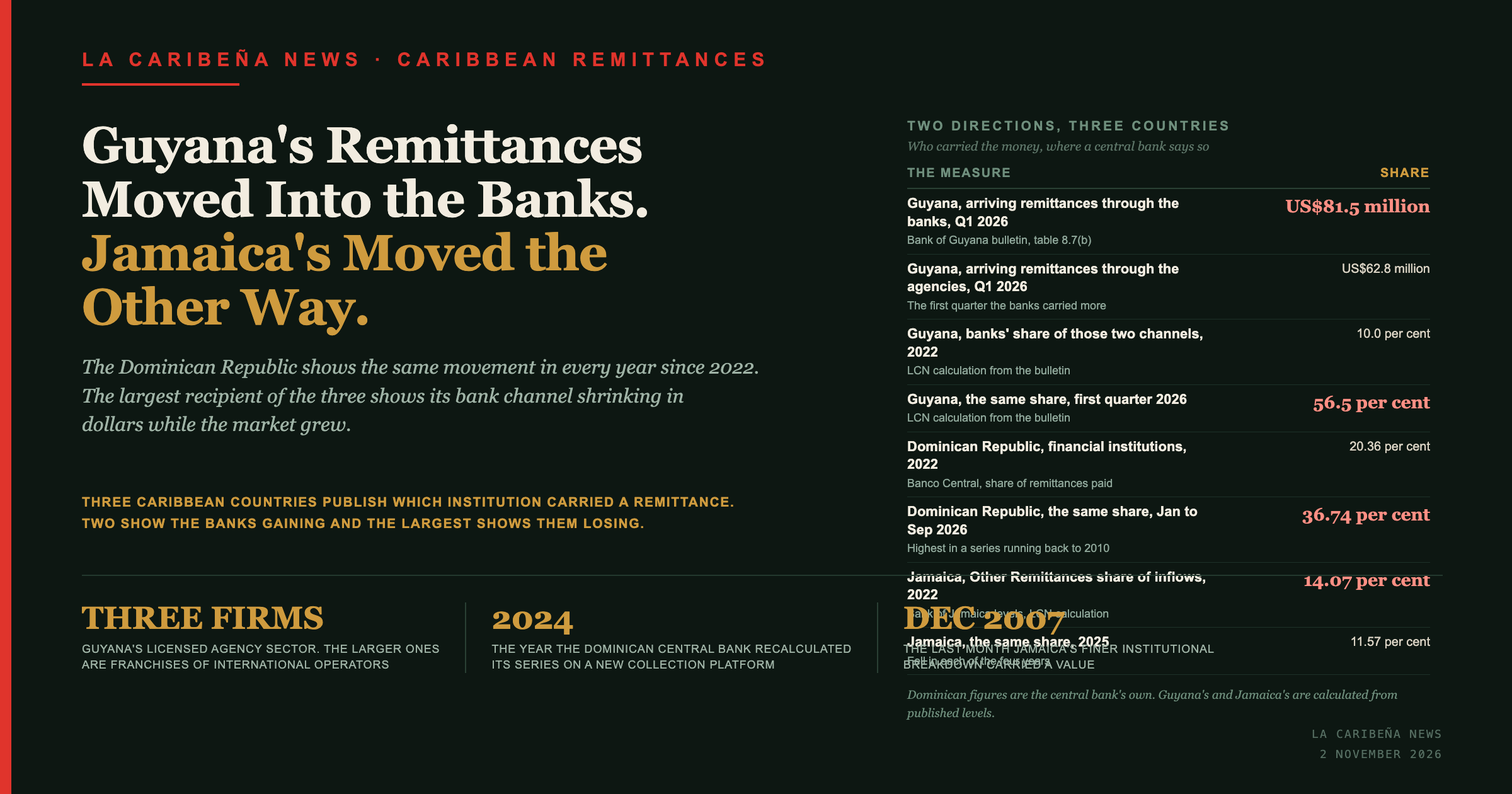
- Headline: Guyana's remittances moved into the banks, and Jamaica's moved the other way.
- Guyana, arriving remittances through the commercial banks in the first quarter of 2026: US$81.5 million. Source: the Bank of Guyana's bulletin.
- Guyana, arriving remittances through the agencies in the same quarter: US$62.8 million. Same source.
- Guyana, the banks' share of those two channels in 2022: 10.0 per cent. This newspaper's calculation.
- Guyana, the same share in the first quarter of 2026: 56.5 per cent. Same basis.
- Dominican Republic, financial institutions' share of remittances paid in 2022: 20.36 per cent. Source: Banco Central de la República Dominicana.
- Dominican Republic, the same share for January to September 2026: 36.74 per cent. Same source, preliminary.
- Jamaica, the Other Remittances share of total inflows in 2022: 14.07 per cent. Calculated from Bank of Jamaica levels.
- Jamaica, the same share in 2025: 11.57 per cent. Same basis.
- Guyana's money transfer sector: three licensed agencies, the larger ones franchises of international operators. Source: the Caribbean Financial Action Task Force, July 2024.
- The year the Dominican central bank recalculated its series on a new collection platform: 2024.
- The last month Jamaica's finer institutional breakdown carried a value: December 2007.
Frequently Asked Questions
Are Caribbean remittances moving from agencies to banks?
In two of the three countries whose central banks publish the channel. Guyana's banks carried US$81.5 million of arriving remittances in the first quarter of 2026 against US$62.8 million through the agencies, and the Dominican Republic's financial institutions have gained share in every year since 2022. Jamaica, the largest recipient of the three, shows its bank channel losing share every year over the same period.
How much has changed in Guyana?
On this newspaper's calculation the banks' share of the two large channels moved from 10.0 per cent in 2022 to 56.5 per cent in the first quarter of 2026. The agencies' inflows fell in each of the four completed years while the two channels together grew, so the banks took existing business rather than new growth.
Is Jamaica's bank channel recovering in 2026?
It is growing in level and still losing share. The Bank of Jamaica's own year-on-year rates for the channel in June, July and August were 11.2, 18.4 and 32.2 per cent, and its calendar-year-to-date rate turned positive in July. The larger channel grew faster over the same months, so the share continued to edge down.
Can the three countries' figures be compared directly?
Not exactly. The Dominican table is a complete partition of remittances paid. Guyana's two channels sit alongside non-bank cambios and a residual, so its percentages are a narrower share and are calculated rather than published. Jamaica's bank line also contains building societies, and the finer breakdown last carried a value in December 2007.
Why does Guyana's three-firm agency sector matter?
Because with three licensed agencies, the larger ones franchises of international operators, a single corporate decision and a genuine change in household behaviour would produce the same movement in the national figures. Nothing published distinguishes them.