By LCN Business Desk
The International Trade Centre and the African Export-Import Bank launched a report in St John's, Antigua and Barbuda on 3 November putting trade between Africa and the Caribbean at up to US$1.65 billion a year by 2030. Sixteen months earlier, the heads of both institutions had published a higher figure for the same horizon.
What does the new report say?
That the corridor has room to roughly double, and that the Caribbean's share of it is in services.
"Reshaping Africa-Caribbean Trade: Opportunities for Economic Transformation" was launched on 3 November 2026 in St John's, Antigua and Barbuda, on the sidelines of the Commonwealth Heads of Government Meeting. It puts annual goods and services trade at up to US$1.65 billion by 2030, excluding mineral fuels, and rests on trade and export potential analysis, sector assessments and a survey of 1,175 businesses and business support organisations across both regions.
Two findings sit under that headline. About 80 per cent of Africa's annual goods export potential to the Caribbean is untapped. And Caribbean export potential lies mainly in services, where it reaches US$481 million.
What had the same two institutions said before?
Twice, and the first two numbers were both higher.
| Published | The figure | For | How it was described |
|---|---|---|---|
| 4 July 2024 | US$1.8 billion a year | 2028 | preliminary findings, released in Nassau |
| 24 July 2025 | US$2.1 billion | within five years | a signed article by both institutions' heads |
| 3 November 2026 | US$1.65 billion a year | 2030 | the full report, launched at CHOGM |
The International Trade Centre and the African Export-Import Bank, from their own releases.
Prof. Benedict Oramah, Afreximbank's President and Chairman of the Board of Directors, presented the first of the three in Nassau, saying the research "confirms the vast Africa-Caribbean trade and investment opportunities that remain untapped" and gave the bank "a strong validation of Afreximbank's Caribbean Strategy". He put the bank's project pipeline at US$2.5 billion and its investment pipeline at US$1.5 billion. He co-signed the second.
July 2025 and November 2026 describe the same destination. A five-year horizon from July 2025 reaches 2030, which is the year the new report names. On that horizon US$2.1 billion has become US$1.65 billion, a reduction of 21 per cent in sixteen months.
::: The same corridor, the same two institutions, the same target year. The number fell by a fifth and the report announcing it was written as an opportunity. :::
Are the three figures measuring the same thing?
On the question that usually breaks a comparison like this, yes.
The new figure excludes mineral fuels, and a projection that strips out fuel is not comparable with one that does not. The 2024 research carries its basis in its notes: trade of US$729 million in goods, excluding "tobacco, arms/ammunition and fossil fuels". Fuel was already out of the measure in 2024, so its removal in 2026 does not explain the drop.
One difference does remain. The 2024 baseline is goods only, while the 2026 projection covers goods and services, and the releases do not say whether the 2024 projection covered services too. If it did not, the two are closer than they look. The 2025 figure carries no such ambiguity, because the article giving it describes interregional trade without restriction.
What has not changed across the three?
The starting point, and the ceiling.
Interregional trade was US$729 million in the 2024 research and US$729 million again in the July 2025 article. Over the same period the two institutions wrote that bilateral trade has never exceeded 6 per cent of total exports for either region, that African exports to the Caribbean have been declining since 2014 and have sat close to 0.1 per cent since 2020, and that 57 per cent of the unrealised potential stems from logistical problems.
They also gave a worked example of the barrier. Caribbean rum exporters face an 88 per cent tariff in African markets.
Did anything move in the opposite direction?
The money behind it. Afreximbank's CARICOM facility went up while the trade forecast came down.
In July 2025 the bank's facility for CARICOM countries was US$3 billion. The November 2026 release gives a US$5 billion regional financing commitment, a two-thirds increase, against about US$1 billion in approved transactions. Roughly four fifths of the stated commitment is therefore undrawn, and the trade it exists to finance is now projected lower than it was when the smaller facility was announced.
The institutional build-out has continued in the same direction. Afreximbank has a CARICOM office in Barbados, a CARICOM Eximbank under development, and a payment system being built with Caribbean central banks and linked to Africa's own.
None of that has reached the firms doing the trade yet. A Guyanese importer buying shea and cocoa butter from Ghana still converts into United States dollars to pay a supplier in Accra, because the Development Bank's loans are in Guyana dollars. The corridor the report measures runs through a currency belonging to neither region.
Nor is every Caribbean state in the queue for the rails. Trinidad and Tobago chairs the committee building the cross-border system on Africa's model, and Guyana is not in its pilot group.
What should a Caribbean exporter take from the new report?
That the opportunity it describes is in services, not in goods.
The US$481 million of Caribbean export potential the report identifies sits mainly in services, and the 2024 research found travel and transport accounted for about two thirds of potential services trade growth. A corridor 1,600 miles wide, carrying an 88 per cent tariff on one of the region's signature goods and 57 per cent of its unrealised potential locked up in logistics, is a hard one to sell physical product into.
The sectors the new report names on the goods side are processed food and animal feed, chemicals, minerals and metals, apparel and textiles, and leather and footwear. The ones it names beside them are tourism, transport services and the creative industries.
What is not established here?
Why the projection was reduced. No published document explains it, and on the public record this newspaper can find, no outlet has asked.
Whether the 2024 projection of US$1.8 billion covered services as well as goods. Its baseline is stated as goods only.
What the 2026 report gives as the current value of the trade. The release does not repeat the US$729 million figure.
The full text of the report. Every figure here comes from the two institutions' own announcements rather than from the report, which is not quoted.
The entities
- International Trade Centre is the joint United Nations and World Trade Organization agency that co-published the report, headed by Executive Director Pamela Coke-Hamilton. - African Export-Import Bank is the multilateral trade finance institution that co-published it, whose Senior Executive Vice President Denys Denya spoke at the launch. - Reshaping Africa-Caribbean Trade: Opportunities for Economic Transformation is the report launched on 3 November 2026 carrying the US$1.65 billion figure. - Commonwealth Heads of Government Meeting is the summit in St John's, Antigua and Barbuda on whose sidelines the report was launched. - Prof. Benedict Oramah is the President and Chairman of the Board of Directors of Afreximbank, who presented the 2024 research and co-signed the 2025 article. - CARICOM is the Caribbean Community whose member states the US$5 billion Afreximbank commitment covers.
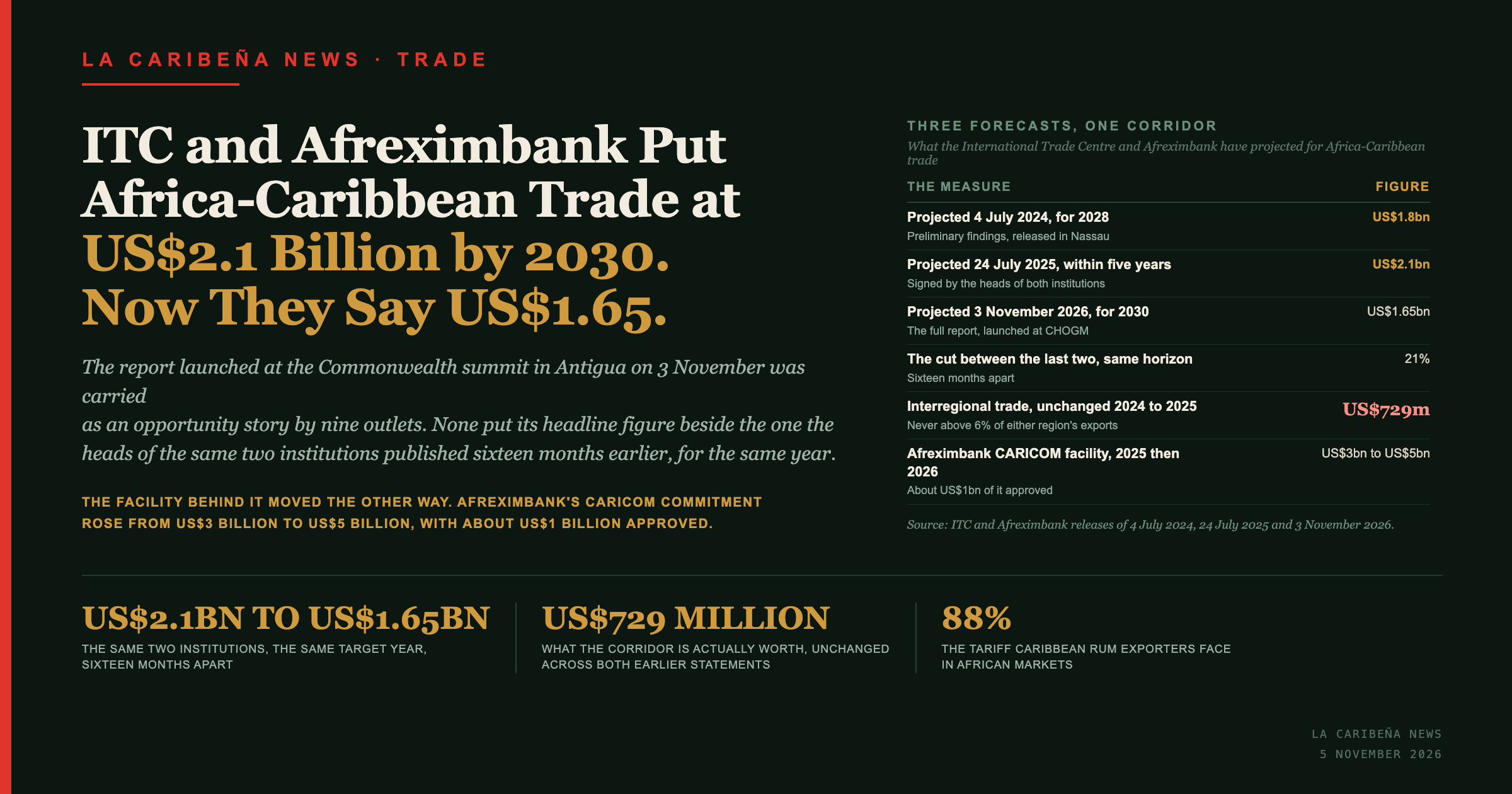
What the title card says
- Headline: ITC and Afreximbank projected US$2.1 billion of Africa-Caribbean trade by 2030, and last week they made it US$1.65 billion. - The new figure: US$1.65 billion a year by 2030, goods and services, excluding mineral fuels. - The July 2025 figure: US$2.1 billion within five years. - The July 2024 figure: US$1.8 billion a year by 2028, described as preliminary. - The reduction between the 2025 and 2026 figures: 21 per cent in sixteen months. - Baseline interregional trade, unchanged across 2024 and 2025: US$729 million. - Caribbean export potential in services: US$481 million. - Afreximbank CARICOM facility: US$3 billion in July 2025, US$5 billion in November 2026. - Afreximbank approved Caribbean transactions: about US$1 billion. - Tariff Caribbean rum exporters face in African markets: 88 per cent. - Source: the International Trade Centre and Afreximbank releases of 4 July 2024, 24 July 2025 and 3 November 2026.
Frequently Asked Questions
What is the new Africa-Caribbean trade figure?
Up to US$1.65 billion a year by 2030, in goods and services and excluding mineral fuels, from the ITC-Afreximbank report "Reshaping Africa-Caribbean Trade: Opportunities for Economic Transformation", launched on 3 November 2026 at the Commonwealth summit in Antigua and Barbuda.
How does it compare with what the same institutions said before?
It is lower. In July 2024 they put the corridor at US$1.8 billion by 2028, describing those findings as preliminary. In July 2025 the heads of both institutions wrote that it could reach US$2.1 billion within five years, a horizon that reaches 2030. The new figure is 21 per cent below that.
Could the difference be explained by the measures not matching?
Not by fuel. The new figure excludes mineral fuels, and the 2024 baseline already excluded fossil fuels along with tobacco and arms. One ambiguity remains: the 2024 baseline was goods only, and the releases do not say whether its projection covered services.
What is Africa-Caribbean trade worth now?
The two institutions gave it as US$729 million in both the July 2024 research and the July 2025 article. They also state that bilateral trade has never exceeded 6 per cent of total exports for either region, and that African exports to the Caribbean have sat close to 0.1 per cent since 2020.
Where does the report say the Caribbean opportunity lies?
In services. It puts Caribbean export potential at US$481 million and says it lies mainly there, with tourism, transport services and the creative industries named alongside goods sectors such as processed food, chemicals, apparel and footwear.