By LCN Business Desk
A country that sells oil and buys almost everything else gets hit twice by the same price.
What did the Governor actually say about energy prices?
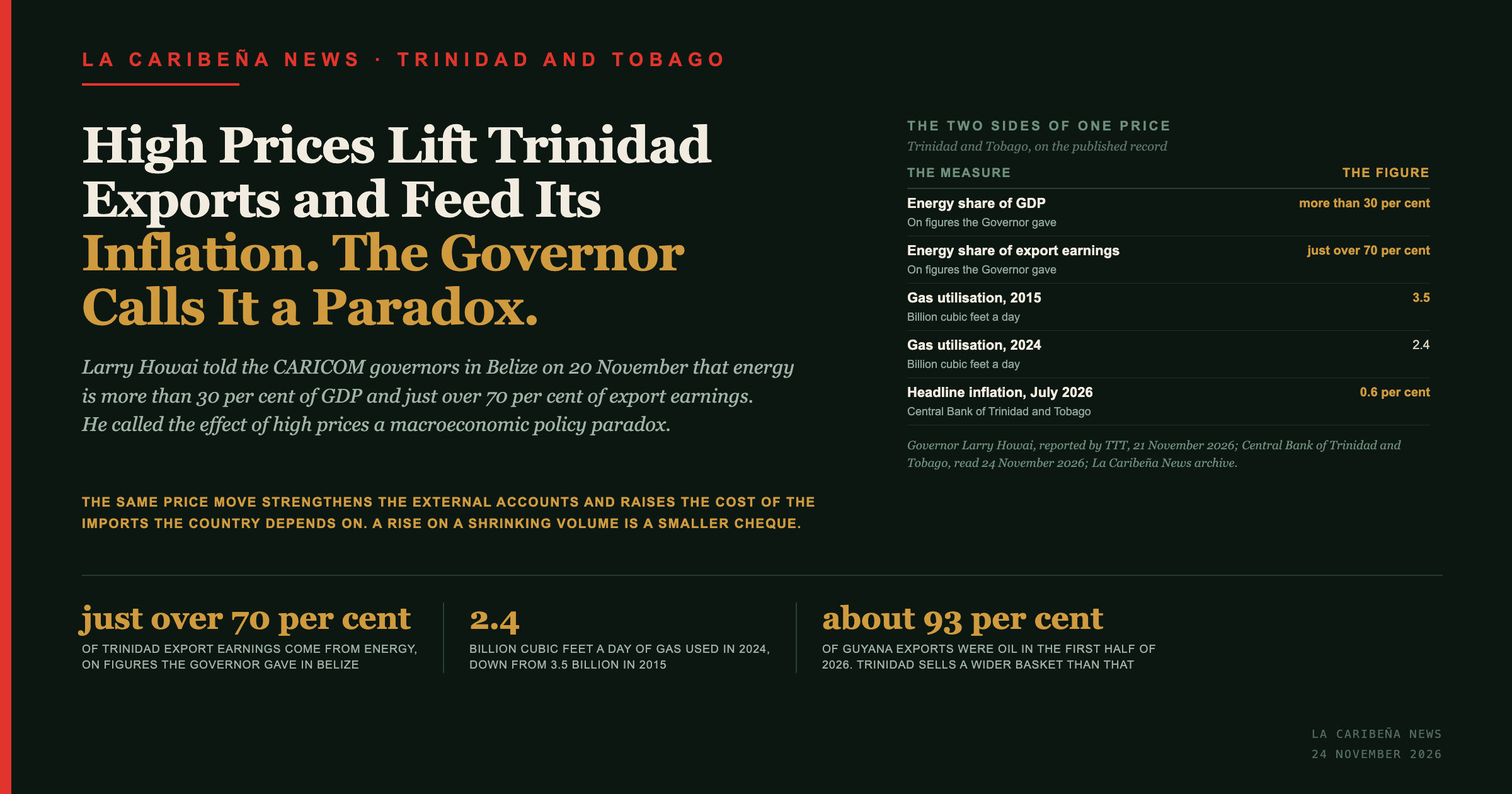
That they cut both ways, and that one side is often missed. Larry Howai spoke at the Governors' Panel Discussion during the 67th Bi-Annual Meeting of CARICOM Central Bank Governors in Belize on 20 November. He sat alongside Dr R. Brian Langrin of the Bank of Jamaica and Dr Kevin Greenidge of the Central Bank of Barbados. The host governor, Kareem Michael of Belize, moderated. Energy, he said, is more than 30 per cent of Trinidad and Tobago's GDP and just over 70 per cent of its export earnings.
Higher prices lift export receipts and strengthen the external current account. They raise government revenue through petroleum taxes and royalties. None of that is in dispute.
Then he added the condition. "High prices are essential, but there needs to be a complementary level of energy production to ensure that we experience meaningful gains."
Why do high prices not simply help?
Because the country buys more than it sells. Trinidad exports energy and remains heavily reliant on imports across much of the rest of the economy. Higher fuel prices raise shipping and other import costs. Those are built into the price of imported goods. They reach the shelf.
So the same price move cuts twice. It strengthens the external accounts. It also feeds domestic inflation, makes liquidity harder to manage, and presses on the Bank's ability to hold prices and the foreign exchange market steady. Howai called it a "macroeconomic policy paradox".
The production condition is not abstract. Gas utilisation fell from 3.5 billion cubic feet a day in 2015 to 2.4 billion in 2024. A price rise on a shrinking volume is a smaller cheque than it looks. Upstream commitments have been moving too. Woodside Energy agreed on 6 August to sell its 70 per cent operated interest in the Calypso deepwater gas project to bp. It had flagged impairments of US$160 million to US$200 million eight days before.
What does he want instead?
Diversification, and he put it above everything else. "While reserves and fiscal dynamics are financial, short-term buffers that are critical to how we respond to exogenous shocks, economic diversification is what will enable long-run economic prosperity in the region," he said.
Then he went further than a central banker usually does on another government's territory. "It is in our best interest, in order to safeguard and enhance the quality of life for today and for future generations, that we, within the small islands of the Caribbean, make economic diversification our top priority."
Trinidad's own attempt at that is under way. Its Government launched a 129-project Revitalisation Blueprint in November 2025 to step away from energy dependence, and the first sod was turned at Invaders Bay on 20 November, on a privately financed project.
What can a central bank actually do about it?
Four things, on his account, and none of them is picking the new sector. Central banks can hold price, exchange-rate and financial stability. They can deepen financial markets. They can modernise payments systems. And they can supply credible data, research and policy advice.
"Our contribution is to make sure that when new sectors do emerge, it does so in an economy that is stable, well financed and open for business," he said.
That is a narrower claim than it first sounds. The Bank is offering conditions, not industrial policy.
One of those four levers is already running. In September the governors of Trinidad and Tobago, Barbados, the Eastern Caribbean and The Bahamas met a team from the Pan-African Payment and Settlement System in Port of Spain. The subject was the region's planned payment system.
The stability lever sits against a harder fact. These remarks are framed by the Bank's Strategic Plan 2026/27 to 2030/31. In that document, across 28 pages, the phrase "foreign exchange" appears once, in the outlook section. No objective and no project addresses it. Yet the Governor named pressure on the foreign exchange market as half of his paradox.
What are the two migration flows?
They run in opposite directions, and he named both.
| Direction | Who | What it does |
|---|---|---|
| Out | high levels of emigration among highly educated adults, alongside an ageing population | bears on pension sustainability, economic growth and financial stability |
| In | Venezuelan migrants | an opportunity to examine how integration into the labour market could ease labour shortages in key productive sectors |
The outward flow has the longer tail. An ageing population and the loss of educated workers land on the same pension arithmetic. Neither reverses quickly.
His proposed response is a surveillance one. "Our initial response must focus on strengthening macroeconomic surveillance by incorporating demographic projections, migration patterns and labour market developments that are more reflective of real-time observations into our forecasting frameworks and policy assessments."
The Bank's own release on the remarks is 95 words and carries no quotation. Its headline reads "Emigration" and its body reads "high immigration levels".
Where do Trinidad's own numbers stand?
Quiet, on the latest published figures.
| Measure | Latest published |
|---|---|
| Headline inflation, July 2026 | 0.6 per cent |
| Core inflation, July 2026 | 0.2 per cent |
| Food inflation, July 2026 | 1.7 per cent |
| Repo rate, September 2026 | 3.50 per cent, unchanged |
| Prime lending rate, median | 7.50 per cent |
| Overnight interbank rate | 0.90 per cent |
| United States dollar, 23 November 2026 | buying 6.7188, selling 6.7675 |
Inflation at 0.6 per cent is not a country being squeezed by import prices today. The paradox he described is a structure, not this month's reading. It decides what happens when the price moves again.
He has been making a version of this argument abroad. In Manila on 20 October he urged policymakers and regulators to treat climate disasters as major risks to economic and financial stability in small, vulnerable economies. He spoke there alongside the Governor of the Central Bank of the Philippines and the Chief Executive of the Hong Kong Monetary Authority.
Does Guyana have the same problem?
The same one, more concentrated. Trinidad earns just over 70 per cent of its export income from energy. Guyana's oil share of exports ran at about 93 per cent in the first half of 2026, on the Ministry of Finance's mid-year figures. The United States International Trade Administration put crude at over 85 per cent of Guyana's exports for 2025, and the Private Sector Commission's own trade data at 91 per cent. Export earnings grew 76.4 per cent to US$16.2 billion in the half year.
So Guyana sells a narrower basket and buys the same wide one. Howai's condition applies with more force, not less.
The foreign exchange half of his paradox is already visible in Georgetown, and it is visible as rationing rather than as inflation. In September, the commercial banks told President Irfaan Ali that unmet requests for foreign currency stood at just over US$200 million. A furniture exporter asked why small businesses cannot open United States dollar accounts, and the Governor of the Bank of Guyana asked her why she wanted one. On 4 November, Dr Gobind Ganga said routinely opening foreign-currency accounts is too risky.
That is a defensible position for a central bank to hold. It is also the same pressure Howai named, managed at the counter rather than at the forecast. And it reaches the ordinary transaction: when the Guyana Development Bank opened in October with a first tranche of US$100 million, an importer buying from Ghana found the payment still had to leave in United States dollars.
A third Caribbean central bank has gone the other way. The Dominican Republic's said on 4 November that its share of spot dollar trading has fallen from 93.06 per cent in 2019 to about 10 per cent, and it now publishes the wholesale rate twice a day. Three countries, three answers to the same pressure.
What the title card shows
- Energy is more than 30 per cent of Trinidad and Tobago's GDP and just over 70 per cent of its export earnings. Source: Governor Larry Howai, reported by TTT, 21 November 2026. - Howai called the effect of high energy prices a "macroeconomic policy paradox". Source: TTT, 21 November 2026. - He said economic diversification should be the Caribbean's top priority. Source: TTT, 21 November 2026. - He named emigration among highly educated adults as a risk and Venezuelan migrants as a possible answer to labour shortages. Source: TTT, 21 November 2026. - Headline inflation was 0.6 per cent in July 2026 and the repo rate 3.50 per cent in September 2026. Source: Central Bank of Trinidad and Tobago, read 24 November 2026. - Oil was about 93 per cent of Guyana's exports in the first half of 2026. Source: Ministry of Finance mid-year figures, reported October 2026.
The entities
- Larry Howai: Governor of the Central Bank of Trinidad and Tobago, who spoke at the governors' panel in Belize. - Central Bank of Trinidad and Tobago: the central bank, whose Strategic Plan 2026/27 to 2030/31 frames the remarks. - 67th Bi-Annual Meeting of CARICOM Central Bank Governors: the meeting in Belize on 19 and 20 November 2026 alongside which the panel ran. - Revitalisation Blueprint: the Trinidad and Tobago Government's 129-project programme, launched in November 2025 to reduce energy dependence. - Bank of Guyana: Guyana's central bank, whose Governor is Dr Gobind Ganga.
Frequently asked questions
What is the policy paradox the Governor described?
That rising global fuel prices strengthen Trinidad and Tobago's external accounts and government revenue while also raising the cost of the imports the country depends on. The same price move helps the balance of payments and feeds domestic inflation, which complicates liquidity management and foreign exchange policy.
How dependent is Trinidad and Tobago on energy?
Energy accounts for more than 30 per cent of GDP and just over 70 per cent of export earnings, on the Governor's figures. Gas utilisation has also fallen, from 3.5 billion cubic feet a day in 2015 to 2.4 billion in 2024.
Why does production matter as much as price?
Because the gain from a higher price depends on how much is sold at it. The Governor said high prices are essential but need a complementary level of production for the country to see meaningful gains.
What did he say about migration?
He named two flows. High emigration among highly educated adults, alongside an ageing population, bears on pension sustainability, growth and financial stability. Separately he said Venezuelan migrants present an opportunity to examine how labour market integration could ease shortages in key productive sectors.
What role does he see for central banks?
Holding price, exchange-rate and financial stability, deepening financial markets, modernising payments systems, and providing credible data and research. In his words, making sure that when new sectors emerge they do so in an economy that is stable, well financed and open for business.