By LCN Business Desk
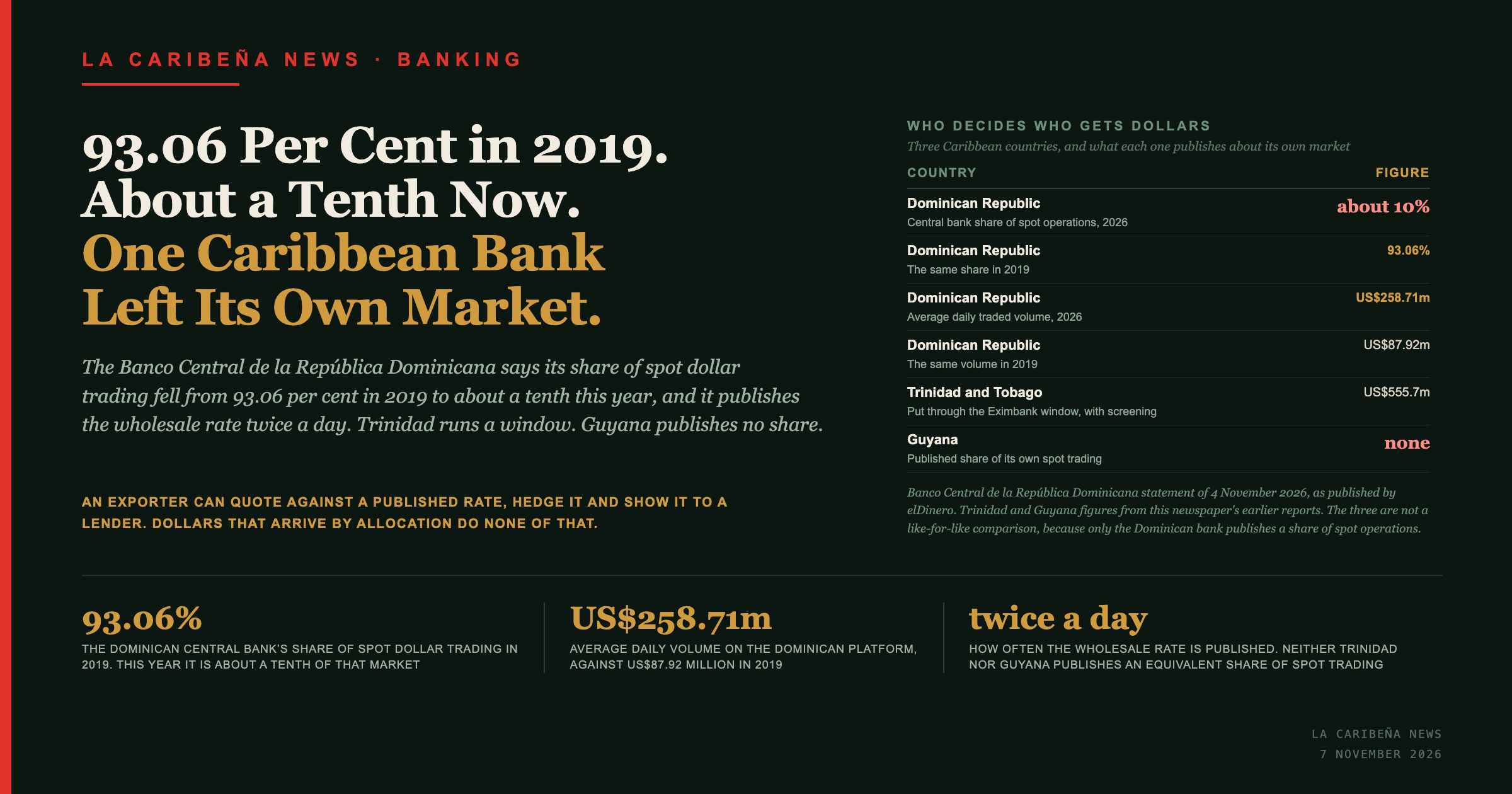
The Dominican Republic's central bank handled 93.06 per cent of spot dollar trades in 2019. Today it handles about a tenth of them. It published both figures on 4 November.
In Trinidad and Tobago a business still queues at the Eximbank window. In Guyana the central bank governor asked a furniture exporter why she wanted a US dollar account.
What did the Dominican central bank say?
That it has stepped back from its own market, and it put numbers to it.
The Banco Central de la República Dominicana set out its case on 4 November. It used its open page, the section it keeps for argument rather than for data. elDinero carried the statement in full, written throughout in the bank's own voice.
| 2019 | 2026 | |
|---|---|---|
| Central bank share of spot operations | 93.06% | about 10% |
| Average daily traded volume | US$87.92m | US$258.71m |
The bank's own figures, as published in its 4 November statement.
The bank rests its case on two things. One is article 28 of the Monetary and Financial Law 183-02, which it says makes the peso freely convertible. The other is the International Monetary Fund, which reclassified the Dominican regime as free floating in late 2025.
What is the platform?
An electronic market the bank runs and reports on.
The bank launched the platform in 2019, with help from the International Monetary Fund. It has since added the euro, forwards, non-deliverable forwards and swaps. The bank publishes the wholesale rate twice a day, and the traded volumes at the close.
Its Monetary Board adopted the FX Global Code in October 2025. The bank puts take-up among money dealers at 92 per cent this year.
The bank also reports that the rate now moves more from day to day. Its measure of that spread went from about 0.11 per cent before 2025 to 0.38. It calls this a wider daily range, not a change in the long-run trend.
What does a business face in Trinidad?
A window, and a form.
Trinidad's Eximbank put US$555.7 million through its foreign exchange window, and the screening it added decides which importers reach it. The Central Bank of Trinidad and Tobago sets the policy behind that window. Its own five-year strategic plan does not name the shortage.
And in Guyana?
A conversation about whether you need the account at all.
A furniture exporter asked why small businesses cannot open US dollar accounts, and the central bank governor asked why she wanted one. The Bank of Guyana publishes no equivalent share of its own spot trading. The International Monetary Fund has said investment imports keep Guyana's currency market tight.
Why does this matter to a business?
Because it decides whether your dollar price is a market price or a queue position.
An exporter who can see a published rate twice a day can quote a buyer against it. She can hedge with a forward. She can show a lender what the currency risk is. An exporter whose dollars arrive by allocation can do none of those things, whatever the posted rate says.
That difference is a cost. It sits in the margin a firm quotes, in whether it can take an order in euros, and in what a bank will lend against a sale it cannot price.
What is not established here?
The figures here come from elDinero's publication of the statement, not from the bank's own page. The statement sits on `bancentral.gov.do` under Página abierta. elDinero carried it on 4 November in the bank's own voice, and that is the text used.
Whether the Dominican figures compare with Trinidad's or Guyana's. The share and volume figures are the Dominican bank's own. Neither Trinidad nor Guyana publishes an equivalent share, so no table here puts the three side by side.
What the analysts said. The statement rejects what it calls recent claims by analysts. It says blaming its actions on particular interests ignores how the market has grown. The analysts' own arguments are not set out here.
Guyana's and Trinidad's current positions. Both come from this newspaper's earlier reports, dated in the links above. Neither bank has restated its position since.
The entities
- Banco Central de la República Dominicana is the Dominican Republic's central bank. It published the 4 November statement and the figures used here. - International Monetary Fund gave technical assistance for the Dominican electronic platform in 2019 and reclassified the regime as free floating in late 2025. - FX Global Code is a voluntary standard for foreign exchange market conduct, adopted by the Dominican Monetary Board in October 2025. - Central Bank of Trinidad and Tobago is Trinidad and Tobago's central bank, whose five-year strategic plan does not name the country's foreign exchange shortage. - Bank of Guyana is Guyana's central bank, whose governor questioned a furniture exporter's need for a US dollar account. - Monetary and Financial Law 183-02 is the Dominican statute whose article 28 the bank cites for free convertibility.
What the title card says
- Kicker: Banking. - Headline: the Dominican central bank handled 93 per cent of spot dollar trades in 2019 and about 10 per cent now. - Deck: its statement of 4 November 2026, on its own figures, against a Trinidadian window and a Guyanese conversation about whether an exporter needs a dollar account. - Standfirst: it publishes the wholesale rate twice a day and the traded volumes at the close. - Panel, "Who decides who gets dollars", sub-headed as three Caribbean countries, with rows of country against mechanism: - Dominican Republic, central bank share of spot operations, about 10 per cent. - Dominican Republic, the same share in 2019, 93.06 per cent. - Dominican Republic, average daily traded volume, US$258.71 million. - Trinidad and Tobago, put through the Eximbank window, US$555.7 million. - Guyana, published share of spot operations, none. - Panel note: Banco Central de la República Dominicana statement of 4 November 2026, as published by elDinero; this newspaper's earlier reports for Trinidad and Guyana. - Chip: 93.06 per cent to about 10, the Dominican central bank's own share of spot trading. - Chip: US$87.92 million to US$258.71 million, average daily volume on the Dominican platform. - Chip: twice a day, how often the wholesale rate is published. - Date line: 7 November 2026.
Frequently Asked Questions
How much of the Dominican spot market does its central bank handle?
About 10 per cent this year, on the bank's own figures. In 2019 it was 93.06 per cent. The bank published both in a statement on 4 November 2026.
What is the Dominican electronic foreign exchange platform?
A market the central bank launched in 2019, with help from the International Monetary Fund. It now covers the euro, forwards, non-deliverable forwards and swaps. The wholesale rate is published twice a day.
Has the Dominican peso become more volatile?
The bank says its measure of daily movement rose from about 0.11 per cent before 2025 to 0.38. It calls that a wider daily range, not a change in the long-run trend.
How do Trinidad and Guyana compare?
Neither publishes an equivalent figure. Trinidad's Eximbank runs a window that put US$555.7 million through screening. In Guyana a furniture exporter was asked why she wanted a US dollar account.
Why would an exporter care?
A published rate can be quoted to a buyer. It can be hedged with a forward. It can be shown to a lender. Dollars that arrive by allocation cannot be used that way.