By LCN Business Desk
An importer in Port of Spain applying for United States dollars is now filing paperwork that two state agencies read together, and the list of what they are reading it for is published.
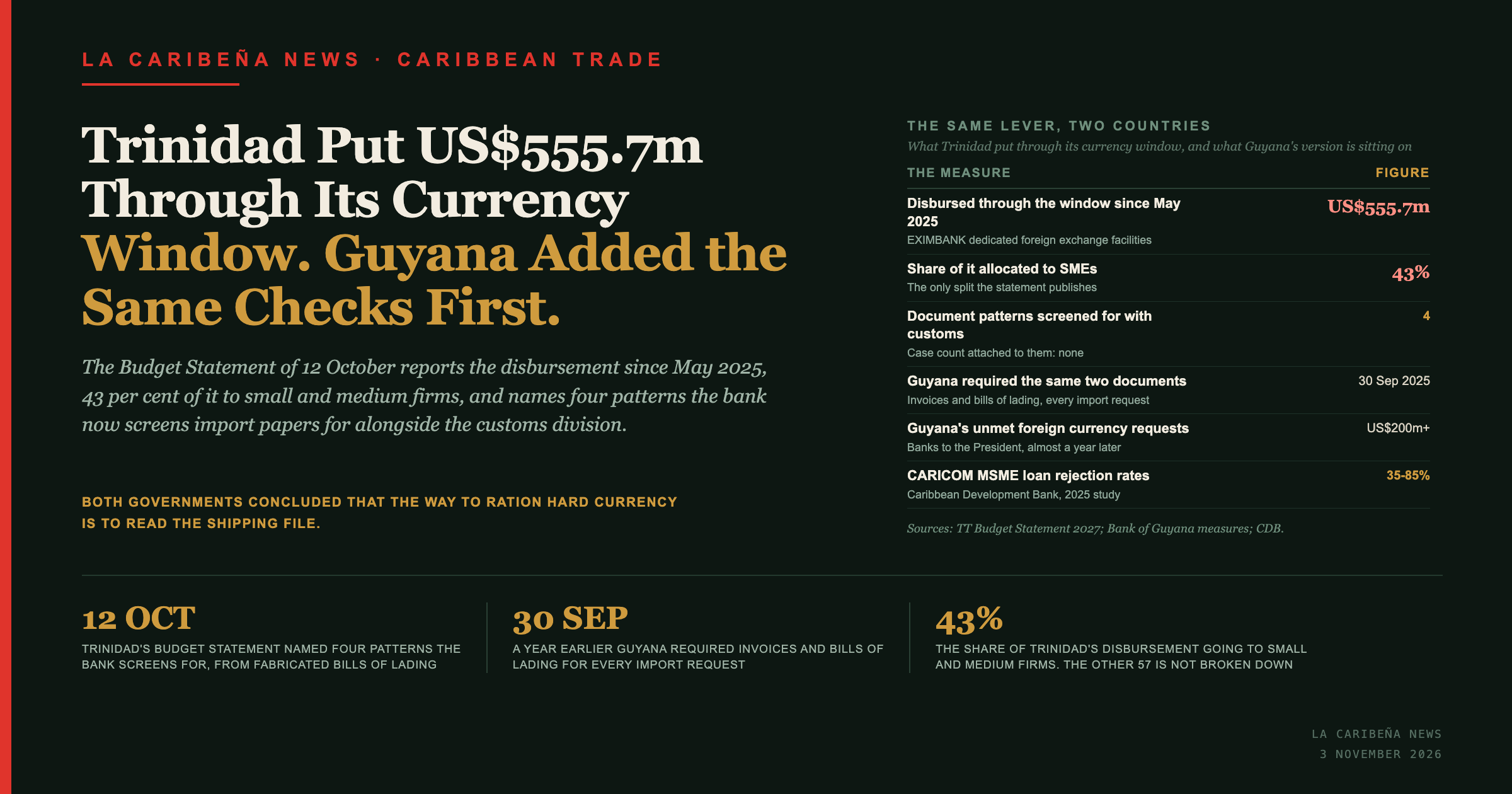
The Budget Statement 2027, presented by Finance Minister Davendranath Tancoo on 12 October 2026, puts a number on the window. *"Since May 2025, the EXIMBANK has disbursed US$555.7 million through its dedicated foreign exchange facilities, with 43 percent allocated to small and medium-sized enterprises."*
It then sets out what the bank looks for. Working with the Customs and Excise Division, it screens for *"fabricated bills of lading"*, *"inflated invoices"*, *"goods represented as shipped when no shipment occurred"*, and *"inconsistencies between declared values and the underlying supporting documentation"*.
What changed in how the currency is handed out?
Five things, and two of them decide who goes to the front of the queue.
Five changes to EXIMBANK's allocation framework are listed. It was revised to broaden access for small and medium-sized enterprises and manufacturers. A transparent eligibility criteria and stronger reporting arrangements were introduced. A limit was placed on allocations to individual entities. A dedicated access for eligible SMEs was implemented.
The fifth is the one a business can act on: greater consideration now goes to firms that either earn foreign exchange through exports or reduce the country's dependency on imports.
What is the bank actually checking?
It screens for four named patterns in import paperwork.
| What is screened for | What it describes |
|---|---|
| Fabricated bills of lading | A shipping document for a shipment that was not made as stated |
| Inflated invoices | A price above the real one, drawing more currency than the trade needs |
| Goods represented as shipped when no shipment occurred | A paper import with no cargo behind it |
| Inconsistencies between declared values and supporting documentation | The file disagreeing with itself |
*Budget Statement 2027, on EXIMBANK's coordination with the Customs and Excise Division.*
These are the categories the screening targets. The statement attaches no case count to them and does not say any application was found fraudulent.
On the customs side the same statement records 120 officers onboarded for surveillance, cargo examination and border enforcement, and an upgrade of the ASYCUDA customs system begun in October 2025 in partnership with the United Nations Conference on Trade and Development.
Where has this been tried already?
Next door, a year earlier, on the same two documents.
Guyana's measures of 30 September 2025 required invoices and bills of lading for every import request, reconciled with the Guyana Revenue Authority and the Bank of Guyana, with personal credit cards barred from business payments and penalties for over-invoicing. Two countries, two currencies, and the same two pieces of paper chosen as the control point.
Did it clear the queue in Guyana?
Not within the first year.
Almost twelve months after those measures, Guyana's commercial banks told President Irfaan Ali that unmet requests for foreign currency stood at just over US$200 million, part of it carried forward from earlier months.
Document screening and an unfilled queue are not alternatives, and Guyana has both. Trinidad's statement reports a disbursement total and no equivalent figure for what remains unmet.
Who is getting the money in Trinidad?
Small and medium firms are getting 43 per cent of it, which is the only split published.
The 43 per cent is the single sectoral figure in the passage. The statement gives no breakdown of the remaining 57 per cent, no number of applicants, and no rejection rate.
That last absence has a regional benchmark. The Caribbean Development Bank's 2025 study found MSME loan rejection rates of 35 to 85 per cent across CARICOM, on a regional picture in which capital exists and the system does not reach the people who need it.
Why does the export condition matter?
Because Trinidad has set a target that the condition feeds.
Priority for firms earning foreign exchange through exports sits alongside a national objective: Trinidad has a US$5 billion non-energy export target, set out on 13 October 2026 in the same week as the budget, against Suriname attaching no measurement to a similar argument and Guyana writing forty reserved categories into statute.
An exporter in Trinidad therefore has two reasons to document export earnings precisely. It supports the national number, and it moves the firm up the currency queue.
What does the statement not establish?
The size of the queue, the cost of the screening, and the fate of the other state lender.
It reports what was disbursed and not what was requested, so the gap between demand and allocation is not stated. It gives no figure for what the verification work costs or how many applications it has touched.
And the National Entrepreneurship Development Company, the state lender for micro and small business, is not named once in the Budget Statement. Its own published terms are an 8 per cent interest rate on all loans, up to TT$250,000 for a first-time borrower and up to TT$500,000 for a repeat borrower, with up to three months grace. That page carries no date, so when those terms were set cannot be read from it.
For a firm in either country, the usable content is the same in both: the shipping file is now the instrument that decides access to currency, and the four patterns above are what it is read against.
The entities
- EXIMBANK is the Export-Import Bank of Trinidad and Tobago, which operates the dedicated foreign exchange facilities described in the Budget Statement.
- Budget Statement 2027 is the Trinidad and Tobago budget presented by the Minister of Finance on 12 October 2026.
- Davendranath Tancoo is Trinidad and Tobago's Minister of Finance, who presented that statement.
- Customs and Excise Division is the Trinidadian revenue agency coordinating with EXIMBANK on document verification.
- Bills of lading are the shipping documents evidencing that goods were received for carriage, and the first of the four patterns screened for concerns fabricated ones.
- ASYCUDA is the customs management system whose upgrade began in October 2025 with the United Nations Conference on Trade and Development.
- National Entrepreneurship Development Company is Trinidad's state lender to micro and small business, which the Budget Statement does not name.
- Caribbean Development Bank is the regional development bank whose 2025 study measured MSME loan rejection rates across CARICOM.
What the title card says
- Headline: Trinidad put US$555.7 million through its foreign exchange window, and the screening it added is the one Guyana added a year earlier.
- Disbursed through EXIMBANK's dedicated foreign exchange facilities since May 2025: US$555.7 million.
- Share of that allocated to small and medium-sized enterprises: 43 per cent.
- Document patterns the bank screens for with the customs division: four.
- The first of them: fabricated bills of lading.
- Case count attached to that screening in the statement: none.
- Date the Budget Statement was presented: 12 October 2026.
- Date Guyana required invoices and bills of lading for every import request: 30 September 2025.
- Unmet foreign currency requests Guyana's banks reported to the President: just over US$200 million.
- MSME loan rejection rates the Caribbean Development Bank measured across CARICOM: 35 to 85 per cent.
- Customs officers Trinidad onboarded for surveillance, cargo examination and border enforcement: 120.
- Times the Budget Statement names the state micro and small business lender: none.
Frequently Asked Questions
How much has Trinidad's EXIMBANK disbursed in foreign exchange?
US$555.7 million through its dedicated foreign exchange facilities since May 2025, with 43 per cent allocated to small and medium-sized enterprises, according to the Budget Statement presented on 12 October 2026.
What does the bank screen import documents for?
Four patterns, named in the statement: fabricated bills of lading, inflated invoices, goods represented as shipped when no shipment occurred, and inconsistencies between declared values and the underlying supporting documentation. The screening is done in coordination with the Customs and Excise Division.
Which businesses get priority for foreign exchange?
Those that earn foreign exchange through exports or reduce the country's dependency on imports. The allocation framework was also revised to broaden access for small and medium-sized enterprises and manufacturers, with a dedicated access for eligible SMEs and a limit on allocations to individual entities.
Has Guyana done the same thing?
Guyana's measures of 30 September 2025 required invoices and bills of lading for every import request, reconciled with the Guyana Revenue Authority and the Bank of Guyana, barred personal credit cards from business payments and set penalties for over-invoicing. Almost a year later its commercial banks reported unmet foreign currency requests of just over US$200 million.
What does the Trinidad statement not say?
It reports what was disbursed and not what was requested, so the unmet demand is not stated. It gives no case count for the screening, no cost for it, no breakdown of the 57 per cent not allocated to SMEs, and it does not name the National Entrepreneurship Development Company at all.