By LCN Business Desk
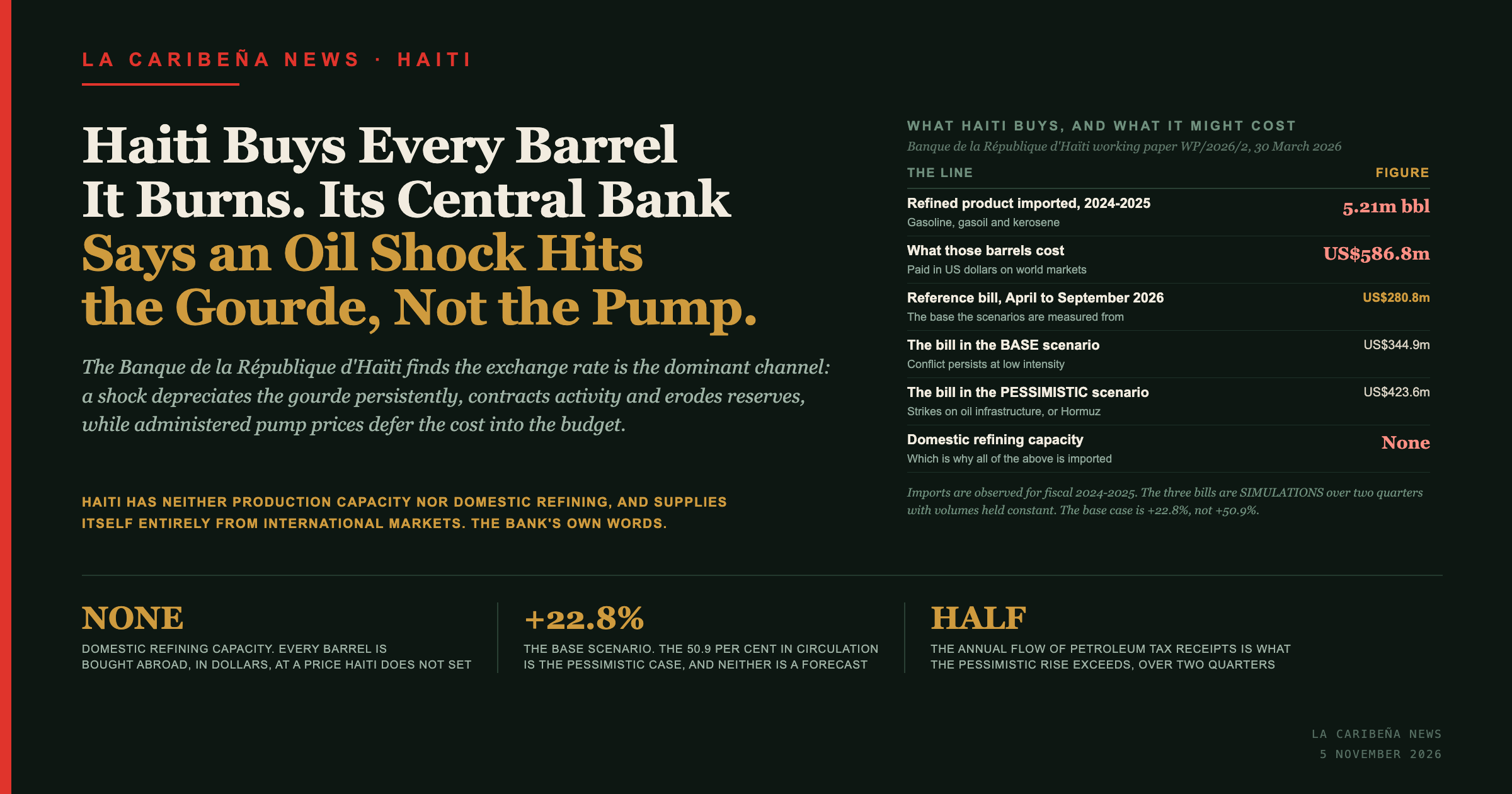
Haiti is a net hydrocarbon importer "ne disposant ni de capacité de production ni d'infrastructures de raffinage domestiques", with neither production capacity nor domestic refining, and supplies itself entirely from international markets. That sentence opens a working paper the Banque de la République d'Haïti published on 30 March 2026, and the rest of the paper is an account of what follows from it.
What follows is that a rise in the world crude price arrives first in the currency. The bank's finding is that the exchange rate is a dominant transmission channel: an oil shock depreciates the gourde persistently, contracts real activity and erodes foreign exchange reserves, the same reserves a country earns from visitors and from trade, while administered prices at the pump damp the effect on domestic prices in the short term at the cost of deferred budgetary tensions.
What does Haiti actually buy?
Three refined products, all of them priced in dollars by markets Haiti does not sit in.
| Fiscal year 2024-2025 | Thousand barrels | Thousand US$ |
|---|---|---|
| Gasoline | 2,807.8 | 317,634.7 |
| Gasoil | 2,302.9 | 257,803.4 |
| Kérosène | 99.9 | 11,362.5 |
| Total | 5,210.6 | 586,800.5 |
Banque de la République d'Haïti working paper WP/2026/2, table 1, sourced to BRH/DAI. The Haitian fiscal year runs October to September. Haiti is one of two members CARICOM's own merchandise trade series leaves out, so its national figures are the available view. Petroleum tax receipts over the same period were 31.2 billion gourdes and energy subsidies 663 million gourdes.
Gasoline and gasoil are 98 per cent of the 5.21 million barrels between them. There is no domestic substitute at any price, which is what makes the import bill a transmission channel rather than a line item. Diesel is also what keeps the lights on: Haiti's generation is diesel and hydro, so the same imported barrel carries both the road and the grid.
What did the bank model?
Three price paths over the two quarters to the end of this fiscal year, against the Iran and United States conflict.
| Scenario, April to September 2026 | WTI average, US$/barrel | Bill, million US$ | Change |
|---|---|---|---|
| Reference | n/a | 280.8 | n/a |
| Optimistic | 75.0 | 308.6 | +9.9% |
| Base | 84.0 | 344.9 | +22.8% |
| Pessimistic | 103.5 | 423.6 | +50.9% |
WP/2026/2, table 3. Scenarios are built from Brent levels observed at the end of March 2026, converted to WTI on a historical average differential of US$4 a barrel, with import volumes held at their 2024-2025 level. The optimistic case assumes de-escalation, the base case a persistent low-intensity conflict, the pessimistic case strikes on oil infrastructure or partial closure of the Strait of Hormuz. That channel has already moved a Latin American currency this year, when oil prices rose after an attack on a tanker in the strait.
::: The 50.9 per cent is the pessimistic scenario. The base case is 22.8. Both are simulations of a price move, not forecasts of one. The volumes are held still, so neither prices a change in what Haiti buys. The reference bill is US$280.8 million. :::
What is the figure that should worry a treasury?
The one the bank draws itself, which compares the increase with the tax it collects.
The pessimistic increase of US$142.8 million, the paper notes, "dépasse la moitié du flux annuel de recettes fiscales pétrolières", exceeds half the annual flow of petroleum tax receipts. Those receipts were 31.2 billion gourdes across the whole of fiscal 2024-2025, and the stream they are levied on fell 72.7 per cent over the year to October 2026, against an increase modelled over two quarters.
Two budget effects run in opposite directions at once. Petroleum tax receipts rise with the bill, because the duty is levied on it. That gain is offset to the extent the state holds pump prices down, which is the mechanism the paper says defers the tension rather than removing it.
Why does the currency move before the price at the pump?
Because the purchase is in dollars and the retail price is administered.
Every barrel is bought with foreign exchange, so a price rise is an immediate call on reserves and on the market for dollars. Haiti has been losing another dollar earner at the same time: Royal Caribbean suspended its calls at Labadee to at least April 2028, moving 44 itineraries to other ports, and its newly published season for April to October 2028 does not name the destination. The price a Haitian driver pays is set rather than passed through, so the signal that would ordinarily show up at the forecourt shows up instead in the gourde and in the reserve position. The paper's recommendation follows directly: priority surveillance of the exchange market, and energy stress scenarios written into policy analysis as standard.
Could Haiti ever produce its own?
Not on the record. Its regulator says nothing is proven.
Eleven wells were drilled between 1945 and 1977, eight onshore and three offshore, and the results did not confirm hydrocarbons. Between 2015 and 2019 three companies applied for exploration permits and two were signed. The director of the Bureau des Mines et de l'Énergie, Claude Prépetit, has confirmed that "il n'existe pas de réserves pétrolières avérées en Haïti", that no petroleum reserves are proven in the country, and that the earlier work identified indications only.
A research permit is exclusive and may not exceed 500 square kilometres, a surface exploration permit runs five years, and a research permit requires a mining convention signed with the Haitian State. The BME is the only body able to issue one.
Where do the reserve figures in circulation come from?
One reading of a survey about somewhere larger.
The numbers attached to Haiti, 941 or 942 million barrels and a valuation of US$120 billion, trace to the French scientist Daniel Mathurin citing a United States Geological Survey assessment of 2000. That assessment covered the whole Greater Antilles and put the region at at least 142 million barrels of oil and 159 billion cubic feet of gas. No independent verification of the larger figures was found, and no reserve figure for Haiti alone survives a check against its source.
What is not established here?
Whether the modelled shock has occurred. The scenarios were built on end-March prices and the paper is a simulation, so nothing here reports what the bill actually was.
Any reserve or resource figure for Haiti. The regulator says none is proven and no published figure traces to a Haiti-specific survey.
Whether a dedicated hydrocarbons law is in current force and whether any exploration permit is active today. The BME's own site returned a verification interstitial rather than its publications, so the permit regime is reported rather than read in the decree.
Whether Haiti's petroleum potential bears on any government's engagement with the country. That proposition is in circulation and no source found asserts it.
The entities
- Banque de la République d'Haïti is Haiti's central bank, whose working paper WP/2026/2 of 30 March 2026 models the transmission of oil shocks. - WP/2026/2 is that paper, "Dépendance énergétique et chocs pétroliers", by Kensley Blaise, Jean Marie Cayemitte, Elie Israël, Lyssandre Léandre and Jean Gardy Victor. - Bureau des Mines et de l'Énergie is Haiti's mining and energy bureau, the only body able to issue petroleum permits. - Claude Prépetit is its director, who has confirmed that no petroleum reserves are proven in Haiti. - Daniel Mathurin is the French scientist whose reading of a 2000 United States Geological Survey assessment is the origin of the reserve figures that circulate as Haiti's. - United States Geological Survey is the body whose 2000 assessment put the whole Greater Antilles at at least 142 million barrels of oil.
What the title card says
- Headline: Haiti imports every barrel, and its central bank finds the shock reaches the currency first. - Barrels of refined product imported in fiscal 2024-2025: 5,210,600. - Value of those imports: US$586.8 million. - Petroleum tax receipts over the same year: 31.2 billion gourdes. - Reference oil bill for April to September 2026: US$280.8 million. - The bill in the base scenario: US$344.9 million, up 22.8 per cent. - The bill in the pessimistic scenario: US$423.6 million, up 50.9 per cent. - Domestic refining capacity: none. - Proven petroleum reserves, per the Bureau des Mines et de l'Énergie: none.
Frequently Asked Questions
Does Haiti produce or refine any oil?
No. The Banque de la République d'Haïti states that the country has neither production capacity nor domestic refining infrastructure and supplies itself entirely from international markets.
How much petroleum does Haiti import?
5,210,600 barrels of gasoline, gasoil and kerosene in fiscal year 2024-2025, worth US$586.8 million.
Will Haiti's oil bill rise by 50 per cent?
That is the pessimistic scenario in the central bank's working paper, not a forecast. Against a reference of US$280.8 million for April to September 2026, the optimistic case is US$308.6 million, the base case US$344.9 million and the pessimistic case US$423.6 million.
Why does the central bank say the exchange rate matters most?
Because the purchases are made in US dollars and the retail price is administered. A price rise is an immediate call on reserves and on the market for dollars, while the pump price is held, so the paper finds a shock depreciates the gourde persistently, contracts real activity and erodes reserves.
Does Haiti have oil reserves?
None are proven. Eleven wells drilled between 1945 and 1977 did not confirm hydrocarbons, and the director of the Bureau des Mines et de l'Énergie has said the earlier work identified indications only.
What about the 941 million barrels figure?
It traces to one reading of a 2000 United States Geological Survey assessment that covered the whole Greater Antilles and put the region at at least 142 million barrels. No independent verification of the larger figure was found.