By LCN Business Desk
A country with a state hydrocarbons company has taken over its state hydrocarbons company, and the queues are still there.
Bolivia placed YPFB under intervention on 3 September, ordering an audit and reorganisation of the import and distribution chain. A month later, on 5 October, drivers were still queuing in Tarija, Santa Cruz, La Paz and Beni.
For a Caribbean reader the interest is not Bolivian politics. It is the gap between producing hydrocarbons and having fuel, which is a gap Guyana is now on the other side of.
What did Bolivia actually do to YPFB?
Put it under ministerial control for up to six months.
The government ordered the intervention to audit and reorganise the import and distribution chain, effective 3 September, overseen by the Hydrocarbons and Energy Ministry and running up to 180 days with a possible further 90 if shortages persist.
Hydrocarbons Minister Marcelo Blanco gave the reason as "structural failures" and "corruption networks both within and outside the supply chain", and said: "We have no time to lose."
The longer plan is to move YPFB's marketing role to the private sector and point the state company at domestic extraction, exploration and refining instead. The instability behind that is in the company's own leadership: three YPFB presidents in under ten months.
Why does a hydrocarbons producer queue for fuel?
Because what it produces and what it burns are not the same molecule.
Bolivia imports 60 per cent of its petrol and 95 per cent of its diesel. A gas-producing state that must buy almost all of its diesel abroad is exposed to shipping, to foreign exchange and to price, and none of those are fixed by having reserves in the ground.
The government has also doubled diesel prices, to about US$1.50 a litre, to attack smuggling. That triggered protests, which is the ordinary consequence of removing a fuel subsidy and the reason subsidies outlive the budgets that carry them.
What is happening at the pumps?
Hoarding, and the policing of it.
At one station in Tarija that normally sells 3,500 litres, demand recently exceeded 10,000 litres a day, El Deber reported on 5 October. Controls were being run across nine departments against repeat loading and diversion.
YPFB's station manager in Tarija, Ronaldo Roque, described one result: "Hemos iniciado el operativo y hemos encontrado un vehiculo clonado, el cual habia cargado en el departamento de Beni, de Santa Cruz y tambien en el departamento de Tarija." A cloned vehicle, loading in three departments.
On why demand jumped, Roque was blunt: "La gente especula pensando que va a incrementar el precio y por eso busca acumular gasolina." People hoard because they expect the price to rise.
A fuel queue is rarely a shortage of fuel. It is a shortage of confidence that the price will hold.
What does this have to do with Guyana?
Guyana produces oil and buys its diesel.
This newspaper reported last month that a third of Guyana's own barrel is already diesel, in the context of a possible United States restriction on diesel exports. Guyana's crude is diesel-rich. Guyana has no refinery of scale. The country therefore sells the molecule abroad and buys the fuel back.
That is the same structural position Bolivia is in, reached from the opposite direction. Bolivia is a mature producer whose output no longer matches its consumption. Guyana is a new producer whose output never has to begin with.
The difference, and it is the whole difference, is the fiscal cushion. Bolivia is managing scarcity with a subsidy it is dismantling under protest. Guyana is managing the same import dependence with oil revenue. The exposure is identical. The ability to absorb it is not, and it lasts exactly as long as the revenue does.
Elsewhere in the region the same question is being answered with price controls rather than subsidies. Guatemala capped fuel and passed two laws to hold prices down at a cost of about US$762 million, and in the Bahamas and the British Virgin Islands the controlled and uncontrolled prices now sit US$2.35 apart.
What would resolve it?
Refining, foreign exchange, or a price people believe.
Bolivia's own stated direction is the first of those, redirecting YPFB towards extraction, exploration and refining. That takes years and capital. The second is a balance of payments question. The third is the one the queues are actually about, and it is the cheapest to fix and the hardest to hold.
The intervention has 180 days, with 90 more available. The queues have already outlasted the first month of it.
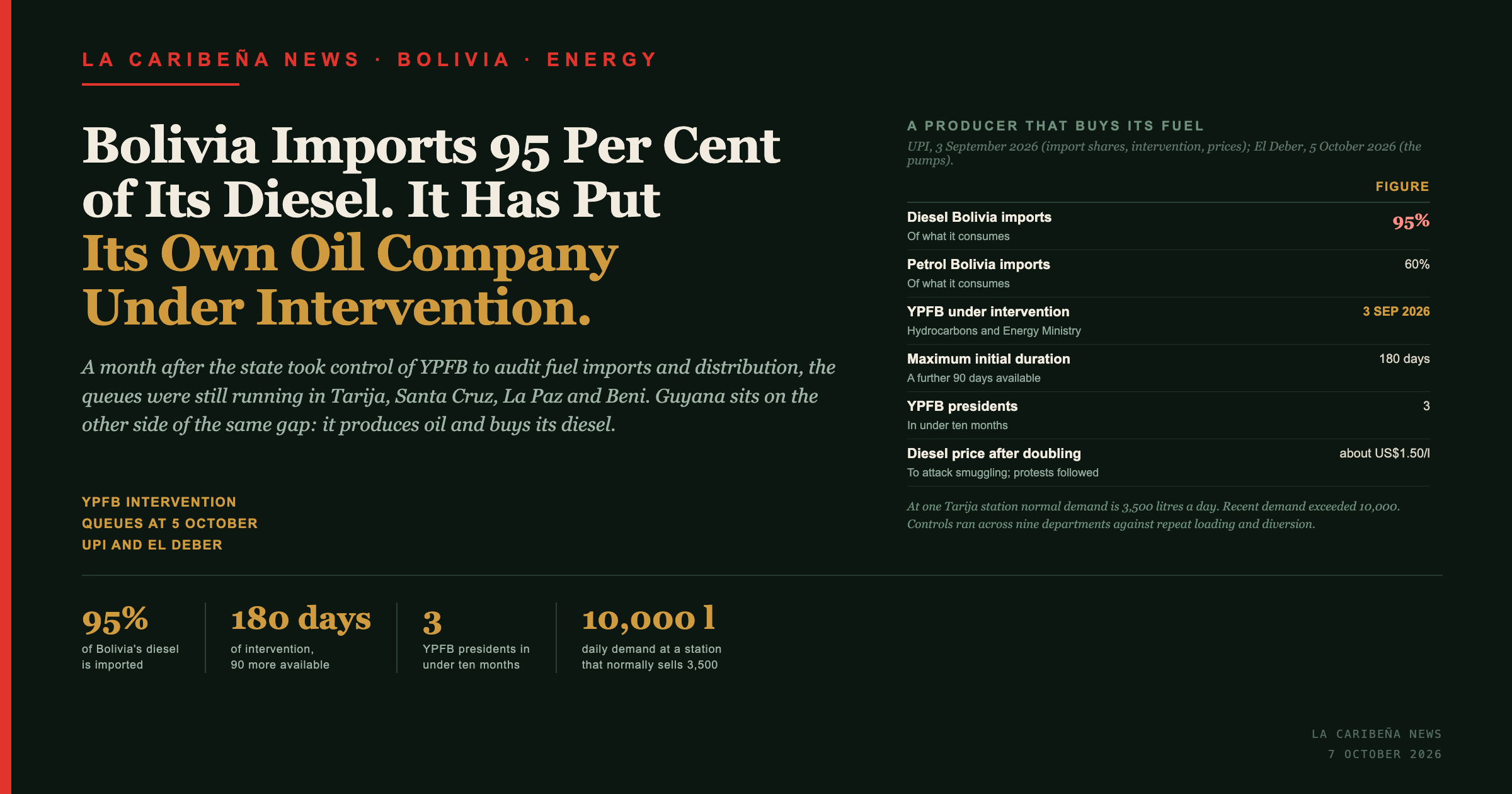
What the title card shows
Every data point on the article's title card, in text.
* 95 per cent. The share of the diesel Bolivia consumes that it imports. Source: UPI, 3 September 2026. * 60 per cent. The share of its petrol that is imported. Source: as above. * 3 September 2026. The date the intervention of YPFB took effect, overseen by the Hydrocarbons and Energy Ministry. Source: as above. * 180 days. The maximum initial duration of the intervention, with a possible further 90 if shortages persist. Source: as above. * Three. YPFB presidents in under ten months. Source: as above. * About US$1.50 a litre. The diesel price after the government doubled it to attack smuggling, which triggered protests. Source: as above. * 3,500 and 10,000 litres. Normal and recent daily demand at one station in Tarija. Source: El Deber, 5 October 2026. * Nine. Bolivian departments under controls against repeat loading and diversion. Source: as above.
Frequently Asked Questions
Why does Bolivia have fuel queues if it produces hydrocarbons?
Because it imports 60 per cent of its petrol and 95 per cent of its diesel. Producing gas does not produce refined fuel, and Bolivia lacks the refining capacity to cover its own consumption.
What is the YPFB intervention?
An order placing the state oil company under the Hydrocarbons and Energy Ministry from 3 September 2026 to audit and reorganise fuel imports and distribution, for up to 180 days with a possible further 90. The minister cited structural failures and corruption networks inside and outside the supply chain.
Has it ended the queues?
Not as at 5 October. Queues persisted in Tarija, Santa Cruz, La Paz and Beni, and controls were running across nine departments against repeat loading and diversion.
Why are people queuing if supply has increased?
Officials attribute part of the demand to hoarding in expectation of a price rise. One Tarija station that normally sells 3,500 litres saw demand above 10,000 litres a day.
Does this affect Guyana?
Not directly, but the structural position is similar. Guyana's crude is diesel-rich and the country has no refinery of scale, so it exports the molecule and imports the fuel. The difference is that Guyana currently has oil revenue to absorb the cost.