By LCN Business Desk
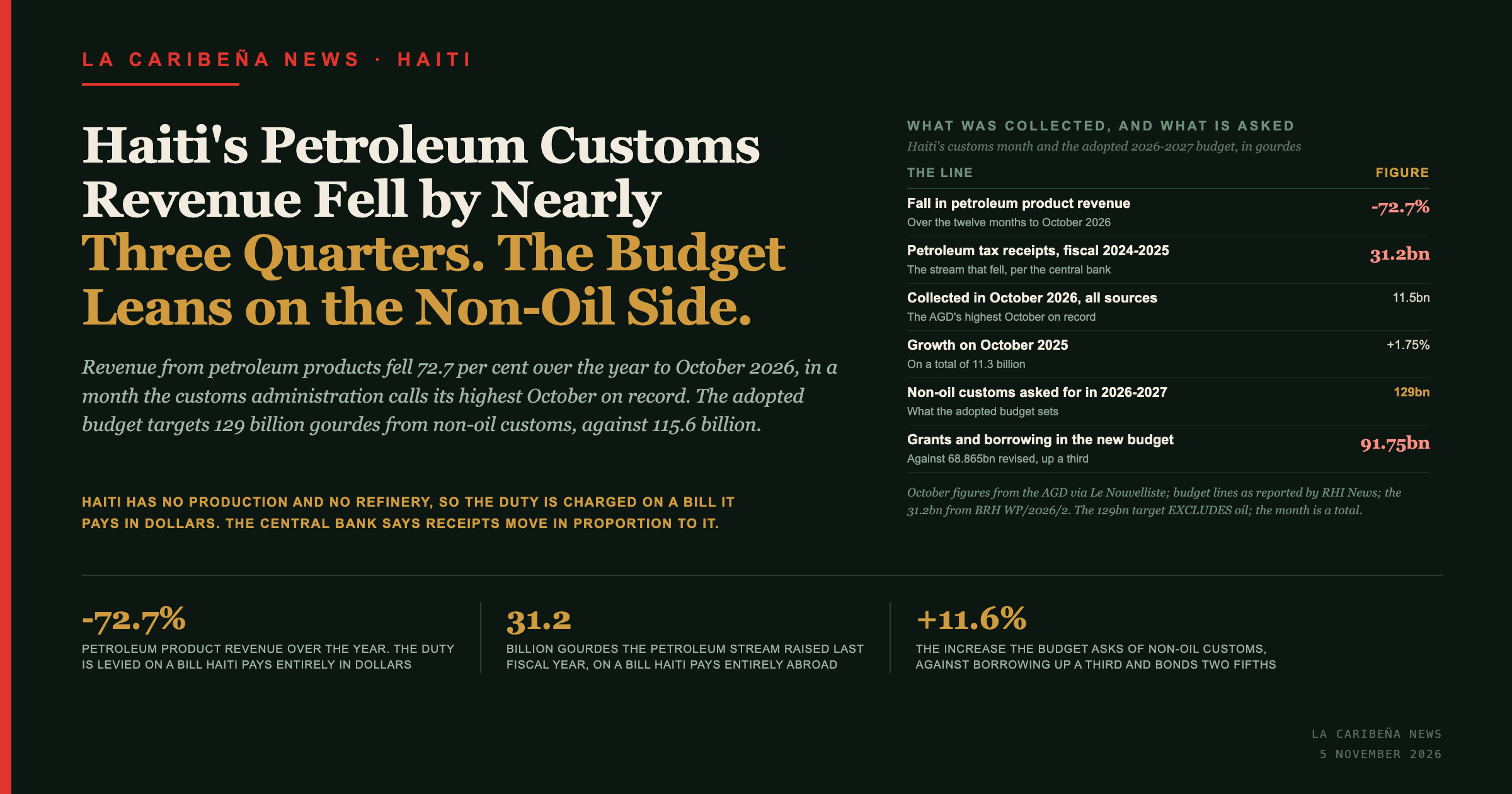
Revenue from petroleum products reaching Haiti's customs fell 72.7 per cent over the year to October 2026, in a month the Administration Générale des Douanes calls the highest October collection it has ever recorded, Le Nouvelliste reported on Thursday. Total collections were 11.5 billion gourdes against 11.3 billion a year earlier, a rise of 1.75 per cent.
Petroleum duty is levied on the import bill, and the central bank puts last year's petroleum tax receipts at 31.2 billion gourdes. A fall of that size in the stream the state taxes hardest is what the rest of the customs base had to cover, and the budget adopted for 2026-2027 asks that base for 129 billion gourdes.
What is the state asking for?
It raises borrowing and treasury bonds by far more than it raises customs.
| Revised 2025-2026 | 2026-2027 | Change | |
|---|---|---|---|
| Customs revenue, excluding oil | 115.6bn | 129bn | +11.6% |
| Current revenue | 243.14bn | 262.9bn | +8.1% |
| Grants and borrowing | 68.865bn | 91.75bn | +33.2% |
| Treasury bonds | 24.8bn | 35.179bn | +41.9% |
Figures in gourdes, from the adopted 2026-2027 budget as reported by RHI News. Percentages are LCN calculations from those two columns. The total budget is 401.2 billion gourdes.
Against those two lines, the increase asked of non-oil customs is the most modest on the page, which is a reasonable measure of how much the state expects borrowing to carry.
Does the October figure tell us the target is reachable?
Not directly, because the two numbers are not measured on the same basis.
The 129 billion is explicitly a non-oil figure. The October collection is reported as a total, and the share of it that came from petroleum is not published. So the monthly figure cannot be annualised against the target, and the difference between the two bases is exactly what is unknown.
::: The target excludes oil. The month, as reported, does not. Nobody has published the split. :::
Total collections grew 1.75 per cent in the month the administration calls its best October, and the component the target leaves out fell by nearly three quarters.
What does a fall in petroleum duty actually mean?
That the bill it is charged on moved, because the two are tied.
Haiti has no production capacity and no domestic refining, so every barrel is imported and the duty is levied on what the country pays for it. The Banque de la République d'Haïti states the relationship directly: petroleum tax receipts rise in proportion to the bill, an effect offset to the extent pump prices are held down. Those receipts were 31.2 billion gourdes across fiscal 2024-2025, on imports of 5.21 million barrels worth US$586.8 million.
The same paper finds that an oil shock reaches Haiti through the exchange rate before it reaches the pump, depreciating the gourde and eroding reserves while administered prices defer the budgetary cost. A customs line that moves by nearly three quarters in a year is the visible end of that mechanism.
Why does a Haitian duty line matter to a regional exporter?
Because it is the price of landing goods, and because Haiti's own figures are the only ones there are.
An importer's duty is a cost that moves with rates and with enforcement, not only with volume. A collection target that rises faster than collections have been rising is met by one of those three or it is missed.
Haiti is also absent from the regional series a trader would otherwise consult. the CARICOM Regional Statistics Programme covers thirteen of its fifteen member states, excluding The Bahamas and Haiti, so the AGD's own monthly releases are the view of Haitian trade that exists.
What else is leaving the revenue base?
Calls that used to arrive by sea.
Royal Caribbean has suspended its calls at Labadee to at least April 2028, moving 44 itineraries across nine ships, and the season it published this week for April to October 2028 does not name the destination. Passenger spending and port fees are not customs duty, but they are the same treasury.
How does a target like this usually hold?
The gap between a budgeted line and a collected one is the thing to watch, and it is published.
Guyana budgeted G$49.7 billion of carbon credit inflows for 2026 and had recorded G$657.5 million by 30 June, about 1.3 per cent of the year's figure at the half-way point, and repeated the estimate in its revised numbers. A target is a statement of intent until a mid-year report measures it, and Haiti's fiscal year began on 1 October.
What is not established here?
Whether the 11.5 billion is a total or already excludes petroleum. It is read here as a total because the oil fall is reported alongside it rather than within it.
Which of those moved. The duty tracks the bill, so a fall of this size is consistent with a lower bill, a rate or exemption change, a volume fall or under-declaration, and the release read names none of them.
The non-oil share of any month's collection, which the administration does not publish in the figures read.
The total of the revised 2025-2026 budget, which the report of the adopted budget does not give, so only the named lines can be compared.
No AGD official, port or customs office is named in the figures read.
The entities
- Administration Générale des Douanes is Haiti's customs administration, which collected 11.5 billion gourdes in October 2026. - Le Nouvelliste is the Haitian daily that reported the October collection on 5 November 2026. - Banque de la République d'Haïti is Haiti's central bank, which puts fiscal 2024-2025 petroleum tax receipts at 31.2 billion gourdes and states that those receipts move in proportion to the import bill. - CARICOM Regional Statistics Programme is the regional body whose merchandise trade series excludes Haiti and The Bahamas. - Royal Caribbean is the cruise line whose suspension of calls at Labadee runs to at least April 2028.
What the title card says
- Headline: petroleum customs revenue fell by nearly three quarters in a month, and the budget rests on non-oil customs growing 11.6 per cent. - Collected in October 2026: 11.5 billion gourdes. - Collected in October 2025: 11.3 billion gourdes. - Growth on the year: 1.75 per cent. - Fall in petroleum product revenue over the year: 72.7 per cent. - Non-oil customs target for 2026-2027: 129 billion gourdes. - The revised figure it rises from: 115.6 billion gourdes. - Grants and borrowing in the new budget: 91.75 billion gourdes. - Total adopted budget for 2026-2027: 401.2 billion gourdes.
Frequently Asked Questions
How much did Haiti's customs collect in October 2026?
11.5 billion gourdes, against 11.3 billion in October 2025, a rise of 1.75 per cent. The Administration Générale des Douanes describes it as the highest October collection it has recorded.
What happened to petroleum revenue?
It fell 72.7 per cent over the year, on the administration's figures as reported.
What does the 2026-2027 budget ask customs for?
129 billion gourdes of customs revenue excluding oil, against 115.6 billion in the revised 2025-2026 budget, an increase of 11.6 per cent. The total adopted budget is 401.2 billion gourdes.
Can the October figure be compared with that target?
No. The target excludes oil and the monthly collection is reported as a total, and the non-oil share of the month is not published. The two are not on the same basis.
What else is in the budget?
Current revenue is projected at 262.9 billion gourdes against 243.14 billion, grants and borrowing at 91.75 billion against 68.865 billion, and treasury bonds at 35.179 billion against 24.8 billion.
Where else can Haitian trade figures be found?
CARICOM's Regional Statistics Programme excludes Haiti from its merchandise trade totals, so the customs administration's own releases are the available view.