By LCN Wire
How much money can First Citizens actually draw?
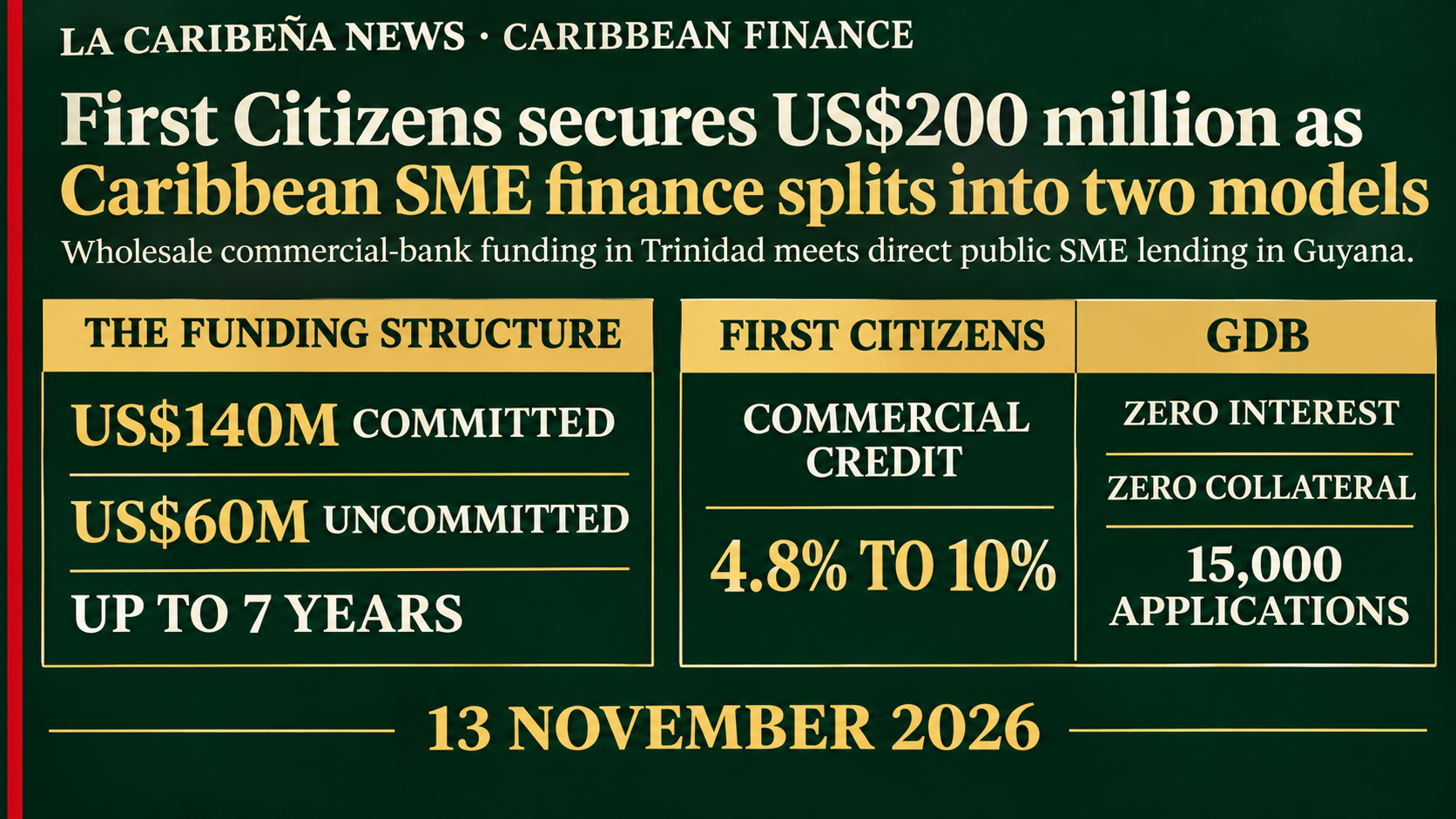
US$140 million is committed. A further US$60 million is uncommitted.
The IDB Invest financing package holds US$100 million from IDB Invest and US$40 million from the Japan International Cooperation Agency, through its TADAC Fund. IDB Invest may put up the last US$60 million, but the announcement does not call that part committed.
The project disclosure describes senior unsecured lending for up to seven years. First Citizens does not have to pledge any asset against it.
That does not make the loans it then writes unsecured. First Citizens says it looks at credit history, cash flow, ability to repay and security. Its published commercial rates run from 4.8 per cent to 10 per cent, over terms of up to 20 years.
Who is supposed to receive the financing?
Small and medium-sized businesses and low- and middle-income mortgage borrowers.
IDB Invest also names green lending and digital products for personal and business customers. It has not published how the money is split between them, a floor for the SME share, a cap on any one loan, or the rates First Citizens must charge.
That distinction matters in a market where Trinidad’s EXIMBANK allocated 43 per cent of US$555.7 million in foreign exchange to SMEs. The new First Citizens facility supplies money to lend. The EXIMBANK window supplies foreign currency to pay for imports.
First Citizens held TT$20.4 billion in customer loans at 30 June 2026, according to its nine-month financial statements. That was TT$703.8 million less than it reported in September 2025.
How do First Citizens loans compare with GDB loans?
The two banks solve different halves of the credit problem.
The Guyana Development Bank received an initial US$100 million, or G$20 billion, from Guyana’s 2026 budget. It lends straight to entrepreneurs who qualify. First Citizens is a commercial bank borrowing in bulk to lend on.
GDB offers a Quick Loan of up to G$300,000 and an SME Loan of up to G$3 million. Both carry zero interest. The government says neither asks for security, and the online estimator offers six, 12, 18 or 24 months to repay.
First Citizens advertises commercial loans at 4.8 per cent to 10 per cent. What it offers can turn on the purpose, the deposit, the security, the cash flow, the credit history and the bank’s prime rate. The seven-year term IDB Invest set does not fix how long any customer gets to repay.
GDB’s G$20 billion first tranche would pay for about 6,666 loans if every borrower drew the full G$3 million. President Dr. Mohamed Irfaan Ali said on 12 November that almost 15,000 applications had already been submitted, more than twice that theoretical number.
Which model reaches businesses that banks reject?
GDB drops the interest and the security. First Citizens gives a commercial lender more to lend.
Guyana’s model carries the credit risk inside a state-funded bank and judges applicants on whether the business works and the cash comes in. The law that set it up also places GDB outside the prudential regime applied to Guyana’s licensed commercial banks.
First Citizens is still supervised by the Central Bank of Trinidad and Tobago and uses its normal lending tests. The new money may mean more loans or longer terms. Nothing published obliges the bank to say yes to an applicant with no security, no credit history and no settled cash flow.
The regional problem is bigger than either facility. LCN has found that Caribbean capital exists while lending systems still struggle to recognise entrepreneurs. The First Citizens deal adds to the money banks have to lend. GDB changes the terms on which a small trader can qualify at all.
What will show whether the First Citizens facility worked?
How many loans it makes, how big they are, and on what terms.
Neither IDB Invest nor First Citizens published a drawdown timetable, an SME target, a mortgage target, or a promise to cut customer rates. The announcement sets no target for women-owned firms, rural borrowers, first-time buyers or people the bank has turned down before.
IDB Invest rates the deal FI-2. That means the loans it funds may carry limited environmental and social risk, of a kind that can be spotted and managed. Its project page gives the amount as US$160 million. The announcement describes a facility of up to US$200 million.
The entities
- First Citizens Bank: the Trinidad and Tobago commercial bank that secured the US$200 million facility.
- IDB Invest: the lender providing the facility.
- Guyana Development Bank (GDB): the state lender whose small-business loans carry no interest and no collateral.
What the title card says
- Facility secured by First Citizens: US$200 million.
- Committed portion: US$140 million.
- Uncommitted portion: US$60 million.
- Tenor: up to seven years.
- First Citizens: commercial credit at 4.8 per cent to 10 per cent.
- GDB: zero interest, zero collateral, 15,000 applications.
- Card date: 13 November 2026.
Frequently asked questions
Is First Citizens receiving the full US$200 million immediately?
The published structure commits up to US$140 million. A further US$60 million is described as an uncommitted IDB Invest loan.
Will First Citizens SME loans be interest-free?
No such term was announced. First Citizens advertises commercial lending rates ranging from 4.8 per cent to 10 per cent, subject to its lending criteria.
How much can a business borrow from the Guyana Development Bank?
A Quick Loan carries a ceiling of G$300,000. The larger SME Loan carries a ceiling of G$3 million.
Does GDB require collateral?
The Government of Guyana says the Quick Loan and SME Loan require no collateral and carry no interest.
Why is the First Citizens facility larger than GDB’s capital?
They are different instruments. First Citizens is receiving up to US$200 million in wholesale debt, while GDB began with US$100 million in government-provided capital for direct lending.
How many GDB applications have been submitted?
President Dr. Mohamed Irfaan Ali said on 12 November 2026 that the bank had received almost 15,000 applications.