By LCN Business Desk
Belize Electricity Limited says it is selling power for less than it pays for it. The Prime Minister agrees, and has said the difference may not go on the bill. Neither has said where it goes instead. On BEL's own shareholding, it stays with the public.
In late October BEL went to the Public Utilities Commission. It asked to raise the monthly limit under its Cost of Power Adjustment from 5 per cent to 10 per cent of the approved Reference Cost of Power. That mechanism is the pass-through by which the cost of fuel and purchased power reaches the customer. BEL wants to double how much of it can arrive in one month. It gave two reasons: high diesel prices, and a shortfall in the electricity Mexico supplies.
On 11 November the Prime Minister, John Briceño, told the media that BEL is running at a loss. Power costs it about BZ$0.80 a kilowatt-hour, or about US$0.40. Customers pay about BZ$0.60, about US$0.30. He called that unsustainable, then refused the obvious route out of it.
"We, as a government, cannot allow BEL to pass that on to the consumers."
The Commission has not ruled.
Who absorbs the twenty cents?
BEL's shareholders, almost all of whom are the public.
| Shareholder | Interest |
|---|---|
| Government of Belize, direct | 65.882% |
| Social Security Board | 31.27% |
| Total public sector interest | 97.155% |
| Over 1,500 small shareholders | the remainder in ordinary shares |
Those are BEL's own published figures, from its company profile. Set against the refusal, the gap does not disappear. It changes pocket. A cost the Commission is not allowed to put on the bill sits instead with a company the state owns two thirds of outright and the national pension fund owns most of the rest. Belizeans are not charged for it as electricity customers. They hold it as taxpayers and as Social Security Board contributors.
It is not a saving. It is a transfer, and neither BEL nor the government has published its size.
How big is the gap?
BZ$0.20 a kilowatt-hour, which is about US$0.10.
Those figures convert at the Central Bank's fixed rate of BZ$2.00 to the US dollar. BEL sold 723.2 gigawatt-hours in 2025 to 116,983 accounts. The Prime Minister gave both per-unit figures as approximations. Applied to that volume they give roughly BZ$145 million a year, or about US$72 million. That is near BZ$1,236 an account.
For scale, Guyana rents 96 megawatts from two floating power plants at 9.5 US cents a kilowatt-hour before fuel. That is a generation price, not a utility's all-in cost of power.
BEL bills Social, Residential, Commercial and Industrial customers on four separate tariff classes. The gap is not even across them. The arithmetic gives the scale of the transfer, not BEL's loss.
What is the Mexican shortfall BEL is citing?
A supply line that carries about two fifths of peak demand.
Belize's grid has been interconnected with Mexico's since 1998, and that link provides 55 megawatts of capacity. BEL met peak demand of 132.3 megawatts in 2025. So the Mexican connection stands behind roughly 42 per cent of the highest load Belize reached last year. BEL owns 55 megawatts of its own generation, and its profile describes that as used primarily for backup.
Michel Chebat, the Minister of National Security, Energy and Ports, took a delegation to Mexico City. A government report of 10 November records agreement to set up three working groups on electricity planning. They are to improve coordination and gather the technical information needed to weigh the options. The release did not say who would sit on them.
The Comisión Federal de Electricidad told Belize it would keep supplying. Chebat said the 55 megawatts is now under discussion rather than fixed. "We have opened the discussion to perhaps increasing that amount," he said. Mexico intends to build new generation plants in its south by 2028. CFE's Director General is Emilia Esther Calleja Alor. She said the utility's Yucatán Peninsula projects would keep meeting demand in southeastern Mexico.
So the cheaper imported power is short, BEL burns more expensive diesel in its place, and the relief on offer is a plant Mexico intends to build in two years.
Briceño also said BEL is working with several companies on solar generation and battery storage. The aim is to shift daytime output into the evening peak. "With the batteries, during the day, we can charge it, and then at night, put it onto the system when the price is highest," he said. Elsewhere in the region that ceiling is written into statute: Costa Rica caps parallel generation at 15 per cent of its national system.
How does this compare with the rest of the region?
Six weeks ago a Caribbean government capped exactly the charge BEL wants to uncap.
Cayman capped its electricity fuel charge for nearly 95 per cent of households on 29 September, alongside a full fuel import duty waiver. BEL's request runs the other way: not a cap on the fuel charge, but a doubling of the ceiling on how fast fuel cost can reach the customer. The same instrument, pointed in opposite directions, within two months.
The regional pattern is that governments are paying this cost somewhere and most of them say how much. St Kitts and Nevis has put more than EC$80 million into electricity subsidies alone. Cayman published its spend to the end of August, about CI$11.35 million. In Guyana the regulator published a scorecard instead of a sum, when the Public Utilities Commission found GPL met two and a half of eight performance targets for 2025.
One regulator is writing down obligations rather than costs. Bahamian regulator URCA opened a consultation on consumer protection plan guidelines on 2 November. Suriname's Cabinet of the President put a number on its own shortfall: 120 to 140 megawatts by 2030. Four companies have offered more than 200 megawatts of solar against it. Belize has published a refusal. No figure accompanies it, and because the cost lands on a balance sheet rather than a budget line, there is no appropriation to read it off.
Which ownership figure is current?
BEL's own documents give two, five months apart.
| BEL document | Government of Belize, direct |
|---|---|
| Company profile, live | 65.882% |
| Rate filing, 22 March 2024 | 32.58% |
| Annual report, 2018 | 32.6% |
The Social Security Board's 31.27 per cent is identical in all three. So whatever moved, moved on the government's side of the register. Between the filing and the profile, in June 2026, the government introduced the Belize Electricity Investments Bill. It would authorise the purchase of 8,138,020 convertible redeemable preference shares in BEL, funded through the Consolidated Revenue Fund. The stated purpose was to strengthen the company's finances. Briceño told the House it was meant to keep the utility stable.
Preference shares are a different class from the ordinary shares the 65.882 per cent describes. Convertible ones become ordinary only on conversion. So the bill does not on its face account for a doubling of the direct holding.
What the June bill does establish is the channel. Five months before refusing the pass-through, the government was already putting budget money into BEL to hold it up. The refusal continues that by a different route.
What does this mean for a firm buying power in Belize?
The tariff is held, the decision is not made, and the exposure moved rather than ended.
For now a Belizean business pays the existing rate. The mechanism that would have raised it is the one the Prime Minister has closed. The decision still sits with the Public Utilities Commission, which as at 13 November had not ruled and had published no date. That is the body to watch, not the Cabinet.
The second thing is slower. A cost absorbed by a company the public owns 97.155 per cent of reaches the same firms later. It arrives through the fund that capitalised BEL in June, or through the pension fund that owns a third of it. The Prime Minister put this inside his answer on the cost of living. Belizean households were already pulling back. The Statistical Institute's Consumer Confidence Index fell to 38.4 in September, its lowest since April 2024.
The entities
- Belize Electricity Limited (BEL) is the primary distributor of electricity in Belize, serving 116,983 accounts. - The Public Utilities Commission (PUC) is Belize's utilities regulator, which approves electricity rates. - The Cost of Power Adjustment (COPA) is the mechanism that passes fuel and purchased-power costs through to Belizean electricity customers, capped monthly as a percentage of the approved Reference Cost of Power. - Reference Cost of Power is the approved benchmark cost against which that monthly cap is measured. - John Briceño is the Prime Minister of Belize. - Michel Chebat is Belize's Minister of National Security, Energy and Ports. - The Social Security Board (SSB) is Belize's national social security institution and BEL's second largest shareholder. - The Comisión Federal de Electricidad (CFE) is Mexico's state electricity utility, which has supplied Belize since 1998.
What the title card says
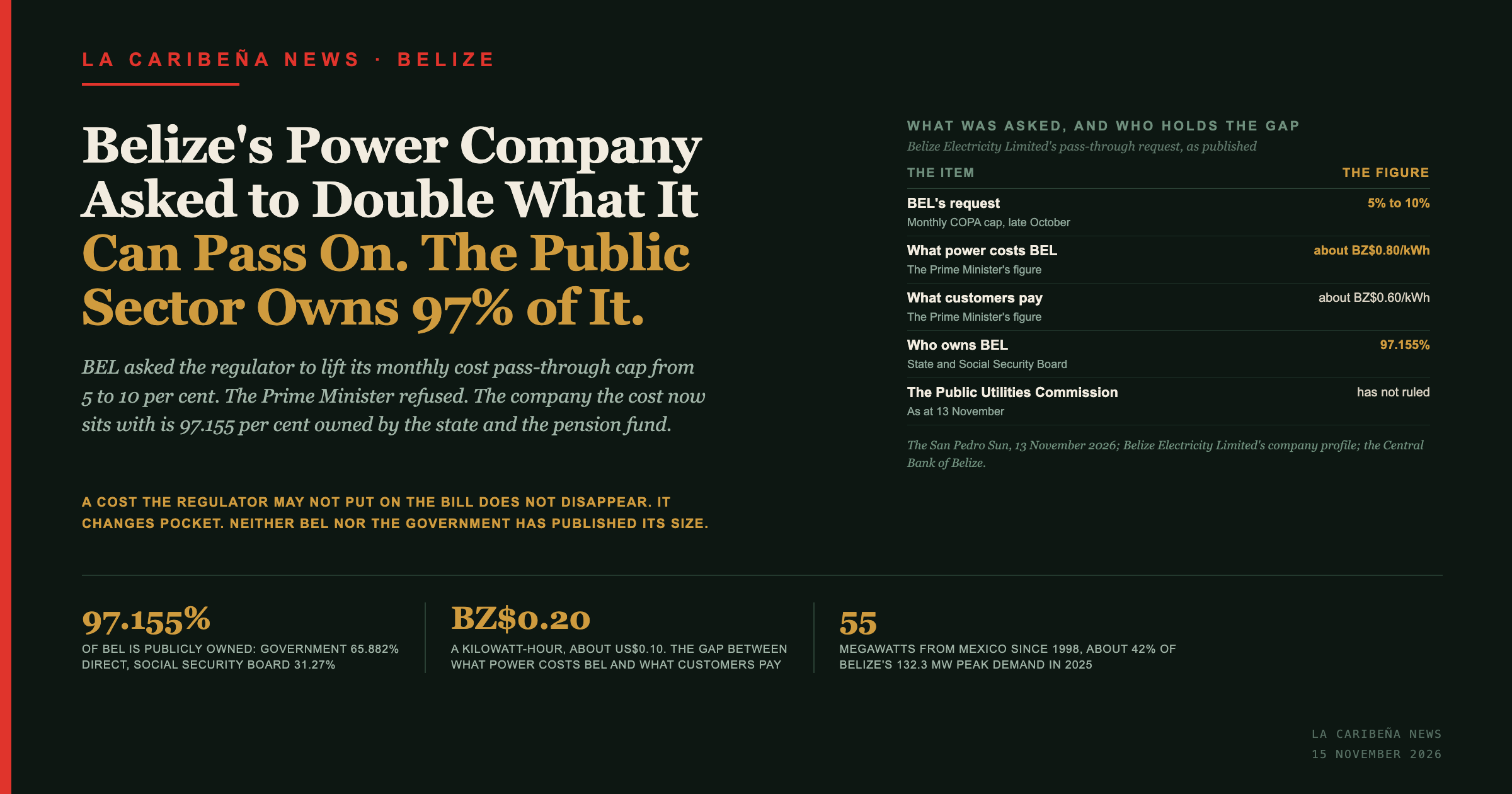
- BEL's request, made to the regulator in late October: lift the monthly COPA cap from 5 per cent to 10 per cent. - What power costs BEL: about BZ$0.80 a kilowatt-hour, the Prime Minister's figure. - What customers pay: about BZ$0.60 a kilowatt-hour, the Prime Minister's figure. - Who owns BEL: the state and the Social Security Board, 97.155 per cent. - The Public Utilities Commission, as at 13 November: has not ruled. - 97.155 per cent of BEL is publicly owned, the government holding 65.882 per cent directly and the Social Security Board 31.27 per cent. - BZ$0.20 a kilowatt-hour, about US$0.10, is the gap between what power costs BEL and what customers pay. - 55 megawatts come from Mexico, and have since 1998, about 42 per cent of Belize's 132.3 megawatt peak demand in 2025. - A cost the regulator may not put on the bill does not disappear. It changes pocket. Neither BEL nor the government has published its size. - Sources: The San Pedro Sun, 13 November 2026; Belize Electricity Limited's company profile; the Central Bank of Belize.
Frequently asked questions
What did BEL ask the Public Utilities Commission for?
To raise the monthly limit under the Cost of Power Adjustment from 5 per cent to 10 per cent of the approved Reference Cost of Power. That would double how much cost can reach customers in a month.
Why did BEL say it needed this?
High diesel prices, and a shortfall in the electricity supplied to Belize by Mexico.
What did the Prime Minister say?
On 11 November he said BEL is operating at a loss. Power costs about BZ$0.80 a kilowatt-hour against about BZ$0.60 paid by consumers. He added: "We, as a government, cannot allow BEL to pass that on to the consumers."
Has the regulator decided?
No. The Public Utilities Commission had not ruled on the request as at 13 November 2026, and no decision date has been published.
Who owns Belize Electricity Limited?
Its company profile gives the Government of Belize 65.882 per cent directly and the Social Security Board 31.27 per cent. That is a public sector interest of 97.155 per cent. Over 1,500 small shareholders hold the rest.
How much electricity does Belize get from Mexico?
The interconnection with Mexico's grid, in place since 1998, provides 55 megawatts of capacity. Belize's peak demand in 2025 was 132.3 megawatts.
What has BEL said its loss is?
The published figures are the Prime Minister's approximate per-unit cost and tariff, about BZ$0.80 against about BZ$0.60. Neither BEL nor the government has published a loss figure for any period.