By LCN Business Desk
A company that wants electricity in Suriname applies to the utility for a connection, and the utility is obliged by law to give it one. The law does not say by when. That deadline lives in a planning document, the Electricity Sector Plan, which has never been signed into force.
The same document holds the criteria for the only tender through which a private company may build generation for the national grid, and the terms on which a business with its own solar panels may sell the surplus back.
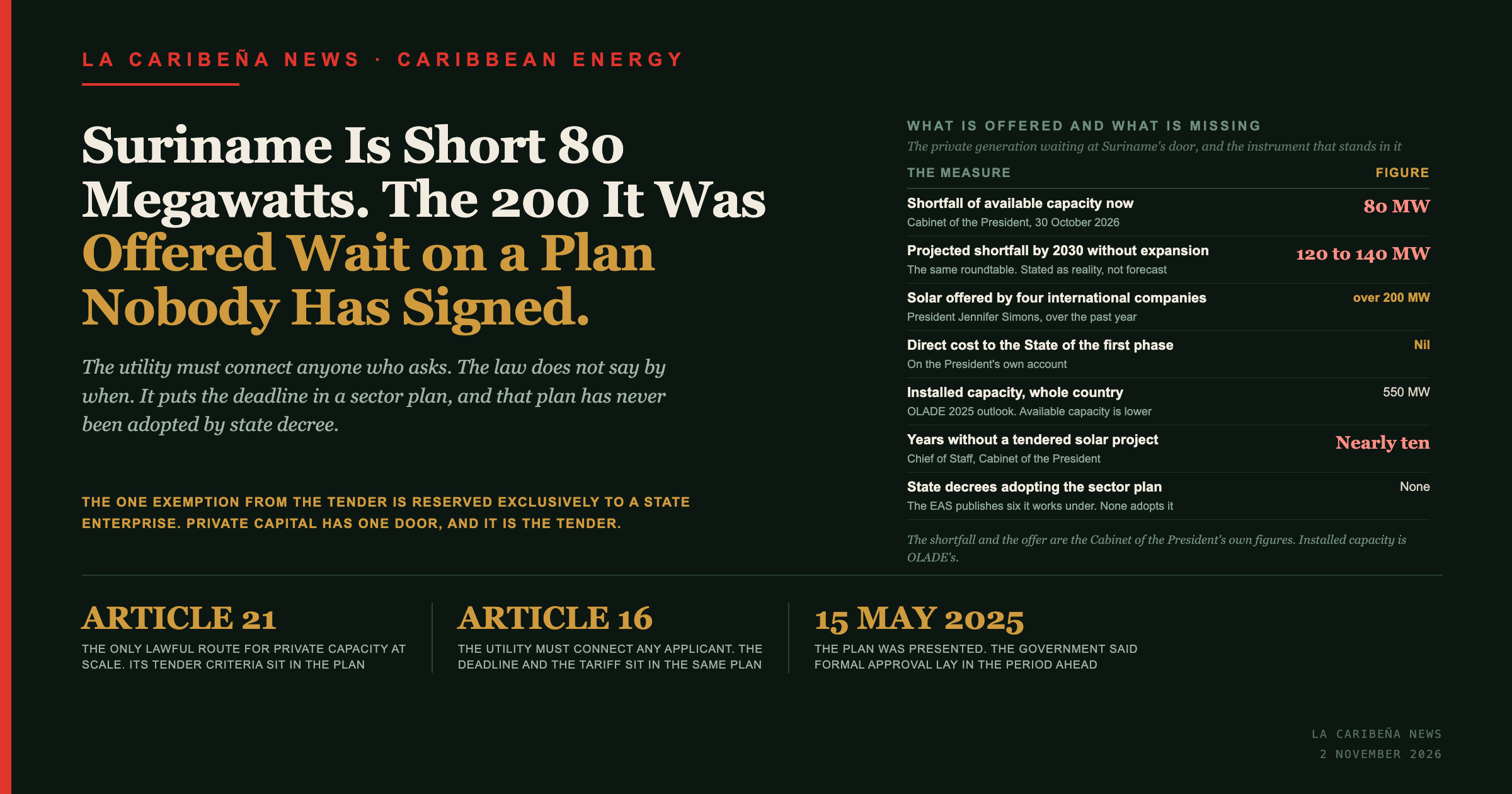
Suriname is short of power now and will be shorter. On Friday 30 October the Cabinet of the President of Suriname put the gap at about 80 megawatts of available capacity, rising to between 120 and 140 megawatts by 2030 without timely expansion. Against that, President Jennifer Simons told the same meeting she had spent the past year listening to at least four international companies offering to build more than 200 megawatts of solar plant, and that the first phase would cost the State nothing.
| What Suriname needs and what it has been offered | Megawatts |
|---|---|
| Shortfall of available capacity now | 80 |
| Projected shortfall by 2030 without expansion | 120 to 140 |
| Solar generation offered by four international companies | over 200 |
| Direct cost to the State of the first phase of those offers | nil |
| Installed capacity, whole country | 550 |
*Shortfall and offer figures from the Cabinet of the President's account of its Strategic Roundtable on solar energy, 30 October 2026. Installed capacity from the Latin American Energy Organization's 2025 regional outlook. The government is speaking about available capacity; the 550 figure is installed capacity, and the two are different measures.*
The offers are larger than the shortfall they would fill, and larger than its 2030 projection. Suriname is not short of proposals and, on the President's account, not being asked for capital either.
What did Suriname's government actually say on 30 October?
That the shortfall is a measurement rather than a projection, and that the Act's tender procedure has not produced a project.
The Strategic Roundtable on solar energy was held in the Congreshal on the initiative of the Cabinet of the President, under the theme of the road to sustainable energy and energy security through investment in solar for Suriname's future. It is intended to feed the National Energy Roadmap 2026 to 2035.
Sergio Akiemboto, Chief of Staff of the Cabinet of the President, put the figures beside their consequence: they bear on investment decisions, economic growth, production costs and ultimately the prosperity of society.
"These are not non-committal figures that we can discuss. They are not forecasts, but reality." SERGIO AKIEMBOTO, CHIEF OF STAFF, CABINET OF THE PRESIDENT
Nearly ten years after the Electricity Act of 2016 came in, no large-scale solar project has been realised through the public tender procedure the Act prescribes. The necessary implementing regulations have not been fully established. Essential frameworks are still absent for tendering, for permitting, for grid connections and for contractual certainty for investors.
President Simons named the same cause. The generated power would be sold to Energie Bedrijven Suriname, the state utility, and then, in her words, the regulations are not in order.
What does the Electricity Act 2016 require before that capacity can be built?
A public tender, supervised by the regulator, run on criteria that live in the Electricity Sector Plan.
The Electricity Act 2016, S.B. 2016 no. 42, deals with new generating capacity at Article 21, under a heading that covers the expansion of capacity for the production of sustainable electricity. Expansion for the national grid happens by holding a public tender, supervised by the Energie Autoriteit Suriname, and the electricity company, as the buyer of the power, is responsible for organising it.
The utility is obliged to enter into a supply agreement with whoever holds the resulting permit. A draft of that agreement forms part of the tender documents, and after the tender there may be no departure from it. An offtake commitment and a non-negotiable contract are written into the primary law, and both are reachable only by winning the tender.
Article 21 subsection 3 says the tender proceeds according to the objective, transparent and non-discriminatory criteria that are included in the Electricity Sector Plan, and lists nine matters those criteria must cover at minimum, from the required capacity and capacity factor of the installation to the applicant's technical, economic and financial standing.
Article 21 subsection 2 allows a state decree to dispense with a tender for hydro works or other generation projects with potentially large social and environmental effects, and then provides that the award shall go exclusively in favour of a state enterprise.
Where does the law put the deadline for an ordinary grid connection?
The law puts it in the Electricity Sector Plan, alongside the tender criteria.
Article 16 obliges the electricity company to provide a connection to the national grid to anyone who requests one, and forbids it from discriminating between applicants. The obligation applies subject to the conditions laid down in the Electricity Sector Plan, and the Act names two of those conditions: the period between application and connection, and the connection tariff.
Article 20 subsection 5 does the same job for self-generation. The conditions for connecting a generating installation to the national grid, the connection costs, and the rate at which a self-generator may net its consumption against its production are all matters for the plan.
| Act 2016 | The decision it governs | Where the Act puts the detail |
|---|---|---|
| Article 16(1) | The utility's duty to connect any applicant | Conditions in the ESP, including the application-to-connection period and the connection tariff |
| Article 20(5) | Self-generation and netting | Connection conditions, connection costs and the netting rate, in the ESP |
| Article 21(3) | Public tender for renewable capacity | Tender criteria, in the ESP |
| Article 21(2) | The only exemption from a tender | Award reserved exclusively to a state enterprise |
| Article 8(1) | Who brings the ESP into force | The Government, by state decree, at least once every five years |
*Articles as enacted in S.B. 2016 no. 42. Article numbering differs from the 2015 bill, in which the tender provision was Article 18.*
A factory manager asking how long a connection takes, and a solar developer asking what the tender will require, are waiting on the same signature. Article 8 makes the Government the only body that can supply it.
Has any part of the Act been implemented by state decree?
Yes. A 2021 decree built the tariff machinery, and stops short of the tender.
A state decree of 12 July 2021, S.B. 2021 no. 88, the Besluit Elektriciteitstarieven 2021, sets the cost allocation, the structure and methodology for calculating the electricity tariff, the feed-in tariff, and a methodology for the connection tariff. It also fixes a power-factor charge at half the consumption tariff for business customers whose power factor falls below 0.80 in a month, and it defines the connection tariff as covering an overhead connection, leaving the full efficient cost of an underground one with the customer.
Nowhere in it does the word tender appear, nor the period between application and connection. What does appear, three times, is the Electricity Sector Plan, including in the decree's own definition of a self-generator, which nets off against the conditions and tariffs as included in that plan. The instrument that exists points at the instrument that does not.
What is the status of the Electricity Sector Plan?
Published in full in May 2025, and not yet given legal force by state decree.
The Energie Autoriteit Suriname was created by the Act in 2016. Its own 2020 annual report shows it became operational on 1 August 2020, four and a half years later, and sets out a phased start-up plan in which writing the sector plan and promulgating the state decree that adopts it sit together as Phase 2 of four.
The plan was presented on Thursday 15 May 2025 at the Royal Ballroom of Hotel Torarica, with energy-sector and business representatives and the Inter-American Development Bank present. The EAS director, Anand Kalpoe, built it on three pillars and named law and regulation as the first of them, the plan identifying the legal frameworks needed to bring transparency, efficiency and direction to the sector. The second is infrastructure and investment, carrying concrete expansion schedules and investment proposals for the following five years. The plan is aligned to the Green Development Strategy launched in February 2025, and its stated aim is electricity as a basic service, accessible and affordable around the clock.
Kenneth Amoksi, then ad interim Minister of Natural Resources, told the launch the plan was not merely a policy intention but a legal obligation under the Electricity Act of 2016, and that it was a national responsibility as much as a technical necessity. He also expressed the hope that there would be sufficient political and institutional will to realise its goals.
"The coming period will be given over to the formal approval and implementation of the ESP." CABINET OF THE PRESIDENT, 15 MAY 2025
Minister Riad Nurmohamed attended the launch representing President Chandrikapersad Santokhi and argued that energy and investment policy should not be left to a single ministry. Eighteen months on, a different administration is holding a roundtable to ask why private solar has not been built, and the signature the plan needs has now outlasted a change of government.
Do the tender rules actually exist?
The rules are written and published. What they have never been given is legal force.
The plan is public in full. The EAS carries all three volumes on its own website, prepared by the advisory firm Castalia and dated May 2025: a strategic plan, a technical plan and a regulatory plan. The regulatory volume sets out the single-buyer procurement sequence step by step, from the request for expressions of interest through pre-qualification, the request for proposals, negotiation of the power purchase agreement, selection of the preferred bidder and licensing.
The bidding rules have been drafted as well. In June 2026 the EAS published a conceptual design for renewable energy tenders prepared by PSR Energy Consultancy and Analytics with MRC Consultants and Transaction Advisers, dated November 2024 and carried on an Inter-American Development Bank project reference. It contains draft bidding procedures whose opening article states that they are established pursuant to Article 21 of the Electricity Act of 2016. The same consultants appear in the EAS diary for 12 December 2023, at a kick-off meeting the regulator recorded as covering the state decrees that must be promulgated under the Act.
On 29 August 2026, during the country's electricity crisis, the EAS published its own assessment. The sector's requirements, it wrote, can no longer be treated as policy intentions and must be translated into binding frameworks and enforceable measures. The sector plan, it said, must in the next phase be translated into concrete regulation, standards, responsibilities, planning obligations and enforceable performance requirements.
"Suriname does not need another plan that remains on paper. Suriname needs a regulatory framework that ensures plans are carried out." ENERGIE AUTORITEIT SURINAME, 29 AUGUST 2026
The EAS prepared that plan, and had presented it fifteen months earlier.
The EAS also publishes the state decrees it operates under. Six are listed: the electricity tariff and subsidy decrees of 2021, and the amendments made to both in 2023 and 2024. None of the six adopts the sector plan.
A month after that assessment the regulator described what arrives in the absence of a tender. Proposals to expand and diversify supply had been coming in over recent years, covering thermal generation, renewables, biomass and wind, and often carrying no more than a general description of the technology on offer. On 28 September the EAS proposed that each should in future carry indicative scores against assessment criteria and pass a pre-screening judged on technical feasibility, reliability, sustainability, scalability and cost. Ranking unsolicited offers against a scorecard is the work Article 21 assigns to a tender.
Why does this pattern look familiar in Suriname?
Because the country's petroleum regime has the same gap between a statute and its implementing detail.
Suriname has required local preference in petroleum since 1990 and has never set percentages or categories against it, as this newspaper reported in August. The duty exists in primary law and the content that would make it operable was left to instruments that did not follow. Electricity is the second instance, in the same country, under a different Act.
Elsewhere in the region the constraint takes a different form. Costa Rica's limit on private renewables is Ley 7200 of 1990, which caps parallel generation at 15 per cent of its national system and each plant at 20 megawatts, numbers in a statute that the legislature can move. Uruguay's runs the other way, a grid that has signed 500 megawatts of data centres while its whole system peaked at 2,507. Suriname's constraint is neither a statutory ceiling nor a committed load. It is a signature.
What does this mean for a business operating in Suriname?
That capacity planning there runs without two numbers a business would normally treat as given.
A firm sizing a plant, a cold store or a data hall needs to know how long a connection takes and what it will cost. Article 16 says the utility must connect it and locates the timetable and the tariff in the sector plan, so the tariff methodology exists under the 2021 decree while the statutory timetable does not. A firm considering its own rooftop or ground-mount solar needs the netting rate, which Article 20 also puts in the plan.
President Simons, who told an investment conference in October that extraction alone is not success and that energy should be a catalyst for other industries, said two banks already offer solar finance to households at reasonable rates, and that she wants a clear increase in solar use during 2027, particularly from businesses and high-consumption households. Self-generation is the route she is pointing at, and Article 20 leaves its terms to the same plan.
The government is counting available capacity rather than installed capacity. Installed plant that is out for maintenance supplies nobody, which is why the two figures differ and why the smaller one governs a commercial decision. It is the same measure that decides whether a small Caribbean system can carry one large new customer, in a region where a docked cruise ship draws up to 12 megawatts and Grenada's entire power system is 70. Guyana Power and Light measures itself the same way, reporting 257 megawatts of peak demand against 265.6 megawatts available in September. The Afobaka hydroelectric station, which President Simons called central to supply, is the asset behind Suriname's own figure.
Guyana's constraint is plant. Suriname has been offered the plant.
The entities
- Energie Autoriteit Suriname (EAS) is Suriname's energy regulator, created by the Electricity Act 2016 and operational since 1 August 2020.
- Energie Bedrijven Suriname (EBS) is the state electricity company, the buyer of power for the national grid and the body responsible for organising a capacity tender.
- Electricity Act 2016 (S.B. 2016 no. 42) is the Surinamese statute governing electricity supply, generation permits and grid connection.
- Electricity Sector Plan (ESP) is the strategic, technical and regulatory plan the Act requires the Government to adopt by state decree at least once every five years.
- Besluit Elektriciteitstarieven 2021 (S.B. 2021 no. 88) is the state decree of 12 July 2021 implementing the Act's tariff articles.
- Cabinet of the President of Suriname convened the Strategic Roundtable on solar energy of 30 October 2026.
- National Energy Roadmap 2026 to 2035 is the energy planning document the roundtable is intended to feed.
- Afobaka hydroelectric station is the plant President Simons described as central to Suriname's electricity supply.
- Castalia is the advisory firm that prepared the three volumes of the Electricity Sector Plan.
- PSR Energy Consultancy and Analytics and MRC Consultants and Transaction Advisers are the firms that prepared the conceptual design for renewable energy tenders.
- Inter-American Development Bank is the lender whose project reference the tender design was prepared under, and which attended the plan's launch.
- Latin American Energy Organization (OLADE) is the intergovernmental energy body whose 2025 regional outlook carries the country capacity tables.
- Green Development Strategy is the national strategy launched in February 2025 to which the sector plan is aligned.
What the title card says
- Headline: Suriname is short 80 megawatts, and the 200 it was offered wait on a plan nobody has signed.
- Shortfall of available capacity now: about 80 megawatts. Source: Sergio Akiemboto, Chief of Staff of the Cabinet of the President, 30 October 2026.
- Projected shortfall by 2030 without timely expansion: 120 to 140 megawatts. Source: the same.
- Solar generation offered by at least four international companies: more than 200 megawatts. Source: President Jennifer Simons, 30 October 2026.
- Direct cost to the State of the first phase of those offers: nil, on the President's account.
- Installed capacity of the whole country: 550 megawatts. Source: the Latin American Energy Organization's 2025 regional outlook. This is installed capacity and the shortfall figures are available capacity, which are different measures.
- Years since the Electricity Act 2016 came into force without a large-scale solar project procured through its public tender: nearly ten, on the Chief of Staff's account.
- Articles of the Electricity Act 2016 whose detail the Act places in the Electricity Sector Plan: Article 16 on the connection duty, including the application-to-connection period and the connection tariff; Article 20 on self-generation and netting; Article 21 on the renewable capacity tender criteria.
- The only exemption from the tender, under Article 21 subsection 2, is reserved exclusively to a state enterprise.
- The Government must adopt the plan by state decree at least once every five years, under Article 8 subsection 1.
- The plan was presented on 15 May 2025 and the Cabinet of the President recorded that formal approval and implementation lay in the period ahead.
- State decrees adopting the Electricity Sector Plan: none. The EAS publishes six state decrees it operates under, being the electricity tariff and subsidy decrees of 2021 and the amendments to both in 2023 and 2024, and none of them adopts the plan.
- A state decree implementing the Act's tariff articles does exist, S.B. 2021 no. 88 of 12 July 2021, and it refers to the sector plan three times.
Frequently Asked Questions
How short of electricity is Suriname?
The Cabinet of the President put the shortfall of available capacity at about 80 megawatts on 30 October 2026, rising to between 120 and 140 megawatts by 2030 without timely expansion. Its Chief of Staff, Sergio Akiemboto, said the figures were reality rather than forecasts, and that they bear on investment decisions, economic growth and production costs.
Who has offered to build generation in Suriname, and on what terms?
President Jennifer Simons said she had heard proposals over the past year from at least four international companies to build more than 200 megawatts of solar plant, that the first phase would cost the State nothing directly, and that the electricity generated would be sold to Energie Bedrijven Suriname. She did not name the companies.
What is stopping those projects from being built?
Article 21 of the Electricity Act 2016 requires new renewable capacity for the national grid to be procured by public tender, on criteria that the Act says are set out in the Electricity Sector Plan. No state decree adopting that plan has been promulgated. The Chief of Staff said essential frameworks remain absent for tendering, permitting, grid connections and contractual certainty for investors, and that no large-scale solar project has been realised through the prescribed tender in nearly ten years.
Does the Act offer a route that avoids the tender?
One, and it is not open to private capital. Article 21 subsection 2 allows a state decree to dispense with a tender for hydro works or other projects with potentially large social and environmental effects, and provides that such an award goes exclusively in favour of a state enterprise.
Does this affect businesses that are not building power plants?
Yes. Article 16 obliges the electricity company to connect anyone who applies, subject to conditions in the Electricity Sector Plan that include the period between application and connection and the connection tariff. A methodology for the connection tariff was set by state decree in 2021. The statutory timetable between applying and being connected sits in the plan.
Do the tender rules exist, or do they still have to be written?
They are written. The Electricity Sector Plan's regulatory volume, prepared by Castalia and published in May 2025, sets out the single-buyer procurement sequence in full. A separate conceptual design for renewable energy tenders, prepared by PSR Energy Consultancy and Analytics with MRC Consultants and Transaction Advisers in November 2024 and published by the EAS in June 2026, contains draft bidding procedures stated to be established pursuant to Article 21. Neither has been given legal force by state decree.
What does the regulator itself say about the plan's status?
On 29 August 2026 the EAS wrote that the sector's requirements can no longer be treated as policy intentions and must be translated into binding frameworks, and that the plan must in the next phase become concrete regulation, standards, responsibilities, planning obligations and enforceable performance requirements. It added that Suriname does not need another plan that remains on paper. The EAS also publishes the six state decrees it operates under, all of them tariff or subsidy instruments, and none adopts the plan.
Has the Electricity Sector Plan been published at all?
It was presented on 15 May 2025 at Hotel Torarica by the Energie Autoriteit Suriname, with the Inter-American Development Bank present, and the then ad interim Minister of Natural Resources, Kenneth Amoksi, described it as a legal obligation under the Act rather than a policy intention. The Cabinet of the President's own account of that launch said the period ahead would be given over to formal approval and implementation.