By LCN Business Desk
What is the government holding down?
Cooking gas and electricity, and for six months of last year the rate of VAT.
At the Roundtable on 5 November, Prime Minister Terrance Drew said the cylinder subsidy continues. A 20-pound cylinder stays at EC$30 and a 100-pound cylinder at EC$140, while in Belize the Prime Minister said no to doubling what the power company can pass on. Both are the lowest in the Eastern Caribbean Currency Union, on the Eastern Caribbean Central Bank's July 2026 comparison.
He gave the reason and the cost in one sentence.
You know why it's $30? Because we are heavily subsidizing it. We are subsidizing it to the tune of about $2 million.
The emphasis on the smaller cylinder is deliberate. It is the size many lower-income households use for daily cooking. The federation imports its fuel, so the government absorbs part of what it pays.
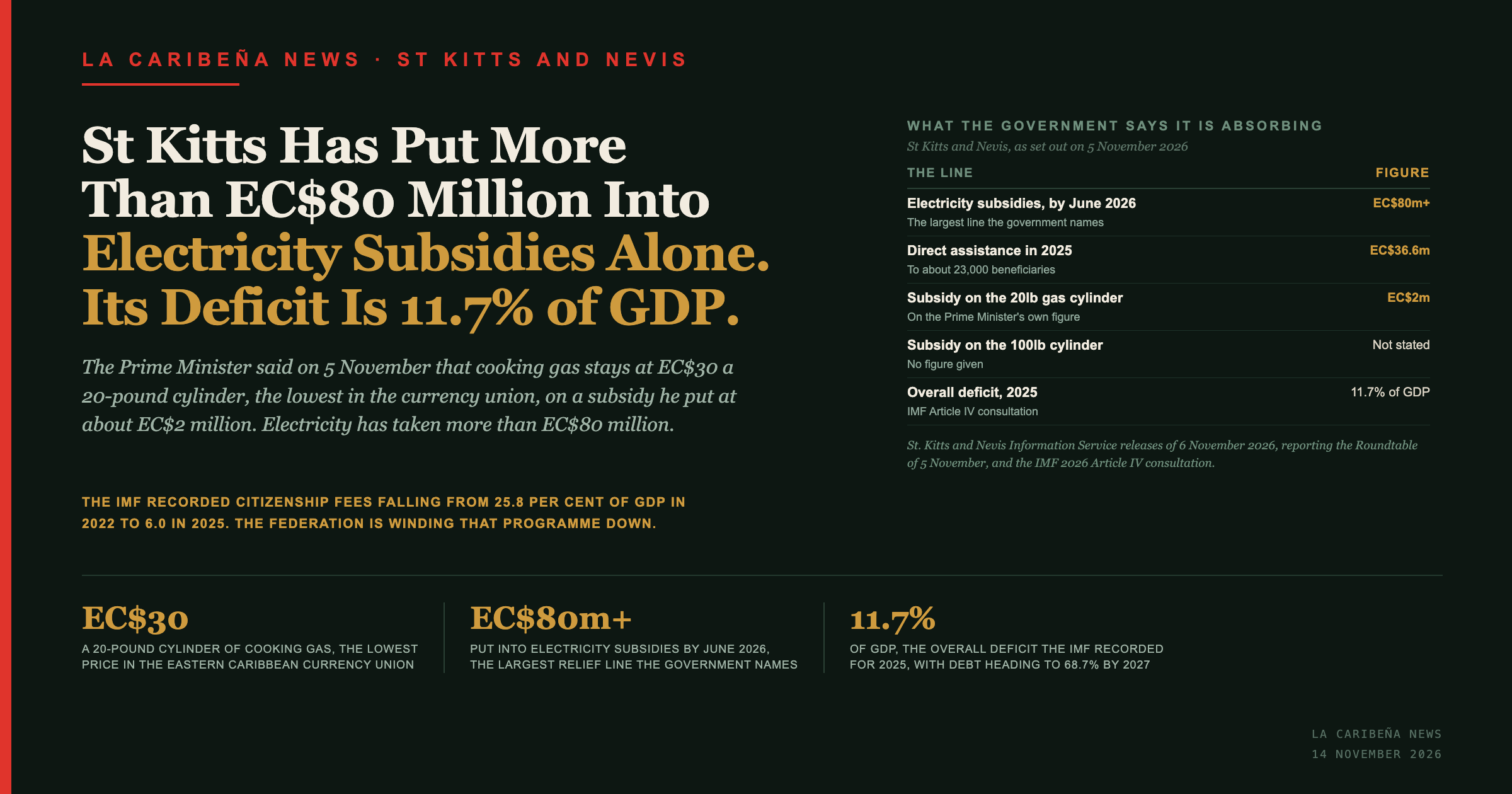
Electricity is the largest line the government names. By June 2026 the government had put more than EC$80 million into subsidising it, to cushion consumers against rising energy costs.
What else is the government carrying?
Cash transfers, a pay rise, and a minimum wage floor.
In 2025 the government paid EC$36.6 million in direct assistance to about 23,000 beneficiaries through its Budget Boost Wallet. It covered utility bills and basic food. The standard rate of VAT was cut temporarily from 17 per cent to 13 per cent over the first six months of that year.
Civil servants received an 8 per cent salary increase, and an additional month's salary each year from 2022 through 2025. Two increases to the national minimum wage brought it to at least EC$500 a week for a 40-hour week.
Drew put the principle in one line.
Sometimes the government has to absorb the lash to protect our people.
Did the Prime Minister not say governments cannot bring fuel prices down?
He did, and both statements hold. They are about different prices.
LCN reported on 9 November that Drew said Caribbean governments cannot dictate fuel prices. His explanation then was about imported prices.
Most of the inflation that we suffer and the increased prices, it is because we import those prices.
He is not the only one absorbing the difference. Trinidad and Tobago put the market price of super gasoline at TT$7.64 a litre over March to September 2026, and said it held the pump price instead.
A government that buys fuel on the world market cannot change what it pays to land it. It can change what a household pays at the counter. The gap between those two prices is not an argument. It is a line in the budget, and the Prime Minister has put a figure on this one.
What does the budget look like behind those figures?
A deficit of 11.7 per cent of GDP, and the revenue that used to cover it is gone.
LCN reported earlier today that the IMF recorded citizenship by investment fees falling from 25.8 per cent of GDP in 2022 to 6.0 per cent in 2025. The federation is winding that programme down on a date still being negotiated with the European Union. The Fund put the overall deficit at 11.7 per cent of GDP in 2025. It projects public debt at 68.7 per cent by 2027, against a regional benchmark of 60 per cent.
The Fund said low citizenship revenue is what keeps those deficits high. Its staff recommend rolling back concessions granted during Covid, broadening the base of VAT, strengthening property taxation and raising excises.
One of those has already happened. The Inland Revenue Department returned the standard VAT rate to 17 per cent on 1 July 2025, when the temporary 13 per cent rate expired. The relief described as an intervention in 2025 ended in the same year.
What happens to the EC$30 cylinder now?
It is a yearly decision in Basseterre, not a world price, and the money behind it is under pressure.
The government says it will maintain support for both cylinder sizes as part of its wider effort to ease the cost of household essentials. No end date is given.
Nor is a total. The EC$2 million names the subsidy on the 20-pound cylinder alone. The release gives no figure for the 100-pound cylinder, and no annual cost for the subsidy programme as a whole. A business or a household reading the price at the counter has the price, and not what it costs to keep it there.
The entities
- Terrance Drew: Prime Minister and Minister of Finance of St Kitts and Nevis, who set out the subsidies at the Roundtable on 5 November 2026. - St. Kitts and Nevis Information Service (SKNIS): the government information service that published both accounts of that briefing on 6 November 2026. - Eastern Caribbean Central Bank (ECCB): the central bank whose July 2026 comparison ranks the federation's cylinder prices lowest in the currency union. - Eastern Caribbean Currency Union (ECCU): the eight-member currency area against which those prices are compared. - Budget Boost Wallet: the direct assistance scheme that paid EC$36.6 million to about 23,000 beneficiaries in 2025. - International Monetary Fund (IMF): the body whose 2026 Article IV consultation records the deficit, the debt path and the fall in citizenship revenue. - Inland Revenue Department: the department that returned the standard VAT rate to 17 per cent on 1 July 2025.
What the title card says
- Cooking gas, 20-pound cylinder: EC$30, the lowest in the ECCU. - Cooking gas, 100-pound cylinder: EC$140, also the lowest. - Subsidy on the 20-pound cylinder: about EC$2 million. - Electricity subsidies by June 2026: more than EC$80 million. - Direct assistance in 2025: EC$36.6 million to about 23,000 beneficiaries. - Overall deficit, 2025: 11.7 per cent of GDP. - Sources: SKNIS releases of 6 November 2026 and the IMF 2026 Article IV consultation.
Frequently asked questions
What does a cylinder of cooking gas cost in St Kitts and Nevis?
EC$30 for a 20-pound cylinder and EC$140 for a 100-pound cylinder. Both are the lowest in the currency union on the Eastern Caribbean Central Bank's July 2026 comparison.
How much is that costing the government?
About EC$2 million on the 20-pound cylinder, on the Prime Minister's own figure. No figure has been given for the 100-pound cylinder.
What is the biggest subsidy?
Electricity. The government put it at more than EC$80 million by June 2026.
Did the VAT cut last?
No. The rate was 13 per cent for the first six months of 2025 and returned to 17 per cent on 1 July 2025.
How does this sit with the Prime Minister saying governments cannot bring fuel down?
Both hold. A government cannot change the price at which it imports fuel. It can change the price a household pays, and that difference is a cost to the budget.
What is the fiscal position?
The IMF recorded a deficit of 11.7 per cent of GDP in 2025 and projects debt at 68.7 per cent by 2027, against a regional benchmark of 60 per cent.