By LCN Business Desk
Dr Terrance Drew, the Prime Minister of St Kitts and Nevis, said in remarks reported on 7 November 2026 that no Caribbean government can bring the price of petrol down, not even Guyana, which produces crude. Three Caribbean territories buying on the same world market post pump prices US$2.35 a gallon apart.
Governments can cushion rising prices but cannot dictate what international suppliers charge, Drew said. "No other Caribbean, not even Guyana, can carry down the price of gasoline," he said, according to News Room. "And Guyana produces, has a lot of fossil fuel." He added: "So I'm not coming here to try to hoodwink, fool our people. It is a fact."
What exactly did the Prime Minister say?
That the region imports its inflation, and that producing oil does not exempt a country from it.
Drew put the mechanism in grocery terms. "Most of the inflation that we suffer and the increased prices, it is because we import those prices," he said. "We buy, let's say, cornflakes from the U.S. Kellogg's. They have a price up there. The price has gone up in the U.S. We buy it from them. What do you think can happen down here? Same thing. It's going to go up."
On fuel he named Guyana, and he also pointed to rising pump prices in the United States, which is among the world's largest producers. The cost of the fuel Guyana buys for itself is already in its power bill: this newspaper reported in September that Guyana pays 9.5 cents for rented power, and more once the fuel it buys is counted.
Is the landed price really the whole story?
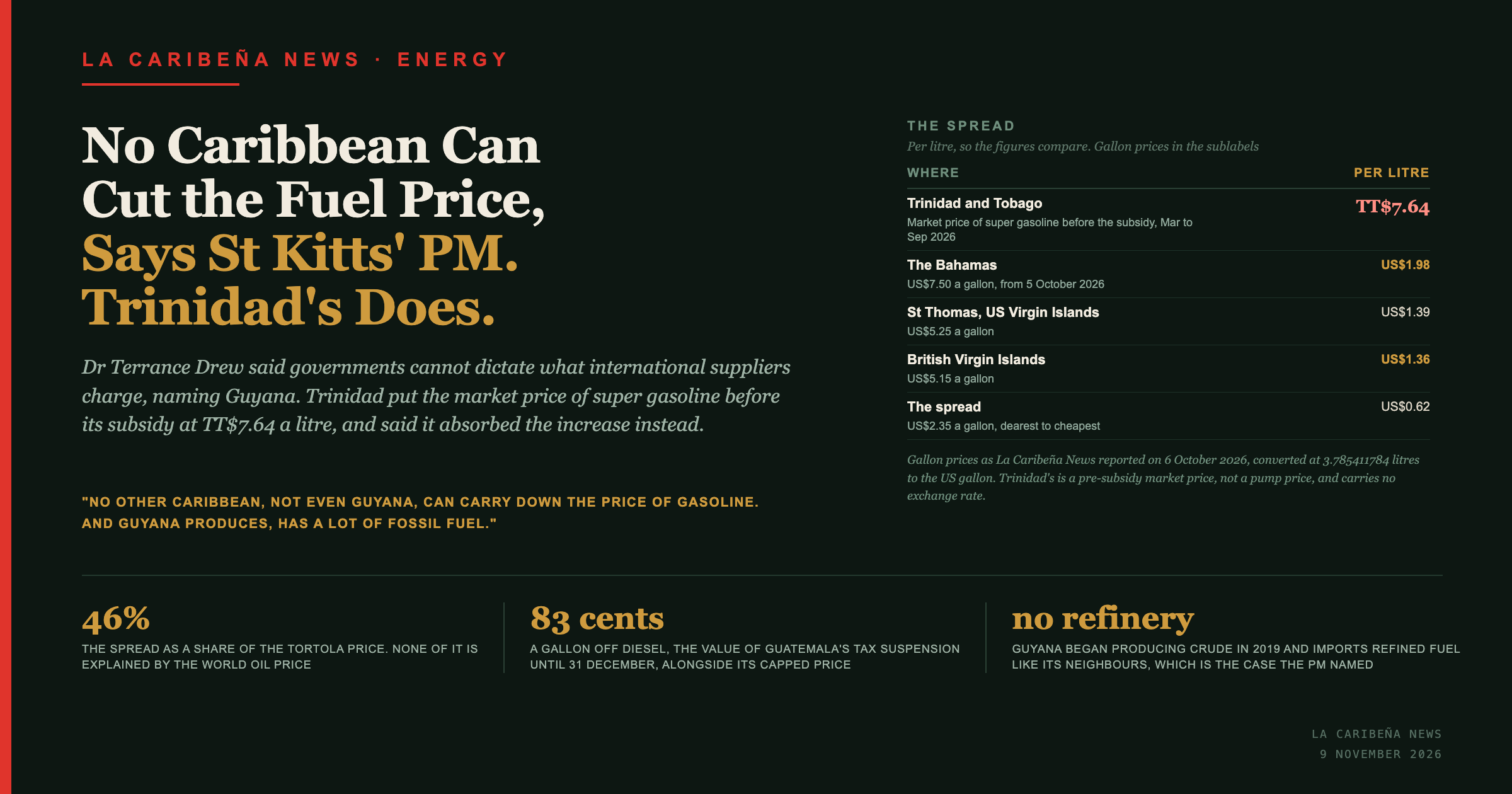
US$2.35 a gallon separates the dearest Caribbean pump price from the cheapest.
| Petrol, regular | Per gallon | Per litre |
|---|---|---|
| The Bahamas, from 5 October 2026 | US$7.50 | US$1.98 |
| St Thomas, United States Virgin Islands | US$5.25 | US$1.39 |
| British Virgin Islands | US$5.15 | US$1.36 |
| The spread | US$2.35 | US$0.62 |
Gallon prices as this newspaper reported on 6 October 2026; the Bahamian figure is the level dealers were given notice of, up from US$7.06. Litre figures converted here at 3.785411784 litres to the United States gallon. Trinidad and Tobago's TT$7.64 is quoted per litre by its own government and is a pre-subsidy market price, not a pump price, and no exchange rate is applied to it here.
All three buy refined product on the same market. The difference between the top and the bottom of that table is 46 per cent of the Tortola price, and no part of it is explained by Brent. It is duty, margin, freight and whatever a government chooses to absorb or add, and on a ten-gallon fill it is the difference between US$51.50 and US$75.00.
What does it cost a government to hold the price down?
Two measures in a fortnight, and a fund that pays importers the difference.
This newspaper reported in October that Guatemala's Congress passed two fuel measures in a fortnight: a suspension of fuel taxes until 31 December, worth about 83 United States cents a gallon on diesel, and a price cap under which importers are paid the difference from a fund. Together they commit about Q5.8 billion, or US$762 million. The cap followed truckers sealing the Mexico and El Salvador routes.
A government that caps a price is buying the gap, every gallon, until it stops paying.
In the British Virgin Islands, Premier Dr Natalio Wheatley announced a technical working group to monitor prices across the territory. Monitoring is not a price, and it commits no money. The commentator Skelton Cline had called for regulation and a trade commission covering competition and consumer protection, pointing at a United States Virgin Islands system that tracks fuel purchases, deliveries, timings and quantities to test whether increases match fuel actually sold. The territory he wanted regulated sells petrol ten cents cheaper than the one he held up as the model.
What do the region's oil producers actually pay?
Trinidad subsidises the pump price. Guyana imports its refined fuel.
Drew named Guyana, and Guyana is the weakest of the three cases for his argument. It began producing crude in 2019 and has no refinery, so it buys refined product on the same market as St Kitts.
Trinidad and Tobago is the case he did not name, and it answers him directly. Presenting Budget 2027, the government put the market price of super gasoline over March to September 2026 at TT$7.64 a litre, against a lower price motorists actually pay, and said it chose to absorb the increase rather than pass it on. That is a Caribbean government moving a pump price by decision and publishing the size of the gap.
It has been doing so across administrations and knows the objection. Presenting the 2022 adjustment, then finance minister Colm Imbert told Parliament that "a fuel subsidy is a regressive measure", and that "the public should be asked to pay half the cost of the increased market prices of fuel, while the Government absorbs the other half".
What Trinidad's motorists pay today is reported inconsistently. Figures of TT$4.97 and TT$5.97 a litre for super both appear in circulation, the lower following a cut announced in October 2025 and the higher quoted in the Budget 2027 exchange, and this newspaper has not obtained the Budget Statement or a Ministry of Energy schedule that settles which stands.
The entities
- Dr Terrance Drew is the Prime Minister of St Kitts and Nevis, who said Caribbean governments cannot dictate fuel and imported food prices. - News Room is the Guyanese outlet that reported his remarks on 7 November 2026 and is the source of the quotations here. - Dr Natalio Wheatley is the Premier of the British Virgin Islands, who announced a technical working group to monitor prices rather than a price measure. - Skelton Cline is the British Virgin Islands commentator who called for regulation and a trade commission, citing a United States Virgin Islands monitoring system. - Trinidad and Tobago is the Caribbean producer Drew did not name. Its government put the market price of super gasoline over March to September 2026 at TT$7.64 a litre and said it absorbed the increase rather than passing it on. - Colm Imbert is the former Trinidad and Tobago finance minister who told Parliament in 2022 that a fuel subsidy is a regressive measure. - Guyana is the oil producer Drew named as unable to bring petrol down. It began producing crude in 2019 and has no refinery, so it imports refined fuel.
What the title card says
- Headline: St Kitts' Prime Minister says no Caribbean government can bring fuel down, and Trinidad's says it held super gasoline below TT$7.64. - Trinidad and Tobago's stated market price for super gasoline, March to September 2026: TT$7.64 a litre, before the subsidy. - Caribbean oil producers the piece covers: Trinidad and Tobago, and Guyana. - Petrol in The Bahamas from 5 October 2026: US$7.50 a gallon, or US$1.98 a litre, up from US$7.06. - Petrol in the British Virgin Islands: US$5.15 a gallon, or US$1.36 a litre. - Petrol in St Thomas, United States Virgin Islands: US$5.25 a gallon, or US$1.39 a litre. - The spread between the dearest and cheapest of the three: US$2.35 a gallon, or US$0.62 a litre. - That spread as a share of the Tortola price: 46 per cent. - What Guatemala committed to suspending taxes and capping the price: about US$762 million. - Value of Guatemala's tax suspension on diesel: about 83 United States cents a gallon. - Source: News Room's report of 7 November 2026, and La Caribeña News of 6 October 2026.
Frequently Asked Questions
What did the Prime Minister of St Kitts and Nevis say?
Dr Terrance Drew said Caribbean governments can cushion rising prices but cannot dictate what international suppliers charge, and that "No other Caribbean, not even Guyana, can carry down the price of gasoline."
Why does Guyana not have cheaper fuel if it produces oil?
Guyana began producing crude in 2019 and has no refining capacity, so it imports refined fuel on the same international market as its neighbours.
How much do Caribbean pump prices differ?
The Bahamas was given notice of US$7.50 a gallon from 5 October 2026, while the British Virgin Islands sells regular petrol at US$5.15 and St Thomas at US$5.25, a spread of US$2.35 between the highest and lowest.
What does capping a fuel price cost?
Guatemala committed about Q5.8 billion, or US$762 million, to a tax suspension worth about 83 United States cents a gallon on diesel together with a price cap paid to importers from a fund.
Is the British Virgin Islands regulating fuel prices?
Premier Dr Natalio Wheatley announced a technical working group to monitor prices across the territory. That is monitoring rather than a price control, and it commits no money.