By LCN Business Desk
What did St Kitts and Nevis decide?
The federation will wind it down. No closing date has been set.
Prime Minister Terrance Drew said in a national address on 13 November that the federation will wind down its citizenship by investment programme "responsibly" and "on a timeline now being negotiated with the EU".
He said he had given that position to the European Union formally. The European Commission invited the federation in June to wind the programme down over a transition period, to keep visa-free travel to the Schengen area. A final application date will be announced once both sides agree one. Until then the programme keeps taking applications.
Drew said nothing changes for people who already hold citizenship. Staff at the Citizenship by Investment Unit will be moved to work on foreign direct investment.
Drew put the programme's lifetime earnings at about EC$6.5 billion between 2008 and 2025, or roughly half of all the cash the federal government collected in those years.
Has the programme really been paying half the bills?
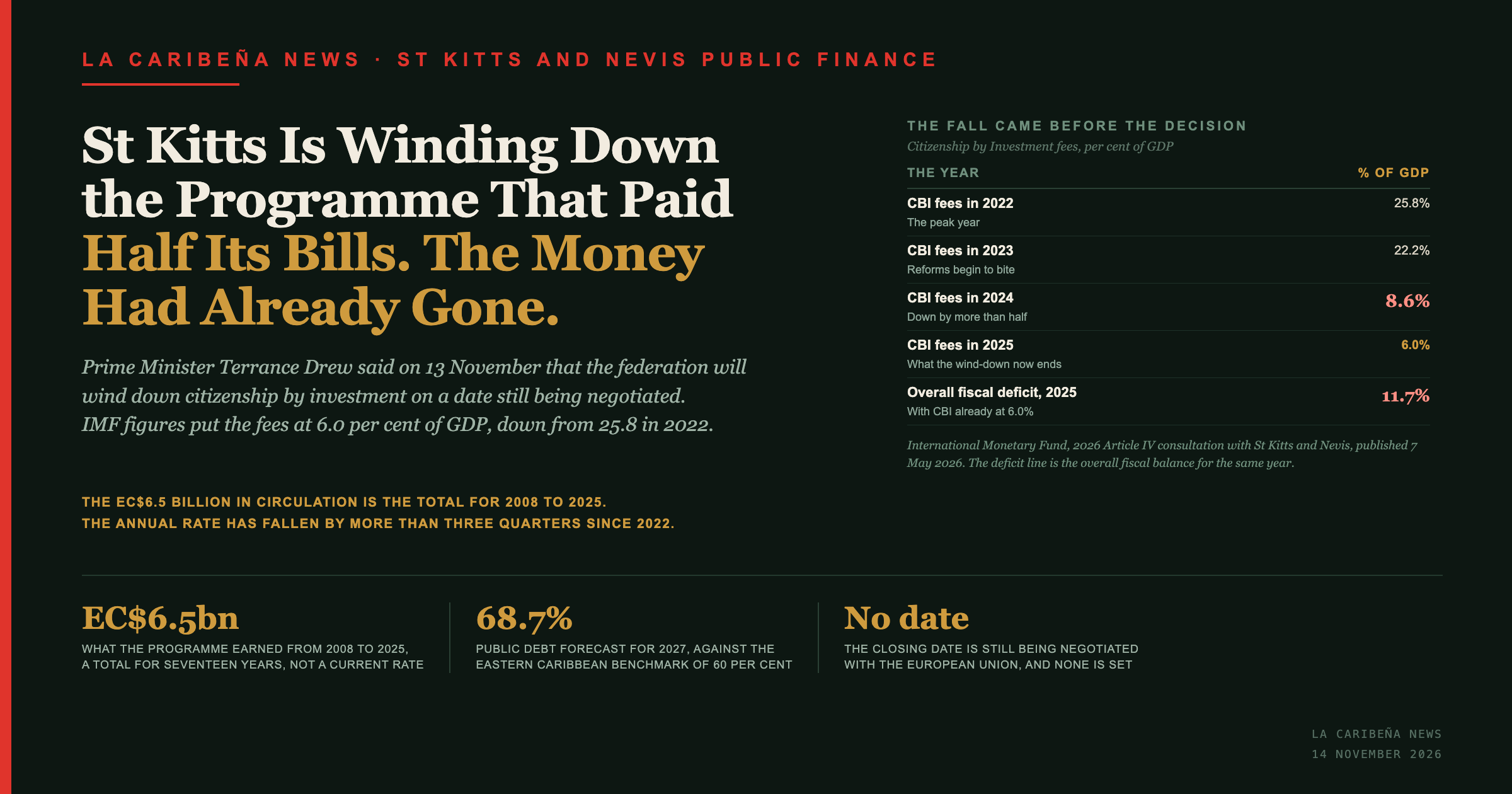
Not since 2022. The IMF puts the 2025 figure at 6.0 per cent of GDP.
The EC$6.5 billion is a total for seventeen years. The budget runs on the annual figure.
| Year | CBI fees, % of GDP |
|---|---|
| 2021 | 23.8 |
| 2022 | 25.8 |
| 2023 | 22.2 |
| 2024 | 8.6 |
| 2025 | 6.0 |
Source: IMF 2026 Article IV consultation with St Kitts and Nevis, published 7 May 2026.
Fees fell by more than three quarters in three years. Drew put the same fall in revenue terms, saying the programme's share of government income dropped from as much as 70 per cent in 2022 to under 20 per cent in 2026.
So the decision announced on 13 November formalises a loss the accounts already carry. The money went first. The announcement came after.
What does that leave in the budget?
A deficit of 11.7 per cent of GDP and debt heading through the regional ceiling.
| % of GDP | 2024 | 2025 | 2026f | 2027f |
|---|---|---|---|---|
| Overall fiscal balance | -11.3 | -11.7 | -8.7 | -7.5 |
| Public debt | 58.1 | 58.4 | 64.0 | 68.7 |
| Real GDP growth | 1.7 | 1.5 | 2.0 | 2.5 |
Source: IMF 2026 Article IV consultation. f = forecast.
The Fund said low CBI revenue is what keeps the deficits high. The Eastern Caribbean debt benchmark is 60 per cent of GDP, so the debt crosses it this year on the Fund's own forecast and keeps climbing for at least another year after that.
What should a business in the federation expect next?
Tax measures, because the IMF has already named them.
To close the gap, Fund staff recommend rolling back concessions granted during Covid, broadening the base of the value added tax, strengthening property taxation, raising excises and improving collection. On spending, they point to current outlays on goods and services.
One of those rollbacks has already happened. The Inland Revenue Department returned the standard VAT rate to 17 per cent on 1 July 2025, when the temporary 13 per cent rate expired. Four points of VAT went back on in the same year CBI fees fell to 6.0 per cent of GDP.
Each measure on the list lands on a business or a household rather than on a passport buyer. The replacement revenue has to come from inside the economy.
The Fund also asked for fiscal rules anchored to the regional debt benchmark, and for the planned Sovereign Wealth Resilience Fund to be set up to manage CBI volatility. That fund is being built to smooth an income stream that is now scheduled to end.
Separately, staff called for changes to the Social Security Fund "without delay" to stop its reserves running out by 2040.
Where does this leave the other four programmes?
One of five has answered. The other four have not matched it.
LCN reported on 13 November that no suspension had been published on the five official programme sites, and that Drew had said on 5 November his government was still gathering information and that a statement would follow. The statement followed eight days later.
Antigua and Barbuda has offered to close by the end of 2030 if the European Union helps fund the transition. It budgeted EC$120 million from passports for 2026 against a forecast surplus of EC$69.5 million. Saint Lucia says it replied to the Commission in writing on 9 November without publishing the letter. Grenada's prime minister has said he wants to keep both the programme and Schengen access. Dominica said on 28 October it would communicate further by 12 November, and on the public record this newspaper can find, it has not said whether it did.
The 1 June 2028 phase-out date in circulation comes from Antigua and Barbuda, which disclosed its copy of the Commission's June letter. Drew did not give that date, and his own statement describes the closing date as unagreed.
LCN's earlier work found the five programmes were worth about five per cent of GDP. The St Kitts figures show how fast that share can move.
What is the number to watch now?
Debt at 68.7 per cent of GDP in 2027, not the closing date.
The closing date decides when the last application is taken. On the Fund's figures it governs about 6 per cent of GDP, not the 25.8 per cent of three years ago.
Debt is the binding number. It crosses the regional benchmark in 2026 and reaches 68.7 per cent in 2027 on current policy. The IMF says a front-loaded consolidation would bring it back to the benchmark by 2031. The federation chooses between that consolidation and the rising path. The passport programme no longer moves either one.
The entities
- Terrance Drew: Prime Minister of St Kitts and Nevis, who announced the wind-down on 13 November 2026. - Citizenship by Investment Unit: the St Kitts and Nevis body that administers the programme and whose staff are being redeployed. - European Commission: the European Union institution that invited the federation to wind the programme down over a transition period. - International Monetary Fund (IMF): published the 2026 Article IV consultation carrying the fiscal and CBI figures used here. - Sovereign Wealth Resilience Fund: the fund St Kitts and Nevis plans, which the IMF recommends setting up to manage CBI revenue volatility. - Social Security Fund: the federation's pension fund, whose reserves the IMF says will run out by 2040 without changes.
What the title card says
- CBI fees, 2022: 25.8 per cent of GDP. - CBI fees, 2025: 6.0 per cent of GDP. - Lifetime earnings, 2008 to 2025: about EC$6.5 billion. - Overall deficit, 2025: 11.7 per cent of GDP. - Public debt, 2027 forecast: 68.7 per cent of GDP. - Regional debt benchmark: 60 per cent of GDP. - Sources: IMF 2026 Article IV consultation and the Prime Minister's national address of 13 November 2026.
Frequently asked questions
Is the St Kitts and Nevis programme closed?
No. It is being wound down. Applications continue until the government and the European Union agree a final application date, and none has been announced.
Does this affect people who already hold citizenship?
Drew said it does not. He said nothing changes for anyone who lawfully holds citizenship of the federation, or for their travel.
How much did the programme earn?
Drew put it at about EC$6.5 billion between 2008 and 2025, which he said was roughly half of all cash the federal government collected in those years.
How much is it worth now?
The IMF recorded CBI fees at 6.0 per cent of GDP in 2025, down from 25.8 per cent in 2022.
What happens to the federation's finances?
The IMF recorded a deficit of 11.7 per cent of GDP in 2025 and projects public debt at 68.7 per cent of GDP in 2027, above the 60 per cent regional benchmark. Fund staff recommend broadening the VAT base, strengthening property taxation, raising excises and rolling back Covid-era concessions.
Have the other four countries decided?
Not in the same terms. Antigua and Barbuda has offered to close by the end of 2030 with European funding for the transition, Saint Lucia says it replied in writing on 9 November, Grenada wants to keep both the programme and visa-free access, and Dominica has not said publicly what it sent.