By LCN Business Desk
Dominican fuel prices are frozen until 7 January, at a cost the government has capped at RD$1,500 million a week, about US$24.7 million. Guatemala, the Cayman Islands and St Kitts and Nevis are all holding a fuel or power price down too. None of them has published a weekly number.
President Luis Abinader announced the freeze on 12 November at a meeting with business and industry at the National Palace in Santo Domingo. He gave the date and the condition in the same sentence.
"From today until 7 January 2027 we are going to keep fuel prices stable, so long as that subsidy does not pass 1,500 million pesos." In the original: "Desde el día de hoy hasta el 7 de enero de 2027 vamos a mantener estables los precios de los combustibles, siempre y cuando ese subsidio no pase de los 1,500 millones de pesos."
That ceiling is about US$24.7 million a week. Converted at RD$60.73 to the dollar, the midpoint of the Banco Central's own spot reference rate for 12 November, the day he said it.
The President put the subsidy for the year at RD$50,000 million by the close, about US$823 million. He placed the pressure on the budget on swings in international prices, and pointed to the effects of the conflict in Iran and the Persian Gulf region on energy markets. That attribution is his.
What does the weekly ceiling mean against the year's spending?
It sits above the running average, with room in it.
Fifty thousand million pesos across 52 weeks averages about RD$961 million, or US$15.8 million, a week. The ceiling is roughly 56 per cent above that. From 12 November to 7 January is 56 days, exactly eight weeks. At the ceiling, the freeze could add RD$12,000 million, about US$198 million, before the condition bites. Those figures are this newspaper's calculation, not published ones.
The release does not say what the subsidy has actually run at in recent weeks. So whether RD$1,500 million is close to current spending or far above it is not something the government has stated.
How does this compare with the rest of the region?
Four governments, four different ways of saying when they stop.
| Country | How it holds the price down | What it publishes as the stop | In US dollars |
|---|---|---|---|
| Dominican Republic | Freezes the pump price and absorbs the rise | A weekly rate, to 7 January 2027 | About US$24.7 million a week |
| Guatemala | Suspends fuel taxes and caps the price, paying importers from a fund | A fund, to 31 December 2026 | About US$327.5 million in the fund |
| Cayman Islands | Waives fuel import duty in full and caps the electricity fuel charge | A date, 31 December 2026 | About US$14 million spent to end-August |
| St Kitts and Nevis | Subsidises electricity and cooking gas, and pays cash transfers | Neither a rate nor a fund | More than US$30 million on electricity |
A fund and a weekly rate are not the same promise. A fund is exhausted when it is exhausted, whenever that falls. A weekly ceiling can be broken in one bad week while most of the year's money is still in the account. The Dominican freeze can therefore end with the budget intact, if the oil price moves far enough in a single week.
Guatemala's two instruments together commit about US$762 million, and that is the larger number in the region by a distance. Decree 22-2026 suspends the taxes; Decree 21-2026 caps the price and pays importers from the fund. But most of it is tax the treasury will not collect rather than cash it will pay out, which is a third shape again: nothing leaves the account, so nothing visibly runs down. The Dominican figure is cash subsidy, which is why it can be metered by the week at all.
The other two are smaller and quieter about it. Cayman extended its waiver on 29 September and publishes what it has spent but nothing about when it will stop spending. St Kitts and Nevis has put more than EC$80 million into electricity subsidies alone, against a deficit the IMF records at 11.7 per cent of GDP, and publishes no stopping point of either kind.
For an operator buying diesel anywhere in this region, the Dominican number is the one worth copying down. It is the only published figure that answers the question a fuel subsidy always raises, which is not what it costs but when it ends.
What else was fixed in the same room?
Bread, and the Christmas table.
Issachar Burgos told the meeting that pan popular has held the same price since 2022. That is the Dominican price-controlled loaf. It is the cheap everyday bread, sold at an agreed price rather than a market one. Mr Burgos sits on the board of the flour producers' union, the Unión de Medianos y Pequeños Industriales de la Harina (UMPIH). The price was agreed in February with the President and the Ministry of Industry, Commerce and Micro, Small and Medium Enterprises. He said it could hold through 2027. The telera, the Christmas loaf, goes out at last year's price.
Iván García spoke for the traders' federation, the Federación Dominicana de Comerciantes. He said 25 million units of chicken would be ready for the season, with enough eggs and pork. He put pork leg at RD$130 a pound, about US$2.14.
Jaak Rannik spoke for the shipowners' association, the Asociación de Navieros de la República Dominicana (ANRD). Sea routes are keeping their usual itineraries, he said, and freight rates have eased a little on the main lanes.
Those are trade bodies describing what their own members intend. They are not government commitments and they are not measured outcomes.
What has the government not said?
Three things a planner would want.
It has not said what happens after 7 January 2027. It has not said whether the ceiling applies to each fuel separately or to all of them together. And it has not published the recent weekly run rate, which is the figure that would show how much headroom the ceiling really carries.
The RD$50,000 million is a projection to the close of the year, not money already spent.
Note on the currency conversions
The Dominican figures are converted at RD$60.73 to the US dollar. That is the midpoint of the Banco Central de la República Dominicana's spot reference rate for 12 November 2026, the day of the announcement. Taking the buying or the selling side instead moves none of the rounded figures in this report. The Guatemalan figure is the one La Caribeña News published in September, converted at Q7.63357, the Banco de Guatemala reference rate for 23 September 2026. The Cayman figure uses CI$1.00 to US$1.227, the retail rate the Cayman Islands Monetary Authority publishes. The St Kitts figure uses EC$2.70 to the dollar, the Eastern Caribbean Central Bank's fixed rate.
The entities
- Luis Abinader is the President of the Dominican Republic. - The Ministry of Industry, Commerce and Micro, Small and Medium Enterprises (MICM) is the Dominican ministry responsible for fuel pricing, headed by Eduardo Sanz Lovatón. - The Unión de Medianos y Pequeños Industriales de la Harina (UMPIH) is the Dominican association of medium and small flour industry producers. - The Federación Dominicana de Comerciantes is the Dominican traders' federation. - The Asociación de Navieros de la República Dominicana (ANRD) is the Dominican shipowners' association. - Pan popular is the Dominican price-controlled bread loaf. - Decree 21-2026 is the Guatemalan instrument that caps the fuel price and pays importers from a fund. - Decree 22-2026 is the Guatemalan instrument that suspends value added tax and the petroleum products tax on fuel.
What the title card says
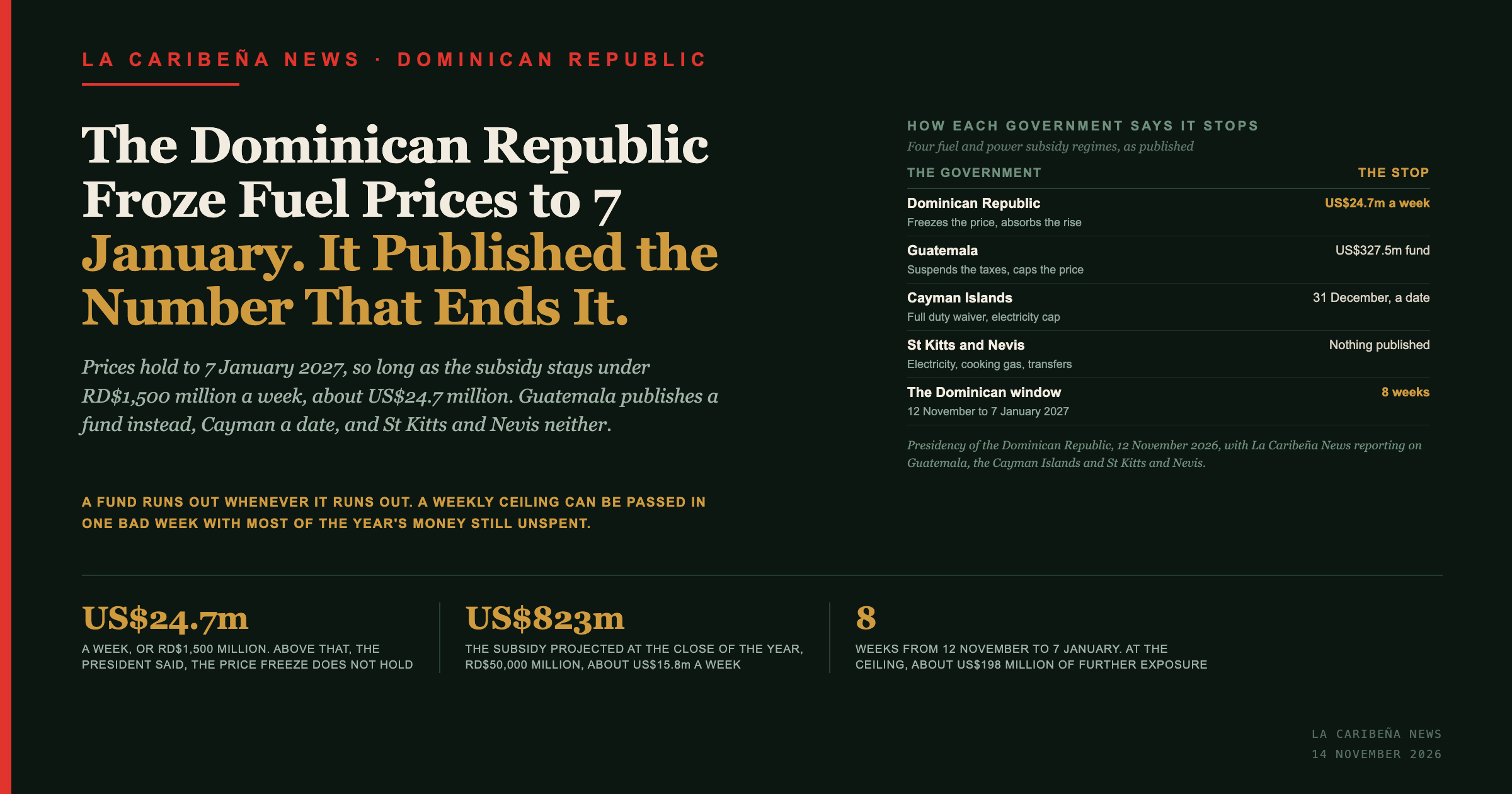
- Dominican Republic: freezes the price and absorbs the rise. The stop is about US$24.7 million a week. - Guatemala: suspends the taxes and caps the price. The stop is a fund of about US$327.5 million. - Cayman Islands: full duty waiver and an electricity cap. The stop is 31 December, a date. - St Kitts and Nevis: electricity, cooking gas and transfers. Nothing published as a stop. - The Dominican window runs 12 November to 7 January 2027, which is 8 weeks. - About US$24.7 million a week, or RD$1,500 million. Above that, the President said, the price freeze does not hold. - About US$823 million is the subsidy projected at the close of the year, RD$50,000 million, about US$15.8 million a week. - At the ceiling, 8 weeks is about US$198 million of further exposure. - A fund runs out whenever it runs out. A weekly ceiling can be passed in one bad week with most of the year's money still unspent. - Sources: the Presidency of the Dominican Republic, 12 November 2026, with La Caribeña News reporting on Guatemala, the Cayman Islands and St Kitts and Nevis.
Frequently asked questions
How long are Dominican fuel prices frozen?
From 12 November 2026 to 7 January 2027, which is eight weeks.
What is the condition attached?
The subsidy holding the prices down must not exceed RD$1,500 million a week, about US$24.7 million. Above that, the President said the freeze does not hold.
How much is the subsidy costing in US dollars?
The President put the projection at RD$50,000 million by the close of the year, about US$823 million at the Banco Central's spot reference midpoint for 12 November 2026. The release does not give a recent weekly figure.
Why did the government act?
The President pointed to swings in international prices and to the effects of the conflict in Iran and the Persian Gulf region on energy markets.
Do other Caribbean governments do this?
Guatemala caps the price and pays importers from a fund of about US$327.5 million while suspending fuel taxes. Cayman waives import duty in full and caps the electricity fuel charge to 31 December. St Kitts and Nevis subsidises electricity and cooking gas.
What makes the Dominican measure different?
The stop is published as a weekly rate rather than as a total. A fund runs out whenever it runs out; a weekly ceiling can be passed in one week while most of the year's money is unspent.
What is pan popular?
The Dominican price-controlled bread loaf, the cheap everyday bread, sold at an agreed price rather than a market one. Producers told the meeting it has held the same price since 2022.
What happens after 7 January 2027?
The announcement does not say.