By LCN Business Desk
A supplier chasing a Venezuelan invoice has had no way of knowing who is ahead of it in the line. On Tuesday the government printed the line.
What did Venezuela publish?
The plan appeared on the website of the Ministerio del Poder Popular de Economía y Finanzas on 24 November 2026, under the title Venezuela Renace. It runs to 97 pages. Spanish and English versions carry the same debt tables. The economic vice-presidency presented it and the information ministry sent it out.
Nobody signed it. The file's own properties name the Vice Presidency, an office rather than a person, and record the document as created five days before release. In all 97 pages no individual is quoted giving the total.
Section 34 states the position in one sentence.
"La deuda pública de Venezuela está en una situación de incumplimiento prolongado y es insostenible... Los pasivos totales identificados del sector público ascendían a USD 237,5 mil millones al cierre de 2025, equivalentes a cerca del 242% del PIB."
>
Venezuela's public debt is in prolonged default and is unsustainable. Identified total public sector liabilities came to US$237.5 billion at the close of 2025, equivalent to about 242 per cent of gross domestic product.
How large is that against the economy carrying it?
The plan puts 2025 output at US$98.1 billion. Central bank reserves stood at US$12.8 billion in July 2026, and roughly US$4 billion of that is gold held in London.
Venezuela's central bank last published a foreign debt figure for 2019, of US$129 billion. Analysts had been working with something nearer US$180 billion, and the Financial Times reported about US$240 billion in June 2026. So the size is not the surprise. What is new is that the state has put its name to a table with the items set out in it.
What is the US$237.5 billion made of?
Five classes, at the close of 2025.
| Class | US$ billion | Share |
|---|---|---|
| Commercial (eurobonds, bank loans) | 116.5 | 49.1% |
| PDVSA non-financial (suppliers, notes, pensions) | 67.3 | 28.3% |
| Arbitration awards and claims | 26.3 | 11.1% |
| Bilateral (China, Russia, Brazil) | 23.3 | 9.8% |
| Multilateral (IDB, CAF) | 4.2 | 1.8% |
| Total | 237.5 | 100.0% |
Components are rounded to the nearest US$100 million and do not sum exactly to the total.
Eurobonds account for US$110.1 billion of the commercial class. The Republic owes US$65.0 billion of that, PDVSA US$44.1 billion and the power company ELECAR US$1.1 billion. Unpaid interest stands at US$45.9 billion against principal of US$64.2 billion, which puts late interest alone above the entire arbitration class.
One lender dominates the bilateral line. China Development Bank holds US$16.9 billion through BANDES, Venezuela's state development bank, against US$5.1 billion for Russia's Vnesheconombank and US$1.1 billion for Brazil's BNDES. That is a loan book, and it sits in the queue with everything else. Argentina's central bank, by contrast, extended its currency swap with the People's Bank of China to 2031 in August on a line of which only US$5 billion was ever drawn.
How much of it does the state owe itself?
US$35.3 billion, by the plan's own footnote. PDVSA notes, pension debts and investment certificates held inside the state, some of them by the central bank. Strip those out and what is owed to lenders outside the state is US$202.3 billion, or about 206 per cent of output. Economists reading the plan arrived at the same figure.
Two ratios therefore describe the same country. The 242 per cent counts money Venezuela owes itself. The 206 per cent is what a lender bargains against.
Who does the plan say gets paid first?
The document sets out an order, and it is specific about which classes sit outside the main exchange.
| Position | Class | Treatment the plan states |
|---|---|---|
| Outside the perimeter | Multilateral (IDB, CAF) | Preferred creditor status. Arrears are cleared as a precondition for any new financing |
| Secured | The PDVSA 2020 bond | The only collateralised instrument, pledged on 50.1 per cent of CITGO Holding shares |
| Reprofiled | Bilateral (China, Russia, Brazil) | Maturities reprofiled, with possible new concessional lending |
| Exchanged | Commercial eurobonds | "Un canje de deuda ordenado", an orderly debt exchange, with the Republic and PDVSA in one perimeter |
| Negotiated separately | Arbitration awards | Settled through structured engagement with claimants, not in the bond exchange |
| Unspecified | PDVSA non-financial | No treatment stated |
For anyone waiting on new money into Venezuela, the multilateral line is the one that bites. Sections 169 and 171 put the US$4.2 billion owed to the Inter-American Development Bank and the Andean development bank CAF ahead of everything, and clearing it comes before new lending rather than beside it. Venezuela's constitution adds a further step: Article 150 requires National Assembly approval for public interest contracts with companies from other states.
Where does that leave a supplier?
In the biggest class in the table, and the only one the plan says nothing about. PDVSA non-financial debt stands at US$67.3 billion. US$17.1 billion of it is supplier debt, recorded as still subject to reconciliation and audit, with joint-venture debts adding a further US$10.8 billion.
New work keeps being signed against that backdrop. Cliper, a Trinidad and Tobago founded group, signed with PDVSA this month to restart the Pedernales oilfield in Delta Amacuro State. ExxonMobil and PDVSA signed a memorandum in Caracas on 9 November that neither party has published, and Exxon has said investment there requires stable policies, clear regulations, strong investment protections and competitive returns. Venezuela's reformed electricity law admits private and mixed companies to generation. Each of those routes ends in an invoice, and the invoice joins the class with no stated treatment.
The plan's own notice is blunt about what a place in the table means.
"La inclusión de cualquier obligación... no constituye reconocimiento en cuanto al monto, fundamento, validez" de dicha obligación.
>
Listing an obligation is not an acknowledgement of its amount, its basis or its validity.
Why does 18 December matter?
Because the one bond with security behind it runs on a licence that ends that day. The United States Office of Foreign Assets Control issued General Licence 5AA on 4 November 2026, moving the licence on the PDVSA 2020 bond from 5 November to 18 December 2026 and replacing General Licence 5Z. Until then OFAC says no licence is in force for holders to act on the pledge, and moving the CITGO shares is barred without a licence of its own.
That date has slipped before, repeatedly, since October 2019. OFAC also says it would look favourably on licensing a deal agreed with bondholders. None of the executive orders underpinning Venezuela sanctions has been revoked, so the wider framework stands. BP separately won an exploration and production licence for Loran Phase 2 in Venezuela in August, under an American authorisation of its own.
What do the arbitration awards add?
US$26.3 billion across 27 claims, before any of the bond work starts. ConocoPhillips holds US$13.0 billion of that across three claims, which makes it the largest single creditor in the plan. Then Agroinsumos Iberoamericanos at US$3.8 billion, Rusoro at US$1.6 billion, Crystallex at US$1.3 billion, Gold Reserve at US$1.2 billion and an ExxonMobil subsidiary at US$874 million. The claims sit across the ICSID, Permanent Court of Arbitration, UNCITRAL and ICC forums.
These are judgments and live claims. A bond can be swapped by agreement; an award has already been decided.
Has a bank said it is coming back?
Citigroup is talking to the United States State Department and the Treasury about what going back would take, and which sanctions waivers it would need. Bloomberg reported it on 24 November 2026, from people it did not name. Citi declined to comment. The bank left Venezuela in July 2021 and sold its local business to Banco Nacional de Crédito. What is under discussion is correspondent banking rather than a branch network.
For a regional exporter that distinction is the whole thing, because correspondent banking is what a Caribbean bank needs before it can clear a Venezuelan payment at all. Guyanese importers already count US$200 million in foreign-currency requests the banks could not fill.
Sovereign and PDVSA bonds rose more than four cents on the dollar when the plan appeared.
Can the old bonds still be sued on?
Sections 245 and 246 commit to an orderly swap, with the Republic and PDVSA inside one ring. The notice in the same plan says PDVSA and the central government are not one legal body, and that neither answers for the other's debts. Both sentences sit in the same 97 pages. A bondholder has to price the gap between them.
On the time limit, the specialist reading is that the clock may not have started at all. New York law allows six years from the date a claim arises. Most Venezuelan bonds, though, set their own limits in the contract, at ten years for principal and three for interest, and the clock starts when the fiscal agent is paid in full rather than when the state defaults. Octus set that reading out in January 2026, citing the lawyer Lee Buchheit. Standstill deals signed in 2023 freeze the limit to 31 December 2028 and a court backed them, but they bound only the institutional holders that signed.
Venezuela's bonds carry old-style voting clauses, series by series, at 75 per cent and in some cases 85 per cent. At least two bonds sold in the 1990s carry none at all.
What does this mean for a business in the Caribbean?
It means the queue is now in print, and a supplier can read its own place in it. One number and three dates do the work. The number is US$17.1 billion, the supplier claims Venezuela says it has yet to check, inside a class of US$67.3 billion the plan says nothing about. The first date is 18 December 2026, when the licence over the one secured bond next falls due. The second is the twelve-month window in which the plan places the debt swap. The third is the clearing of US$4.2 billion owed to the development banks, which the plan makes a condition of new lending.
So new work is being signed while old work is still being checked, and the plan does not say when the checking ends. The International Monetary Fund told Reuters it is going through the figures and that comment would be early. The Venezuela Creditor Committee declined to comment.
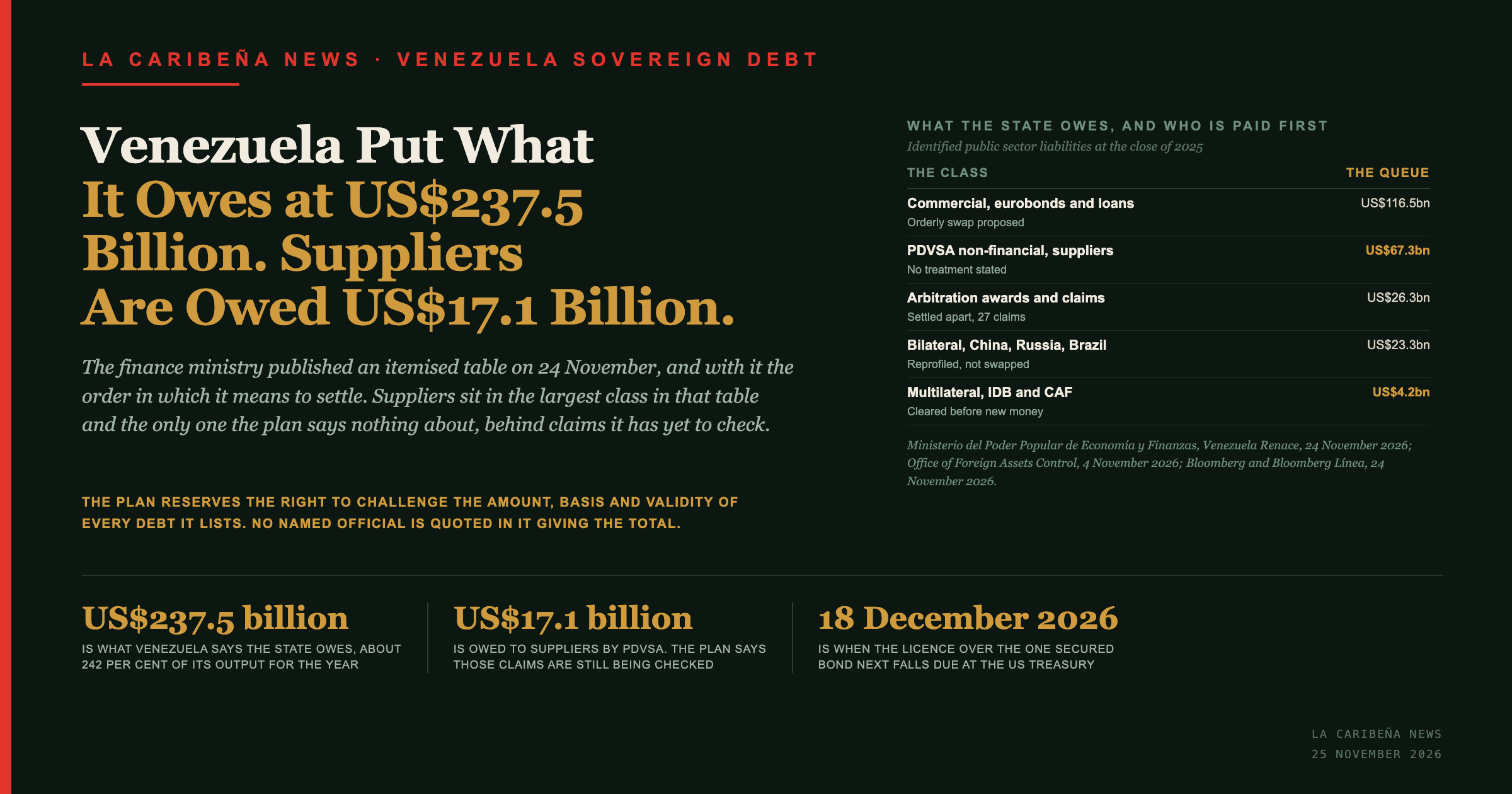
What the title card shows
- Identified total public sector liabilities: US$237.5 billion at the close of 2025, per the Ministerio del Poder Popular de Economía y Finanzas, Venezuela Renace, 24 November 2026. - Ratio to 2025 output: about 242 per cent, on output of US$98.1 billion stated in the same document. - Owed outside the public sector: US$202.3 billion, about 206 per cent of output, after the US$35.3 billion the plan's footnote marks as intra-public-sector. - Commercial class: US$116.5 billion, 49.1 per cent of the total. - PDVSA non-financial class: US$67.3 billion, 28.3 per cent, of which US$17.1 billion is supplier debt subject to reconciliation and audit. - Arbitration awards and claims: US$26.3 billion across 27 claims, ConocoPhillips US$13.0 billion of it. - Bilateral: US$23.3 billion, China Development Bank US$16.9 billion of it. - Multilateral: US$4.2 billion, arrears to be cleared before new financing. - Next licence date on the PDVSA 2020 bond: 18 December 2026, General Licence 5AA, OFAC, 4 November 2026.
Sources: Ministerio del Poder Popular de Economía y Finanzas, 24 November 2026; Office of Foreign Assets Control, 4 November 2026; Bloomberg, 24 November 2026; Bloomberg Línea, 24 November 2026; Correo del Caroní, 24 November 2026; Octus, 16 January 2026.
The entities
- Ministerio del Poder Popular de Economía y Finanzas is Venezuela's economy and finance ministry, on whose website Venezuela Renace was published on 24 November 2026. - Petróleos de Venezuela, S.A. (PDVSA) is the Venezuelan state oil company, named in the plan as owing US$44.1 billion in eurobonds and US$67.3 billion in non-financial debt. - Office of Foreign Assets Control (OFAC) is the sanctions administrator of the United States Department of the Treasury, which issued General Licence 5AA on 4 November 2026. - CITGO Holding is the parent of PDVSA's United States refining business, 50.1 per cent of whose shares are pledged to the PDVSA 2020 bond. - Inter-American Development Bank (IDB) is owed US$2.7 billion and holds preferred creditor status in the plan. - Corporación Andina de Fomento (CAF) is the Andean development bank, owed US$1.4 billion. - China Development Bank is the Chinese policy lender holding US$16.9 billion through BANDES, Venezuela's state development bank. - ConocoPhillips is the United States oil company holding US$13.0 billion in arbitration claims, the largest single creditor in the document. - Citigroup is the United States bank reported on 24 November 2026 to be discussing re-entry with the State Department and the Treasury. - Cliper is a Trinidad and Tobago founded group that signed with PDVSA this month on the Pedernales oilfield.
Frequently asked questions
Is US$237.5 billion a government figure or an estimate?
It is a government figure, published by Venezuela's economy and finance ministry in its own document on 24 November 2026, with an itemised table behind it. The document calls it identified total public sector liabilities, and reserves the right to challenge the amount, basis and validity of any obligation listed.
Why do two different percentages of output appear?
Because US$35.3 billion of the total is debt the state owes itself, which the plan footnotes. Against 2025 output of US$98.1 billion, the full figure is about 242 per cent and the amount owed to outside creditors is about 206 per cent.
Where does a supplier rank?
In the PDVSA non-financial class, US$67.3 billion, the largest single block in the table and the only class for which the plan states no treatment. US$17.1 billion of it is supplier debt the plan records as still subject to reconciliation and audit.
What happens on 18 December 2026?
The OFAC authorisation relating to the PDVSA 2020 bond, extended by General Licence 5AA on 4 November 2026, next falls due. Until then OFAC states no authorisation is in effect for holders to act on the pledge over CITGO Holding shares. That date has been deferred repeatedly since 2019.
Has Venezuela agreed any of this with its creditors?
No. The plan sets out what the government intends. The International Monetary Fund told Reuters it is reviewing the information and that comment would be premature, and the Venezuela Creditor Committee declined to comment.