By LCN Business Desk
Two sets of ueno Bank customers held money at one institution, under one brand, through one app. One set has been paid to a ceiling of about US$35,656 each. The other has been offered about US$4,685 a week, and a vote on whether the thing holding their money should be wound up.
All guaraní figures in this report are converted at G.6,402.78 to the United States dollar, the Banco Central del Paraguay's closing sale reference for 25 November 2026.
What have ueno Bank's depositors received?
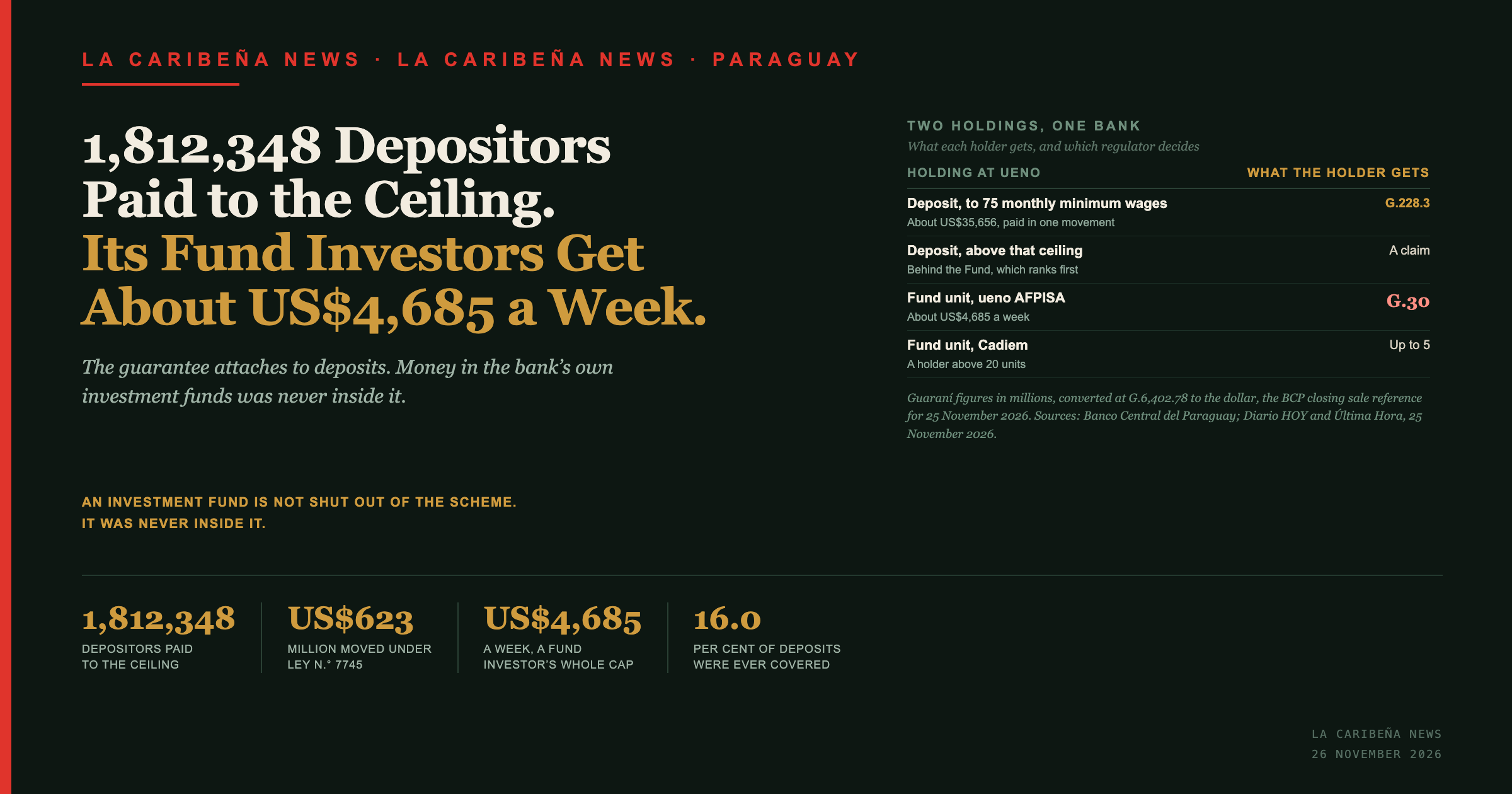
All of them, to the limit. The Banco Central del Paraguay is the country's central bank. In its release of 11 November it said it had paid the banks for the last groups of ueno Bank SA savers, about 29,988 people, worth ₲1.79 trillion, or about US$280 million. That took the total to 1,812,348 people, which it called the whole body of depositors entitled to the advance. ₲3.99 trillion moved, about US$623 million, inside the deadline set by Ley N.° 7745.
The advance runs to 40 monthly minimum wages, about G.121.76 million or US$19,017. José Maciel, who directs the unit that runs the deposit guarantee fund, set that out on 11 November. The full ceiling in law is 75 monthly minimum wages, which is G.228.3 million, or about US$35,656, for each depositor at each entity. Paraguay's monthly minimum wage has been G.3,044,000, about US$475, since 1 July 2026. This newspaper reported the ceiling when the bank was dissolved on 2 November.
One class of depositor is paid but not yet liquid. The central bank said holders of a savings certificate, a certificado de depósito de ahorro, will have funds credited once it has checked they still hold it. They do that on a platform, by uploading the certificate or by marking an option that reads "No tengo evidencia", meaning they have no proof of it. Money in sight accounts and programmed savings can be used or drawn now. Certificate money waits on the check.
Why are the fund investors on a different track?
Because their money is not a deposit, and the body that holds it is not the bank. ueno Administradora de Fondos Patrimoniales de Inversión ran two funds, ueno Cash Guaraníes and ueno Cash Dólares. The securities of each sit with the Caja de Valores del Paraguay, the country's securities depository, La Nación reported on 24 November. They answer to the Superintendencia de Valores. That is Paraguay's securities regulator, not the deposit guarantee.
Unit holders had asked that regulator to speed up the mechanisms for moving the funds to another administrator. The following day Última Hora reported that the route would not be a transfer or an auction but a liquidation, "debido a que ninguna otra administradora aceptó asumir la gestión de estos recursos". No other administrator would take them on. The stated aim is an orderly close distributing the real market value of the assets.
The Superintendencia has convened an assembly of unit holders to resolve whether the two funds should be wound up. It has not published a date for that meeting.
Redemptions restart next week under a cap. The central bank said unit holders may ask for up to G.30 million a week, about US$4,685, once the suspension on the administrator is lifted for a time. Diario HOY reported it on 25 November. Investor Casa de Bolsa, a brokerage, will sell the securities and pay out. Unit holders need not open an account there.
The two figures are worth putting side by side. A depositor was covered to G.228.3 million, about US$35,656, and paid it in one movement. A fund investor may draw G.30 million a week, about US$4,685. Reaching the depositor's ceiling at the fund investor's rate would take seven and a half weeks, and only if the assembly leaves the fund standing.
Does Paraguay's deposit guarantee cover a mutual fund?
The guarantee attaches to deposits. The Asociación de Bancos del Paraguay is the banking association, and it sets out what is covered: deposits "bajo cualquier modalidad y denominación" in private firms of the national financial system. Any form, any name, and a deposit in each case.
Rocío Craiyacich speaks for the affected savers. She told Diario HOY that mutual funds fall outside the guarantee, because they count as risk investments. She also said the product did not exist in the market when the guarantee law was passed. Ley N° 2334/03 was promulgated on 12 December 2003. On the public record this newspaper can find, no regulator has published a statement of its own on the point since the resolution began.
Her account fits where the money has gone. The Fund paid depositors and is now chasing the bank. Maciel said the Fund "está en primer lugar dentro del orden de prelación de cobro". In paying depositors it takes over their rights, and claims against the bank itself. The unit holders are in a separate process, before a separate regulator, with no fund standing in for them.
Diario HOY put the number of affected savers at between 29,000 and 30,000 and the value of the two funds at about US$46 million. Both are single-sourced estimates, carried without attribution to any institution. The same report calls the fund's portfolio sound, with its furthest bond maturing in 2031.
The same regulator is handling a second set of investors at a different firm. Cadiem Casa de Bolsa is another brokerage. A holder of up to 20 units there, about G.2.6 million or US$406, may recover the whole balance. A holder above that may recover only up to 5 per cent of it. Investors there opened talks with the board and expect a formal answer, with no date set for full normalisation, ABC Color reported on 22 November.
How much of Paraguay's deposit base was ever inside the guarantee?
Sixteen per cent of it. In October 2023 the guaranteed deposits in the country's 15 private banks came to Gs 20.5 trillion. ASOBAN records that as 16.0 per cent of all deposits. Its own figures put the Fund at US$1,013 million in the same period, and at 5.5 per cent of all deposits. That places total deposits near US$18.4 billion, and the guaranteed share near US$2.9 billion. Both sums are this newspaper's calculation from those two figures. Its reading of the gap is that private banking here leans on corporate clients, who hold more than the limit covers.
So the ceiling that covered 1,812,348 people covered a minority of the money. That is the arithmetic behind the public bodies now suing. Itaipú Binacional, the hydroelectric utility Paraguay owns with Brazil, held US$163.8 million and G.115,200 million on 3 November. The account was opened under a rule of its own that required five years in the market. The guaraní half converts to about US$18.0 million, so the two together come to US$181.8 million, which is the US$182 million InfoNegocios reported for Itaipú citing Bloomberg Línea. ANDE, the state power utility, had about US$21 million set aside for grid work. Conatel, the telecoms regulator, had G.70,000 million, about US$10.9 million, close to 15 per cent of its funds. The money above the ceiling is being chased in three countries, and the prosecutor running that work resigned on 17 November.
| Holding at ueno | What governs it | What the holder gets |
|---|---|---|
| Deposit, to 75 monthly minimum wages, about US$35,656 | Ley N° 2334/03, as extended by Ley N.° 7745 | Paid; ₲3.99 trillion, about US$623 million, by 11 November |
| Deposit, above that ceiling | The resolution and the queue of creditors | A claim, behind the Fund, which ranks first |
| Mutual fund unit, ueno AFPISA | The Superintendencia de Valores | G.30 million a week, about US$4,685, and a vote on liquidation |
| Mutual fund unit, Cadiem | The Superintendencia de Valores | 100 per cent to 20 units, up to 5 per cent above |
What does Guyana's scheme cover?
Deposits, to G$2,000,000, about US$9,600. The Deposit Insurance Corporation sets that limit for each depositor at each member bank, and counts accrued interest inside it. Hold several accounts at one bank and they share the one limit. Hold accounts at two banks and each carries a limit of its own. The categories it names are savings, chequing and time deposits. It must pay within 30 calendar days of liquidation.
Its list of what is not covered runs to seven items.
| Not covered by Guyana's scheme | What the exclusion turns on |
|---|---|
| The part of a deposit above the limit | The amount |
| Deposits of financial institutions, insurance companies and pension funds among them | Who holds it |
| Deposits of central and local government | Who holds it |
| Deposits of branches that operate outside Guyana | Where it is held |
| Deposits of board members | Who holds it |
| Deposits of large shareholders and their relatives | Who holds it |
| Deposits of people under criminal investigation, or suspected of money laundering | Who holds it |
Every one of those seven excludes a kind of deposit, or a class of depositor. A pooled investment product is on the list nowhere, and that is not an oversight. The thing the scheme acts on is a deposit, from the limit per depositor to the three named categories to what it pays out on. An investment fund is not shut out of the scheme. It was never inside it.
Guyana's treatment of pension funds runs the opposite way to Paraguay's, where the state pension fund is paid first and Guyana's scheme excludes them. Paraguay also sets a 10 per cent ceiling on a pension fund's holding in one bank.
What does the Paraguayan case establish for a regional saver?
That the protection follows the product, not the brand. The depositors and the unit holders bought from the same institution and are now in two processes, under two regulators, on two timetables. One was complete within weeks of the resolution. The other has no administrator willing to take it, a weekly withdrawal cap, a valuation struck at 6 November, and an assembly yet to be called.
Paraguay's ceiling moves with the minimum wage and stands at about US$35,656. Guyana's is a fixed G$2,000,000, about US$9,600. Neither reaches an investment account, because neither scheme was built to.
The rescue legislation has moved for the depositors and for the workers. A bill before Congress would put firms linked to the bank under state control, and names administrators and grants them immunity. On the public record this newspaper can find, no bill has been introduced for the unit holders.
Title card, text equivalent
All figures on the title card, with their sources.
- 1,812,348 depositors entitled to the guarantee advance, and ₲3.99 trillion transferred, about US$623 million, under Ley N.° 7745. Source: Banco Central del Paraguay release, 11 November 2026.
- Final groups disbursed: about 29,988 people, ₲1.79 trillion, about US$280 million. Source: the same release.
- Depositor ceiling: 75 monthly minimum wages, G.228.3 million, about US$35,656, per depositor per financial entity. Source: Ley N° 2334/03, as described by the Asociación de Bancos del Paraguay and by the Fondo de Garantía de Depósitos.
- Guarantee advance: 40 monthly minimum wages, about G.121.76 million or US$19,017. Source: José Maciel, Fondo de Garantía de Depósitos, 11 November 2026.
- Fund investor redemption cap: G.30 million a week, about US$4,685. Source: Banco Central del Paraguay via Diario HOY, 25 November 2026. All guaraní conversions use G.6,402.78 to the dollar, the Banco Central del Paraguay's closing sale reference for 25 November 2026.
- Guaranteed deposits as a share of total deposits in the 15 private banks: 16.0 per cent, October 2023. Source: Asociación de Bancos del Paraguay.
- Cadiem recovery: 100 per cent up to 20 units, about G.2.6 million or US$406; up to 5 per cent above that. Source: Última Hora, 25 November 2026.
- Guyana insured limit: G$2,000,000, about US$9,600, per depositor per member institution, including accrued interest; reimbursement within 30 calendar days of liquidation. Source: Deposit Insurance Corporation of Guyana.
Entities named in this report
- Banco Central del Paraguay (BCP) is Paraguay's central bank, and it administers the deposit guarantee fund.
- Fondo de Garantía de Depósitos (FGD) is the statutory deposit guarantee fund created by Ley N° 2334/03 and administered by the BCP.
- Superintendencia de Valores (SIV) is Paraguay's securities regulator, which supervises fund administrators.
- ueno Administradora de Fondos Patrimoniales de Inversión (ueno AFPISA) is the fund administrator that ran ueno Cash Guaraníes and ueno Cash Dólares.
- Caja de Valores del Paraguay (Cavapy) is the custodian holding the securities of each fund.
- Investor Casa de Bolsa is the brokerage acting as seller of securities and paying agent for the capped redemptions.
- Cadiem Casa de Bolsa is a separate Paraguayan brokerage whose own fund investors are in a parallel process.
- Itaipú Binacional is the Paraguay and Brazil hydroelectric entity that held US$182 million at the bank.
- Administración Nacional de Electricidad (ANDE) is Paraguay's national electricity administration.
- Comisión Nacional de Telecomunicaciones (Conatel) is Paraguay's telecommunications regulator.
- Asociación de Bancos del Paraguay (ASOBAN) is the Paraguayan banking association.
- Deposit Insurance Corporation (DIC) is the Guyanese scheme administrator established under the Deposit Insurance Act 2018.
Frequently asked questions
Were ueno Bank's depositors paid in full?
They were paid to the ceiling, not in full. On 11 November the central bank said all 1,812,348 depositors entitled to the advance had been covered, and ₲3.99 trillion moved, about US$623 million. Cover stops at 75 monthly minimum wages, which is G.228.3 million or about US$35,656, for each depositor at each entity. Anything above that is a claim on the estate.
Are mutual fund investors covered by Paraguay's deposit guarantee?
The guarantee attaches to deposits, in any form or name, held in private firms of the national financial system. A spokesperson for the savers says mutual funds fall outside it, because they count as risk investments. The funds answer to the securities regulator, and the unit holders are in a securities process, not a guarantee one.
How much can a ueno fund investor withdraw?
Up to G.30 million a week, about US$4,685, from next week, once the suspension on the administrator is lifted for a time. Investor Casa de Bolsa, a brokerage, will sell the securities and pay out. A depositor was covered to about US$35,656 and paid it in one movement.
Why are the funds being liquidated rather than transferred?
No other administrator would take them. Unit holders had asked the regulator to speed up a move to another manager. Última Hora reported on 25 November that the route would be liquidation instead, to close the funds in order and share out what the assets are really worth. An assembly has been called to decide, and no date is set.
Does Guyana's scheme protect money in an investment fund?
Guyana's scheme insures deposits to G$2,000,000, about US$9,600, for each depositor at each member bank, in three named kinds: savings, chequing and time deposits. Each of its seven exclusions names a kind of deposit, or a class of depositor. A pooled investment product is on none of them, because the thing the scheme acts on is a deposit.