By LCN Business Desk
A company with more than G.228,300,000 in ueno bank does not get paid until the Instituto de Previsión Social has been. The IPS is Paraguay's equivalent of Guyana's National Insurance Scheme: it collects from private-sector employers and workers and pays their pensions, sickness, maternity and workplace-injury benefits. The ranking is statute, not a term anybody negotiated, and this newspaper reported it on 4 November. On Friday a prosecutor told the Senate how big the claim in front of that company had grown, and how fast.
That fund held about 70 billion guaraníes at the bank in September 2023, around US$12 million, on figures the prosecutor Raúl Benítez presented to the chamber. By December 2024 it was 1.77 trillion, about US$300 million. It peaked in April 2026 at 2.15 trillion, roughly US$364 million, held in certificates of deposit, bonds and demand deposits. Senators then voted 44-1 to remove the President, and prosecutors ordered him held at home.
What did the prosecutor put to the Senate?
About US$12 million became about US$364 million over 31 months, and the dates it happened on.
| Instituto de Previsión Social at ueno bank | Guaraníes | US dollars |
|---|---|---|
| September 2023 | about 70 billion | about US$12 million |
| December 2024 | 1.77 trillion | about US$300 million |
| April 2026, the peak | 2.15 trillion | about US$364 million |
Figures as presented to the Senate by prosecutor Raúl Benítez on 6 November 2026 and reported by ABC Color. They are allegations in a criminal proceeding, not findings. The Paraguayan record writes these as "G. 70.000 millones" and "G. 1,77 billones": a Spanish billón is a million million, so those are trillions in English, not billions. Dollar figures here are converted at G.5,900 to the dollar, the rate on the Banco Central del Paraguay's sheet of 31 August 2026 and the basis of this newspaper's 4 November report. The guaraní has moved materially during 2026, so equivalents struck on other dates will differ.
Senator Líder Amarilla put the shortfall in public money at about US$860 million, of which he said US$350 million belongs to pensioners. Al Jazeera reports US$355 million of state pension funds invested in the bank. This newspaper's 4 November report on the resolution carried around US$380 million, on figures published at the dissolution.
Those three figures were given by three different speakers and none rests on an audited balance. They are worth setting against the prosecutor's guaraní series, because that series converts to about US$364 million at its April 2026 peak. Four numbers reached by four routes land between US$350 million and US$380 million.
What the figures have in common is the direction. The institution Paraguayan statute puts first in the queue is also the institution whose deposits grew fastest at the bank that failed.
Where does that leave a business depositor?
Second, behind a claim of roughly US$364 million, with no sale and no timetable.
The structure has not changed since the bank was dissolved on 2 November. Cover stops at 75 times the monthly minimum wage, G.228,300,000, about US$38,600. Below that the Fondo de Garantía de Depósitos pays. Above it, a depositor is a creditor against whatever the bank's assets fetch, and the state pension fund is paid before the rest.
Two things did change this week. Ley 7745, promulgated on 4 November, signed the same day it cleared both chambers, let the fund advance up to 40 times the wage ahead of the statutory window. And the central bank moved G.197,191 million, around US$33 million, to 15 financial institutions acting as paying agents, covering 722,037 accounts, which Perspectivas calculated at an average of about G.273,000 an account, roughly US$46.
An average of about US$46 against a ceiling of about US$38,600 is the distance between the first payment and the guarantee. Against a claim of roughly US$364 million it is a different order of magnitude again.
What would the same failure look like in Guyana?
Smaller cover, a 30-day clock, and the national scheme's own money excluded by statute.
Guyana runs a deposit insurance scheme under the Deposit Insurance Act 2018, administered by the Deposit Insurance Corporation, whose board is chaired by the Governor of the Bank of Guyana. A business is covered automatically, without applying, at any of the eight member institutions.
| Paraguay | Guyana | |
|---|---|---|
| Instrument | Ley 2.334/03 | Deposit Insurance Act 2018 |
| Cover, per depositor per bank | 75 times the monthly minimum wage, G.228,300,000, about US$38,600 | G$2,000,000, about US$9,600, interest included |
| Several accounts at one bank | combined, one ceiling | combined, one ceiling |
| Joint accounts | ceiling divided between the holders | one ceiling, divided equally |
| Trust accounts | not established | insured separately from the trustee's, settlor's and beneficiary's own accounts |
| Foreign currency | not established | insured, but repaid in Guyana dollars at the failure-date rate |
| Paid within | 15 days of the resolution, extendable by 15 | 30 days |
| Above the ceiling | a creditor against the sale proceeds | a claim to the Liquidator |
| The national scheme's own deposits | covered, and ranked first above the ceiling | ineligible for protection under section 36 |
Paraguay as set out above. Guyana from the Deposit Insurance Corporation's own brochure and its "Calculating the Deposit Insurance Coverage" document.
The two schemes are built the same way and treat the same party in opposite directions. Paraguay insures its social security institute's deposits and then puts that institute in front of every business when the assets are sold.
Guyana does the reverse by statute. Section 36 of the Deposit Insurance Act 2018 makes certain deposits ineligible for protection, and the Bank of Guyana's annual reports set out that section as covering the deposits of financial institutions including insurance companies and pension funds, the deposits of central and local government, and the deposits of overseas branches of member institutions. The Corporation states the same exclusions in its own public guidance.
::: Section 36 makes two kinds of deposit ineligible that matter to a Guyanese reader: pension funds, and central and local government. A national insurance scheme answers to both descriptions. :::
Neither position is the comfortable one. In Paraguay a business above the ceiling is second, and knows what it is second to. In Guyana, were a member bank to be wound up, an uninsured claim by a national scheme and an uninsured claim by a business would reach the same Liquidator, and no source this newspaper can find says which is met first.
Two details in the Corporation's own worked examples matter more to an exporter than the headline limit. A foreign-currency account is insured, but "reimbursable in Guyanese dollars", at "the exchange rate applicable on the date when ABC Bank failed": the Corporation's Scenario 2 takes a US$12,000 chequing account at an illustrative US$1 to G$200, making G$2,400,000, of which G$2,000,000 is insured and G$400,000 is not. The depositor carries the conversion, and the rate is fixed on the day of the failure rather than the day of the deposit. And a trust account is the one structure that lifts the ceiling: funds held in trust "shall not be combined with the individual deposit accounts of a trustee, settlor or beneficiary", with each beneficiary's interest insured up to its own G$2,000,000. Opening more accounts at more branches of the same bank does nothing at all.
Bank of Baroda (Guyana) Inc. is among the eight members.
Who is executing the payout now?
A central bank on its second interim president in a week, and a former governor for whom prosecutors have sought detention.
Carlos Carvallo resigned as president of the Banco Central del Paraguay after Peña asked him to go on 3 November. On 6 November prosecutors asked the Juzgado de Garantías to detain him, to be held not at his home but at premises the Comandancia determines. Carvallo led the firm then trading as Financiera Ueno from June 2021 until he took the central bank in 2023, and the regulator has said he took no part in decisions concerning Ueno.
Liana Caballero was acting at the central bank when the first disbursement of up to G.10,000,000 was set. Pedro Acosta Bernal has since been designated interim president, and it was Acosta who said the next step is to cover amounts up to the 75-wage maximum.
The arrest order names Santiago Peña Palacios and Carlos Dagoberto Carvallo Spalding, under case 92/2026, captioned as breach of trust and others. Peña is held at home under a prosecutors' resolution. Among those already in custody is Miguel Vázquez, whom this newspaper recorded presenting himself to the Policía Nacional on 3 November as the third director of the bank to be detained.
What happened to the presidency?
A resignation refused, a removal by 44 votes, and a successor sworn in that evening.
Peña resigned on 5 November. Congress declined the resignation and impeached him instead. Article 189 of the Constitution makes an elected former president a senator for life "salvo que hubiesen sido sometidos a juicio político y hallados culpables", so the seat survives an impeachment and falls only to a conviction, and a resignation would have left it intact. The Chamber of Deputies voted 78-0 to impeach. The Senate convicted and removed him by 44 votes of 45, one senator abstaining, on the constitutional ground of mal desempeño de funciones, against a threshold of 30.
Pedro Alliana, Vice President since 2023, took the oath at 19:45 that evening at an extraordinary bicameral session, as Paraguay's 53rd president. Congress declined to open impeachment hearings against him. Horacio Cartes, a former president and the Colorado Party leader, said the party supported the impeachment "in order to restore the republic's institutions". Peña was identified in 2023 as a shareholder of ueno's parent company and says he sold in early 2025.
What does a business take from this?
Check who is ahead of you in the queue, and check what their balance has been doing.
A deposit guarantee is a ceiling with a queue behind it, and this newspaper has argued that the recoverable amount turns on how high the ceiling is and who is in front of it. Paraguay has now supplied the second half of that lesson in detail. The party ranked first was the state pension fund, whose money at the bank grew about thirty times in under three years, and the ranking is statutory, so no commercial term a depositor negotiated would have altered it.
Both facts were available before the bank failed. The ranking is in Ley 2.334/03. The state pension fund publishes where it invests. A company that reads only the ceiling is reading half the instrument.
What is not established here?
The prosecutor's figures have not been tested. They were presented to the Senate on 6 November 2026 in support of an impeachment and a criminal case, and are reported here as allegations. No audited statement of the state pension fund's holdings at ueno bank is cited.
Why the three dollar figures differ. A senator's US$350 million, Al Jazeera's US$355 million and the US$380 million published at the dissolution are not the same measure, and no source read reconciles them. Converting the guaraní series above into dollars would produce a fourth number and is not done here.
Whether section 36 captures the National Insurance Scheme specifically. The Bank of Guyana's annual reports set the section out as covering the deposits of financial institutions including insurance companies and pension funds, and the deposits of central and local government. The National Insurance Scheme is a national social-insurance scheme under its own Act rather than an occupational pension fund or a government department. Section 36's own words have not been read: the Corporation's regulations and FAQ pages could not be retrieved, so which limb if any captures the Scheme is not established here.
Where an uninsured depositor ranks in a Guyanese liquidation. On the public record this newspaper can find, no source states the statutory order of priority, so the comparison above is made on cover and timing, not on ranking.
The exclusion balance. The central bank has up to fifteen days from the dissolution to draw up the balance that settles who is owed what. Until it is published, the amount available to creditors above the ceiling is unknown, and so is any recovery rate.
What case 92/2026 alleges in its own terms. The caption and the two names in the arrest order are reported. The file itself has not been read.
Whether the 17 November deadline will be extended to 2 December, which Ley 2.334/03 permits and nobody has announced.
The entities
- Instituto de Previsión Social (IPS) is Paraguay's social security institute for private-sector workers, the equivalent of Guyana's National Insurance Scheme, paid before other depositors above the deposit guarantee ceiling. The prosecution puts its position at ueno bank at 2.15 trillion guaraníes, about US$364 million, in April 2026. Paraguay's public servants are covered by a separate scheme, the Caja Fiscal, which is not involved here. - ueno bank is the Paraguayan lender, fifth-largest in the country with about three million customers, dissolved by the central bank on 2 November 2026. - Banco Central del Paraguay is the central bank that dissolved the lender and transferred G.197,191 million to 15 paying agents. - Fondo de Garantía de Depósitos is the deposit guarantee fund created by Ley 2.334/03, covering 75 times the monthly minimum wage per depositor per bank. - Ley 7745 is the law promulgated on 4 November 2026 allowing an advance of up to 40 times the monthly minimum wage. - Santiago Peña is the President of Paraguay removed by the Senate on 6 November 2026 and held under house arrest by prosecutors' order. - Pedro Alliana is the President of Paraguay, sworn in on 6 November 2026, previously Vice President since 2023. - Carlos Carvallo is the former president of the Banco Central del Paraguay, for whom prosecutors sought detention on 6 November 2026. - Pedro Acosta Bernal is the designated interim president of the Banco Central del Paraguay. - Raúl Benítez is the prosecutor who presented the pension-fund figures to the Senate. - Deposit Insurance Act 2018 is the Guyanese statute establishing that country's deposit insurance scheme, with cover of G$2,000,000 per depositor per member institution and the exclusions at section 36. - Deposit Insurance Corporation is the independent entity administering the Guyanese scheme, chaired by the Governor of the Bank of Guyana, reimbursing insured depositors within 30 days of a failure. - National Insurance Scheme is Guyana's national social-insurance scheme, named here as the closest equivalent to Paraguay's Instituto de Previsión Social. - Article 189 is the constitutional provision making elected former presidents lifetime senators unless impeached and found guilty.
What the title card says
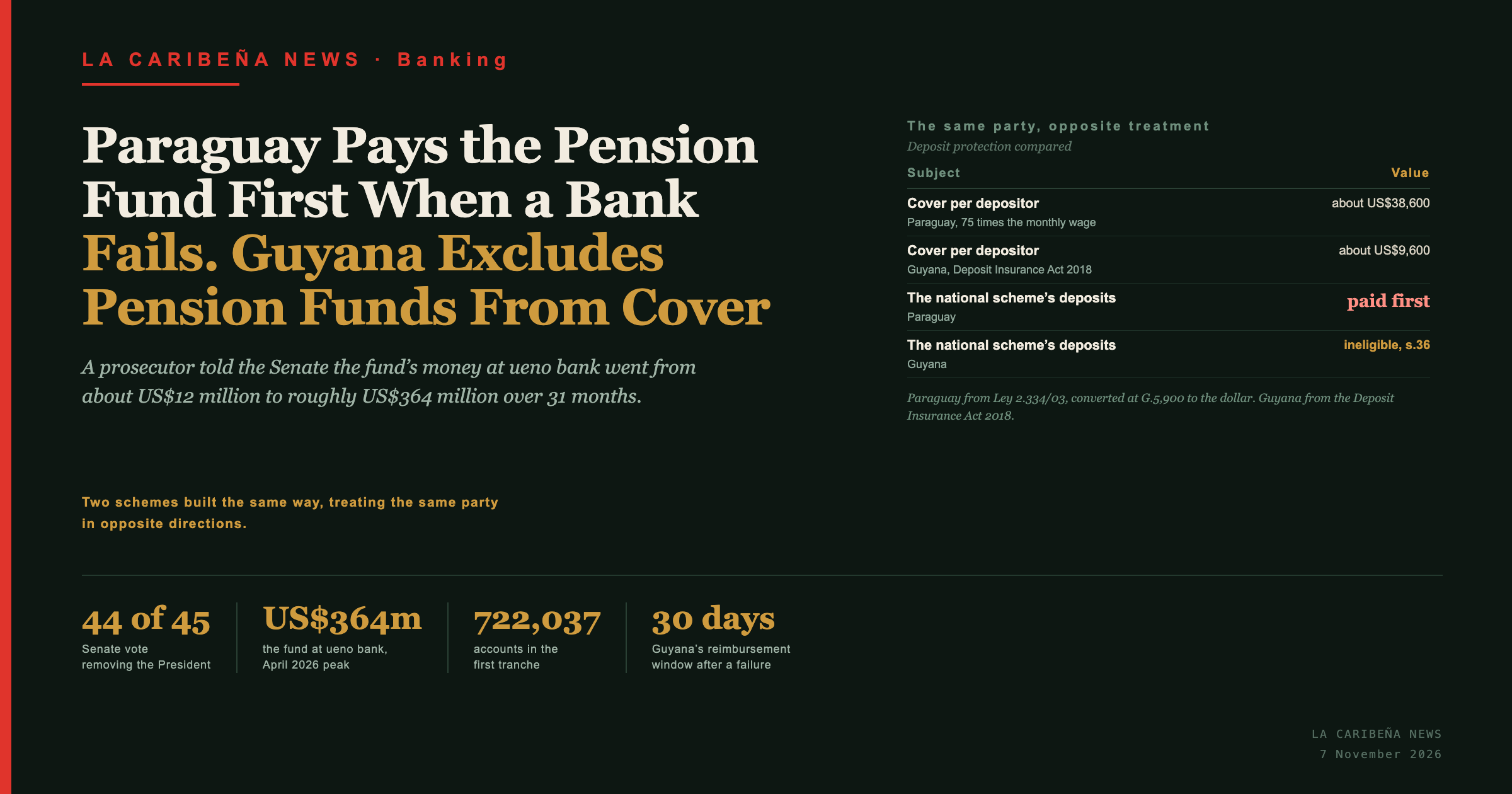
- Kicker: Banking. - Headline: Paraguay pays the pension fund first when a bank fails, and Guyana excludes pension funds from cover. - Deck: a prosecutor told the Senate the fund's money at ueno bank went from about US$12 million to roughly US$364 million over 31 months. - Standfirst: two schemes built the same way, treating the same party in opposite directions. - Panel, "The same party, opposite treatment", sub-headed as deposit protection compared, four rows of subject and jurisdiction against value: - Cover per depositor, Paraguay at 75 times the monthly wage, about US$38,600. - Cover per depositor, Guyana under the Deposit Insurance Act 2018, about US$9,600. - The national scheme's own deposits, Paraguay, paid first. - The national scheme's own deposits, Guyana, ineligible under section 36. - Panel note: Paraguay from Ley 2.334/03, converted at G.5,900 to the dollar; Guyana from the Deposit Insurance Act 2018. - Chip: 44 of 45, the Senate vote removing the President. - Chip: US$364 million, the fund's money at ueno bank at its April 2026 peak, on the prosecution's figures. - Chip: 722,037, accounts in the first tranche of payments. - Chip: 30 days, the Guyanese reimbursement window after a failure. - Date line: 7 November 2026.
Frequently Asked Questions
Who is paid first if ueno bank's assets are sold?
The Instituto de Previsión Social, Paraguay's social security institute for private-sector workers and the equivalent of Guyana's National Insurance Scheme, ranks before other depositors for amounts above the guarantee ceiling. The ranking is set by Ley 2.334/03, not by any commercial term a depositor agreed.
How much did the state pension fund hold at the bank?
Prosecutor Raúl Benítez told the Senate on 6 November that the position was about 70 billion guaraníes in September 2023, 1.77 trillion in December 2024 and 2.15 trillion at its April 2026 peak. These are allegations in a criminal proceeding.
Has any money reached depositors?
Yes. The central bank transferred G.197,191 million from the deposit guarantee fund to 15 financial institutions acting as paying agents, covering 722,037 accounts. That is an advance under Ley 7745 and a payment on account, not the full guarantee.
What happened to President Peña?
The Chamber of Deputies impeached him 78-0 on 5 November 2026 after Congress declined his resignation. The Senate removed him by 44 votes of 45 the next day for mal desempeño de funciones, and prosecutors ordered him detained at his home. Pedro Alliana was sworn in as president that evening.
Does the change of government affect the payout?
The ceiling, the statutory queue and the 17 November deadline do not depend on who holds the presidency. What depends on the institutions is the publication of the exclusion balance and any decision to extend the deadline to 2 December.