By LCN Business Desk
The President of Paraguay's Senate has a bill to defend and a clause in it he will not defend.
What does the bill actually do?
It hands the companies to a state administrator, because the central bank cannot reach them. The Executive has sent Congress a bill setting up temporary state control of certain firms tied to ueno bank. Senator Basilio Núñez, who presides over the upper house, set out its shape to reporters on 20 November. It creates a council, names administrators to run the firms, and grants those administrators immunity. The regime would run for about eight months.
Its reach is narrower than the group it is named for. Three kinds of company are carved out: any firm already in a bankruptcy case, any firm under criminal inquiry, and any firm held by Senabico, the agency that keeps seized assets. So the bill cannot touch the parts of the group already in trouble with a court.
Núñez framed the choice bluntly. "Más fácil sería que vayan directo a la quiebra." The easier course would be to let them go straight to bankruptcy.
Why can Paraguay not simply examine these companies?
Because the central bank has no power to. Núñez said the Banco Central del Paraguay (BCP) can step into a bank but "no tiene atribuciones para examinar directamente a las empresas vinculadas". It cannot look at the linked firms directly.
That one sentence is why the law exists. A watchdog's reach ends at the edge of the licence. The firms that banked with ueno, borrowed from it and shared its owners sat on the far side of that edge. No one was watching them as a group. Paraguay dissolved the bank, its fifth-largest private lender, on 2 November after its solvency ratio fell below half the required minimum, and ueno had published three different capital numbers in the eight months before that. When the licence went, the only tool left for everything attached to it was an act of Congress, written after the fact.
The edge is the part that travels. Paraguay caps its own pension fund at 10 per cent of its book in any one bank, a limit that binds the fund rather than the bank's affiliates. Itaipú wrote itself a five-year rule for the banks that may hold its cash. Neither instrument looks past the licence to the firms standing behind it.
How many jobs does the bill say it is saving?
Two numbers are in play. They count different things.
| Figure | What it counts | Tense | Who said it |
|---|---|---|---|
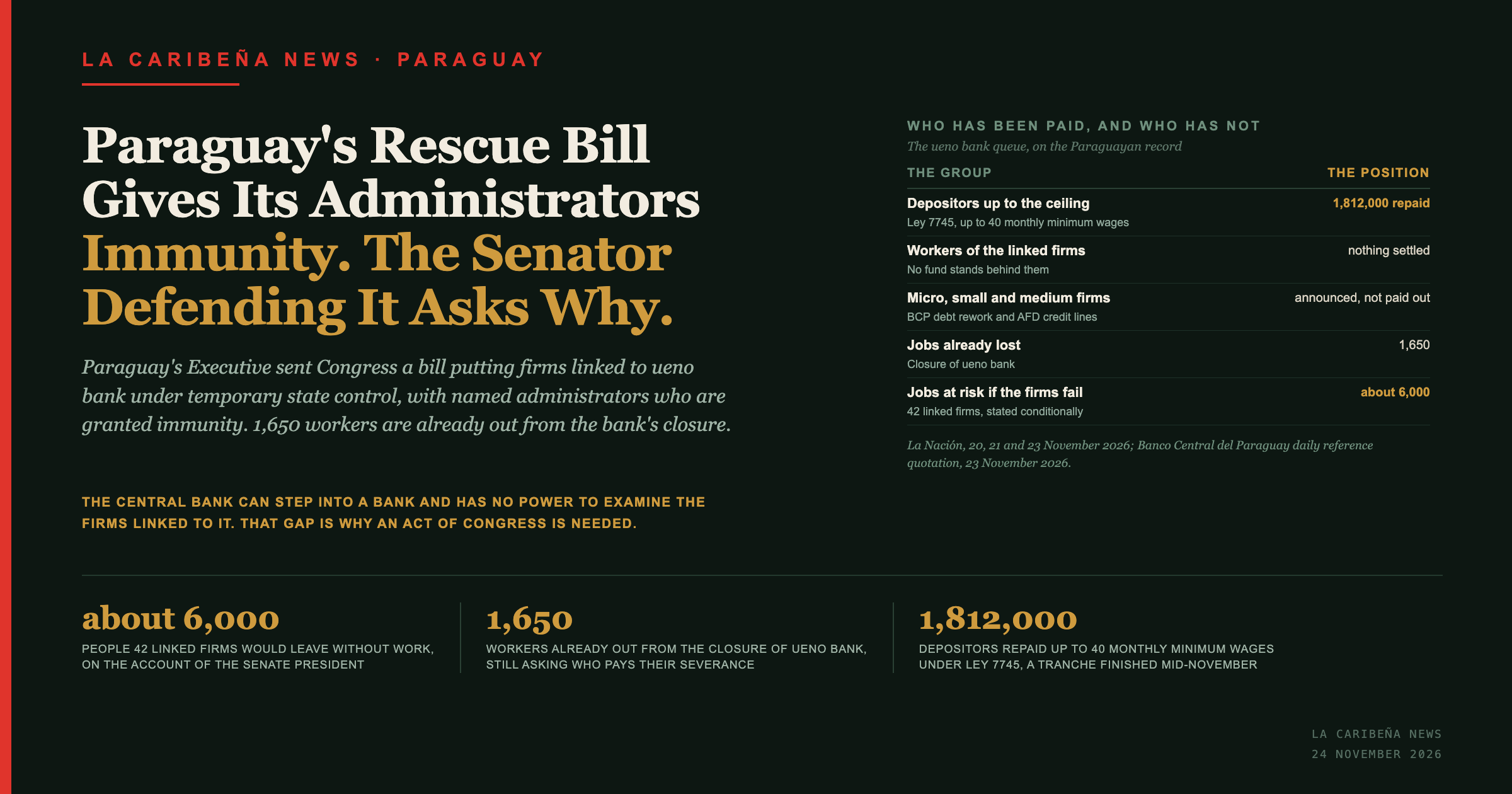
| 1,650 | workers out of work from the closure of ueno bank | already happened | Cheryl Cazuriaga, spokesperson, 23 November |
| about 6,000 | people 42 linked firms would leave without work | conditional, "estarían" | Basilio Núñez, Senate President, 20 November |
Neither figure corrects the other. No one in Paraguay has yet explained in public how the two fit together. The smaller is a loss already taken. The larger is the loss the bill is meant to stop, which is why the man quoting it is the man selling it.
The bill reaches fewer than 42 firms in any case. Three groups of company are cut out of it, and the Government has not said how many of the 42 are left inside. Núñez also said these are not the only Paraguayan firms shedding staff. Others failed before ueno did, and put people out then.
What do the workers who already lost their jobs want?
Not this bill. Staff let go when the Grupo Vázquez firms shut have rejected state control of those firms. They want paying out of the public purse instead. The state can get its money back later, they say, by selling what is left at auction.
Cheryl Cazuriaga speaks for the staff of Itti, the group's tech firm. She told Así son las cosas, on GEN and Universo 970 AM, that a state payout is their main demand "teniendo en cuenta los tiempos", given how long the rest will take. Her case:
"No podemos esperar un tiempo indefinido por parte del Estado, entonces creemos que es lo más factible, que el Estado facilite los mecanismos necesarios para que nosotros podamos acceder a nuestros beneficios laborales y que se permita recuperar los recursos a partir de los bienes existentes, su realización a través de un remate."
The wait she is refusing is the one written into the bill. Nobody yet knows the full sum owed. The figure doing the rounds is US$10 million, which is about G.64,291 million at the central bank's rate of G.6,429.07 to the dollar on 23 November. The staff have been pressing the legislature since the shutdown and have had no answer.
What happened to the credit promised to the small firms?
It was announced. It has not arrived. Guillermina Imlach speaks for Paraguay's small-business federations. She told 1020 AM that the relief has not reached the accounts it was meant for: "No hay plata en las cuentas, puro anuncios." There is no money in the accounts, pure announcements.
What exists on paper is precise. An affected firm may rework its debt at the BCP without losing its credit grade. The Agencia Financiera de Desarrollo (AFD), the state's development lender, has opened lines of G.50 million to G.350 million a firm. At Monday's rate that is about US$7,800 to US$54,400. The term is up to six months.
What does not exist is a date or a price. Imlach said there are no firm dates for reaching any of it, and no clear word on the interest rates. The paperwork is itself a wall. The firms that need the cash most are the ones least able to supply it, because a one-person business has the thinnest records and the least credit history of all. Her verdict was a proverb. "Del dicho al hecho hay un gran trecho." Saying and doing are a long way apart.
Who has actually been paid?
Savers, in their millions. Nobody else.
| Group | Instrument | Position |
|---|---|---|
| Depositors up to the ceiling | Ley 7745, up to 40 monthly minimum wages, G.121.7 million each | 1,812,000 repaid, tranche completed mid-November |
| Workers of the linked companies | none; a bill before Congress | nothing settled, total sum unknown |
| Micro, small and medium firms | BCP debt rework and AFD lines | announced, not paid out |
That order is not a scandal. It is what a deposit guarantee is built to do, and Paraguay's moved fast: the law letting the guarantee fund advance up to 40 minimum wages was signed on 4 November, and its author was impeached the next day. The order also stops dead at the guarantee. Cover stops at about US$38,600 a depositor, whether the depositor is a person or a binational utility. A worker owed severance is not a depositor at all, and neither is a supplier owed an invoice, so no fund stands behind either of them. The law that would is still a draft.
Past the guarantee line the queue runs longer, and it is moving slowly. Money above the ceiling is being chased in three countries, with the state pension fund paid before other depositors when a failed bank's assets are sold. The prosecutor who was running that recovery resigned on 17 November. The Asociación Rural del Paraguay, the country's cattle body, asked on 8 November for the payback to be finished and gave its reason in one line: "Es prioritario sostener la cadena de pagos, el crédito y las condiciones para producir, invertir y trabajar en el país." Holding the chain of payments is the priority.
Will the immunity clause survive?
Its own sponsor will not vouch for it. La Nación reports that Núñez is willing to review the immunity given to the administrators. He put the objection in his own mouth. He agrees with asking "por qué darle inmunidad a una persona que va a estar dirigiendo estas empresas, porque lo que se está tratando de hacer es salvarlas": why immunity should go to someone who will be running these firms, when the point is to save them.
He was just as plain that the bill may die. "Acá vamos a estudiar, también se podría rechaza, y no pasa nada." We will study it here, it could be thrown out, and nothing happens. From the man who chairs the chamber that must pass it, that is a live risk and not a form of words.
There is a reason an administrator might want the cover. These firms are being searched. On 17 November prosecutors took more than G.9,000 million in cash belonging to ueno bank, about US$1.4 million, out of the group's security company. They handed it to the BCP. The same day the Fiscalía, Paraguay's public prosecution service, found about G.3,090 million missing against the books, some US$481,000. It ordered the arrest of the firm's legal officer, Fabricio Martínez Appleyard. The next day agents went back in to log the guns found on site, after claims that weapons had been taken out in secret before the bank fell. Paraguay's deputy prosecutor for international affairs has said American help on the collapse is confirmed and intense, and that no American agents are travelling to Paraguay.
Whoever takes over a company in that state inherits its books. Congress is being asked to settle what that person must answer for.
What the title card shows
- Paraguay's Executive has sent Congress a bill creating temporary state control of companies linked to ueno bank, with a council and named administrators who are granted immunity. Source: La Nación, 20 November 2026. - 42 companies linked to the group, which Senate President Basilio Núñez said would leave about 6,000 people without work. Source: La Nación, 20 November 2026. - 1,650 workers already out of work from the closure of ueno bank. Source: Cheryl Cazuriaga in La Nación, 23 November 2026. - 1,812,000 depositors repaid, up to 40 monthly minimum wages or G.121.7 million each, under Ley 7745. Source: La Nación editorial, 20 November 2026. - Exchange reference G.6,429.07 to the United States dollar. Source: Banco Central del Paraguay daily reference quotation, 23 November 2026.
The entities
- ueno bank: the Paraguayan bank put into a resolution procedure by the central bank in November 2026, after its solvency index fell below half the required minimum. - Grupo Vázquez: the economic group whose firms, among them the tech company Itti and a security company, employed the staff now seeking severance. - Banco Central del Paraguay (BCP): the central bank, which can step into a bank and has no power to examine firms linked to it. - Agencia Financiera de Desarrollo (AFD): Paraguay's state development lender, which opened the credit lines for affected small firms. - Senabico: the Paraguayan agency holding seized assets, whose remit is one of the three carve-outs from the bill. - Ley 7745: the law letting the deposit guarantee fund advance up to 40 monthly minimum wages to depositors.
Frequently asked questions
What does Paraguay's temporary administration bill cover?
Certain firms tied to ueno bank. It leaves out any company already in a bankruptcy case, under criminal inquiry, or held by Senabico. It sets up a council, names administrators to the firms inside its reach, and grants those administrators immunity. The state would run them for about eight months.
Why does the central bank need a law to reach these companies?
Because its powers end at the bank. The Senate President said the Banco Central del Paraguay can step into a bank but has no power to examine the linked firms directly. No existing tool reaches a company attached to a failed licence.
How many people lost their jobs?
1,650 were put out of work by the closure of ueno bank, on the account of the workers' spokesperson on 23 November 2026. Senate President Basilio Núñez separately said 42 linked firms would leave about 6,000 people without work, and he said it conditionally. The two figures count different things, and no public account of how they fit has been given.
Do the workers support the bill?
No. They have rejected state control of the firms. They want paying from the public purse, with the state recouping later through an auction of what is left. Their spokesperson said they cannot wait for an open-ended period, and the sum needed is put unofficially at US$10 million.
Has the promised credit reached small businesses?
No. The voice of Paraguay's small-business federations said on 21 November 2026 that there is no money in the accounts, only announcements. Lines of G.50 million to G.350 million exist on paper through the AFD, with no published dates and no published interest rates.