By LCN Business Desk
A Paraguayan pension entity's debt holdings at any one bank "no podrá representar más del 10% (diez por ciento) del valor total de los recursos". No more than a tenth of the total value of its resources. A second limit caps the same holding at 20 per cent of that bank's callable liabilities, and the stricter of the two applies. That is article 42 of Ley N° 7235/2023, promulgated on 14 December 2023.
The Instituto de Previsión Social is the institute the cap was written for. It is Paraguay's equivalent of Guyana's National Insurance Scheme. It collects from private-sector employers and workers. It pays their pensions, sickness, maternity and workplace-injury benefits.
On 2 November 2026 the Banco Central del Paraguay dissolved ueno bank, the country's fifth-largest private lender. This newspaper reported that week how cover stops at G.228,300,000 a depositor, and that above it the state pension fund is paid first.
Nobody has settled whether the holding was ever inside the cap.
The entities
- ueno bank is the Paraguayan lender the central bank dissolved on 2 November 2026. - Instituto de Previsión Social is Paraguay's social security institute, the IPS, whose holding at the bank is the subject of this report. - Ley N° 7235/2023 is the Paraguayan statute whose article 42 sets the 10 per cent ceiling. - Superintendencia de Jubilaciones y Pensiones is the Paraguayan pension supervisor created by that statute. - Griselda Figueredo heads that Superintendencia and confirmed the excess in July 2026. - Hugo Díaz is the IPS director of investments. - Banco Central del Paraguay is the central bank, which dissolved the lender and is a defendant in the IPS complaint. - Líder Amarilla is an opposition PLRA senator who named those he holds responsible on 15 November 2026. - Sudameris Bank is the Paraguayan lender with the next largest share of the pension portfolio. - Miguel Vázquez is the ueno bank chief executive, held with five other former directors. - Carlos Carvallo is a former president of the Banco Central del Paraguay, for whom pre-trial detention was ordered. - Ministerio Público is Paraguay's public prosecution service, which seized an aircraft on 15 November 2026. - CONMEBOL is the South American football confederation, named in seized rental contracts for that aircraft. - National Insurance Scheme is Guyana's social security scheme, the NIS. - National Insurance and Social Security Act is the Guyanese statute, Chapter 36:01, governing that scheme.
How much of the pension fund was at ueno bank?
Nobody has given one answer. The figures on the record run from about 9 per cent of the fund's portfolio to about 15 per cent, and the two widest apart come from the same official.
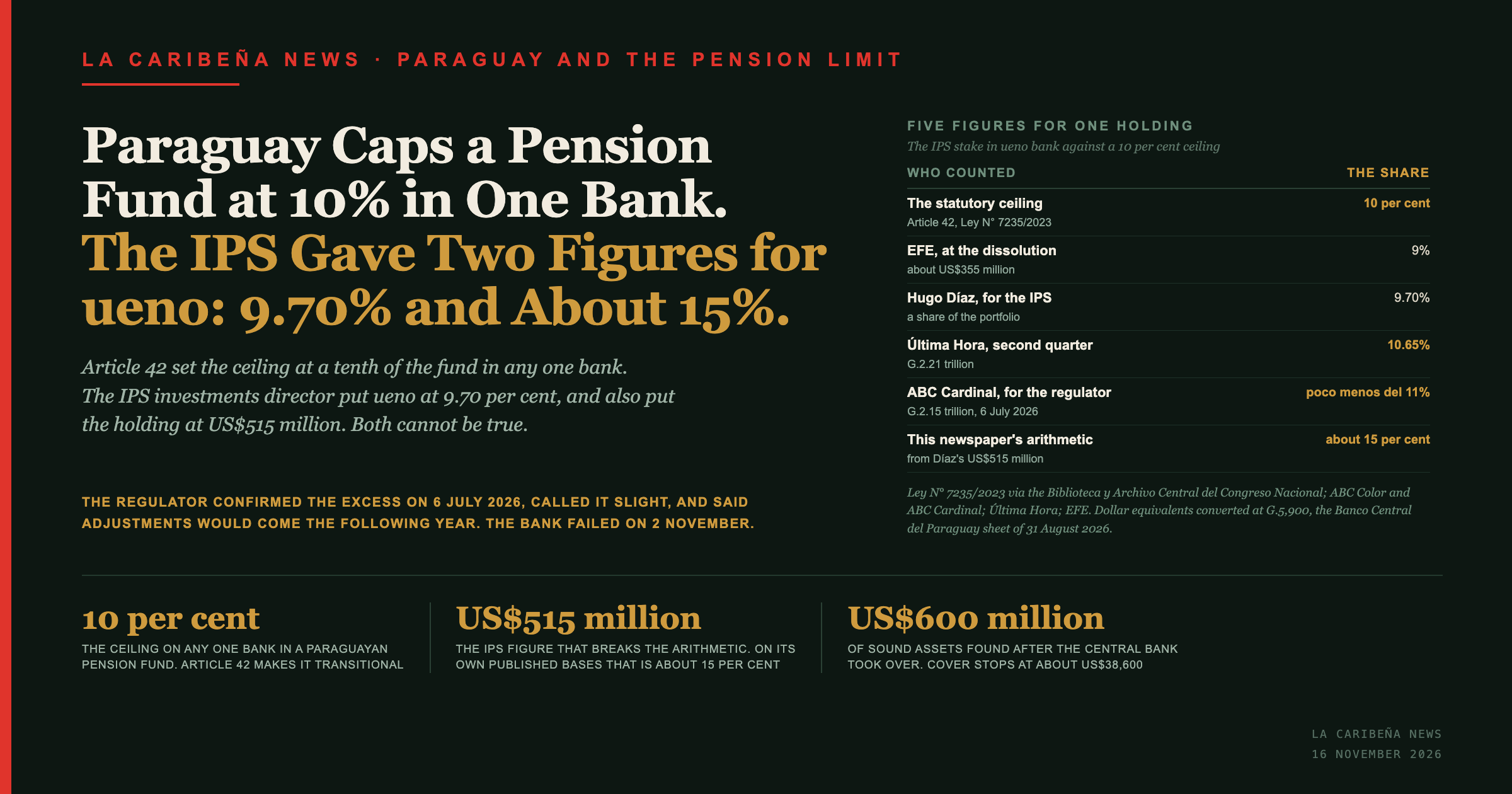
| Who measured | The holding | As a share | As at |
|---|---|---|---|
| EFE, at the dissolution | about US$355 million | about 9% of the total portfolio | 6 Nov 2026 |
| Hugo Díaz, IPS | 9.70% of the IPS investment portfolio | within the limit | 2026 |
| Última Hora | G.2.21 trillion, about US$375 million | 10.65% of FCJP and Contingency Fund resources | Q2 2026 close |
| ABC Cardinal, for the regulator | G.2.15 trillion, about US$364 million | "poco menos del 11%" | 6 Jul 2026 |
| Hugo Díaz, IPS, second figure | US$515 million, about G.3.04 trillion | about 15 per cent on the bases above | 12 Nov 2026 |
Compiled from the sources named in each row. Dollars are converted at G.5,900 to the dollar. That is the rate on the Banco Central del Paraguay's sheet of 31 August 2026, and the basis of this newspaper's earlier reports. The Paraguayan record writes these as "G. 2,15 billones". A Spanish billón is a million million, so those are trillions in English, not billions. The guaraní moved a lot during 2026, so equivalents struck on other dates will differ.
These are not four tries at one measurement. The bases differ. Díaz counts against the IPS investment portfolio. Última Hora counts against the combined resources of the Fondo Común de Jubilaciones y Pensiones and the Contingency Fund. A share means only as much as the base beneath it, and these bases are not the same.
Can the pension fund's own two figures both be true?
No. They imply portfolios about 50 per cent apart.
Díaz has given two numbers. One is a share: ueno at 9.70 per cent of the IPS investment portfolio, inside the ceiling. The other is an amount: US$515 million of pension money at the bank. Read together they do not hold.
Both published shares imply roughly the same portfolio. Última Hora's G.2.21 trillion at 10.65 per cent implies about G.20.75 trillion. The regulator's G.2.15 trillion at just under 11 per cent implies about G.19.72 trillion. Against either, US$515 million converts to about G.3.04 trillion and lands at 14.6 to 15.4 per cent, around half again the ceiling.
Run it the other way and the gap is plainer. For US$515 million to be 9.70 per cent, the portfolio would have to be about G.31.3 trillion, half again the size the published shares imply.
This newspaper's own arithmetic, from figures published by the sources named, converted at G.5,900 to the dollar. It is not an official calculation, and the IPS has not published the base it used. One of the two figures is wrong, or they count different pots and neither has been labelled.
So the honest range is not 9 to 11 per cent. It runs to about 15, and the top of it comes from the fund's own investments director.
Did the regulator know before the bank failed?
Yes. It confirmed the excess in July 2026, four months before the bank was dissolved.
Griselda Figueredo heads Paraguay's Superintendencia de Jubilaciones y Pensiones. She told ABC Cardinal on 6 July 2026 that the IPS had gone over the limit on its ueno deposits. She called the excess "levemente", or slight.
She said it was too early to speak of a possible irregularity: "aún no se puede hablar de una posible irregularidad". She put the excess down to cuentas a la vista, sight or demand accounts. Those, she said, are "operativas", operational, and should not count as investments.
She added that which accounts were operational and which were investments had still to be worked out. The Superintendencia was writing its regulations that year. Any adjustments would follow the year after.
The IPS accepted the position in the regulator's own words. Díaz told ABC: "nosotros hoy estamos excedidos según el criterio de la Superintendencia". Today we are in excess, on the Superintendencia's criterion. He has also held that ueno was 9.70 per cent of the IPS investment portfolio, inside the legal limit, and that the IPS made no new placements at ueno during 2026.
What is actually in dispute?
Whether a current account counts toward a limit written for investments.
That one question decides the rest. If a sight account held to pay salaries is an investment in the bank holding it, the fund was out of compliance. If it is plumbing, it was not.
Figueredo drew the line by purpose. Accounts used to meet current obligations such as payroll are operational. Accounts used for loan collections from staff, or holding certificados de depósito de ahorro, savings certificates, could count as investment accounts.
The distinction holds in ordinary times. It does not survive a resolution. When the central bank dissolved ueno, the exposure did not sort itself by purpose. Operational guaraníes and invested guaraníes sat in the same bank on the same morning. Both sat above a guarantee ceiling of G.228,300,000, about US$38,600 a depositor.
ueno was not the only holding near the line. Sudameris Bank stood at 9.86 per cent of the portfolio counted for the per-issuer limit, the next largest after ueno. The Agencia Financiera de Desarrollo was above the share set for the limit measured on equity. Both figures are Última Hora's. A ceiling that several entities sit just under is doing less work than its number suggests.
Was the 10 per cent cap still in force during 2026?
Not established. It is the open question in the file.
Article 42's limits are transitional. They "permanecerán vigentes hasta la culminación del período de transición previsto en el Artículo 41". They hold until the transition period in article 41 ends, or earlier if the Superintendencia issues its own regulations. Article 41 runs that transition for up to 24 months from the day after publication in the Gaceta Oficial. It allows a further capacity-building phase of up to 12 months.
Publication was 14 December 2023. Twenty-four months from then ends in mid-December 2025.
So the dating matters. ABC Color has reported that ueno went through the 10 per cent ceiling from February 2025. That date falls inside the 24-month window on any reading. What governed concentration during 2026 is a separate question. Figueredo's July 2026 remark that the Superintendencia was still writing its regulations suggests the permanent rules had not yet replaced the transitional ones.
This newspaper has not obtained the full official text of Ley 7235/2023, or any Superintendencia regulation replacing it. It does not assert that a legal limit was in force in 2026. Three things are on the record. A statutory cap of 10 per cent. A regulator who said in July 2026 that the fund was over it. A bank that failed in November with the money inside.
Where has the accountability question gone?
To the Senate, to a criminal complaint, and to the prosecutors.
The IPS filed a criminal complaint on 10 November 2026. It named ueno bank and the Banco Central del Paraguay itself. The charges cited are lesión de confianza and asociación criminal, breach of trust and criminal association. A pension fund suing its own banking regulator alongside the failed bank reverses the usual order of things.
Díaz confirmed on 12 November 2026 that he had met the then-president about the ueno deposits. The Senate removed President Santiago Peña four days after the bank was dissolved, by 44 votes.
On 15 November 2026 the opposition senator Líder Amarilla of the PLRA named those he holds responsible for placing public and pension money at the bank. He pointed at the heads of Itaipú and Yacyretá, the former head of the IPS and its board, and the directors and presidents of ANDE. Other bodies and municipalities are still to be added. He asked for repeal of the norms and decrees that let public bodies deposit outside the Banco Nacional de Fomento, the state bank.
The courts have moved as well. ueno declared more than 2.94 million clients, on Infobae's report of the case. That is the population standing behind the complaint. Miguel Vázquez, the ueno chief executive, is held with five other former directors of the bank. Pre-trial detention was ordered for several people implicated, among them Carlos Carvallo, a former president of the Banco Central del Paraguay. Infobae reported both, on the prosecutors' case.
On 15 November 2026 the Ministerio Público seized an aircraft at a hangar at Silvio Pettirossi International Airport. It belonged to the group that controlled the bank. Seized rental contracts show it was hired several times by CONMEBOL, the South American football confederation. Infobae reported the aircraft reached Paraguay in July, and made at least 5 trips after that. Outlets disagree on the aircraft: EFE calls it a light aircraft on a United States registration, while ABC Color is cited for a Gulfstream G-IV jet. The prosecution service's own statement has not been obtained, so this newspaper does not settle the type.
These are allegations in a political forum, and a complaint in a criminal one. Neither is a finding.
What would the same question look like in Guyana?
The searched sources carry no matching percentage ceiling.
Guyana's scheme runs under the National Insurance and Social Security Act, Chapter 36:01. On the 1969 Act as enacted, money in the Fund may be invested by the Board "in such securities as may be approved of by the Minister responsible for Finance". That is an approval model, not a ceiling. It names who decides, not how much may sit in one place.
| Paraguay | Guyana | |
|---|---|---|
| Statute governing investment | Ley N° 7235/2023, art. 42 | National Insurance and Social Security Act, Cap. 36:01 |
| Limit per single bank | 10% of total resources, and 20% of that bank's callable liabilities | not evidenced in the sources searched |
| How the limit is set | a number in statute, transitional | securities "approved of by the Minister responsible for Finance" |
| Supervisor of the fund's investments | Superintendencia de Jubilaciones y Pensiones | not established in the sources searched |
| The scheme's own deposits, if a bank fails | insured, and ranked first above the ceiling | ineligible for protection under section 36 of the Deposit Insurance Act 2018 |
| Share of the portfolio actually in banks | 9% to 10.65% at ueno alone, on the four counts | 33.8% across all banks and financial institutions, 2019 report |
| Share at the largest single bank | the disputed figure above | not stated in the published reports |
Paraguay from the BACN text of Ley 7235/2023. Guyana's investment provision is from the 1969 Act as enacted. The consolidated current text of Cap. 36:01 has not been obtained and may differ. The deposit-insurance row is as this newspaper reported on 7 November 2026.
A recorded absence is not a finding of absence. Five sources were searched for a single-institution cap on the National Insurance Fund: the 1969 Act as enacted, the Financial Institutions Act Cap. 85:01, the Insurance Act 1998, the Bank of Guyana's insurance investment guidelines, and an International Labour Organization review of the scheme. None produced one. The consolidated Cap. 36:01 was not obtained. Neither was the NIS Board's investment policy, nor its recent annual reports. Any of the three may set a cap. This newspaper puts the question to the National Insurance Scheme and to the Bank of Guyana.
The Guyanese record does show how much of the Fund sits in banks. Its 2019 annual report, laid in Parliament, puts investments at G$27,450,136,000, with G$9,275,892,000 held as deposits with banks and other financial institutions. That is 33.8 per cent, and this newspaper reported on 9 November 2026 that it is spread across institutions rather than in one. The 2023 report puts total investments at G$31,774,154,000.
So the Guyanese share held in banks is three times the Paraguayan ceiling for a single bank. That is not the same measurement, and the difference is the whole point. Paraguay's 10 per cent is a cap on one institution. Guyana's 33.8 per cent is the total across all of them.
What the published record does not give is the split. How much of that G$9,275,892,000 sits with the largest single institution is not stated in the 2019 report as reproduced, and the 2023 accounts appear there as scanned pages. A scheme can hold a third of its portfolio in banks and be well spread, or hold it in two. This newspaper has asked.
The point Paraguay has made for everyone else
A limit measured four ways is not one limit.
Paraguay did what a careful jurisdiction is supposed to do. It put a figure in statute. It created a supervisor. It gave itself a transition to get there.
Then the figure turned out to depend on three things. Which fund you measured against. Whether a current account is an investment. Whether the transitional rule had expired. By the time those questions were being asked aloud, the bank was gone.
Whether any of it comes back rests on a figure the central bank gave after it took the bank over. Its authorities were reported as finding about US$600 million of sound assets at ueno, against a guarantee that stops at about US$38,600 a depositor. That figure is the central bank's own, reported by ABC Color, and it is not an audited balance.
The lesson is not that a tenth is too high or too low. A concentration limit needs a settled base, a settled definition of what counts, and a supervisor willing to call an excess an excess. Without those three it is a sentence in a statute rather than a control on a balance sheet.
What the title card says
- Headline: Paraguay caps a pension fund at 10 per cent in one bank, and the IPS gave two figures for ueno, 9.70 per cent and US$515 million. - The statutory ceiling: 10 per cent of total resources at any one bank, and 20 per cent of that bank's callable liabilities, article 42 of Ley N° 7235/2023. - EFE at the dissolution: about US$355 million, about 9 per cent of the portfolio. - Hugo Díaz for the IPS: 9.70 per cent of the IPS investment portfolio, within the limit. - Última Hora at the second quarter: G.2.21 trillion, about US$375 million, 10.65 per cent. - ABC Cardinal for the regulator, 6 July 2026: G.2.15 trillion, about US$364 million, poco menos del 11%. - A fifth figure that fits none of them: US$515 million, reported from the same IPS director. - The next largest holding: Sudameris Bank at 9.86 per cent. - Sound assets found after the central bank took over: about US$600 million. - The guarantee ceiling: G.228,300,000, about US$38,600 a depositor. - Statute promulgated 14 December 2023; transition runs 24 months; bank dissolved 2 November 2026. - Guyana's National Insurance Scheme, 2019: G$9,275,892,000 of G$27,450,136,000 in bank deposits, 33.8 per cent.
Frequently Asked Questions
What is Paraguay's limit on pension money in one bank?
No more than 10 per cent of the total value of the fund's resources, and no more than 20 per cent of that bank's callable liabilities, with the stricter applying. It is article 42 of Ley N° 7235/2023, promulgated on 14 December 2023.
Did the pension fund break that limit at ueno bank?
That depends on which figure is right, and the IPS has given two that cannot both be. Its investments director put ueno at 9.70 per cent of the portfolio, inside the ceiling, and also put the holding at US$515 million. Against the portfolio implied by the two published shares, US$515 million is about 15 per cent. Última Hora measured 10.65 per cent at the close of the second quarter of 2026, and the regulator's figure was just under 11 per cent.
Was the limit still in force in 2026?
Not established. Article 42's limits are transitional and run until the article 41 period ends, 24 months from publication on 14 December 2023, or earlier if the Superintendencia issues its own regulations. This newspaper has not obtained the full statute text or any replacing regulation, and does not assert a 2026 breach.
Did the regulator know before the bank failed?
Yes. Griselda Figueredo of the Superintendencia de Jubilaciones y Pensiones said on 6 July 2026 that the IPS had gone over the limit. She called the excess slight, attributed it to operational sight accounts, and said adjustments would come the following year. The bank was dissolved on 2 November 2026.
What is the actual dispute?
Whether a current account counts toward a limit written for investments. The regulator drew the line by purpose: payroll accounts are operational, while accounts holding savings certificates could count as investments.
How much of Guyana's National Insurance Scheme sits in banks?
G$9,275,892,000 of a G$27,450,136,000 investment portfolio in its 2019 annual report, which is 33.8 per cent, held across banks and other financial institutions rather than in one. How much sits with the largest single institution is not stated in the published reports, and the searched sources carry no single-institution cap for the Scheme.